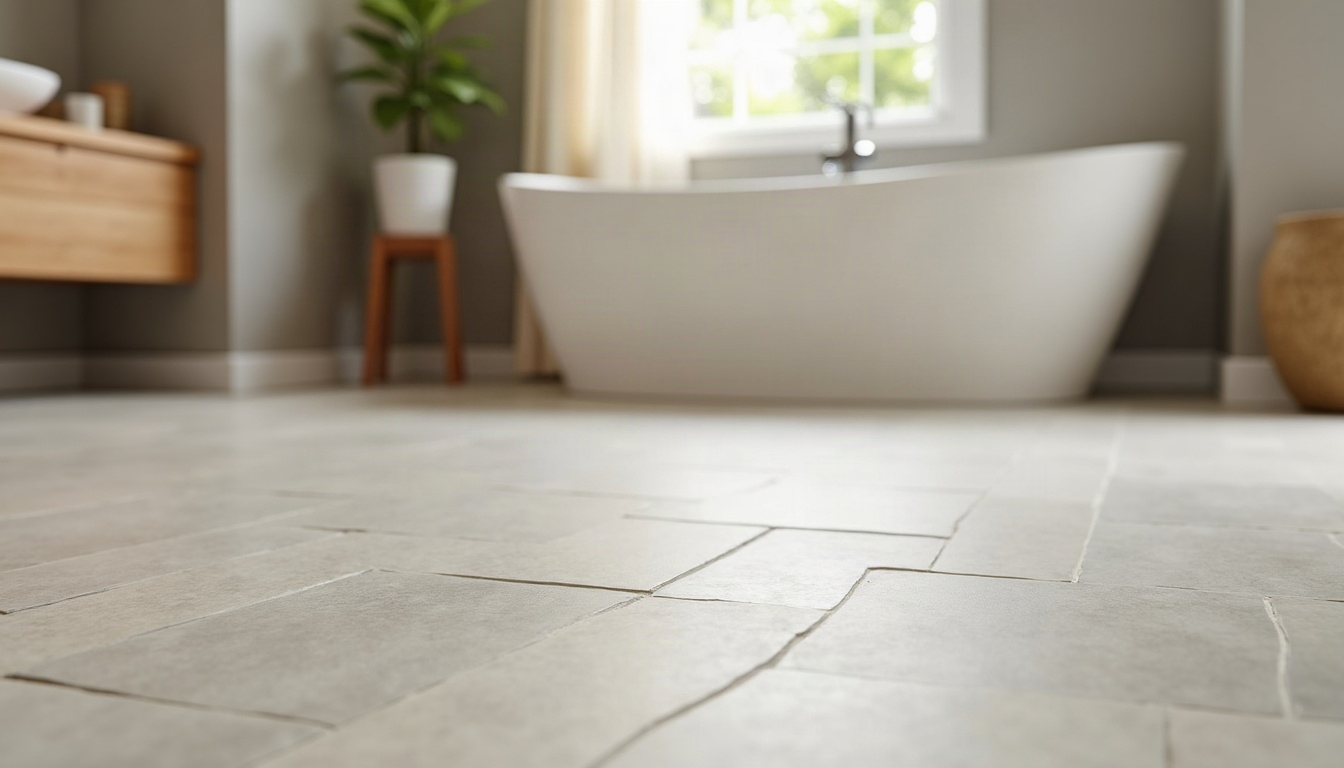
Every bathroom floor gets judged in the same moment: someone steps out of the shower with wet feet. Humid summers keep a bathroom damp for longer, and the bathroom remodel in Greenville that homeowners are happiest with years later usually settled the floor question before anyone picked a vanity or a paint color.
The factor that matters most is how the floor handles standing water at the edges, because that is where bathroom floors fail: along the tub, around the toilet, across the door threshold. Below I compare the four materials that come up most often, using the terms you’ll meet on a spec label. The wear layer is the clear top coat on vinyl and laminate that takes the scuffing. The core is what the plank is made of beneath it. Slip resistance is the grip the surface keeps when wet, and it depends on texture and grout lines as much as on the material.
The short answer: porcelain tile is the most dependable bathroom floor, rigid-core vinyl plank is the best second choice, sheet vinyl wins on joints, and laminate is the one I’d skip.
Spec sheet: four bathroom floors compared for water, grip and wear
| Option | Water resistance | Slip resistance | Wear and scratches | Comfort and sound | Cost band | Best for |
|---|---|---|---|---|---|---|
| Porcelain tile | Excellent (grout needs sealing) | Good to excellent, depending on texture | Excellent | Poor: hard and cold | $$$ | Full baths used daily |
| Rigid-core luxury vinyl plank | Good (seams and edges are the weak point) | Good | Good | Good | $$ | Flat subfloors and tighter budgets |
| Sheet vinyl | Excellent (few seams) | Fair to good | Fair | Good | $ | Small baths, rentals, kids’ baths |
| Laminate | Poor | Fair | Good | Good | $ | Dry half baths only |
Porcelain tile: the benchmark
Porcelain is a dense, fired tile that absorbs very little water, so the tile itself is not the part that fails. The weak points are the grout, which is porous unless sealed or specified as epoxy, and the surface finish. Ask for the abrasion class on the carton, which rates how well the glaze resists wear, and choose one rated for floors rather than walls.
Best for
A full bathroom that will be used every day for years. Tile does not swell, warp or dent, it ignores a wet bath mat left on it overnight, and it pairs with the shower surround without a visible change of material at the curb.
Watch out for
Glossy tile is slick when wet, and large smooth tiles give you few grout lines to grip. For a bathroom floor, a matte or textured surface or a smaller format with more grout lines gives better footing. Tile also needs a stiff, flat subfloor, because it cracks on a floor that flexes. If a contractor finds soft spots, that has to be fixed before anything is laid. Heated mats under tile involve electrical work that belongs to a licensed electrician, and they only make sense if you decide on them before the tile is ordered.
Rigid-core luxury vinyl plank: the forgiving choice
Luxury vinyl plank has a printed image layer, a clear wear layer and a core. Rigid cores are made of a stone-plastic or wood-plastic composite, and the stone-based type is usually denser and more stable, while the wood-based type is softer underfoot. “Waterproof” on a carton means the plank itself does not absorb water. It does not mean water cannot get under the floor through a seam, a gap at the wall or a gap around a pipe.
Best for
A bathroom where the subfloor is flat and sound and the budget has to cover a vanity and a shower as well. It is warmer and quieter than tile, it handles dropped bottles without chipping, and a floating click-lock plank can go down faster than a floor that has to be grouted.
Watch out for
Edges. Water that sits at the tub or the toilet can work into a joint, so the perimeter needs a proper gap, sealing where the manufacturer allows it and trim that covers the edges. Residential and commercial wear layers differ in thickness. A hall bath rarely needs the commercial grade, but a rental unit or a salon restroom may, because the floor there is walked on all day by many people instead of a household of a few.
Sheet vinyl: the fewest seams
Sheet vinyl comes in a roll and covers a small bathroom in one piece, which removes almost every seam. Modern sheet is not the dated look many people picture, and the printed patterns include stone and wood styles. Its weakness is the thin wear layer, which is why quality varies so much from one roll to another.
Best for
Small baths, kids’ baths and rentals, where the aim is a floor that keeps water out of the subfloor and is cheap to replace. The lack of seams is a real advantage around the tub and toilet, where most leaks begin. The same logic is why commercial restrooms often use sheet goods or poured floors with few joints: fewer seams means less to clean and less for water to find.
Watch out for
Dents and tears from heavy objects, and a surface that shows every bump in the subfloor beneath it. Any imperfection in the subfloor will telegraph through. It is also easy to get wrong by using the wrong adhesive or trimming too tightly around fixtures, which is why I’d leave the install to a flooring professional.
Laminate: the one to question
Laminate has a fiberboard core under a printed top layer. Some versions are sold as water-resistant, and the claim usually applies to the surface, while the core still swells if water reaches its edges. In a room built around a tub and a shower, that is a lot of exposure.
Best for
A dry half bath with no shower, where the biggest risk is a splash at the sink and you want a wood look on a tight budget. Even there, wipe up spills promptly.
Watch out for
Swollen edges at the tub or the toilet that do not recover. Once a laminate board has soaked up water, it stays raised and the repair is a plank replacement. I would not put it in any bathroom where the floor gets wet on purpose.
Which one fits your bathroom
- If it is a full bath you’ll use daily and you plan to stay, choose porcelain tile with a matte or textured surface.
- If the subfloor is flat and you want a warmer, quieter floor without grout, choose rigid-core luxury vinyl plank.
- If the room is small, or a rental or a kids’ bath, choose sheet vinyl for its minimal seams.
- If you want a wood look in a half bath on a tight budget, choose luxury vinyl plank over laminate.
- If the room has a tub or a shower, choose anything but laminate.
Before you buy
- Order samples of each, wet them and stand on them barefoot. Slip resistance is something you feel, and a friction number on a carton does not capture it.
- Have the subfloor checked for soft spots, stains and old moisture damage around the tub and toilet before the plan is final. If there has been a leak, it has to be found and fixed first.
- Read the label for the wear layer, the core type and what the manufacturer’s water claim covers: the plank only, or the installed floor with its seams and edges.
- Plan the heights. A new floor, especially tile on its setting bed, can sit higher than the hall floor, and doors and the toilet connection may need adjusting. A contractor should account for that when scoping the job.
- Settle the order of the work with your contractor. On most remodels the wet work and subfloor repairs come first, the floor goes in before the vanity and toilet are set, and paint is finished before the final trim goes on.
- Check the ventilation. In humid weather, an exhaust fan that vents outside protects every floor on this list by clearing steam before it settles. Fan wiring and venting are work for licensed trades, so raise it when the job is scoped.
- Order extra for cuts. A bathroom has more cuts around fixtures than any other room, and a few spare pieces are useful for later repairs.
If it were my own main bathroom, I’d choose matte porcelain tile in a smaller format, seal the grout and have the subfloor checked before anything else. For a guest bath, a rental or a house on a tight budget, I’d move to rigid-core vinyl plank and spend the savings on getting the edges and the transitions right.