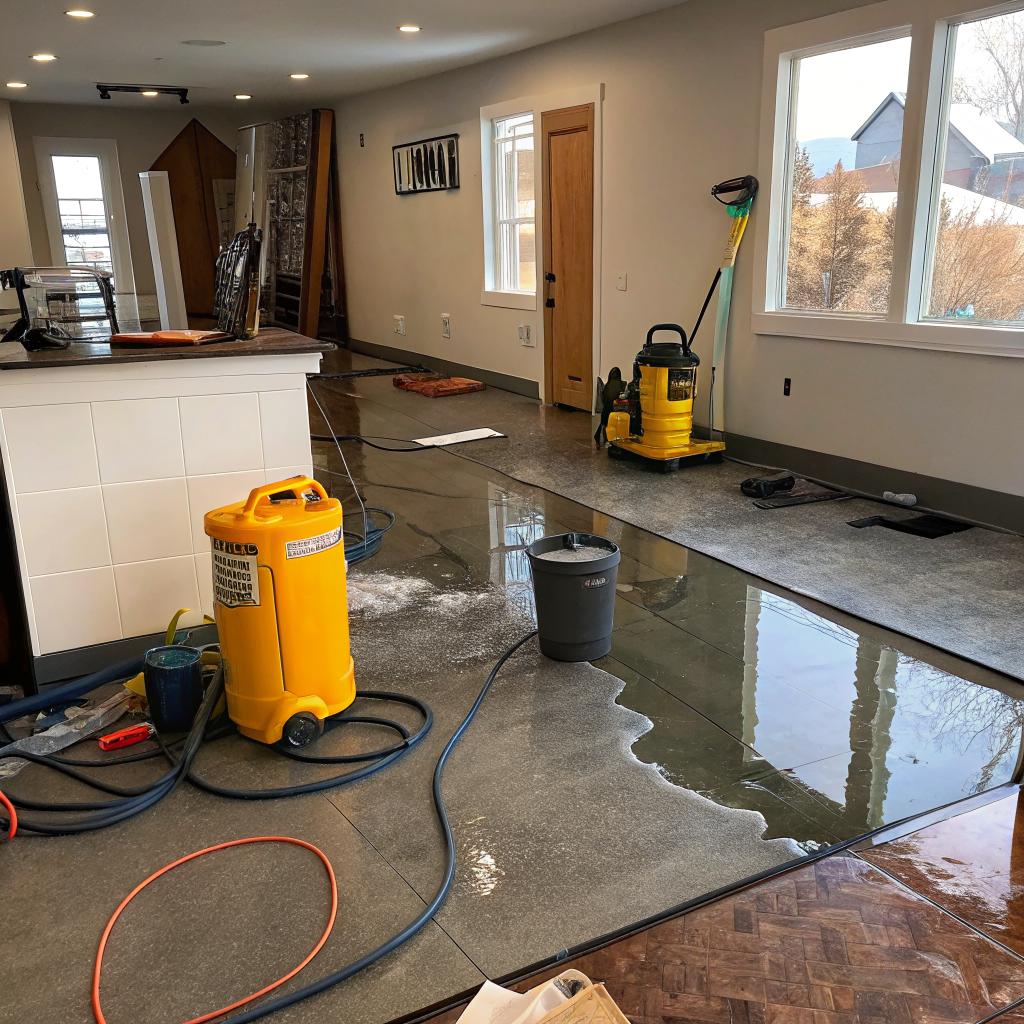
So, you are trying to figure out how to handle water damage cleanup in Salt Lake City and what that means for your flooring. The direct answer is: stop the water, dry the area fast, pull up or open the flooring where needed, check the subfloor, and then decide whether to repair, refinish, or fully replace based on the material and how long it stayed wet.
In other words, you are not just drying a wet floor. You are dealing with moisture inside layers you cannot see, and in a dry climate like Salt Lake City, that can be a bit tricky. Things might look fine on the surface in a day or two, but subfloors can stay damp, wood can cup weeks later, and trapped moisture can lead to mold if you are unlucky. So the goal is simple: act early, be methodical, and do not guess about what is going on under the surface.
- Act in the first 24 to 48 hours if you want to save flooring.
- Different flooring types need different cleanup steps.
- Salt Lake City’s dry air helps, but it does not fix hidden moisture.
- Subfloor and underlayment condition matter more than the visible surface.
- DIY can work for small, clean leaks; bigger or dirty water needs pros.
- Documentation and photos can help with insurance and contractor quotes.
- Future-proofing (drains, better materials) is easier right after an incident.
If you want professional help early in the process, you can look at local services like water damage cleanup Salt Lake City, but let me walk through the logic first so you know what you are even asking for.
Understanding water damage in Salt Lake City homes
Water problems in Salt Lake City have a few patterns. You probably know most of these, but it helps to list them:
- Winter pipe breaks from freezing in basements, garages, and exterior walls.
- Spring runoff that finds any small grading or drainage mistake near the foundation.
- Swamp coolers, HVAC condensate lines, and water heaters that leak slowly.
- Old supply lines to fridges, dishwashers, or washing machines that finally fail.
The flooring impact depends less on the source and more on:
- How long the water sat.
- What the water touched on the way down (clean, gray, or dirty water).
- The material and installation method of your floor.
The general rule is: if clean water is removed within 24 hours, you often save flooring; if it stands for days, you should expect to replace at least some materials.
So your first job is not choosing new flooring. It is understanding what kind of wet problem you actually have.
Step 1: Stop the water and make the area safe
This sounds obvious, but people skip parts when they feel stressed.
Shut off water and check power
- Close the nearest supply valve or the main shutoff.
- If water is near outlets or cords, kill power to that circuit at the panel.
- Do not walk through water with live electrical risk. If you are unsure, wait.
Remove loose items fast
Get rugs, floor mats, boxes, furniture with fabric, and anything porous off the floor. Even 1 extra hour in water can ruin legs on wood furniture or particleboard shelving.
Think of the first 30 minutes as “move and lift” time: move what you can, lift what you cannot move, and get air under everything that is damp.
Step 2: Start drying and dehumidifying
Now you want water gone from the surface and from the air.
How to dry with what you already have
- Use towels, a wet/dry vacuum, or a small pump to get standing water out.
- Open windows if outside air is dry and temperatures are mild.
- Bring in any fans you own and keep air moving across the floor.
In Salt Lake City, the outside air is often fairly dry, which helps. But that can trick you into thinking everything is dry when only the surface is.
A rental dehumidifier is often worth the cost if:
- More than one room is affected.
- Water soaked into carpet, pad, or wood for more than a few hours.
- The area is a basement, which tends to hold moisture longer.
Aim for 3 days of forced air and dehumidification at a minimum for non-trivial events.
Step 3: Inspect layers, not just surfaces
If you only look at the visible flooring, you will miss hidden damage. Flooring is a stack of layers.
Here is a simple way to think about it:
| Layer | Common materials | Water reaction | What you check |
|---|---|---|---|
| Surface floor | Wood, laminate, LVP, tile, carpet | Can swell, stain, delaminate | Warping, gaps, bubbles, stains |
| Underlayment | Foam pad, felt, cement board, OSB | Holds moisture, can grow mold | Soft spots, smell, dampness |
| Subfloor | Plywood, OSB, concrete | Can rot, crack, or stay damp | Bouncy feel, discoloration, high moisture readings |
If water came from above and soaked the flooring, at least one layer is hiding moisture. A cheap moisture meter from a hardware store is surprisingly helpful, especially on wood and drywall.
How different flooring types react to water
Now to the part most people care about: what happens to each type of flooring.
1. Solid hardwood floors
Salt Lake City has plenty of older homes with real hardwood. Water and hardwood are not friends, but all damage is not the same.
Common water reactions:
- Cupping: edges of boards curl up higher than the center.
- Crowning: center of boards bulges higher than the edges, often after uneven drying.
- Gaps between boards when wood dries too fast.
Short answer for hardwood: if water is removed quickly and the boards are not heavily distorted, they can often be dried, sanded, and refinished.
Steps:
- Clean and vacuum all debris from between boards.
- Run dehumidifiers and fans but avoid blasting very hot dry air directly at boards. That can cause cracking.
- Wait. Cupping can look terrible in the first week and then relax over several weeks.
- After moisture is stable, a flooring contractor can assess if sanding will flatten the boards.
When replacement is more realistic:
- Boards are severely cupped or twisted across a wide area.
- Subfloor is compromised or moldy.
- Water was from a dirty source like a sewer backup.
With solid hardwood, patience matters. Rushing to sand while the wood is still drying can lock in a warped shape and create more work later.
2. Engineered wood flooring
Engineered wood has a veneer of real wood over plywood or other cores. It often comes in click-together planks.
Pros and cons with water:
- More stable than solid hardwood in normal humidity changes.
- The layers can separate if water penetrates for too long.
- Many engineered products cannot be sanded more than once, if at all.
If water is on the surface for a short time:
- Dry quickly and watch for edges lifting or small bubbles.
- If planks look flat after a week or two and clicks are tight, you may be fine.
If seams are swollen or the top layer is separating, replacement of affected planks or full sections is usually the real solution. This is one case where people often try to “live with it” and then regret it a year later when joints fail.
3. Laminate flooring
This one is harsh: most laminates do not forgive standing water.
Laminate has a high-density fiberboard core that swells and does not return to normal. If water gets into the joints and sits, the planks may:
- Swell at edges.
- Bubble in the center.
- Lose their click connections and start to separate.
Realistically:
- Surface-only spills wiped quickly are fine.
- Flooding across a room for hours often means full replacement in that area.
If you are mid-renovation and trying to choose materials, this is why many people in lower levels or near entry doors lean toward luxury vinyl plank instead of laminate.
4. Luxury vinyl plank (LVP) and vinyl tile
LVP is common in Salt Lake City remodels because it handles kids, pets, and some moisture well. But “waterproof” on the box does not mean “your entire floor system is safe during a flood.”
Vinyl itself does not absorb water. The real questions are:
- Did water get under the planks?
- What is the subfloor made of?
For click-together LVP:
- If water seeped underneath, you may need to pop up planks, dry the subfloor, and reinstall.
- If you cannot remove the water under the planks, you risk odor and mold along baseboards.
For glued-down vinyl:
- Adhesives can soften and fail when soaked.
- Some areas may release, bubble, or shift.
You can sometimes save LVP by careful removal, drying, and relaying. Still, that takes time and organization. Labeling planks during removal helps.
5. Tile and stone floors
Porcelain, ceramic, and stone handle water on the surface very well. Many bathrooms and entries in Salt Lake City are tiled for this reason.
But tile is usually on top of:
- Cement board or mortar.
- Or directly on a concrete slab.
- Or, sometimes, on a plywood subfloor.
Tile problems from water:
- Grout can stain or harbor mold.
- Subfloor under the tile can be wet or rotting without clear signs for a while.
- Cracked grout or “hollow” sounding tiles may hint at underlying damage.
If you had a major leak that soaked an adjacent room’s subfloor, check transition areas carefully. Tile might survive while the wood under a neighboring laminate section fails.
6. Carpet and padding
Carpet is common in basements and bedrooms. Many people hope they can just “clean it well” and move on. That works sometimes, but the padding is the big factor.
If water is clean and you act quickly:
- Carpet can be pulled back, padding removed, subfloor dried, then new pad installed, and the same carpet re-stretched.
- This is often cheaper than full replacement.
If water is dirty (basement backups, outside runoff, etc.):
- Padding and carpet often need full replacement. The material holds contamination.
The tricky part is the “smell test.” A carpet can look dry and clean but hold a lingering odor from trapped moisture or bacteria.
Subfloor types and what they mean for cleanup
You cannot plan long-term flooring decisions without considering the subfloor.
Wood subfloor (plywood or OSB)
Common in main floors and sometimes basements over joists.
Reactions:
- Edges of panels can swell.
- Persistent dampness can lead to mold or rot, especially at seams.
If caught early, drying with dehumidifiers and airflow can save wood subfloors. Use a moisture meter to see if readings return to normal compared to dry areas.
If you feel:
- Bouncy spots.
- Soft areas when you press.
- Or see dark staining that spreads over time.
Then you are often looking at cutting out and replacing sections, at least before you lay new flooring.
Concrete slabs
Many basements in Salt Lake City sit on concrete slabs. Concrete does not rot, but it can hold a lot of moisture.
Things to watch:
- Moisture vapor coming through the slab even after visible water is gone.
- Adhesives for flooring not sticking well if the slab is still damp.
- Efflorescence, which is a white powdery residue from water moving through concrete.
If you plan to install new flooring over a previously wet slab, ask:
- Do you need a vapor barrier or moisture-tolerant adhesive?
- Is a raised subfloor system better for that particular space?
This is where talking to a flooring installer who knows local basement conditions is better than guessing based only on a product brochure.
DIY vs professional help for floor-related water damage
You do not need a restoration company for every damp patch. But you also do not want to be stubborn when the damage crosses a certain line.
Here is a simple comparison:
| Situation | DIY reasonable? | Pro strongly advised? |
|---|---|---|
| Small, clean spill on hard surface floor, dried within hours | Yes | No |
| Minor leak affecting part of one room, caught same day | Often yes, with care | Maybe, if wood or multilayer flooring is involved |
| Several rooms affected or water soaked walls and insulation | Risky | Yes |
| Basement flooding, unknown source, or dirty water | Usually no | Yes |
| Any situation with visible mold growth | No | Yes |
What pros often bring that homeowners do not:
- Moisture meters and thermal cameras to find hidden wet areas.
- High-capacity dehumidifiers and air movers that shorten drying time.
- Clear documentation for insurance, which can save arguments later.
You can still stay in control by understanding the process. Ask what moisture readings are, which materials they plan to remove, and how they will protect areas that are still intact.
Flooring decisions after water damage: repair, refinish, or replace?
Once things are dry, you get to the renovation side. This can actually be a decent chance to improve your flooring plan, especially if you already disliked parts of it.
Think in three steps:
- What can be saved realistically?
- What should be changed for durability or moisture resistance?
- How will transitions between old and new areas look?
When repair makes sense
Repair is realistic when:
- The damage is limited to a small area.
- You still have spare planks or tiles from the original installation.
- The product is still available, so matching is possible.
Examples:
- Replacing a few warped LVP planks near a sliding door after a minor leak.
- Patching a small section of hardwood where a radiator leaked, then refinishing that room.
When refinishing works
Refinishing mostly applies to solid hardwood and, sometimes, thicker engineered wood.
Refinishing might be the right call if:
- The boards dried flat enough that sanding will remove surface defects.
- You want a fresh stain or finish color anyway.
This can be a good time to finish flooring on the main level all at once, even if only one corner was wet, to avoid mismatched sheen or color.
When replacement is the honest answer
Replacement is usually needed when:
- Water stood for a long time.
- Laminates blew out, or vinyl adhesives failed.
- Carpet or pads were soaked with dirty water.
- Subfloor has structural or mold problems.
This can feel frustrating, but dragging out flooring with hidden damage rarely saves money; it tends to shift the cost into later repairs and more disruption.
Choosing better flooring after a water incident
If you already need new flooring, you may as well choose materials that fit your risk level and how you use the space.
Questions to ask before picking materials
- Is this area above grade or in a basement?
- How likely is water here again? Think bathrooms, laundry rooms, entry doors, and basements near slopes.
- Do you want continuous flooring between rooms or can you change materials by zone?
- How much do you care about resale compared to pure function?
You might, for example, keep real hardwood on a main living area that does not see many spills, while using LVP or tile in basements, mudrooms, and near doors.
Material comfort vs moisture tolerance
To compare quickly:
| Material | Feels underfoot | Moisture tolerance | Where it tends to work well |
|---|---|---|---|
| Solid hardwood | Warm, classic | Moderate, needs care | Main floors, bedrooms (above grade) |
| Engineered wood | Similar to hardwood | Moderate, slightly better stability | Main floors, sometimes basements with dry history |
| Laminate | Firm, less warm | Low if flooded | Low-risk areas, budget projects |
| LVP / vinyl tile | Slightly softer, quiet | High on surface, watch subfloor | Basements, kitchens, bathrooms, rentals |
| Tile / stone | Hard, cool | High, strong with water | Bathrooms, entries, some basements |
| Carpet | Soft, warm | Low when flooded | Bedrooms, family rooms with low water risk |
For people in Salt Lake City with a history of spring basement moisture, many end up with a mix: LVP or tile in the lowest level, then warmer surfaces upstairs.
Preventing future flooring damage after cleanup
Once you have gone through the stress of a leak, you start to see small upgrades differently. Some of these are cheap but make a real difference.
Plumbing and appliances
- Replace old rubber washing machine hoses with braided stainless versions.
- Use leak detection pans under water heaters and washing machines if they are above living spaces.
- Check and clean AC and dehumidifier drain lines each season.
Basement and exterior drainage
Salt Lake City homes vary a lot here. Some have perfect drainage, others not so much.
Things to review:
- Gutters and downspouts that move water away from foundations.
- Grading near the house that does not slope toward the foundation.
- Sump pumps, if you have them, and whether they still work.
If your basement flooded once during a big storm, you might not change much. If it has happened twice, then flooring choice should probably change toward more water-tolerant options.
Flooring installation details
How flooring is installed can affect future water performance.
Examples:
- Using moisture barriers on concrete under wood or certain vinyl products.
- Caulking or sealing gaps in wet-prone areas like around tubs and toilets.
- Leaving proper expansion gaps and following manufacturer rules so boards do not fail if they swell slightly.
These small decisions do not guarantee safety from floods, but they can buy you time and reduce the damage from normal everyday spills and minor leaks.
Working with flooring and restoration pros without losing control
One thing I notice is that people either hand everything over to contractors or try to do all of it alone. There is a middle option where you stay in charge, but you let specialists handle specific steps.
You might:
- Handle emergency shutdown, moving items, and initial shop-vac work yourself.
- Hire a restoration team just for drying, moisture testing, and tear-out of clearly ruined materials.
- Then bring in a flooring installer you trust to rebuild with products you actually like.
When talking to any pro, ask direct questions such as:
- “What moisture readings are you seeing in the subfloor?”
- “Which materials are you planning to remove, and why?”
- “Are there sections we can realistically save without risking mold or failure later?”
If a contractor cannot explain their plan in plain language that makes sense to you, that is a red flag, no matter how many tools they bring.
You do not need perfect knowledge, but you do deserve clear, honest answers.
Common questions about water damaged flooring in Salt Lake City
How long does it take for water under flooring to cause serious problems?
For clean water, you have roughly 24 to 48 hours before saving becomes much harder. Past that, materials like laminate and carpet pads usually fail. Wood might be salvageable, but you risk warping and potential mold over the next days and weeks.
Is Salt Lake City’s dry climate enough to dry floors on its own?
Not really. It helps, but trapped water in subfloors, underlayment, and wall cavities does not magically move into the air fast enough on its own. You still need airflow and often dehumidifiers to pull moisture out quickly and safely.
Can I just install new flooring over a previously wet subfloor?
You can, but it is risky if you have not checked moisture levels. A subfloor that “feels” dry can still be too damp for adhesives or wood. A simple moisture meter reading compared to an unaffected area can prevent surprise failures later.
Is carpet in a basement a bad idea after a flood?
Not always, but it is a tradeoff. If your basement flood was a one-time event and you fix drainage or plumbing issues, carpet might be fine. If your basement tends to get wet during heavy storms or snowmelt, more water-tolerant flooring like LVP or tile is usually smarter.
When should I call a pro instead of trying to handle this myself?
If multiple rooms are affected, water has been sitting for more than a day, the water is dirty, or you see any sign of mold or strong odor, it is wiser to get help. Smaller, contained incidents on hard surfaces are better candidates for DIY.
What part of your floor are you most worried about right now: the visible surface, the subfloor you cannot see, or how to choose better materials for the next remodel?