
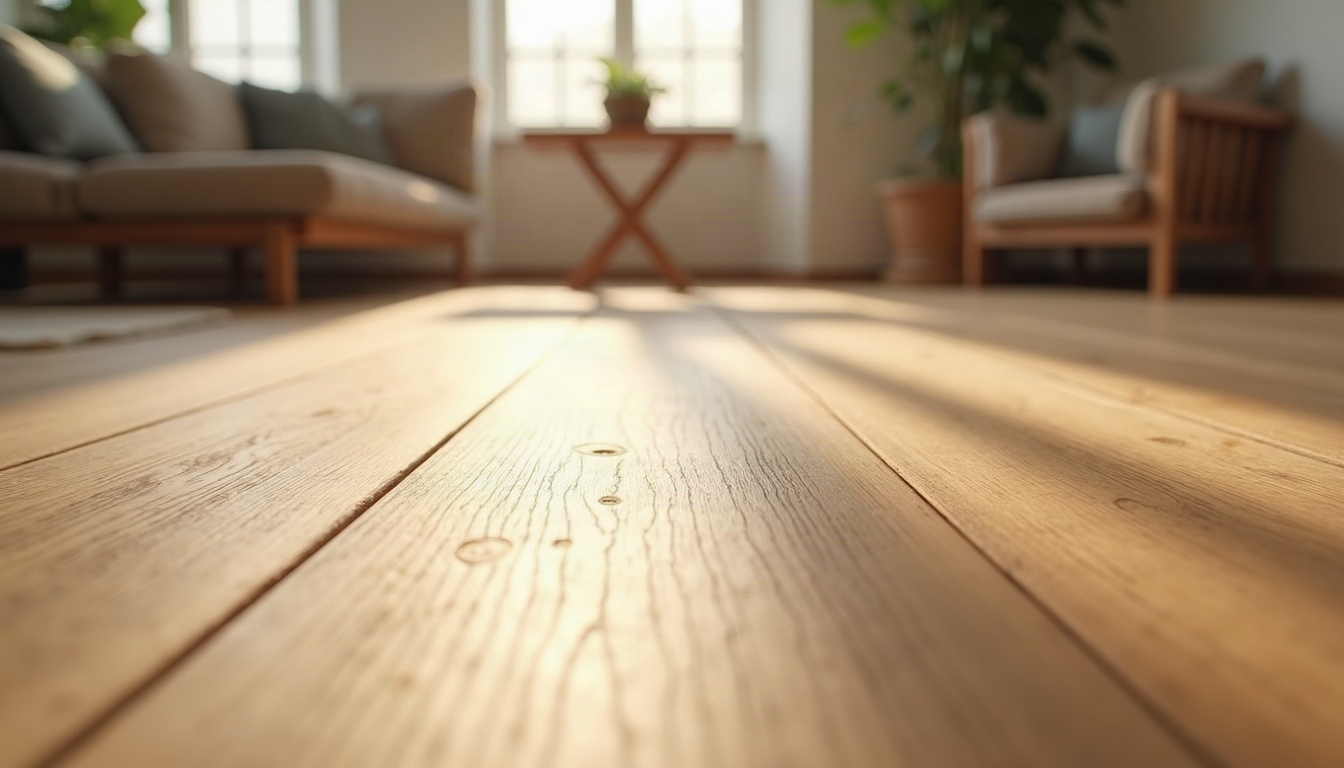
You’ve decided to replace the old ceiling fixture with a row of recessed lights, and now the floor has to live under them. The factor that matters most is sheen, meaning how much light the surface throws back at your eyes. A glossy finish turns every fixture into a bright streak across the boards. New lighting is licensed electrical work, so it belongs with a pro, and a local company such as Power Path Electric Salt Lake City is one place to start that conversation.
The floor choice comes second, but it shouldn’t come last. Lights placed near a wall skim across the boards at a low angle, and that kind of light shows every ripple, scratch and dust line. I care about the footprint of a renovation as much as the look, so I always ask one thing before any of this: can the floor you already have stay? A good floor with a dull finish is often better kept and refinished than torn out. If it can’t, the three options below are the ones I’d weigh.
The short answer: reclaimed oak with an oil finish is the best match for raking light, cork is the quiet and warm pick, and bamboo works where you want a hard-wearing satin surface.
Spec sheet: three sustainable floors compared for a room with new recessed lighting.
| Option | Glare control | Wear and scratches | Comfort and sound | Sourcing and finish | Cost band | Best for |
|---|---|---|---|---|---|---|
| Reclaimed oak, oil finish | Excellent | Good | Fair | Reused boards; low-sheen oil, touch-up friendly | $$$ | Living rooms and hallways with wall-washing lights |
| Strand-woven bamboo, satin | Good | Excellent | Fair | Fast-growing grass, imported; ask about adhesives and the factory finish | $ | Kitchens and family rooms |
| Cork, sealed | Excellent | Fair | Excellent | Bark harvested while the tree stands, imported; ask about the sealer and glue | $$ | Bedrooms and home offices |
Ratings are relative to each other. Glare control is how well the finish scatters light instead of mirroring the fixtures. Cost bands include installation. Sourcing and finish is the column I weigh hardest, because a floor’s green reputation can disappear into its adhesives and shipping. Ask the supplier where the material came from, and read the maker’s own information instead of a marketing label.
Three things control glare: the sheen of the finish, the texture of the boards and the angle of the light. You can’t change the angle once the ceiling is cut, so ask the electrician early how close to the walls the fixtures will sit. Lights near a wall skim the floor most. Lights spread evenly across the middle of the room mostly hit it from above, which is kinder to a glossier floor.
Reclaimed oak with an oil finish: the character choice
Reclaimed boards are salvaged from old buildings, then cleaned, milled and sold as flooring. The wood has already had decades to settle, and the surface carries nail holes, color shifts and tight grain that new boards lack. An oil finish soaks into the wood instead of forming a film on top, which is why it reads as low sheen.
Best for
Living rooms and hallways where the lights wash the walls and graze the floor. Texture and a matte surface hide the ripples that raking light exposes. Oil finishes can also be touched up in a worn patch, without sanding the whole room. Salt Lake City has a dry climate, and heated indoor air in winter is drier still, so solid boards can open small gaps at the seams in cold months. Narrower boards open smaller gaps.
Oils differ. Some are low-odor and some are not, so read the maker’s data sheet and ventilate the room while the finish cures.
Watch out for
Provenance and consistency. “Reclaimed” is a claim you can ask a supplier to back up with where the boards came from. Boards vary in thickness and color, so order from one lot. The wood is hard and loud underfoot, and bare oil needs periodic maintenance coats. If you want a floor you never think about, this isn’t it.
Strand-woven bamboo: the hard-wearing satin
Bamboo is a grass, not a wood, which grows back quickly after harvest. Strand-woven boards are made by compressing shredded fibers with adhesive into dense blocks, then milling them into planks. That’s why this type is often harder than many hardwoods and also why the adhesive deserves a question.
Best for
Kitchens and family rooms where heavy traffic meets bright lights. Dense bamboo also stands up to rolling chairs and furniture feet. A satin factory finish is tougher than most home-applied coats, and the surface scatters light enough that a row of downlights doesn’t leave mirror streaks. Pick satin or matte, not gloss. A gloss bamboo under recessed fixtures looks like a wet road at night.
Watch out for
Honest sourcing. Bamboo is renewable, but it’s mostly imported, and the glues and finishes decide how clean the product is indoors. Ask the maker for its emissions information on the board and the adhesive, and read it. A hard board is also hard to repair, so a deep gouge usually means replacing a plank. Because it’s dense, bamboo needs acclimating and a spot at the wall for expansion.
Cork: the quiet, warm choice
Cork is stripped from the bark of the cork oak, and the tree keeps growing and can be harvested again after years. The material is full of tiny air pockets, so it’s springy and warm, absorbs footsteps and stays naturally matte. It’s usually sold as click planks or glue-down tiles, with a sealed top.
Best for
Bedrooms and home offices where sound and warmth matter. Cork barely reflects light, so spot lighting never produces a glare, and a warm tone looks good under warm-white bulbs. For a room that stays dry, a floating click cork floor avoids glue altogether.
Watch out for
Dents. Heavy furniture presses into cork, so use wide felt pads under legs, and move pieces gently. Strong sun can fade it in front of a big window. The sealer matters too: a sealed surface protects the cork from water and stains, but a gloss sealer will bring back the glare you chose cork to avoid. Ask for a matte sealer.
Which one fits your newly lit room
- If your existing floor is sound but glossy, choose refinishing it with a low-sheen finish. Ask a flooring pro what the floor can take before you replace anything.
- If your lights wash walls and skim the floor, choose reclaimed oak with an oil finish. Its texture hides what raking light shows.
- If the room is a busy kitchen or family room, choose strand-woven bamboo in satin, and ask about the adhesive.
- If the room is quiet and you want warmth underfoot, choose cork with a matte seal.
- If you’re still choosing fixtures, choose your floor first, then pick fixtures and bulbs with the electrician. The two decisions affect each other.
Before you buy
- Ask if you can keep the floor you have. Refinishing keeps the material in service and spares the landfill, and a flooring pro can tell you whether the boards have enough wood left to sand.
- Do the ceiling work first. Cutting for lights makes dust and drops debris. Let the electrician and drywall finish before any floor finish is applied, and cover the floor you already have while they work.
- Judge samples under the actual bulbs, in the evening as well as by day. Warm-white and cool-white bulbs change the color of the same sample, and what looks right at noon can turn flat or yellow at night. Efficient LED fixtures are one of the easier energy wins in a renovation, so it’s worth picking bulbs deliberately instead of accepting whatever comes in the box.
- Tilt the sample under a lamp so the light skims across it. If glare or ripples bother you on a small piece, they will bother you on the whole floor.
- Ask about adhesives and finishes. Get the maker’s information on emissions, choose low-odor products where you can, and ventilate while they cure.
- Acclimate and order extra. Let boards sit in the room’s dry winter air before they go down, and keep spares for repairs.
If it were my living room, I’d keep the oak floor I had, if it was sound, and have it refinished in a matte finish. Failing that, I’d choose reclaimed oak with an oil finish, ask the electrician about dimmers so the evening glow stays soft, and judge every sample under the bulbs I planned to use.