
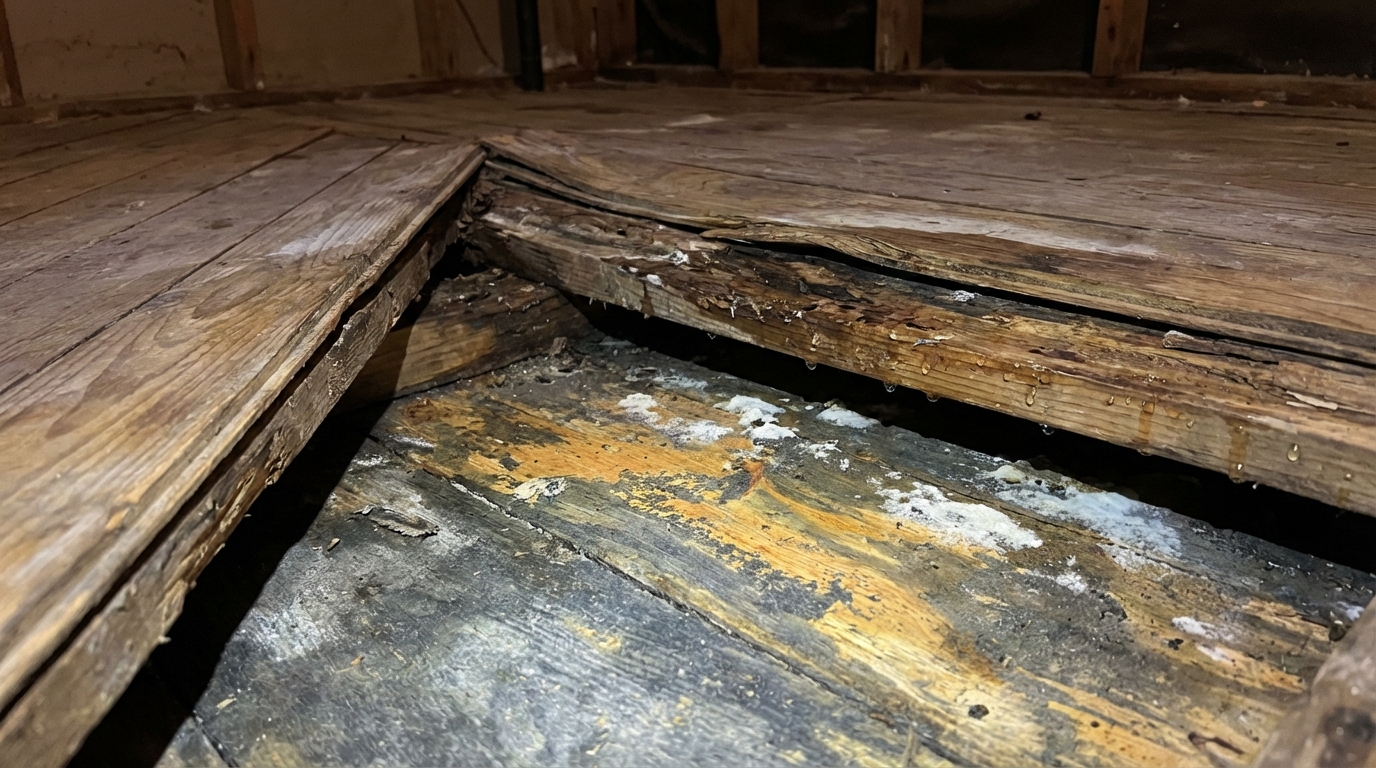
So, you are trying to figure out if water damage is causing your subfloor to rot and what signs you should watch for.
You check for soft, spongy, uneven, or squeaky floors, musty smells, staining, warped boards, and visible mold; then confirm with a moisture meter or by opening up a small test area.
Rotting subfloors are sneaky. Water gets in from a leak, spill, or humidity, and the wood starts to break down long before the surface flooring tells the full story. If you catch it early, you can often fix a small section. If you ignore it, you end up tearing out whole rooms, replacing joists, and writing big checks.
Here are the key things you should keep in mind before you touch a single floorboard:
- Rot shows up as soft, springy, or sagging spots that get worse over time.
- Musty smells, even if you cannot see water, are a serious red flag.
- Tiles cracking, grout crumbling, or planks separating can signal movement from a weak subfloor.
- Bathrooms, kitchens, and laundry rooms are the most common trouble zones.
- Water stains on ceilings below, or on walls near floors, often trace back to damaged subfloors.
- Mold growth, even small patches, usually means the moisture problem has been around for a while.
- A moisture meter, a flashlight, and a screwdriver can tell you a lot before you start demolition.
- Long-term leaks from slow plumbing drips do more harm than one big spill that gets dried fast.
- Sometimes repairing the plumbing or roof first is more urgent than touching the floor itself.
- If you find structural damage to joists or beams, you call a pro; you do not guess your way through it.
Why water damage causes subfloor rot in the first place
Wood does not rot just because it gets wet once. It rots when it stays wet, or keeps getting wet, long enough for fungi to grow and break down the fibers. Subfloors are often plywood or OSB (oriented strand board). Both are strong when dry, but the glue and fibers weaken when moisture sits in them.
You end up with:
- Loss of strength, so boards bend and sag.
- Fastener failure, so nails and screws loosen and squeak.
- Surface movement, so tiles crack and planks separate.
- Mold growth, which brings health and air quality problems.
Water gets to the subfloor from a few main sources:
- Plumbing leaks under sinks, tubs, showers, and toilets.
- Spills and overflows that are not dried fast, especially on carpet or vinyl.
- Roof leaks that travel down framing and wet the floor below.
- High humidity and poor ventilation, especially over crawl spaces.
- Condensation around HVAC or poorly insulated pipes.
So you are not just looking for “wet.” You are looking for signs that moisture has been there long enough to change how the floor looks, feels, or smells.
Main signs your subfloor is rotting from water damage
1. Soft, bouncy, or spongy spots underfoot
If the subfloor is sound, your floor should feel solid. It can squeak, sure, but it should not feel like a trampoline.
Warning signs:
- A spot that feels softer than the area around it.
- A “give” when you shift your weight, like a foam pad under the floor.
- A tiny sag that you only notice when you stand on one foot.
You often notice this first:
- Next to a tub or shower.
- Around the toilet base.
- In front of a sink or dishwasher.
- Near exterior doors that see rain or snow.
Try a simple test:
Walk slowly across the floor in socks, not shoes, and pay attention to small changes in how firm the floor feels. Your feet will notice subtle differences that your eyes cannot see.
If you feel a soft spot, gently press down with your heel or both feet and shift your weight. If it moves more than a tiny bit, that area needs a closer look.
2. Sagging or uneven floors
When rot progresses, the subfloor loses stiffness. That shows up as:
- A slight dip between walls or along one side of the room.
- A ridge or hump where damaged and solid areas meet.
- Cabinets or furniture that no longer sit perfectly level.
This is where a low-tech tool works better than any app.
Take a marble or small ball and set it on the floor. If it starts rolling toward the same spot every time, you have a low area that needs attention.
Uneven floors can also come from foundation movement or joist issues, so you do not assume it is only subfloor rot. But if the low area lines up with a bathroom, laundry, or kitchen, water is a strong suspect.
3. Squeaks and creaks that are getting worse
A squeak by itself is not proof of rot. Many older homes squeak just from normal wear.
What you want to pay attention to is change:
- A new squeak that shows up near a plumbing fixture.
- A squeak that spreads across a larger area.
- Multiple squeaks plus softness or unevenness.
When a subfloor weakens, nails and screws can pull slightly away from joists. Every step moves the wood around that fastener and you hear noise.
If you have a squeaky spot and it also feels spongy or smells musty, you treat that as a serious warning, not just a nuisance.
4. Musty or earthy smells, especially after rain or showers
Your nose often catches trouble before your eyes do. A musty, damp, or earthy smell that lingers is usually a sign of:
- Mold or mildew on or under the subfloor.
- Moist carpet or padding on top of a wet subfloor.
- Moisture rising from a crawl space with poor ventilation.
Key patterns that matter:
- The smell is stronger in the morning or after you run a shower.
- The smell gets worse when the house is closed up.
- The smell is strongest near the floor, not near ceilings or windows.
You do not need to see black spots for mold to be involved. Many colonies start between layers or under flooring where you cannot see them.
If you walk into a room and it smells like a wet basement, that is your signal to start looking under the surface, especially around water sources.
5. Visible water stains or discoloration
Look for stains in three places:
- On the finished flooring.
- On ceilings below the room.
- On baseboards and lower wall sections.
Common signs:
- Darkened patches on wood or laminate flooring.
- Yellowish or brown stains on vinyl or linoleum seams.
- Brown rings on the ceiling below a bathroom or laundry.
- Paint or trim that looks swollen or bubbly near the floor.
A single stain from a one-time spill that dried quickly might be harmless. A stain that keeps growing, or one that is next to a soft spot, is not.
6. Cracked tiles, loose grout, or lifted flooring
Tile and stone do not like movement. When a subfloor rots and moves, that stress goes straight through to the tile.
What you might see:
- Hairline cracks running across several tiles in the same area.
- Grout that crumbles or pulls away from tile edges.
- Tiles that “crunch” or move slightly when stepped on.
For other flooring types, look for:
- Laminate or engineered planks separating at the joints.
- Vinyl flooring lifting, bubbling, or curling at the edges.
- Carpet with wrinkles or ripples that were not there before.
A small pattern of damaged tiles right next to a shower curb or toilet base almost always points back to moisture below.
7. Mold, mildew, or dark spots
Surface mold on caulk or grout is common in wet rooms. Subfloor mold is more serious.
You might notice:
- Dark, spotty growth around the base of walls or cabinets.
- Stains at the transition between flooring types.
- Mold visible from below, in a basement or crawl space.
Not every dark spot is mold, but mold almost always means:
- Moisture has been present for days or weeks, not just minutes.
- The area is not drying between wet episodes.
- There is a risk to indoor air quality if left alone.
Think of mold as a timer: if you can see it, the clock has already been running for a while. You are not at the start of the problem anymore.
8. Doors and cabinets that go out of alignment near wet rooms
This is subtle but worth watching. When the subfloor sinks a little in one area, it can twist frames and cabinets near it.
Clues include:
- A bathroom door scraping the floor when it never used to.
- Gaps opening on one side of a door frame.
- Cabinets near a sink that look slightly off level.
On their own, these signs could be from other issues. Together with odors, stains, or soft spots, they point back to structural movement from moisture damage.
High-risk areas where subfloor rot happens most often
Some rooms almost always rank higher for water damage. That pattern helps you focus your inspection.
Bathrooms
Bathrooms combine water, humidity, and often poor ventilation. The main trouble spots:
- In front of tubs and showers where people drip water.
- Around the base of toilets, especially if wax rings fail.
- Under and in front of vanities with sink leaks.
Small leaks from supply lines or drains can keep the subfloor damp for months before anyone notices. Kids splashing in a tub every night can do the same if water keeps hitting the same area of flooring.
Kitchens
You have multiple potential sources:
- Dishwasher leaks or overflows.
- Sink supply and drain line leaks.
- Refrigerator ice maker or water dispenser lines.
- Spills that run under cabinets or appliances.
Check:
- In front of and beside the dishwasher.
- Under the kitchen sink, including the cabinet bottom.
- The floor under and behind the fridge, if you can slide it out.
Laundry rooms
Washers and dryers bring vibration plus water.
Look out for:
- Hose leaks or burst supply lines.
- Drains that clog and overflow.
- Condensing dryers venting moisture into small rooms.
If the washing machine shakes a lot, that motion can magnify an already weak or rotting subfloor, which you notice as louder noise or more movement over time.
Entryways and mudrooms
Snow, rain, and wet shoes soak small zones around doors. Over time:
- Wood or laminate at the entry can swell and warp.
- The subfloor near exterior thresholds can start to soften.
- Moist mats can trap water on top of the floor for hours.
If you see cupping or raised edges on boards right at the door, you inspect what is under them.
Rooms above crawl spaces or unconditioned basements
You might not have a direct leak. Instead, you might have:
- Moist air rising from a damp crawl space.
- Condensation on the underside of the subfloor.
- Mold and surface rot on joists and sheathing.
If you have a crawl space, a quick visual check a few times per year is one of the lowest-cost habits you can build.
Quick comparison: subfloor water damage vs surface water damage
Sometimes the surface looks ugly, but the structure is fine. Other times the surface looks “okay enough,” while the subfloor is falling apart underneath.
Here is a simple comparison to help you separate them:
| Sign | More likely surface damage | More likely subfloor rot |
|---|---|---|
| Softness when you step | None or very slight | Noticeable bounce or spongy feel |
| Visible stains | Shallow stain, no change in firmness | Stain plus sagging, odor, or mold |
| Squeaks | Localized squeak, long-term, no change | New or spreading squeaks plus softness |
| Tile condition | One or two cracked from impact | Cluster of cracks, loose grout, crunching sound |
| Odor | No persistent smell | Musty or earthy smell that lingers |
| Underfloor inspection | Dry wood, normal color | Dark, crumbly, or moldy wood |
If you have more than two “subfloor rot” signs lining up in the same area, plan on a deeper inspection there. Do not rely on just one clue.
How to confirm if your subfloor is actually rotting
You do not need to rip up an entire room to start. You want a step-by-step way to check what is going on.
Step 1: Map out the suspect areas
Walk room by room and mark:
- Soft or bouncy spots.
- Squeaks and creaks.
- Visible stains, cracks, or warped flooring.
- Places where the smell is strongest.
Use painter’s tape on the floor or a simple sketch on paper. The goal is to see patterns.
Step 2: Check from below if you can
If you have a basement or crawl space under the area:
- Use a bright flashlight.
- Look at the underside of the subfloor directly under your marked spots.
- Check joists and beams that run under those spots too.
Red flags from below:
- Dark stains on wood that do not wipe off like dust.
- Wood that flakes or crumbles when you press with a screwdriver.
- Mold patches on joists or the subfloor underside.
- Metal hangers or fasteners with rust around specific areas.
A simple test:
Press the tip of a screwdriver into the wood. If it goes in easily or the wood feels crumbly, you are not just looking at surface staining anymore.
Step 3: Use a moisture meter on suspect zones
You can pick up a basic moisture meter at most hardware stores. There are two main types:
- Pin-type: Two small pins measure moisture between them.
- Pinless: A flat sensor that reads moisture near the surface.
Tips:
- Take readings in both suspect areas and clearly dry areas.
- Compare the numbers; you are looking for higher readings relative to the dry baseline.
- Wood higher than roughly 16 to 20 percent moisture for long periods tends to support rot and mold growth.
If you read consistently high numbers in a grouped area, and you also have soft spots or odor, you treat that area as active water damage.
Step 4: Open a small test section (when needed)
If you cannot access from below, or the readings and signs are unclear, you sometimes need to open a small piece of the floor.
Common access points:
- Under a removable floor vent cover.
- Inside a closet corner where flooring removal is less visible.
- Under a baseboard or trim piece you can pull and later replace.
What you look for when you open it up:
- Dark, stained, or delaminated plywood layers.
- OSB flakes that are swollen or separating.
- Mold on the surface or between layers.
- A musty odor coming straight from the exposed wood.
If the wood feels solid when you press or tap with a screwdriver and shows only light staining, you might have caught it early. If it breaks apart or feels like wet cardboard, that area is in failure range.
Step 5: Track back to the water source
Once you confirm rot, you still need to answer one key question:
Where did the water start?
Common hidden sources:
- Toilet wax ring leaks that only show as a subtle stain.
- Slow drips from sink traps or supply lines inside cabinets.
- Shower pan or tile failure, especially at corners and curbs.
- Plumbing inside walls that leaks down to the floor deck.
If you repair the subfloor without fixing the source, you will be repeating the job later.
Health and safety concerns with rotting subfloors
Rot is not only about structure; it can affect health and safety too.
- Mold spores can spread into the room, especially when disturbed.
- Weak areas can give way under heavy loads, causing trips or falls.
- Insects, including termites and carpenter ants, are more attracted to damp wood.
Some warning signs that raise the stakes:
- Family members with allergies or asthma feel worse in certain rooms.
- You can see widespread mold on walls plus floor issues.
- You hear cracking or popping under load, not just squeaking.
If you have widespread mold or structural concerns, that is not a weekend DIY patch; that is when you call someone who deals with structural repairs and remediation regularly.
What to do when you spot signs of subfloor rot
Once you see some of these signs, the question becomes: act now or wait?
When you can watch and monitor
You might choose to monitor a spot for a short time if:
- The area feels firm, not soft.
- You have one or two hairline tile cracks but no odor or staining.
- You just fixed a known source of water and want to confirm it stays dry.
In that case:
- Take moisture meter readings weekly for a few weeks.
- Mark the cracked tiles or stained area with tape and check if the pattern spreads.
- Keep the area well ventilated and use a fan or dehumidifier nearby.
When you need to act quickly
You move faster when:
- The floor feels soft or bouncy under normal walking.
- You see mold growth or smell a strong musty odor.
- The damage is near fixtures like tubs, toilets, or water heaters.
- The area is a primary pathway where people walk daily.
High-priority actions:
- Shut off water to suspect fixtures until you know what is going on.
- Dry any accessible wet areas with fans and dehumidifiers.
- Call a plumber if you suspect an active leak.
- Plan for at least partial flooring removal in the worst zones.
DIY vs hiring a pro
You can often handle some parts on your own:
- Basic inspection from above and below.
- Using a moisture meter and mapping suspect zones.
- Removing small sections of finish flooring.
You should strongly consider hiring help when:
- The damage spans a large area or multiple rooms.
- Joists, beams, or main structural members are affected.
- You see significant mold growth or smell strong odors.
- The floor feels unsafe to walk on in spots.
You are not just paying for labor; you are paying for experience judging how far to cut back, how to sister joists, and how to rebuild safely.
Preventing subfloor rot in the future
Prevention sounds boring compared to ripping up floors, but it is far cheaper and less stressful.
Control water at the source
Simple habits help a lot:
- Check under sinks a few times a year for drips, stains, or soft cabinet bottoms.
- Inspect toilet bases for any wobble or staining around them.
- Replace washing machine hoses that are old or cracked.
- Watch for ice maker lines that kink or show moisture.
Planned checks:
- Schedule a plumbing inspection every few years, especially in older homes.
- Have the roof checked regularly for leaks if it is near the end of its life.
Improve ventilation and drying
Moisture that dries quickly is less of a problem than moisture that lingers.
Things that help:
- Run bathroom exhaust fans during and after showers.
- Vent dryers to the outside, not into attics or crawl spaces.
- Use dehumidifiers in damp basements or humid climates.
- Keep crawl space vents clear and, where suitable, consider ground vapor barriers.
Protect high-risk flooring areas
You cannot keep water out of bathrooms and kitchens, but you can protect what is under them.
Some practical steps:
- Use waterproof membranes under tile in showers and wet zones.
- Caulk gaps around tubs, showers, and along baseboards where splashes happen.
- Add trays or pans under washing machines and water heaters where possible.
- Place mats at entry doors, but lift and dry them often so moisture does not sit against flooring.
Watch for small changes and act early
The biggest difference between a minor repair and a major rebuild is timing. The signs start small:
- A faint musty smell you only notice on humid days.
- A slight soft spot that you dismiss the first time you feel it.
- One crack in grout right next to a shower curb.
If you build the habit of investigating small changes instead of ignoring them, you catch problems while the fix still fits into a weekend instead of a month.
Set a recurring reminder on your phone once or twice a year: “Walk floors for soft spots and smells.” Ten minutes of attention can save you thousands of dollars later.
One practical tip before you do anything else today: pick the one room in your home that sees the most water, walk it slowly in socks, and mark any spot that feels even slightly different underfoot with a piece of painter’s tape so you remember exactly where to recheck with fresh eyes tomorrow.