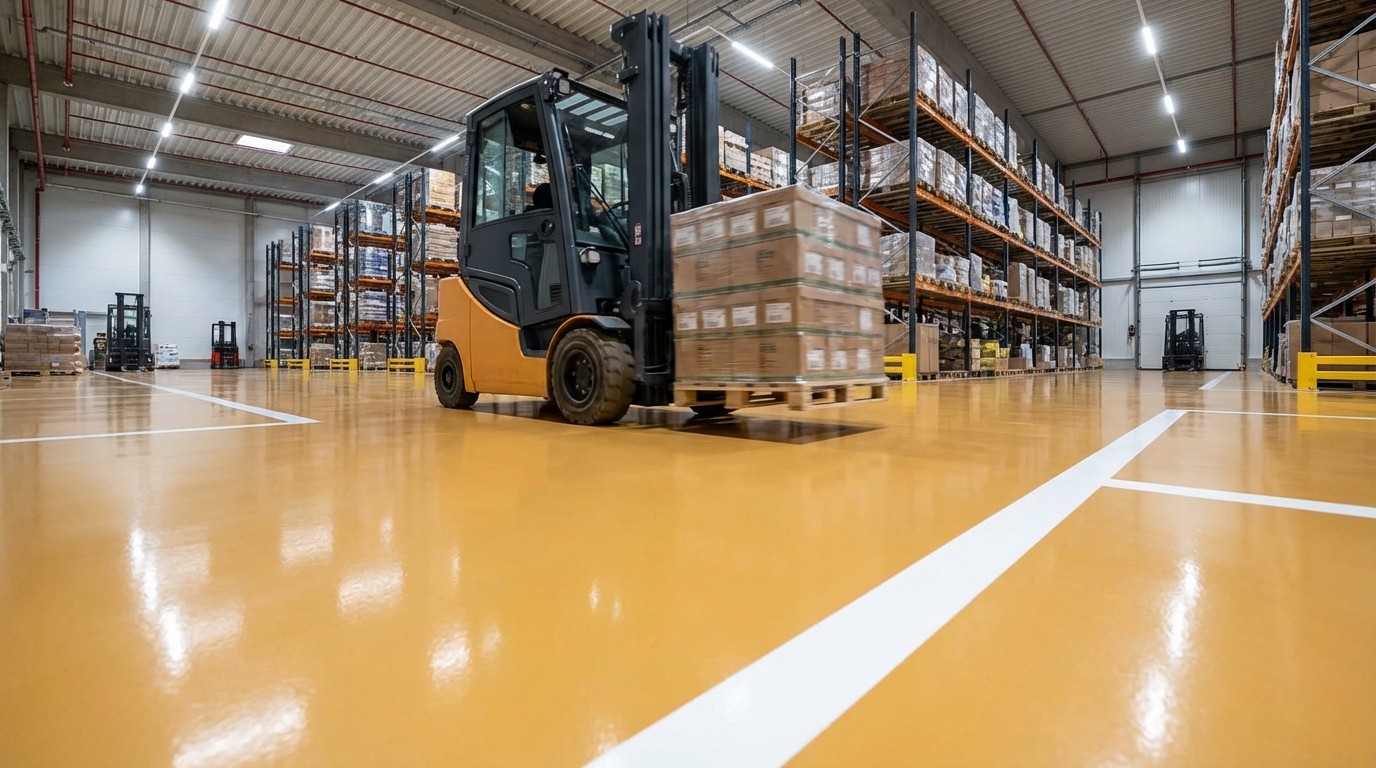
So, you are trying to figure out which warehouse flooring epoxies can actually withstand forklifts all day without failing under load or destroying your logistics flow.
The direct answer is: you need a high-build, industrial epoxy (or epoxy + urethane system) with proper concrete prep, correct thickness, and the right topcoat for impact, chemicals, and tire traffic.
If you run a warehouse or logistics operation, flooring is not just a facilities choice. It touches safety, uptime, pick speed, equipment life, and even how often you shut down a lane for repair. Forklifts do not forgive weak coatings. The wrong epoxy looks fine for 3 months, then you start seeing tire wear paths, flaking at joints, and chipped concrete in front of docks. From there, your WMS screens say one thing, your floor says “go slower.”
Here are the key things you need to know before you commit to any epoxy flooring in a forklift environment:
- Concrete prep matters more than the epoxy brand.
- Thickness and system type (epoxy only vs epoxy + urethane vs epoxy mortar) decide forklift durability.
- You need compressive strength, impact resistance, and abrasion resistance, not just a glossy look.
- Forklift traffic patterns should shape your coating spec zone by zone.
- Temperature, moisture, and cure time change your install plan.
- Good flooring reduces logistics costs: fewer accidents, less equipment damage, better line marking.
- Budget coatings on heavy forklift routes usually cost more over 3 to 5 years than a proper industrial system.
Why forklift-resistant epoxy is different from “regular” epoxy
A lot of people search “epoxy floor” and see photos of shiny garage floors or nice retail spaces. Then they try something similar in a warehouse with 6,000 lb forklifts carrying 3,000 lb pallets, turning in place in the same spots all day.
Those systems are not built for that.
Forklifts bring three big stresses to your floor:
- Concentrated wheel loads at contact patches
- Shear forces from turning and braking
- Impact at cracks, joints, dock plates, and expansion cuts
On the chemical side, you may have:
- Hydraulic fluid
- Battery acid (for electric forklifts and pallet jacks)
- Oils and greases in maintenance zones
- Occasional solvent spills in some tech or packaging areas
So the question is not “epoxy or no epoxy.” The real question is:
- What epoxy system
- At what thickness
- Installed on what surface prep
- In what zones of your warehouse
You want the coating to act like an engineered part of your logistics system, not just a coat of paint.
Core properties you need for forklift warehouse epoxy
When you compare products, ignore the pretty marketing photos and look for these technical points.
1. Compressive strength
Forklift wheels focus a lot of weight on a small area. That weight transfers through the epoxy into the concrete.
Good industrial epoxy mortars sit around or above:
- 8,000 to 12,000 psi compressive strength (or higher)
Standard neat epoxy coatings can be high as well, but mortar systems (epoxy mixed with graded aggregate) give you much more body and resistance to crushing and impact.
2. Abrasion resistance
Forklift tires, especially solid rubber or polyurethane, act like sandpaper over time. They drag dust, sand, and small debris across the floor.
Look for test data like:
- ASTM D4060 Taber abrasion loss (lower is better)
If a product does not publish abrasion numbers, be careful. In a warehouse, abrasion is one of the main failure drivers.
3. Impact resistance
Pallets get dropped, forks hit the ground, and wheels slam into joints. Impact chips weak coatings. Once a chip starts, hot tires and forklift turning pry off more pieces.
Many industrial epoxies list:
- ASTM D2794 impact test values (often in inch-pounds)
You do not need to memorize every test method. You just want to see verified lab data that this is a traffic-grade, not decorative, system.
4. Chemical resistance
You do not need lab-grade resistance in every warehouse. You do need a floor that does not soften or stain badly where your forklifts actually travel.
Common forklift-related chemicals:
- Hydraulic oil
- Transmission fluid
- Battery acid and electrolyte
- Diesel or gasoline in mixed-use sites
Ask for a chemical resistance chart and check those specific chemicals. Look for “no change” or “slight dulling” rather than swelling or softening.
5. Slip resistance
Smooth, glossy epoxy looks nice but can be slick with dust, water, or oils. In high forklift zones, you cannot afford slip for operators or pedestrians.
You can use:
- Fine aggregate broadcast into the epoxy or topcoat
- Textured urethane topcoats
There is a tradeoff: more texture increases cleaning time. In forklift aisles you may want a medium profile, while walkways get slightly more traction.
Types of epoxy systems that work under forklifts
Let us break the main categories of epoxy systems you see in warehouses, and how they line up for forklift traffic.
Thin-mil epoxy coatings (not enough for main forklift lanes)
These are usually:
- 8 to 15 mils total thickness (a mil is one thousandth of an inch)
They go down like paint. They help with dust control and light reflectivity. They are fine for:
- Light foot traffic
- Storage rooms
- Mechanical rooms with limited wheeled traffic
But under forklifts, especially daily use, thin-mil coatings tend to:
- Wear through in tire paths
- Peel at joints and turning points
- Hot-tire pickup when forklifts sit then move
If a contractor proposes only a thin-mil epoxy for heavy forklift operations, you need to push for a thicker industrial system.
High-build epoxy coatings (baseline for forklift areas)
High-build systems usually run:
- 20 to 60 mils total thickness
These go down in one or more coats and create a thicker “shell” over the concrete. For many warehouses, this is the minimum level for main aisles.
They:
- Resist tire wear better
- Help level minor imperfections
- Give you enough body for light texture
Still, in the heaviest traffic zones, or where there are impact risks, high-build neat epoxy might not be enough on its own.
Epoxy mortar systems (best for heavy forklift abuse)
Epoxy mortar combines epoxy resin with graded sand or aggregate. It is more like a troweled, resin-rich concrete topping.
Typical thickness:
- 1/8 inch to 1/4 inch (125 to 250 mils) or more
Advantages for forklift operations:
- Very high compressive strength
- Better impact resistance
- Can rebuild damaged concrete or worn joints
These systems cost more upfront and take more skill to install, but in heavy logistics zones, they often pay back by avoiding frequent patching.
Epoxy + urethane topcoat systems
A common industrial build for forklift warehouses is:
- Concrete prep
- Epoxy primer
- High-build epoxy or epoxy mortar
- Polyurethane or polyaspartic topcoat
Why add a urethane or polyaspartic top layer?
- Better UV resistance (for dock doors with sunlight)
- Improved abrasion resistance
- More color stability
- Texture and easier cleaning balance
Many of the best-performing forklift-resistant floors are actually multi-layer systems, not single products.
How flooring ties directly into business and logistics
Epoxy talks often stop at “durable, chemical resistant, looks nice.” That skips the real story for a warehouse: your floor is a logistics tool.
Here is how flooring links to your business metrics.
1. Throughput and travel speed
If your aisles have ruts, patches, or peeled epoxy, forklift drivers slow down. Not by choice, by self-preservation.
Slower travel speed per trip adds up fast:
- If a forklift runs 100 trips per shift and each trip takes 10 seconds longer, that is 1,000 seconds per shift, or almost 17 minutes.
A flat, uniform epoxy system with clear markings lets drivers keep a steady, safe pace without dodging defects.
2. Safety and incident rates
Floor quality touches several risk points:
- Trips and slips in mixed forklift-pedestrian areas
- Shifting loads when forklifts hit bumps or broken joints
- Skidding in wet or dusty conditions
With epoxy, you can:
- Define pedestrian walkways in contrasting colors
- Mark forklift routes clearly
- Add texture where wet conditions happen, like near docks
That is not just for compliance. Every avoided minor accident protects people and avoids unplanned downtime.
3. Equipment wear and maintenance
Forklifts do not like bad surfaces. Rough or broken concrete does things like:
- Cause faster tire wear
- Increase shock to mast and hydraulics
- Loosen bolts and attachments more quickly
Those costs show up as:
- More frequent tire changes
- Higher maintenance hours
- Shorter equipment life
A solid, well bonded epoxy system acts like a smoother track. The surface is still hard, but you remove the localized shocks from holes or large spalls.
4. Cleanliness and product quality
Bare, worn concrete creates dust. That dust:
- Settles on inventory
- Gets into packaging equipment and conveyors
- Clogs sensors and readers
For technology products, food, or pharma-related storage, this becomes a quality concern. Epoxy seals the surface and reduces dusting. Cleaning teams can work faster because the floor does not trap as much grime.
5. Data and automation readiness
As you move toward more technology in your warehouse, floor quality affects:
- Automated guided vehicles (AGVs) and AMRs (autonomous mobile robots)
- Barcode and QR floor labels
- Line-following sensors or cameras
An epoxy floor with:
- Stable color
- Clear, durable markings
- Minimal surface variation
helps your automation hardware read the environment better.
> A rough, inconsistent floor does not just annoy forklift drivers. It restricts your ability to roll out automation later.
Matching epoxy systems to logistics zones
Not every square foot in your warehouse needs the same build. Treat flooring like slotting: match the system to the traffic pattern.
Main forklift aisles
Characteristics:
- Continuous forklift travel
- Frequent turning at intersections and ends
- Occasional pallet dragging or misaligned forks
Recommended approach:
- Concrete prep: Mechanical grinding or shot blasting
- Primer: Penetrating epoxy primer
- Build: High-build epoxy (40 to 60 mil) or epoxy mortar in high stress sections
- Topcoat: Urethane or polyaspartic with medium texture
This gives a tough, thick surface with good abrasion resistance and manageable cleaning.
Loading docks and staging areas
These zones see:
- Heavy point loads from pallet jacks and forklifts pivoting
- Impact at dock plates and thresholds
- Moisture from outside air and open doors
For dock fronts and immediate staging areas, you often need:
- Epoxy mortar system, 1/4 inch, around joint lines and high impact zones
- Chemical-resistant topcoat for exposure to road salts, water, and fuels
You might reinforce expansion joints with flexible joint fillers that sit flush with the epoxy, so wheels roll smoothly.
Racking aisles
In narrow aisles:
- Forklifts often run on very consistent paths
- Impact risk is lower than at docks
- Precision and flatness matter a lot for VNA (very narrow aisle) trucks
In many cases a high-build epoxy with urethane topcoat is enough. If your racks carry very heavy loads and aisles see constant traffic, consider a mortar build under tire paths.
Battery rooms and maintenance bays
These are chemically aggressive zones.
You need:
- Strong acid resistance (battery acid, electrolyte)
- High slip resistance when wet
Here, a chemical-resistant epoxy system with broadcast aggregate is a good base. Top with a chemical-resistant urethane designed for acids and caustics.
> If budget is tight, do not cut corners in the battery area. Small failures there can spread fast once chemicals attack the concrete.
Office, packing, and light-use zones
These areas usually deal with:
- Limited forklift travel
- Mainly foot traffic and carts
A thinner high-build epoxy or even a thinner coat might work here. That lets you save more robust systems for the forklift-critical zones.
Surface preparation: the foundation of forklift-resistant epoxy
Strong epoxy on poorly prepared concrete fails anyway. Prep is where many projects go wrong.
Concrete moisture and age
Epoxy does not like high moisture vapor transmission from below. If your slab is new or sits on ground with poor vapor barrier, you can get:
- Bubbles
- Blistering
- Debonding
Steps:
- Test moisture (calcium chloride or in-slab probes)
- Use a moisture-tolerant primer or mitigation system if readings are high
Skipping this step is one of the fastest ways to ruin an otherwise good epoxy job.
Mechanical profile
The concrete surface needs a profile for the epoxy to grab onto. Common prep methods:
- Shot blasting
- Diamond grinding
These create a rough surface at a microscopic level. For forklift areas, shot blasting to a concrete surface profile (CSP) of 3 to 4 is common, then vacuuming dust before primer.
Cracks, joints, and spalls
Forklifts hit cracks and unfilled joints hard. Those become starting points for epoxy failure.
Typical steps:
- Chase and clean cracks
- Fill with epoxy crack filler or semi-rigid polyurea, depending on movement
- Repair spalls with epoxy mortar or similar repair material
> If your floor already has joint damage where forklifts cross expansion joints, fix those areas before you coat, or you will trap movement under the epoxy.
Installation timing and cure for logistics operations
From a logistics view, the key question is: how long is this area offline?
Standard epoxy cure windows
Typical industrial epoxies require:
- 8 to 24 hours between coats (at moderate temperatures)
- 24 to 72 hours before light traffic
- 3 to 7 days before full heavy forklift traffic
Fast-cure systems (like some polyaspartics) can shorten this, but often cost more and require tight installation control.
Phased installation around operations
Many warehouses cannot shut down entirely. You can approach flooring like you would a racking re-layout:
- Divide the building into zones
- Reroute traffic around the zone under work
- Coordinate with inbound/outbound schedule to pick slower windows
Think about:
- Weekend or holiday work on main aisles
- Night shift work when fewer forklifts run
- Temporary storage moves to keep pick paths alive
If you are planning a major WMS upgrade or racking reset, flooring work can sometimes align with that project, so downtime stacks instead of spreading.
Comparing flooring choices for forklift warehouses
Sometimes you are deciding between epoxy, polishing, or other toppings. Here is a simple comparison.
| Floor system | Forklift durability | Maintenance | Best use case |
|---|---|---|---|
| Thin-mil epoxy paint | Low under heavy loads | Frequent recoating | Light traffic storage, utility rooms |
| High-build epoxy coating | Moderate to high (zone dependent) | Periodic topcoat renewal | General warehouse aisles, racking areas |
| Epoxy mortar + topcoat | Very high | Spot repair at extreme impact zones | Docks, heavy transfer lanes, high abuse zones |
| Polished concrete (densified) | Good if done well, but joints still vulnerable | Joint and crack maintenance, dust control | Large, open areas, DCs with moderate forklifts |
| Resinous urethane cement | Very high, strong thermal resistance | Low, long life | Cold storage, food, or high thermal shock |
> For pure forklift resistance, epoxy mortar with a urethane topcoat usually outperforms basic epoxy paint and unprotected concrete.
Cost, lifecycle, and ROI from a logistics view
Epoxy that truly stands up to forklifts is not cheap. You want to look at the total picture.
Upfront cost vs lifecycle
Rough idea (numbers vary by region and spec):
- Thin-mil epoxy: Low per square foot, shorter life
- High-build epoxy: Moderate per square foot, 3 to 7 years in heavy use before renewal
- Epoxy mortar systems: Higher per square foot, often 7 to 15 years in critical zones with proper care
If you factor:
- Downtime cost per recoat
- Lost throughput from slow zones
- Extra forklift maintenance
you often find that a more robust system in heavy traffic lanes has a better return.
Examples from logistics operations
Here are two simple, realistic scenarios.
A regional DC installed a thin epoxy coating in all aisles to “get rid of dust and look cleaner.” Within 14 months, tire paths in main aisles had worn down to bare concrete. They had to shut sections over two summers to recoat, each time losing a weekend of full operation.
Compare that with this approach:
Another site only used high-build epoxy with urethane topcoat in main aisles and docks, and went with a more basic system in low-traffic storage areas. After 5 years, main aisles had worn, but not to the concrete. They simply added a new topcoat in one holiday period, no major rebuild.
The difference was not just material. It was matching system to traffic and planning for renewal like you plan for equipment replacement.
Common mistakes when picking epoxy for forklift warehouses
If you avoid these, you are already ahead of many projects.
1. Treating all areas the same
Putting the same light-duty epoxy everywhere might make purchasing simpler, but it ignores traffic patterns. It often fails first where forklifts work hardest.
2. Skipping proper prep
Trying to save money by doing minimal grinding or avoiding moisture testing often shifts cost into peeling, blistering, and rework.
3. Focusing on color and gloss first
Appearance matters, especially for audits and customer visits, but you need the mechanical numbers first, then pick color and finish.
4. Ignoring joint design
If you coat over joints without planning:
- Forkloads chip epoxy at joint edges
- Movement cracks the coating
Plan joint filler materials and details with forklift wheel paths in mind.
5. Not involving operations early
Maintenance teams often drive flooring decisions, but operators know exactly where floors take the most abuse.
> Walk your forklift drivers through the building with your flooring contractor. Ask them where they feel impacts the most.
Practical tech tie-ins: data, sensors, and warehouse software
Since your niche is technology and logistics, it helps to think about epoxy flooring as a base for data and automation.
Better line marking for WMS and routing
With epoxy floors, you can integrate:
- Permanent aisle IDs
- Dock position labeling
- Staging zones mapped to WMS statuses
When your physical labels stay readable and do not peel from dust or moisture, your WMS screen and the floor match. That reduces picking errors and routing confusion.
Support for smart forklifts and automation
Modern forklifts increasingly carry:
- Vision systems
- Location sensors
- Onboard cameras
Clean, uniform flooring helps:
- Line-following or floor mark detection
- QR or 2D codes on the floor for positioning
If you ever want to introduce AMRs or AGVs, good flooring is not just nice, it becomes a base requirement.
Data on flooring performance
Some larger operations track:
- Incident heatmaps (near misses, small impacts)
- Maintenance logs tied to floor locations
Overlaying that data on a map can show where your floor needs a higher-grade system next time. You do not have to guess which dock, which aisle, or which crossing area deserves epoxy mortar rather than standard coating.
How to talk to vendors and contractors about forklift epoxy
When you speak with flooring providers, you want to move past generic pitches and get technical clarity.
Key questions you can ask:
- “What is the total system thickness in mils or inches in main forklift lanes?”
- “What is the compressive strength and abrasion resistance of the system you are proposing?”
- “How do you handle expansion joints and existing cracks where forklifts cross?”
- “What is the cure time before we can put full forklift traffic on it, at our typical building temperature?”
- “Can you show references where this system has been used with similar forklift traffic and load profiles?”
You can also share your data:
- Average daily forklift trips per lane
- Heaviest pallet weights
- Aisle widths and turning patterns
That lets the vendor design for your actual logistics patterns instead of some generic “warehouse” template.
Your goal in these conversations is not to pick the shiniest floor. Your goal is to pick the system that supports your throughput targets with the fewest interruptions.
One practical tip you can apply right away
Before you spec any epoxy, walk your warehouse with a simple printed map and a marker. Mark three things:
- Zones where forklifts turn sharply or often pivot in place
- Spots with existing concrete damage, chips, or joint breakdown
- Areas where near misses or small incidents happen most often
Use those marks to tell your flooring contractor: “These are our forklift stress points.” Then push for epoxy mortar or a higher build in those specific locations, even if you use a lighter system elsewhere. This single step makes your flooring project far more aligned with your logistics reality.