
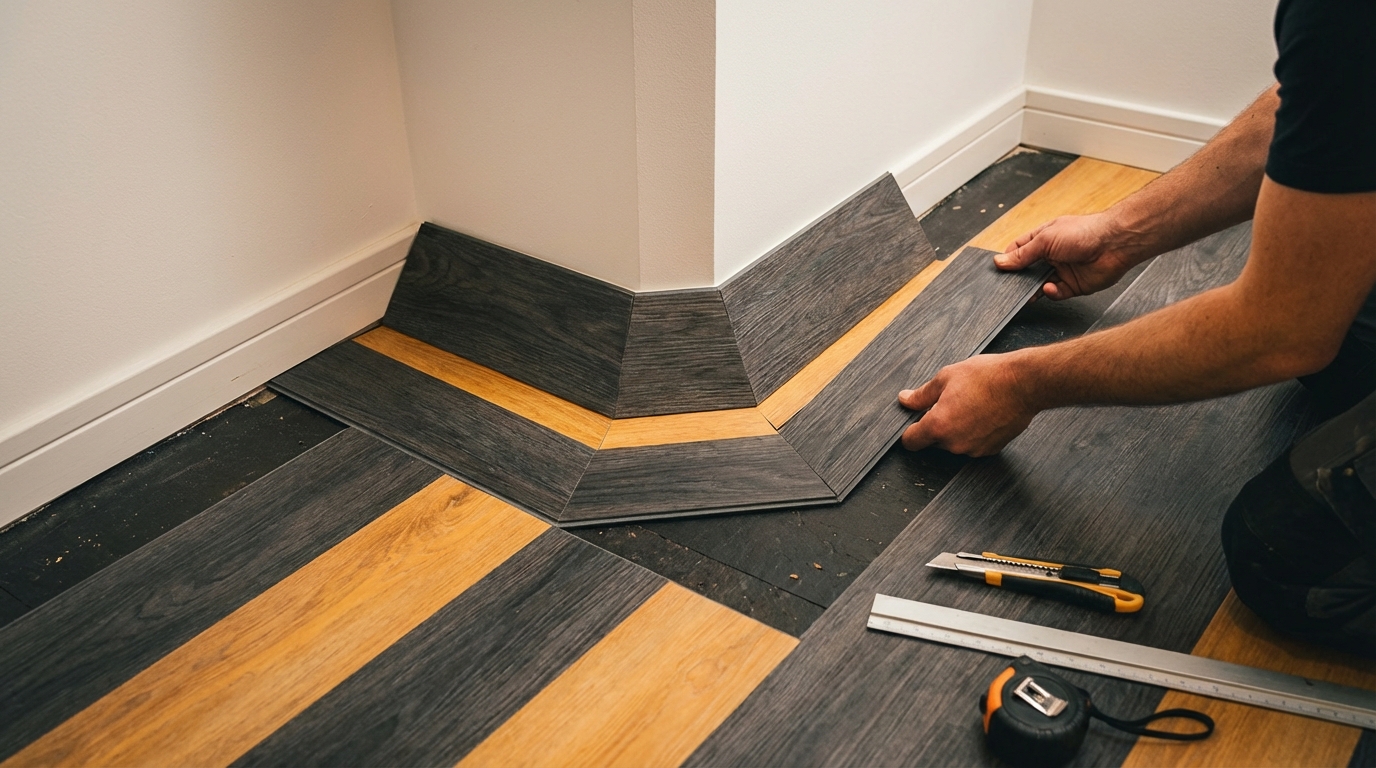
So, you are trying to tackle vinyl plank installation around tricky corners and you are worried about messing it up. The direct answer is: you need to slow down, measure twice, template the corner, and cut once with the right tools while keeping your expansion gap consistent.
Corners feel hard because vinyl plank is rigid, rooms are never perfectly square, and walls often bow or flare out. What looks like a simple 90-degree corner usually is not. The good news is that if you think through your approach, use cardboard templates, and work from a solid reference line, you can get clean corners that look professional.
Things you need to know:
- Most inside corners are not true 90-degree angles.
- You must keep an expansion gap at corners, not jam planks tight.
- Templates (cardboard, scrap plank, or paper) save expensive planks.
- Outside corners need extra support and careful locking of click joints.
- Doorways and casing cuts are where most visible mistakes show up.
- Wrong sequence (laying in the wrong direction) makes corners much harder.
- The right blade and score-and-snap technique prevent chipped edges.
Understanding “tricky corners” with vinyl plank
You are not only dealing with simple squares. Let me break down the main types of tricky corners you will run into:
- Inside corners at walls (where two walls meet inward).
- Outside corners (like column edges or stair landings).
- Doorway corners and casing legs.
- Irregular corners (angles that are not 90 degrees, jogs, niches).
- Inside corners under cabinets or around built-ins.
- Inside/outside corners where vinyl meets another floor (transitions).
You will handle all of these with the same basic ideas:
- Leave room for expansion.
- Work from a straight reference line.
- Template first, cut second.
- Lock joints without forcing or bending too much.
> Corners exaggerate every small mistake you make in layout or measuring.
> If your layout is off by even a quarter inch, the corner will show it.
Prep that makes corners easier
Check your room for square and wall bow
Before you cut anything:
- Measure from one wall to the parallel wall at several points.
- Use a long level or straightedge against the wall to see if it bows in or out.
- Mark high spots on the drywall or trim where the wall sticks out.
You want a mental map of where the walls are crooked, because those spots will affect your cuts at corners.
Decide your starting wall and direction
The direction of your planks has a big impact on how hard your corners feel.
- Pick one main visual wall. Often the longest wall or the wall you see first when you walk in.
- Lay planks parallel to that wall so the room looks longer and cleaner.
- Start on the straightest wall you have, even if it is not perfect.
If you start in a corner that is out of square, you just carry that problem across the whole room.
> Good layout reduces how many “problem corners” you actually have.
> Bad layout turns normal corners into complicated puzzles.
Keep your expansion gap around corners
Every vinyl plank product has a required expansion gap, usually around 1/4 inch. Check the box, but plan for at least 1/4 inch.
At corners, it is easy to forget about this and cut your plank tight. That leads to:
- Cupping or buckling in the floor later.
- Click joints separating in other parts of the room.
- Visible gaps opening when the material shrinks seasonally.
Use spacers at corners just like along straight walls. Do not pull them until the floor is fully installed and trim is ready.
Tools that matter for corner work
You do not need a fancy workshop, but for tricky corners, some tools make your life much easier.
Cutting tools
- Sharp utility knife with extra blades (for score-and-snap cuts).
- Vinyl plank cutter (optional but nice for straight cuts and repetitive cuts).
- Jigsaw with a fine-tooth laminate/vinyl blade (for tight inside corner cuts).
- Oscillating multi-tool (for undercutting door casings and trim).
- Handsaw or pull saw (for undercuts if you do not have an oscillating tool).
Measuring and templating tools
- Tape measure.
- Speed square or combination square.
- Contour gauge (for complex shapes like trim profiles).
- Cardboard or heavy paper (for templates).
- Pencil and a fine marker (pencil for plank, marker for cardboard).
> If you have to choose one “extra” tool for corners, pick an oscillating multi-tool.
> Being able to undercut trim and jambs cleanly changes the quality of your finish instantly.
Inside corners: clean fits without binding
Inside corners are where two walls join inward. These are the corners behind toilets, in closets, or where a hallway turns.
Basic method for a simple inside corner
Imagine you are running planks left to right, and you come to an inside back-left corner.
Step-by-step:
- Dry fit the last full plank before the corner. Click it in, keep your expansion spacers along both walls.
- Measure the distance from the edge of that last plank to each wall:
- Measure from the left side of the plank to the corner wall.
- Measure from the top of the plank to the back wall.
- Transfer these measurements to a new plank:
- Mark the width you need from one end.
- Mark the length you need along the side.
- Draw the “L” shape for the inside corner cut on the plank.
- Subtract your expansion gap from each measurement before you cut.
- Use a utility knife and square to score along the lines and snap, or use a jigsaw for the inner portion of the L.
- Dry fit that L-shaped piece into the corner first, then click it to the previous plank.
Key detail: you usually need to angle the L-shaped plank into place. Do not force it. If you have to bend the tongue or groove too much, you might break it.
Dealing with walls that are not square
If you follow the simple L shape method and you still get a gap on one leg of the corner, your walls are not square.
In that case:
- Place a full plank on top of the previous row with its tongue toward the corner, but do not lock it.
- Slide it toward the corner until it almost touches both walls while sitting on spacers.
- Take a short scrap plank with a factory edge and use it as a scribing block:
- Hold the scrap against the wall and slide it along the wall with a pencil on the main plank.
- This transfers the wall’s exact angle onto your plank.
- Cut along that scribed line.
This method follows the reality of your wall instead of the theory of a 90-degree corner.
> Scribing takes a few extra minutes, but it saves you from “filling” gaps later with caulk that always looks like a patch.
Managing inside corners behind toilets or tight spaces
Small bathrooms add one more headache: you cannot always angle planks in easily.
Options:
- Work backward into the corner:
- Pre-assemble small sections outside the bathroom.
- Bring them in and click them together in the open area first.
- Then slide the assembled pieces under the toilet flange area.
- Use a slight slide-and-tap method:
- Engage the long side joint at a shallow angle.
- Tap the short side in with a tapping block and pull bar.
If you really cannot angle the piece in at all, some products allow “flat” assembly for the short joints, but you have to read the manufacturer’s instructions. Some click systems are not built for that and you can damage the lock.
Outside corners: preventing weak edges and chipping
Outside corners are the edges that stick out into the room, like:
- A wall that ends before the next wall starts.
- A column or post.
- A stair landing edge.
These corners expose cut edges and are easy to chip or break.
Planning the layout around outside corners
Whenever possible:
- Avoid leaving a sliver of plank running into an outside corner. Try to keep at least 1/3 of a plank width there.
- Shift your starting line if needed so that you do not end on a 1-inch strip at that corner.
This planning step can save an hour of frustration later.
Cutting around an outside corner
Picture an L-shape but reversed: you are cutting a notch out of the plank to wrap around the corner.
Method:
- Dry fit the last full plank before the corner.
- Place a new plank over it, overlapping across the corner area where it will eventually sit.
- Use a scrap plank along each wall to “transfer” the corner onto the top plank:
- Hold the scrap against the wall, slide it to the corner, mark where it hits the top plank.
- Do this for both walls.
- Connect your marks to draw the notch that will go around the outside corner.
- Subtract the expansion gap from both sides of the notch.
- Cut the notch using a jigsaw or by scoring and snapping where possible.
Dry fit carefully. If you cut too tight, the corner of the wall will bite into the vinyl and might squeak or chip later.
> When you cut for an outside corner, think of protecting the plank’s corner.
> A rounded inside cut holds up better than a sharp 90-degree one.
You can slightly round the inside corner of your notch with the jigsaw. That reduces stress on that point.
Protecting outside corners with trim
Outside corners are usually covered with:
- Quarter-round or shoe molding wrapping the corner.
- Outside corner molding that covers vinyl and drywall edges.
- Metal or PVC corner guards in high-traffic areas.
Plan your expansion gap so the trim actually covers it. Measure the width of your trim before you cut the floor too short or too long.
Doorways and casing corners: where people notice flaws first
Doorways bring all the worst elements together in one small spot: inside corners, outside corners, transitions, and trim.
Undercutting door jambs and casings
You want your vinyl plank to slide under the door trim rather than trying to cut around it perfectly.
Here is the basic method:
- Take a scrap piece of your vinyl plank and a scrap of underlayment (if it is separate).
- Lay them tight against the door casing.
- Use an oscillating multi-tool or handsaw to cut the casing at that height, using the plank as a guide.
- Pull out the cut piece of casing and clean out debris.
Now your plank can slide under the casing, hiding small irregularities and giving a cleaner finish.
> Cutting around casings almost always leaves tiny gaps.
> Sliding under the casing hides all that and looks far more precise.
Inside and outside corners inside a doorway
Picture a standard door opening:
- Each side has a casing leg that you undercut.
- The floor often transitions to another floor type on the other side.
There are two common scenarios:
1. Same vinyl plank continues through the doorway
You want the planks to run straight through, with no threshold.
Tips:
- Lay your rows so that you do not end a plank exactly at the middle of the doorway if you can avoid it.
- Stagger joints so a seam does not land exactly where traffic is heaviest.
- Let the plank extend under each casing by a bit to keep the visual line clean.
You will usually cut a notch in the plank so that its middle passes through the opening while the sides tuck under each casing. Treat those as two small inside/outside corners, one on each side.
2. Vinyl meets a different floor material
Here, you often use a T-molding or reducer.
Steps:
- Position the track for the T-molding or reducer centered in the doorway (often recommended by manufacturers).
- Measure your last full plank row so that its cut edge lands under the edge of the molding.
- Keep the expansion gap under the molding so the vinyl can move freely.
You still undercut the casings and slide both the vinyl and the other flooring under, then drop the molding over the joint.
Template method for tight doorway corners
Doorway corners are easy to mess up by 1 or 2 mm, and then the gap shows. This is where cardboard templates shine.
Method:
- Cut a piece of cardboard roughly the size of the plank piece you need.
- Fit the cardboard into the doorway, trimming little pieces until it fits perfectly around both casing legs and undercuts.
- Mark orientation (front/back, left/right) on the cardboard.
- Lay the cardboard template on your plank and trace it.
- Cut the vinyl along the traced lines.
This keeps your expensive plank safe while you experiment with the fit.
Irregular corners and weird shapes
Sometimes you are not dealing with simple right angles at all. You might have:
- Angled walls (45-degree corners).
- Bay windows with multiple angles.
- Column bases with rounded trim.
- Built-in benches or fireplaces with offsets.
Handling non-90-degree angles
For angled walls:
- Lay a plank in place lightly without locking it, so it crosses the angled wall.
- Use a bevel gauge or speed square to capture the angle:
- Place the bevel gauge against the angled wall and lock it.
- Transfer that angle onto the plank.
- Score and cut along that angle.
You can also scribe the angle by sliding a scrap along the wall and tracing the line, like earlier.
Using contour gauges for complex trim or rounded corners
For rounded column bases, bullnose corners, or decorative trim:
- Press a contour gauge against the shape until its pins match the profile.
- Carefully move the gauge to your plank without bumping the pins.
- Trace the shape and cut with a jigsaw.
This gives a surprisingly tight fit under complex trim.
Working around cabinets and built-ins
Cabinets and built-ins often create shallow inside corners that are hard to see but still matter.
Floating floor under or up to cabinets?
Manufacturers usually say:
- Do not trap a floating vinyl plank floor under heavy fixed cabinets that will crush its ability to move.
So your sequence often looks like:
- Install cabinets first, down to the subfloor.
- Run vinyl plank up to the cabinet faces with an expansion gap.
- Cover the gap with toe kick or trim.
At the corners where cabinets meet walls, you get small inside corners. Use the same L-cut and template tricks you used for wall corners, but measure from the face of the cabinet, not the face of the original wall.
Toe kick recesses and shallow corners
For toe kicks:
- Treat the underside as a low wall. You still need a gap there, even if it is small.
- Do not try to shove planks too far under toe kicks you cannot reach. Go far enough that the shadow line hides the edge, then stop.
You can slide a piece of cardboard under, mark how deep the visible area is, and template to that depth.
Sequencing your installation around corners
One thing that trips people up is sequence: which pieces go first, and which are inserted later.
General sequence rules
- Work from a straight main wall and move across the room.
- Finish most of a row before you cut its final tricky corner piece, so your measurements are based on actual installed planks.
- When you hit a complex area (doorway, column), pause and dry plan:
- Which pieces anchor the click system?
- Which piece will “drop in” last?
Sometimes, you assemble a small cluster of planks near a corner and install that cluster as one unit. That lets you engage multiple joints at once, reducing stress on any single tongue or groove.
> Think in small sections, not only single planks.
> Sections let you work around corners that do not allow a clean angle for one board at a time.
Common mistakes at corners (and how to avoid them)
1. Ignoring expansion gaps
Problem:
- Planks cut tight into a corner or under casing.
Consequence:
- Buckling or peaking months later, sometimes in the middle of the room.
Fix:
- Always subtract your gap from each measurement to the wall or trim.
- Use spacers right at the corner and leave them until the row is done.
2. Overcutting inside corners
Problem:
- Jigsaw cuts overshoot the inside corner, leaving a visible notch past the wall line.
Fix:
- Stop short and finish the last bit with a utility knife.
- Or drill a small hole at the inside corner and cut up to it. The rounded hole stops cracks from spreading.
3. Weak narrow strips at outside corners
Problem:
- A 1-inch wide strip of plank sticks past a corner and breaks or chips.
Fix:
- Rework layout so you have a wider piece at that location.
- If you cannot rework layout, back the area with a firm underlayment and protect it with corner trim.
4. Forcing joints at bad angles
Problem:
- You bend planks hard to get them into place at a corner and the tongue cracks.
Fix:
- Disassemble a few planks back, change the sequence, and re-assemble with more space to angle.
- Use a tapping block and pull bar gently rather than slamming joints together.
5. Measuring from the wrong reference
Problem:
- Measurements taken from a bare wall, but there is trim or a baseboard planned that changes where the floor visually stops.
Fix:
- Measure to the finished surface you will see, not just the raw framing or drywall.
- If trim is already installed, measure to the trim and plan your gap behind it.
Advanced small-space corner tips
Once you get comfortable with the basics, these tricks can help when a corner looks impossible.
Using “slip tongues” or glue in rare cases
Some installers in tight corners will:
- Cut off a damaged tongue and use a spline or “slip tongue” with adhesive to connect boards that cannot click together at an angle.
You need to check your product warranty, though. Gluing click planks can void support, but sometimes it is the only realistic path in a hidden corner behind a toilet or deep in a closet.
Assembling short rows fully, then sliding them
In very narrow hallways that turn a corner:
- Assemble a short row (2 or 3 planks) in the open area.
- Slide the whole row into the hallway section where you cannot stand easily.
- Tap the long joints together with a pull bar from the open end.
This reduces the awkward plank-by-plank gymnastics at the bend.
Table: Inside vs outside corner strategy
| Corner type | Main challenge | Best tools | Key tip |
|---|---|---|---|
| Inside wall corner | Keeping tight fit without binding | Utility knife, jigsaw, spacers | Scribe the wall if it is not square; keep the expansion gap. |
| Outside wall/column corner | Preventing chipped edges and weak strips | Jigsaw, cardboard template | Avoid narrow pieces; add gentle radius at inside notches. |
| Doorway corner | Multiple corners in small area | Oscillating tool, contour gauge, cardboard | Undercut casings and slide planks under instead of cutting around. |
| Cabinet corner | Hidden but tight spots for expansion | Utility knife, scrap planks | Treat cabinet faces as walls and maintain the gap under toe kicks. |
| Angled / bay corner | Non-90-degree cuts that show visually | Bevel gauge, jigsaw | Capture the true angle with a gauge or scribing block. |
Small data points that help your decisions
You do not need heavy statistics here, but a few numbers give context:
- Most click vinyl plank products expand and contract about 1-3 mm per meter of length with seasonal temperature and humidity swings.
- Standard recommended expansion gap is usually in the 1/4 inch range, larger for big rooms.
- Room corners can be out of square by 1-3 degrees in a lot of homes, especially older ones. That small angle can create a visible wedge-shaped gap over 12-18 inches.
Those small numbers are why precise cuts at tricky corners matter. The material moves. The house is not perfect. Your job is to leave controlled room for that movement without leaving visible gaps.
> You do not need to be a master carpenter to get clean vinyl plank corners.
> You just need patience, templates, and a habit of checking each cut before you commit.
One practical tip you can try on your next corner: before cutting your actual plank, do a “dry sketch” on a scrap piece, write the exact measurements and deductions for gaps right on it, and hold it up in the corner. If the scrap looks right, then trace and cut your good plank based on that mockup. This one extra step removes most of the guesswork from tricky corners.