
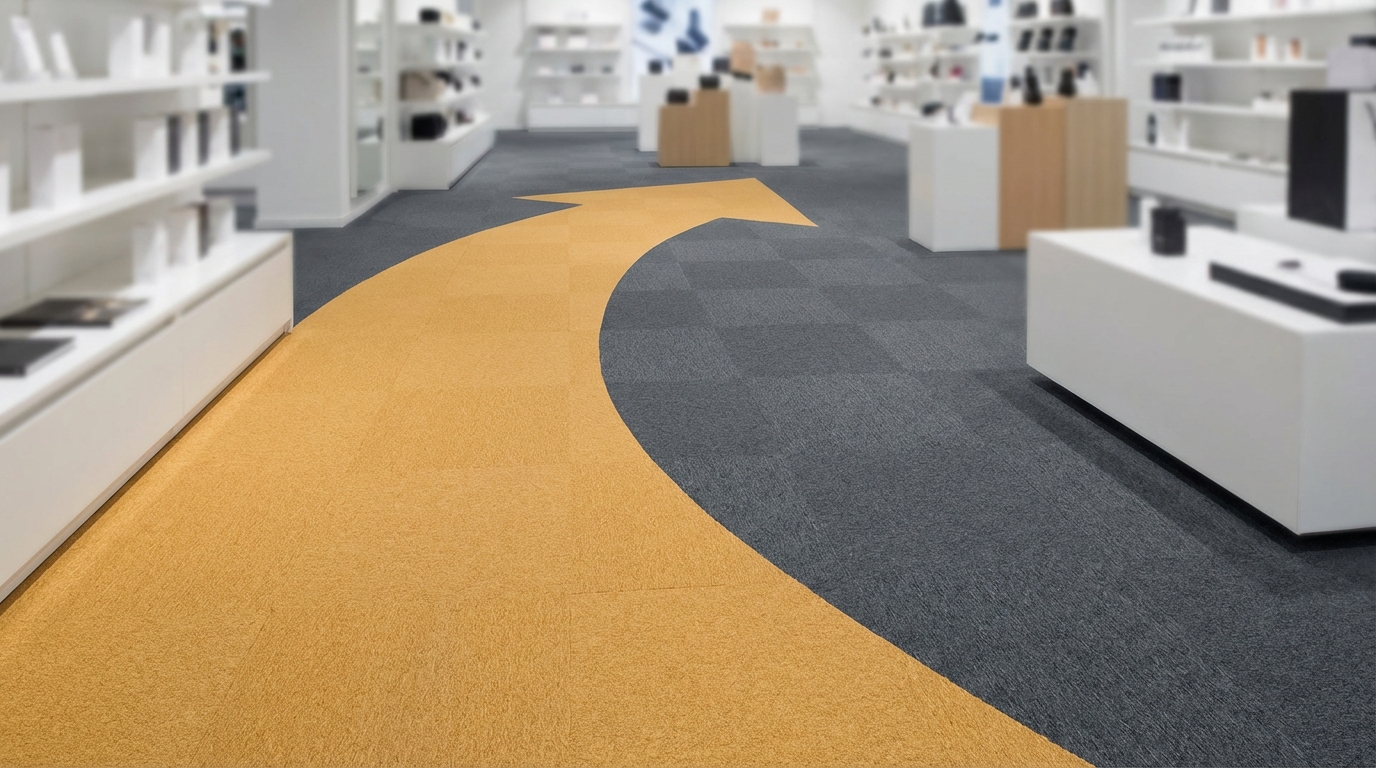
So, you are trying to understand the psychology of retail flooring and how it can guide customers through your store.
The direct answer is: your floor can act like a quiet roadmap that nudges shoppers where you want them to go, shapes how long they stay, and even what they buy.
Most store owners obsess over shelving, lighting, and signage, but the floor is literally under every single step. It sets pace, direction, mood, and comfort. Customers rarely point at the floor and say “this is why I bought more”, but their brains react to texture, pattern, contrast, and layout in very predictable ways. If you design flooring with intent, you get smoother traffic, better product exposure, and higher basket size.
Things you need to know:
- Flooring is wayfinding: lines, contrast, and changes in material quietly tell shoppers where to walk and where to stop.
- Pace matters: smooth, continuous surfaces speed people up; texture and pattern slow them down.
- Zone changes on the floor signal “you are entering a new area”: great for departments, feature zones, and upsell paths.
- Light + floor + fixtures work as a system; you cannot design the floor in isolation.
- Bad acoustic and visual choices on the floor cause fatigue and early exits.
- Right flooring near high-ticket products increases dwell time and perceived value.
- Subtle floor cues often outperform big overhead signs for directing traffic.
- Consistent “main path” flooring creates a natural loop that keeps people moving.
- Flooring mistakes are expensive to fix, so it pays to prototype and test traffic before you commit.
Why the floor has so much psychological power
You never walk into a store and say, “nice wayfinding system on the floor”. You just follow it.
Your eyes might look at products and signs, but your body responds to what your feet feel and what your peripheral vision picks up. The floor does four big psychological jobs:
- It sets the pace of movement.
- It directs the path shoppers take.
- It marks where to pause, browse, or decide.
- It frames how “premium” or “cheap” the experience feels.
Here is the simple mental model:
Your walls talk to your eyes.
Your floor talks to your body.
When the body feels rushed, uncertain, or tired, people buy less. When it feels safe, comfortable, and gently guided, people relax into browsing. That is when the average basket grows.
The “transition zone” and why your floor should calm people right away
Retail research often mentions a “transition zone” near the entrance. The first 5 to 15 feet inside the door is where customers’ brains switch from outdoor mode to shopping mode. During those first steps, they ignore signs, offers, and even staff.
Your floor can either help that transition or fight it.
If you have a harsh pattern, high glare, or sudden step in that zone, you add friction to a moment when the brain is already processing a lot of change.
Better approach:
- Use calm, simple flooring right inside the door.
- Avoid busy patterns or harsh contrasts in the first few steps.
- Make the surface feel stable and predictable: no surprises.
Think of your entrance floor as a “buffer”. It should say: “You are safe. Take your time.”
Once people pass that threshold, you can start to guide them.
How flooring directs movement without a single sign
You can treat your floor like a visual and physical GPS. Shoppers follow obvious, low-effort paths. Your job is to design those paths instead of leaving them random.
There are four core tools here:
- Contrast
- Lines and direction
- Material changes
- Rhythm and repetition
Contrast: where the eye goes, the feet follow
Contrast on the floor can mean:
- Change in color (light to dark, warm to cool).
- Change in texture (smooth tile to softer LVT or carpet tile).
- Change in pattern (plain to geometric).
Humans have a natural tendency to notice edges and boundaries. The brain uses them to map spaces quickly. If your main aisle is one tone and the side areas are another, people will see the “road” even without thinking about it.
Example:
| Floor Strategy | Psychological Effect | Retail Impact |
|---|---|---|
| Light, plain floor in main aisle; darker or patterned floor in side bays | Main path reads as “easy, open”; side bays feel like “places to explore” | More customers follow the full aisle loop; those who step into bays spend more time browsing |
| No contrast; same flooring everywhere | Space feels flat; paths are vague | People cut straight to what they need and exit faster; less impulse buying |
If everything looks like a path, nothing feels like the main path.
So you want one flooring “language” for the spine of the store, and another for browsing areas.
Lines and direction: why plank orientation matters
Most plank or tile products are directional. Your brain reads that direction as movement, just like road markings.
If you run planks lengthwise from the entrance into the store, you subtly say “move forward”. If you run them across the path, you put a small brake on movement.
Here is a simple rule of thumb:
- Run planks along your desired traffic corridors to encourage flow.
- Rotate planks or change pattern orientation where you want people to slow down.
You can test this. In mock-ups or renderings, rotate the flooring in a key area and ask people where they “feel” like walking. Most will follow the orientation of the planks without realizing why.
Material changes as “chapter breaks”
Think of your store as a book. Departments and key zones are the chapters. Flooring is your chapter break.
A material change signals:
- “New category here.”
- “Different price level here.”
- “Pay more attention now.”
For example, in a tech store:
- Use resilient LVT with a subtle pattern for general aisles.
- Switch to a softer, slightly darker floor in premium device zones.
- Add a textured insert in front of demo tables to create “decision islands”.
Customers might not remember the exact pattern, but they remember the feeling: “I stepped into the laptop area and it felt more focused.”
Rhythm and repetition: floor as a metronome
Repeating floor elements at intervals sets a rhythm for the walk.
Examples:
- A different tile in front of every fourth bay.
- Contrast strips at regular distances along a main aisle.
- Repetitive color blocks under promotional tables.
This does two things:
- It keeps the brain engaged with small “beats” so people do not zone out completely.
- It creates mental markers: “I passed three markers; I am halfway through the store.”
Just do not overdo it. If the floor turns into a checkerboard of accents, the rhythm becomes noise.
Using flooring to control shopping speed and dwell time
Your goal is not to make everyone walk slowly everywhere. That frustrates shoppers who know exactly what they want.
You want:
- Fast, clear routes for essentials.
- Slower zones around higher-margin and discovery products.
Your floor is one of the cleanest ways to tweak pace.
Smooth and continuous floors speed people up
A long, smooth corridor, one material, minimal joints, low pattern: that says “keep walking”. Grocery chains often do this on the perimeter so you can reach dairy or produce fast.
If your main floor is:
- Low contrast
- Low texture
- Low visual “noise”
People will move at a natural walking speed. That is useful for routes:
- From entrance to core departments.
- From checkout back to entrance.
- Around the outer loop of the store.
Texture and pattern slow people down
Once you want people to slow down, you add friction. Not unsafe friction, but sensory friction.
Ways to slow people:
- Introduce a slightly textured or matte area underfoot.
- Shift to a more detailed pattern that invites visual scanning.
- Add a subtle border or edge that makes people feel like they entered a defined area.
Researchers in environmental psychology have seen this in other settings. When the floor pattern becomes more detailed, walking speed often drops because the brain invests more attention in the environment.
If you want a shopper to think, give their feet a cue to pause.
Place that cue:
- In front of high-margin displays.
- Near cross-category bundles (for example, phones plus accessories).
- Around new product launch islands.
Comfort, fatigue, and how long people stay
Hard floors reflect sound and transmit more impact to the body. Over time that creates fatigue. The longer someone has been on a hard, echo-prone floor, the more likely they are to cut the visit short.
This is where material choice matters:
- Resilient vinyl or rubber underfoot in long aisles can reduce perceived fatigue.
- Acoustic backings cut noise, which reduces cognitive load.
- Soft insets near service counters feel kinder when someone queues.
Simple test: stand in your store for twenty minutes in the same area and listen. If your own shoulders are tense from noise and hardness, your customers feel that too.
Flooring and queues: make waiting feel shorter
Queue areas are often treated as an afterthought. People stand on whatever floor happens to be there. That is a missed chance.
You can:
- Use a different floor color or material to clearly mark the queue “lane”.
- Add pattern elements that subtly show where to line up.
- Use a slightly softer or warmer-feeling material to reduce perceived discomfort.
If the line “feels” organized underfoot, people are less anxious about where to stand.
That calm spills back into how they perceive your brand when they finally reach the counter.
Zone psychology: matching flooring to the type of area
Your store is not one uniform space. You have:
- Entry and transition area
- Main aisles and loops
- Exploration zones
- High-focus decision zones
- Service and checkout areas
Each of these needs a slightly different flooring strategy.
Entrance and front-of-store
Goal: Welcome, orient, and create a clear first direction.
Flooring tips:
- Calm, low-pattern surface for the first several feet.
- Gradual change into the main aisle flooring, not a visual “shock”.
- Subtle directional cue toward the right-hand path if you want a standard loop (most shoppers turn right).
Tech example: In a consumer electronics store, use a light neutral LVT tile at the entry that then flows into a more directional plank pattern guiding people toward feature tables.
Main aisle or loop
Goal: Keep people moving, but invite side exploration.
Flooring tips:
- Clear, distinct flooring along the main route (color or texture contrast with side areas).
- Directional orientation of planks along the path.
- No abrupt pattern changes that might feel like trip hazards in peripheral vision.
Think of it like a hallway in an airport. Clear, obvious, stable.
Exploration bays and side aisles
Goal: Slow people slightly and encourage scanning.
Flooring tips:
- Introduce a slightly darker tone or richer texture in bays.
- Maybe a pattern that visually “frames” each bay.
- A different tile layout (for example, herringbone within bays, straight lay in main aisles).
Changing the floor at the entrance to a bay is like adding a soft door without blocking the view.
Customers who step into that “door” are more likely to look around, not just grab and leave.
High-focus decision zones
These are areas where people consider expensive or complex products:
- TV walls
- Premium laptops
- Smart home bundles
Goal: Reduce distraction, boost perceived value, and create a sense of calm.
Flooring tips:
- Use a consistent, low-noise floor with fewer joints and patterns.
- Consider a slightly softer or warmer-feeling surface.
- Avoid high-gloss that reflects screen light or ceiling light harshly.
A study from the Journal of Consumer Research pointed out that visual clutter and glare can reduce perceived product quality. Your floor is part of that visual field. If the floor is shouting for attention, the product feels cheaper.
Service desks and support areas
These are emotional zones. People ask for help, handle returns, solve problems.
Goal: Reduce stress and support longer, comfortable interactions.
Flooring tips:
- Use warmer tones or a different material to separate service zones from sales zones.
- Increase acoustic absorption under and around these counters.
- Create a clear, defined “waiting area” on the floor, so people do not cluster in confusion.
A clear service zone on the floor tells customers: “You are in the right place for help.”
That alone can reduce tension before a staff member even speaks.
Checkout and exit
Goal: Smooth, predictable flow and last-minute exposure to add-ons without pressure.
Flooring tips:
- Distinct floor pattern or striping that shows queue direction.
- Softer underfoot material in waiting lines.
- Low visual clutter under impulse racks so product, not pattern, gets attention.
Here, you want zero ambiguity. Confusing queues lead to frustration, which can erase positive impressions from earlier in the visit.
Color psychology on the floor: more than taste
Color choices on the floor carry meaning, even when people do not articulate it.
You want to balance brand expression with behavioral effects.
Light vs dark floors
- Light floors feel more open and larger. They reflect more light and often feel more casual. They also show dirt and wear faster.
- Dark floors feel more enclosed and focused. They can make products “pop” more, especially lighter fixtures. They hide scuffs better but can show dust and lint.
Psychological effect:
| Floor Tone | Perceived Space | Typical Use |
|---|---|---|
| Light neutral | Open, easy to scan | Main aisles, large-format stores, supermarkets |
| Medium neutral | Balanced, grounded | General retail, electronics, fashion |
| Darker neutral | Intimate, focused | Premium sections, tech demo zones |
For tech, a common approach is: light to mid tones along the main path, slightly darker in high-engagement zones. That way, shoppers feel drawn into those spaces without feeling trapped.
Warm vs cool tones
- Warm floors (beige, warm gray, wood-look) can feel more human and welcoming.
- Cool floors (blue-gray, concrete-look) can feel more structured and sleek.
Many tech retailers pick cool tones for the main surfaces, then add warmth with wood-look in specific areas where they want people to relax, like seating or “try it” spaces.
You can play with this tension:
- Cool, neutral base floor.
- Warm wood-look under collaborative tables or lounge-like demo areas.
That says: “Most of this space is about products and information; this corner is about comfort and testing.”
Brand colors on the floor: use restraint
Putting your brand color on the floor can go wrong very fast. If used everywhere, it overwhelms and dates quickly.
Better strategy:
- Keep 80 to 90 percent of the floor in stable neutrals.
- Use small amounts of brand color in insets, borders, or directional elements.
- Place brand color near key features like new product areas, not scattered randomly.
Your brand color on the floor should act like a highlighter, not like a bucket of paint.
This also helps if you ever rebrand. Neutral floors survive brand updates; giant brand-colored floors do not.
Flooring, safety, and perceived security
People shop better when they feel physically safe. Not just “I will not fall”, but “I know where to walk, stand, and stop”.
Floor design contributes to that at three levels:
- Slip resistance
- Level changes and edges
- Visual clarity
Slip resistance and behavior
If a floor looks glossy or wet, people instinctively shorten their stride. They feel less secure and keep more of their attention on not slipping, which leaves less attention for products.
That does not mean you must skip polished looks, but you should:
- Avoid high-gloss finishes in areas with frequent spills or wet shoes.
- Use more matte finishes in key circulation paths.
- Match actual slip resistance to what the floor “looks” like. If it looks slippery but grips, people still walk cautiously.
There is a mismatch when a floor looks unstable but feels stable. The brain does not trust it fully. You end up with more mental effort per step.
Level changes, joints, and transitions
Small height differences or aggressive transitions can cause micro-stumbles, especially for older adults.
Psychologically, one stumble is all it takes to make someone more cautious through the rest of the visit.
Floor basics:
- Keep transitions between materials as flush as possible.
- Avoid tiny step-ups that do not read clearly as steps.
- Use clear visual cues (color or strips) where level changes are necessary.
Every time a shopper looks down to check their footing, they are not looking at your products.
Over the span of a full trip, that adds up.
Visual clutter and cognitive load
The brain handles complex patterns, but it pays a price. Very busy floors add to cognitive load. In a retail setting full of packaging, signage, and screens, the last thing you need is another noisy surface.
Signs that your floor might be too visually complex:
- Product photos and shelves look less prominent in photos of the store.
- From a short distance, you cannot tell where aisles begin and end.
- People walk closer to shelves as if they are scanning for edges.
If you already have a busy floor, you can soften its effect by:
- Using simpler, solid-colored mats under key displays.
- Adding neutral runners along main paths.
- Keeping fixtures and lower shelves in calmer, consistent tones.
Acoustics: what your floor is doing to sound
People do not think about sound when they pick flooring, but shoppers feel it right away.
Hard surfaces bounce sound. When you combine:
- Hard floors
- Few soft materials
- Music, conversations, kids, carts
You get a sharp sound environment. That raises stress levels, especially for older shoppers and neurodiverse customers who are sensitive to noise.
Loud, echoing spaces push people to shop faster and leave sooner.
Flooring can help:
- Use materials with acoustic backing where possible.
- Add area rugs or carpet tiles in defined zones like seating areas or kids zones.
- Pick products with tested sound absorption ratings for multi-level stores.
Better acoustics do not show up in photos, but they show up in time spent, and time spent often ties to money spent.
Tech retail examples: guiding the journey with flooring
Since your site niche is technology, let us look at simple scenarios in tech-related stores.
Smartphone and accessories store
Store layout:
- Small to medium footprint.
- Wall bays for accessories.
- Central tables for phones.
- Service counter in the back or side.
Floor strategy:
- Neutral, light-to-mid plank flooring running from the door toward the main phone tables.
- A subtle darker border around demo tables, forming an “interaction ring” that says “this is where you stand and explore”.
- Slightly different pattern or tone in front of the service counter so customers quickly learn where to go for help.
- Simple, low-contrast strips or tiles guiding to the checkout, not crossing the whole store but starting where people typically finish their choice.
Result:
- New visitors see the natural path: door → phone tables → accessories → service/checkout.
- Regulars can take a faster line: door → service, while still feeling like they are within the planned circulation.
Big box electronics store
Store layout:
- Large area with multiple categories: TVs, computers, audio, appliances, gaming.
- Wide main aisle that loops or snakes through.
- Secondary aisles into product zones.
Floor strategy:
- One clear flooring style along the main spine, possibly a light neutral tile or plank, oriented along the loop.
- Each major category gets a slight variation: tone shift, pattern, or material that stays within the same family.
- Premium or demo-heavy areas, like home theater, get softer, darker floors to create a more focused mood.
- Under self-service kiosks or “learn more” stations, add defined floor pads, maybe with brand color accents.
Customers will learn, “When I reach this change in floor, I am in the TV world” or “This softer area is where I can test audio.” They do not say it out loud, but their navigation gets easier.
Measuring if your flooring is guiding customers correctly
You cannot manage what you do not observe. Once you change flooring or plan a new layout, you need simple ways to see if it is working.
Observation and simple mapping
Print a blank plan of your store. Over a few days:
- Stand in a discreet spot and track a sample of customer paths.
- Draw the average paths with a pen: entrance to first stop, then second, and so on.
- Mark where people pause, look confused, or backtrack.
Do this before and after flooring changes. Compare:
- Are more people taking the full loop?
- Are more people entering side bays or staying in decision zones longer?
- Are you seeing fewer awkward dead-ends or collisions?
If your floor is working, your heatmap of movement should line up with your business priorities.
Use simple metrics
You do not need complex systems to see impact. Track:
- Average transaction value before and after changes.
- Time in store, if you have access control or Wi-Fi analytics.
- Sales of products on side aisles or exploration zones.
Look for patterns across weeks, not just one weekend.
Ask customers targeted questions
Instead of asking “Do you like the floor?”, ask behavior-focused questions:
- “How easy was it to find the product you were looking for?”
- “Did you walk through any areas that felt confusing or crowded?”
- “If you could change how you move through the store, what would you change?”
You are listening for navigation pain, not style opinions.
Common flooring mistakes that hurt shopper psychology
Let us look at patterns that show up often and quietly damage sales.
Same flooring everywhere
When you use one material, one color, and one pattern for everything, you lose:
- Natural wayfinding cues.
- Visual hierarchy between areas.
- Opportunities to highlight special zones.
The store feels like one big block of “stuff”. That encourages in-and-out, list-based shopping, not exploration.
Overly aggressive patterns
Strong geometric or high-contrast patterns can be striking in photos, but in real use they:
- Compete with product packaging.
- Make it harder to read edges and distances.
- Cause visual fatigue faster.
Use character in limited zones, not on every square meter.
Ignoring acoustics
All hard surfaces, no soft breaks: sound bounces around.
This leads to:
- Higher stress levels.
- Shorter visits for sensitive customers.
- Staff fatigue, which affects service quality.
Even partial fixes like softer flooring in half the store can change the feel significantly.
No clear difference between shopping areas and back-of-house
If customers are not sure where they can walk, they feel uneasy. A clear flooring difference between sales floor and staff-only areas reduces accidental intrusions and confusion.
Simple trick:
- Use a different, clearly practical floor in back-of-house spaces and visible staff doors.
- Keep sales floor materials more refined and consistent.
The visual language then tells customers where they belong.
Practical design process for better retail flooring
Let us put this into a step-by-step approach you can actually follow with your designers or contractors.
Step 1: Map your desired customer journey
Before you look at any floor samples, answer:
- Where should shoppers go first?
- Which route do you want most of them to take?
- Where do you want them to slow down?
- Where do you need clear, fast routes?
Draw it. Even a rough sketch helps.
Step 2: Define your zones and their roles
List your zones:
- Transition / entrance
- Main loop
- Feature zones
- Premium / high-focus zones
- Service / support
- Checkout and exit
For each, pick:
- Target pace: fast, normal, slow.
- Target feeling: open, focused, relaxed, confident.
This will guide texture, color, and pattern choices.
Step 3: Pick a base family of materials
Look for flooring products that:
- Come in multiple tones or patterns within one family.
- Support different textures or formats (plank, tile, insets).
- Have compatible thickness for smooth transitions.
Using one family with variations keeps the store cohesive, so the design feels intentional rather than patched together.
Step 4: Design your main path first
Lock this in:
- Which material, color, and orientation mark the main path.
- How the path moves from entry through key departments to checkout.
- Where you make deliberate turns to expose more product.
Once the spine is defined, you can “hang” other zones off it.
Step 5: Layer in contrasts and accents carefully
For each secondary zone, decide if the floor contrast is:
- Strong, to signal a separate environment.
- Subtle, to create a gentle shift.
Keep accent areas limited. Ask yourself:
- Does this accent help someone navigate?
- Does it highlight a business priority zone?
- Or is it just decoration?
If it does not help behavior or business, skip it.
Step 6: Prototype and walk it
Before full installation:
- Lay sample boards or temporary strips along the proposed paths.
- Walk the route at different speeds.
- Bring in 3 to 5 people who do not know the plan and ask them to find certain products.
Watch:
- Do they naturally follow the intended path?
- Where do they hesitate?
- Where do they look down more often than forward?
Use that feedback to adjust transitions, contrasts, and pattern directions.
Step 7: Train your staff to read and use the floor
Staff should understand why the floor is the way it is. That way:
- They can avoid placing temporary displays where they block the visual path.
- They can position mobile fixtures within defined floor zones, not randomly.
- They can guide customers using floor language: “Follow the lighter floor to the laptop area.”
Your flooring design works only as long as staff do not fight it with misplaced fixtures.
A quick reference: flooring choices and psychological effects
Here is a compact table you can revisit when making decisions.
| Floor Feature | Psychological Effect | Best Used For |
|---|---|---|
| Light, plain surface | Openness, faster movement | Main aisles, large circulation paths |
| Darker, richer tone | Focus, smaller perceived space | Premium zones, demo areas |
| Directional planks oriented along path | Forward motion, clear direction | Guiding customers deeper into the store |
| Cross-oriented pattern | Subtle braking, pause cue | Decision zones, near key displays |
| Texture increase | More attention to footing, slower pace | Exploration bays, service counters |
| Material change between zones | “New chapter”, mental reset | Category boundaries, entrance to premium areas |
| High-gloss, reflective finish | Perceived slip risk, visual glare | Use sparingly, away from main traffic paths |
| Acoustic backing / softer surface | Lower fatigue, quieter feel | Long aisles, queue areas, service zones |
One practical tip you can act on this week
If you are not changing your flooring right now, you can still apply the psychology.
Pick one high-priority product zone and make the floor around it feel like its own “chapter”:
- Lay a neutral rug or modular tiles that contrast gently with the main floor.
- Keep the pattern simple and the shape clear (rectangle, not a random blob).
- Make that area your primary feature or demo zone for the next month.
Watch how many customers step onto that defined patch, how long they stay, and how often those products sell compared with similar items elsewhere. You will start to see, in real numbers, how much power the floor has to guide behavior.