
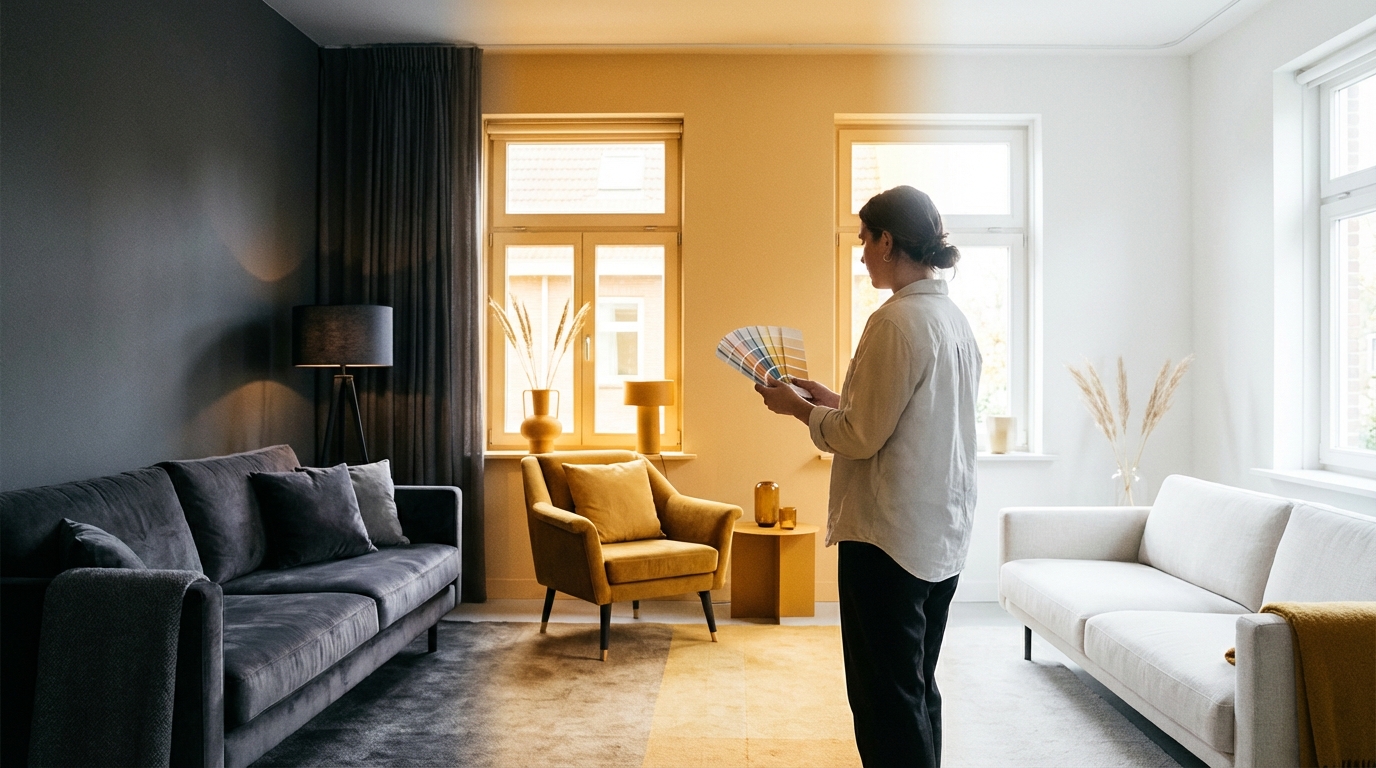
So, you want to understand the psychology of color in interior design and how it actually affects the way people feel in a room.
Color drives mood, behavior, and even how long people stay in a space.
Color is not just decoration. Your brain turns color into feelings, expectations, and habits. That is why the same room painted in soft blue can feel calm, while the same room in bright red can feel tense or energetic. If you design or redesign spaces without thinking about color psychology, you leave a lot of influence on the table.
Things you need to know:
- Color affects heart rate, focus, appetite, and even perceived temperature.
- Warm colors tend to feel active and social; cool colors tend to feel calm and reserved.
- Saturation, brightness, and contrast change the emotional impact more than the exact color name.
- Cultural background, age, and personal memories change how people react to the same color.
- The same color can work well in one room and fail in another because of light, size, and function.
- Neutrals are not boring by default; they quietly control balance and attention.
- Testing color in real light at different times of day beats any color chart or digital mockup.
“Color is a powerful nonverbal language inside your home. People read it even when they are not aware of it.”
How your brain reacts to color in a room
Before you pick paint, it helps to know what is going on inside the brain.
When light hits a colored wall, your eyes send signals to the brain. These signals reach areas tied to emotion, memory, and basic survival. Over time, culture and experience layer extra meaning on top of these basic reactions.
Scientists talk about a few consistent effects:
- Arousal: Warm, intense colors can raise heart rate and create alertness.
- Relaxation: Cool, soft colors can lower arousal and support recovery.
- Approach vs avoidance: Some colors invite you in, others make you pull back.
- Perceived time and space: Color shifts how spacious or cramped a room feels and how long time seems to pass.
For example, controlled studies have shown that red can increase heart rate and blood pressure slightly, while pale blue tends to keep both lower. You do not notice it as a number on a screen. You feel it as “busy” or “calm.”
“Your reaction to a color happens in under a second. You explain it later with logic, but the feeling comes first.”
Hue, saturation, and brightness: the real drivers
Instead of thinking only in terms like “red” or “green,” think in three variables:
- Hue: The actual color family (red, blue, yellow, green, etc.).
- Saturation: How intense or gray the color looks.
- Brightness (value): How light or dark the color is.
Here is why this matters. A dark, grayish blue can feel serious and heavy, while a light, bright blue feels open and airy. Same hue, very different room mood.
| Color factor | Psychological effect (typical) | Example in a room |
|---|---|---|
| High saturation | Stronger emotion, higher energy | Bright red accent wall that pulls focus in a living room |
| Low saturation (muted) | Softer emotion, more relaxed | Dusty green bedroom that helps you wind down |
| High brightness (light) | Spacious, open, less heavy | Pale yellow kitchen that feels sunny even on cloudy days |
| Low brightness (dark) | Cozy, intimate, sometimes moody | Deep navy dining room that feels like a restaurant booth |
Warm vs cool colors: how they change a room
Designers often start with one basic split: warm and cool colors.
- Warm colors: Reds, oranges, yellows.
- Cool colors: Blues, greens, purples.
This split shows up in body reactions:
- Warm colors tend to feel closer and more stimulating.
- Cool colors tend to feel more distant and calm.
You can use this to your advantage. If a large living room feels empty and cold, shifting toward warm tones can bring the walls “in” a bit and make the space more social. If a small home office feels cramped, using cool tones can help it feel a bit more open and focused.
“Think of warm colors as ‘come talk to me’ and cool colors as ‘give me a little space.'”
Where warm colors often work well
- Dining areas: Warm reds and oranges can subtly boost appetite and conversation.
- Living rooms: Soft warm neutrals can feel welcoming and help people open up.
- Entry halls: A warm color says “you made it, you are home” faster than a white box.
There is research that links red and orange hues to hunger and energy. Many restaurants lean into this without saying it out loud. At home, this effect can encourage longer, more engaged meals.
Where cool colors often work well
- Bedrooms: Soft blues and greens reduce visual tension and support sleep.
- Bathrooms: Cool tones often feel clean and fresh, like water and sky.
- Offices and study spaces: Muted blues and greens can help focus and reduce mental clutter.
Studies on classroom colors found that cooler, softer tones helped some students stay more focused compared with very bright or warm schemes. The same logic carries into a home office. Less visual noise, more attention on the task.
The emotional profiles of common colors
Now let us go color by color. Keep in mind, these are common patterns, not rigid rules.
Red: energy, urgency, and attention
Red grabs the eye faster than many other hues. It carries strong associations:
- Alertness, urgency
- Passion, intensity
- Warning, danger in many cultures
In interior design, red is powerful but tricky.
| Use of red | Psychological effect | Where it can work |
|---|---|---|
| Accent wall or artwork | Draws attention, creates focus | Living room, dining room, creative studio |
| All walls saturated red | Overstimulating, can raise tension | Small zones only, like a reading nook if controlled |
| Muted brick red | Warm, grounding, less aggressive | Rustic kitchen, cozy library |
If you use red in bedrooms or relaxation spaces, keep it muted and limited. Some research suggests that bright red can slightly increase heart rate and make it harder to fully relax.
Orange: social, friendly, and creative
Orange combines the energy of red with the brightness of yellow. It often feels:
- Social and inviting
- Casual and friendly
- A bit playful
In homes, orange can work well in:
- Living rooms: Terracotta or burnt orange can feel grounded and warm.
- Kitchens: Soft orange tones can make the space feel active without being frantic.
- Kids play areas: Paired with neutrals, it supports creativity and movement.
Just watch saturation. A highly saturated orange wall in a small room can feel loud. Muting it toward clay or peach gives you warmth without chaos.
Yellow: light, optimism, and mental activity
Yellow connects closely to sunlight in many cultures, so people often link it with:
- Cheerfulness
- Alertness
- Clarity
Studies show that yellow can promote alert thinking. At the same time, too much harsh yellow can cause eye fatigue and irritation.
| Yellow type | Perceived effect | Suggested use |
|---|---|---|
| Pale, creamy yellow | Soft, warm, gentle uplift | Kitchens, breakfast nooks, small hallways |
| Bright, saturated yellow | Very stimulating, can feel harsh | Small accents only, artwork or accessories |
| Earthy mustard yellow | Mature, grounded warmth | Dining rooms, living rooms with wood tones |
For a home office, a subtle yellow undertone in a neutral wall can help you feel awake without buzzing.
Blue: calm, trust, and mental clarity
Blue is one of the most liked colors across many countries. It often suggests:
- Calm, rest
- Trust, reliability
- Coolness, distance
From a psychological angle, blue can reduce perceived temperature. People in blue rooms sometimes report feeling cooler than people in warm colored rooms at the same air temperature.
“A soft blue bedroom can feel like a quiet exhale after a long day. That is not an accident, your nervous system responds to it.”
How to use blue:
- Bedrooms: Light blue or blue-gray supports rest and quiet.
- Home offices: Muted blues help with long focus sessions without feeling dull.
- Bathrooms: Blue supports spa-like, clean atmospheres.
Be careful with very dark, cold blues in small rooms. They can feel heavy or even sad if you do not balance them with texture, warm lighting, and natural elements.
Green: balance, nature, and recovery
Green sits between warm and cool on the color wheel, and people often experience it as balanced. It carries associations like:
- Nature, plants, growth
- Restoration and healing
- Balance between stimulation and calm
There is research showing that green views in hospitals and workplaces can support recovery and reduce stress. Even simulated nature, like green walls or plant patterns, can have some effect.
In interiors:
- Living rooms: Soft sage or olive can feel grounded and stable.
- Bedrooms: Gentle green supports rest, especially paired with natural fabrics.
- Workspaces: Green supports focus without the coldness of some blues.
Dark emerald or forest green can make a room feel sophisticated if you balance it with light flooring, mirrors, and warm metals.
Purple: luxury, introspection, and creativity
Purple blends blue and red, so it can feel both calm and intense. Common links include:
- Luxury or “specialness”
- Spiritual reflection for some people
- Artistic thinking
In interior design, purple is often more successful in softer, grayed tones:
- Lilac and lavender: Gentle and calming in bedrooms or reading corners.
- Deep plum: Dramatic for dining rooms or accent walls.
Pure, saturated purple over large surfaces can feel artificial or overwhelming. If you like purple, test soft versions and use it in fabrics, art, and accessories before putting it on all four walls.
Pink: softness, comfort, and emotional safety
Pink carries strong cultural meanings, but from a psychological angle, light pink can have a calming effect. There is some debated research on “Baker Miller Pink” used in certain institutions to reduce aggression for short periods.
For homes:
- Blush or dusty pink can make a room feel gentle and welcoming.
- Terracotta pinks move toward earthy, mature warmth.
- Very bright bubblegum pink works better as an accent than a main wall color.
Pink can be powerful in living rooms and bedrooms when paired with dark neutrals or woods. It stops feeling childish and becomes more grounded.
Neutrals: the quiet drivers of mood
Neutrals are not just background. They shape how every other color behaves.
Common interior neutrals:
- White and off white
- Gray and greige (gray plus beige)
- Beige and tan
- Brown and wood tones
- Black and charcoal
White and off white
White reflects light and can make spaces feel bigger and cleaner. That is why galleries often use white. Still, an all white space can feel sterile or tiring if you do not add texture, contrast, and warm lighting.
Gray and greige
Gray gained popularity because it sits in the middle: not too warm, not too cool. Yet pure cool grays can feel flat or gloomy, especially in low natural light.
Greige, which mixes gray with beige or brown undertones, often feels more human. It still looks modern, but it feels more relaxed.
Beige, tan, and brown
These colors mirror earth and natural materials, so they often feel reassuring. They support:
- Stability
- Warmth
- Grounding
If a room feels nervous or scattered, bringing in warm neutrals through walls, rugs, or wood furniture can pull it together.
Black and deep charcoal
Black adds contrast and weight. Psychologically, it can create:
- Clarity around shape and form
- Intensity and focus where applied
- Risk of heaviness if overused
You often do not need much black. Window frames, small furniture, or a single dark wall can anchor a space, making the other colors feel sharper.
“Think of neutrals as the pause between notes in music. They control rhythm just as much as the bright colors do.”
How color changes perception of space and time
Color does not just affect emotion. It alters what you think about size and time in a room.
Perceived size and depth
- Light colors reflect more light and tend to make walls feel farther apart.
- Dark colors absorb more light and can pull walls visually closer.
- Cool colors often feel more distant; warm colors often feel nearer.
Practical uses:
- Small room feels tiny: Use light, cool colors to make it feel more open.
- Long, narrow hall feels like a tunnel: Paint the far wall a darker, warm color to bring it closer.
- Low ceiling feels oppressive: Keep the ceiling lighter than the walls to visually lift it.
Perceived time and pace
Colors can also affect how fast time seems to pass and how you pace your activities.
- High energy colors (reds, bright oranges) can make you move and decide faster.
- Low energy colors (soft blues, greens, muted neutrals) can slow your pace.
Think of a fast casual restaurant. Often there are bright colors, loud sounds, and strong contrasts that keep you alert and moving. Now picture a spa waiting room. Colors tend to be muted, with limited contrast, which encourages lingering and deep breathing.
At home, if you want a breakfast nook that helps you wake up and leave for work on time, mild warm tones and a bit of color contrast can help. If you want a reading corner where you lose track of time, use soft, low contrast colors and textures.
Cultural and personal differences in color psychology
Color psychology is not a single global rulebook. It is filtered by culture, age, and personal history.
Cultural meaning
- In some countries, white is linked with purity, while in others it can be linked with mourning.
- Red can signal luck and celebration in parts of Asia and danger or warning in other places.
- Green may link to nature and growth in one region and to religion or politics in another.
If you design for a household with mixed cultural backgrounds, ask what certain colors mean to them. A color that feels neutral to you may carry strong emotion for them.
Personal memories and associations
Your own story shapes how you read color.
Example:
- Someone who grew up near the ocean may feel safe in soft blues and greens.
- Someone who had a strict school with gray walls may feel anxious in gray spaces.
This is why you should not trust universal color lists blindly. Use them as a starting point, then check in with your own reactions.
“When a “calming” color makes you feel uneasy, trust your body, not the textbook.”
Color for different room functions
Let us match color psychology with specific rooms and tasks.
Living room: connection and flexibility
The living room often has many functions: talking, watching TV, reading, sometimes working. You want a balance between calm and energy.
Good starting points:
- Base: Warm or neutral walls (greige, warm white, soft taupe).
- Energy: Controlled pops of color in cushions, rugs, or art (coral, teal, mustard).
- Anchor: Darker elements like a charcoal coffee table or black framed art.
Psychologically, this mix makes it easy to relax or host. You can add or remove color accents to shift mood without repainting the whole room.
Kitchen: alert, social, and practical
The kitchen is about food, movement, and conversation. You want clarity, hygiene cues, and warmth.
Color ideas:
- Walls or cabinets: Light warm neutrals or soft colors (pale yellow, gentle green, warm white).
- Accents: More saturated colors on stools, backsplashes, or appliances.
- Ceiling: Keep it light to avoid feeling heavy overhead while you work.
From a psychological angle, clear surfaces and moderate contrast help you spot dirt and stay organized. Very dark colors on all cabinets can look stylish in photos but feel heavy daily, especially in small kitchens.
Bedroom: rest, intimacy, and safety
The bedroom is where color can change sleep patterns and intimacy.
Helpful color profiles:
- Soft blues and greens: Lower visual tension, promote rest.
- Muted blush or peach: Gentle, intimate atmosphere.
- Deep tones behind the headboard: Navy, forest green, or charcoal to create a cocoon effect.
Avoid very bright or high contrast schemes near the bed. If you love bold color, reserve it for items that are not in your direct line of sight when you are lying down.
Home office: focus and mental stamina
For knowledge work, you need clear thinking, low distraction, and enough energy to stay engaged.
Color guidance:
- Walls: Muted blues, greens, or balanced neutrals.
- Accents: A few energizing elements (small red, orange, or yellow objects) outside direct eye level.
- Background for video calls: Calm, neutral colors that flatter skin tones (warm gray, soft beige, greige).
Research on attention suggests that low to medium saturation colors are less tiring over long periods. If your work is creative, you can add more color through art boards, textiles, or shelves while keeping walls calm.
Kids rooms: stimulation vs rest
Children need both play and sleep in the same space. Heavy use of primary colors on all walls can overstimulate some kids.
Better pattern:
- Base: Soft or neutral walls.
- Play zone accents: Brighter colors in rugs, toys, and storage boxes.
- Bed area: Soothing colors that are less saturated.
This way, you separate “sleep signals” and “play signals” using color without needing two rooms.
Light: the partner of color
The same paint can look like three different colors across the day because of light. Your eye reads color as a mix of pigment and light source.
Natural light directions
- North-facing rooms: Cooler, more stable light; colors can feel a bit cooler and darker.
- South-facing rooms: Warmer light most of the day; colors can feel more yellow or warm.
- East-facing rooms: Warm in the morning, cooler later.
- West-facing rooms: Cool in the morning, warm and sometimes intense in late afternoon.
If you paint a north-facing room in a cool gray, it can feel flat and cold. A warmer neutral or muted warm color can correct that. In a very sunny south-facing room, cool colors can balance the warmth and keep it from feeling overly hot.
Artificial light and color temperature
Bulbs have color temperature, measured in Kelvin (K):
- Warm white: Around 2700K to 3000K. Yellowish, cozy.
- Neutral white: Around 3500K to 4100K. Balanced.
- Cool white / daylight: 5000K and up. Bluish, alert.
Warm light will make warm colors even warmer and can soften cool colors. Cool light will make cool colors feel crisper and can make warm colors look a bit dull or off.
If a room feels “off” color wise, test changing the bulb temperature before repainting everything.
Using contrast and color combinations
Single colors rarely live alone. Combos and contrast determine a lot of the psychological impact.
High vs low contrast
- High contrast: Strong differences between light and dark or between hues (for example, black and white, blue and orange).
- Low contrast: Colors close in value or hue (for example, soft beige with slightly darker taupe).
Effects:
- High contrast energizes and sharpens focus but can feel intense long term.
- Low contrast soothes and blurs edges, but can feel bland if overdone.
Balance them by using high contrast on focal points and keeping the rest more even.
Common color schemes that work with psychology
- Analogous: Colors next to each other on the wheel (blue, blue-green, green). Feels harmonious, low conflict.
- Complementary: Colors opposite on the wheel (blue and orange, red and green). Feels lively and dynamic.
- Monochromatic: One hue with different brightness and saturation. Feels cohesive and calm.
For a relaxing bedroom, a monochromatic blue or green scheme with varied textures works well. For a lively dining room, a complementary pairing like blue and orange in controlled amounts can encourage conversation.
A simple process to choose colors with psychology in mind
Here is a short, practical workflow you can follow.
1. Define the main feeling you want
Ask yourself:
- Do I want this room to energize me or calm me?
- How much time will I spend here daily?
- What activities actually happen here?
Write down 2 to 3 words, like “calm,” “focused,” “cozy,” or “social.” Use those words as a filter for every color choice.
2. Pick a base temperature: warm or cool
Based on the feeling you want:
- Pick warm leaning neutrals for social, cozy, or active rooms.
- Pick cool leaning neutrals for calm, focused, or spacious rooms.
This base color goes on the largest surfaces: walls and maybe the ceiling.
3. Add one or two accent colors
Choose colors that support both the room function and your emotion words. Keep saturation moderate if you want long term comfort.
Examples:
- Home office: Base greige, accent desaturated blue and a touch of muted mustard.
- Bedroom: Base warm white, accent sage green and soft blush textiles.
- Living room: Base light taupe, accent deep teal and rust pillows.
4. Test in real light across the day
Buy sample pots or large peel and stick swatches. Place them on multiple walls. Watch them in:
- Morning light
- Midday light
- Evening light
- Artificial light only
Take phone photos if it helps you compare. Notice which samples still feel right when you are tired, not just when you are excited about the project.
5. Adjust with neutrals, texture, and lighting
If a color feels slightly too intense:
- Pair it with deeper neutrals to absorb some of the energy.
- Use it on smaller surfaces instead of full walls.
- Shift lighting warmer or cooler to balance it.
You rarely need to throw out a color you like. Small placement and balance changes can shift the whole feel.
“Color psychology in your home is less about rules and more about gentle steering. Tiny shifts in tone or placement can change your daily mood more than you expect.”
Try this simple experiment: pick one small space, like a hallway or reading corner, and repaint it with a clear emotional goal in mind. Live with it for two weeks and write down how often you use that spot and how you feel when you are there.