
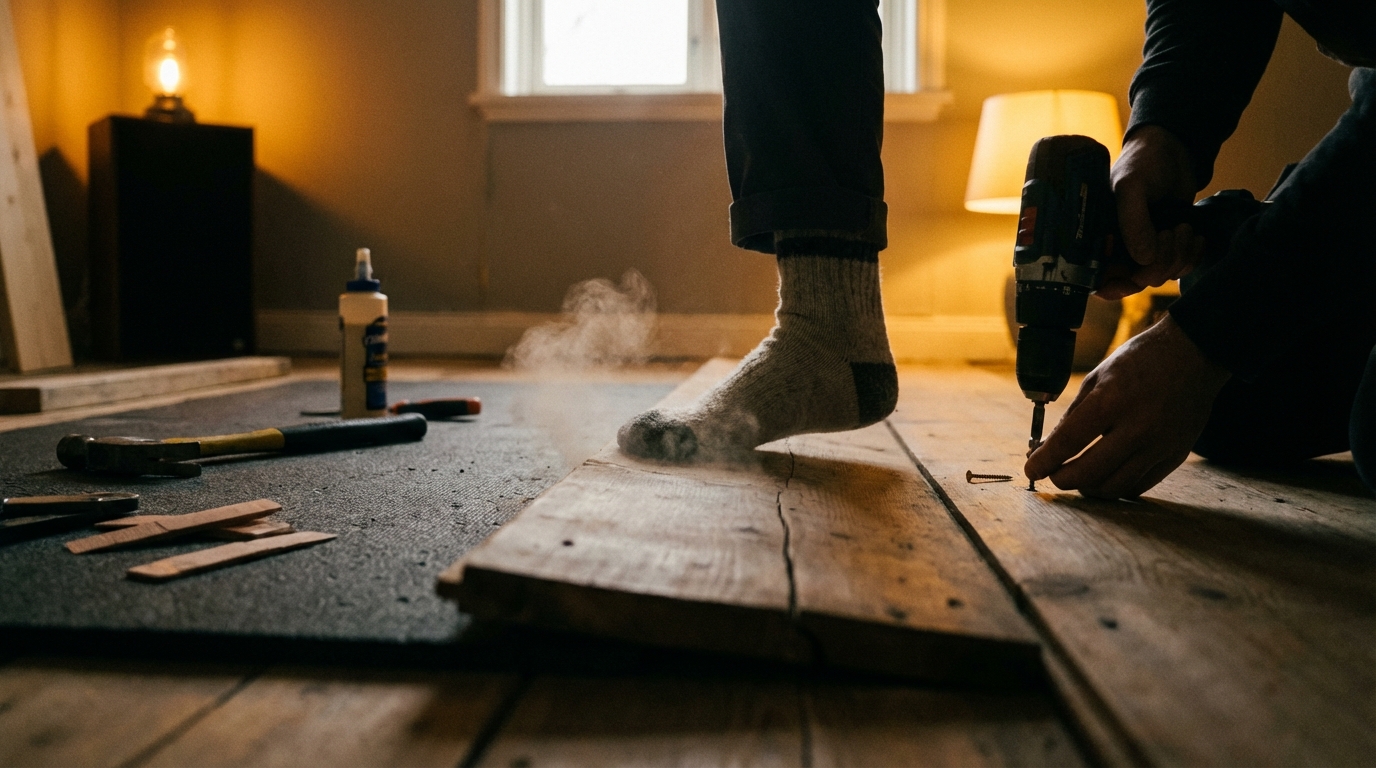
So, you are trying to stop squeaky floorboards and finally silence that noisy floor.
You can stop most squeaks by finding the loose boards or joists and locking them together with screws, shims, or adhesive from above or below, depending on where you can reach.
The real story is that a squeak is almost always wood rubbing on wood or on a nail when you step. Fix the movement and you fix the sound. That means you are not chasing the noise itself, you are hunting for tiny gaps, loose fasteners, and spots where the floor flexes. Once you see it this way, the fix becomes methodical instead of frustrating.
Things you need to know:
- Most squeaks come from movement between subfloor and joists, or between finished flooring and subfloor.
- Finding the exact spot is half the job; do that before you buy tools or kits.
- Access from below (basement or crawlspace) gives the strongest, cleanest repair.
- From above, you can use special screws, nails, or fillers to tighten or “lock” boards without ruining the surface.
- Humidity and temperature changes create and worsen gaps that cause squeaks.
- Carpeted floors need a different approach than exposed hardwood or laminate.
- A few strategic screws often fix a large area; you do not need to treat every board.
- If the floor feels bouncy or saggy, you might have a structural issue, not just a noise problem.
What actually causes noisy floorboards
You are hearing friction. Nothing more mysterious.
When you step on a floor and hear a squeak or creak, something is moving. That movement can be:
- Subfloor moving against joists
- Finished floorboards sliding against each other
- Nails sliding in and out of wood as it flexes
- Gaps opening and closing because of humidity changes
> A silent floor is a tight floor.
> Every fix you apply is about removing unwanted movement.
Main sources of floor squeaks
- Loose subfloor
If your house has a wood subfloor (plywood or OSB) over joists, nails can loosen over time. When you step, the sheet flexes against the joist and the nail shank rubs. That gives you the classic “eeek” sound. - Board-to-board friction
With solid hardwood floors, boards may shrink a little as they dry. Tiny gaps appear. When you step, one board lifts or slides a bit and rubs against the one next to it. - Screws or nails that missed joists
During construction, some nails or screws miss the joist and only grab the subfloor. That area is weaker. It flexes and squeaks more. - Structural movement
Sometimes the joist itself is twisted, undersized, notched, or carries more load than it should. If the joist deflects too much, the floor flexes with every step and squeaks grow worse. - Changes in humidity
Wood absorbs moisture and then dries out again. That slow breathing of the house widens and closes gaps, and also weakens fasteners over many seasons.
How to think about squeaks before you start
Try this mindset:
> The noise is not random.
> It is a hint about exactly where the floor moves and how.
So before touching a tool, aim to answer three questions:
- Where exactly is the squeak?
- What layers of flooring do you have (hardwood, laminate, carpet, subfloor type)?
- Can you reach the area from underneath?
Once you know these, you can pick the right method and avoid tearing into things blindly.
Step 1: Find the exact location of the squeak
You do not want to guess. A successful repair hits the trouble spot within a few centimeters.
Tracking squeaks from above
Here is a simple routine:
- Walk slowly over the area and listen. Mark the loudest spots with painter’s tape or a pencil.
- Try different shoes and bare feet. Sometimes bare feet help you feel the flex better.
- Have another person walk while you crouch and place your fingers along the boards to feel movement.
- On hardwood, watch for boards that lift ever so slightly as someone steps nearby.
- On carpet, listen carefully. The noise might sit between two joists, not directly under your foot.
> Spend more time finding the source than you think you need.
> A precise fix is usually faster than chasing random spots.
Finding joist locations from above
You need to know where joists sit if you plan to screw down from the top.
Methods:
- Look in the basement or crawlspace to see joist spacing and direction.
- Measure from a known reference, like an outside wall. Joists often sit 16 inches or 24 inches on center.
- Use a stud finder with deep scan mode to detect joists through the subfloor.
- Tap lightly and listen for “solid” vs more hollow spots as you move across the floor.
Once located, mark joist centerlines with tape or a light pencil mark. This saves you from guesswork later.
Finding squeaks from below
If you can see the underside of the subfloor:
- Ask someone to walk on the floor above while you watch the subfloor and joists from below.
- Look for:
- Subfloor lifting off joists
- Nails moving a bit when weight is applied
- Cracks along joints or at ends of panels
- Mark suspect areas with a marker directly on the wood.
> If you can reach the area from below, your odds of a permanent repair are much higher.
Step 2: Identify your floor type and access
You do not fix a squeak in carpet the same way you fix one in hardwood. So classify things first.
Key floor layers to look for
| Top surface | Common structure below | Typical squeak source |
|---|---|---|
| Exposed solid hardwood | Hardwood nailed to plywood/OSB over joists | Loose boards or nails, subfloor over joists |
| Engineered wood or laminate | Floating floor over underlayment, subfloor, joists | Board joints, underlayment friction, subfloor |
| Carpet with pad | Pad over plywood/OSB subfloor on joists | Loose subfloor or nails popping |
| Tile | Tile on cement board on subfloor | Subfloor movement, weak underlayment |
In this article, we will zero in on wood and carpeted floors over wood subfloor, since those are the most common noisy ones and they are fixable without full replacement.
Step 3: Fixing squeaky floors from below (best approach)
If you can access the underside through a basement or crawlspace, start there. You can strengthen the floor quietly, without touching the finished surface.
1. Secure loose subfloor to joists with screws
This is the most direct method.
- Have someone walk on the floor and watch for gaps where the subfloor lifts off the joist.
- Mark those spots.
- Use 2.5 to 3 inch wood or construction screws and drive them up through the joist into the subfloor.
- Space screws every 6 to 8 inches in noisy areas and 12 inches on quieter stretches.
> Do not overdrive the screws.
> You want them snug, not punching through the finished floor.
If you do not know how thick the subfloor is, start with shorter screws and test in a hidden area. Many subfloors are 5/8 to 3/4 inch thick, but older houses can vary.
2. Add construction adhesive along joist edges
If you see or feel gaps between the subfloor and joist, you can bond them.
Steps:
- Clean dust and debris along the top edges of joists.
- Apply a continuous bead of construction adhesive where the subfloor meets each suspect joist.
- Have someone walk gently above to help the adhesive spread into gaps.
- Support the subfloor temporarily (with a brace or by hand) as the adhesive sets if there was visible sag.
This method works well when nails are not horribly loose but there is a slight gap that squeaks.
3. Install shims between subfloor and joists
If there is a visible gap you can slide something into, a thin shim may be your answer.
- Use wood shims or composite shims.
- Gently tap the shim into the gap where the squeak occurs.
- Stop as soon as the shim feels snug. Do not force it, or you can lift the floor and create another problem.
- Cut off the excess shim flush with the joist.
- For extra strength, you can add a bit of construction adhesive on the shim before placing it.
> The goal is to fill the gap, not jack up the floor.
> Light taps, not hammer swings.
4. Sistering boards to joists
If you see a joist that is twisted, cracked, or undersized under the noisy spot, you can “sister” it with another board.
- Cut a 2×6 or 2×8 to match at least part of the joist length under the noisy zone.
- Apply adhesive to the side of the existing joist.
- Press the new board tight against it and clamp if possible.
- Secure with structural screws in a staggered pattern.
- Then screw the subfloor into the new sistered board from below.
This is closer to structural work, but for severe squeaks in older homes, it can change the feel of the floor.
5. Blocking between joists
If the subfloor flexes between joists, you can add blocking.
- Cut short pieces of 2x lumber to fit snugly between joists under the noisy area.
- Toe screw them into both joists.
- Screw up through the blocking into the subfloor.
This reduces flex over that area, which often lowers or removes squeaks.
Step 4: Fixing squeaky hardwood from above
Sometimes you do not have access from below. Maybe the basement is finished or it is an upper floor. In that case, you work from the top.
1. Tighten boards with finish nails or trim screws
For visible hardwood, you want something discrete.
- Find the noisy board and the joist line under it.
- Drill a small pilot hole at an angle through the tongue side of the board into the joist.
- Drive a trim screw or finish nail through the pilot hole.
- If using a nail, set the head slightly below the surface with a nail set.
- Fill the tiny hole with a wood filler that matches your floor color, then lightly sand and touch up finish if needed.
> Aim for the tongue side of the board where the groove of the next board can hide defects better.
Be very careful with prefinished floors. Test a small area in a closet or under a rug first.
2. Use specialty “squeak” repair screw kits
There are kits designed to fix squeaks from above with minimal visible damage. Many of them work like this:
- You locate the joist line with the kit’s tool.
- You drive a special scored screw through the finished floor into the joist.
- The screw snaps off just below the surface so you do not see a traditional head.
- The tiny hole is either hardly visible or filled with a small dab of filler.
Kits can feel a bit gimmicky on the shelf, but for carpet and some hardwood setups, they actually work quite well because they help you:
- Hit the joist more reliably.
- Avoid raised screw heads.
3. Dealing with board-to-board friction
If the squeak seems to come from two boards rubbing:
- Sprinkle a small amount of powdered graphite, talc, or a dry lubricant into the joint.
- Work it in by walking or sliding a cloth over the area.
- Wipe away the excess to avoid a mess.
This does not fix movement, it just quiets friction. So it can be temporary. Still, for minor squeaks, it can buy you time.
> Lubricant fixes noise, not structure.
> Use it when the floor is stable but noisy, not when it feels loose or spongy.
4. Repair loose nails
If you see or feel nails that have backed out slightly:
- Do not just hammer them back. That can make squeaks return quickly.
- Instead, add a screw within 1 inch of the nail, through the board into the joist.
- Then, if needed, set the nail and fill the surface.
The screw provides holding power that nails often lose over time.
Step 5: Fixing squeaks under carpet
Carpet hides the floor, so the method changes. You are mostly dealing with a loose subfloor over joists.
Approach 1: Specialty carpet squeak kits
There are kits that include:
- A tool to help you find joists through carpet
- Breakaway screws designed to be driven through the carpet without tangling fibers
- A driver that lets the screw snap off just below the surface of the subfloor
Basic process:
- Find the squeak area and mark it.
- Locate joist positions with the kit tool or a stud finder.
- Drive the special screws through the carpet into the joist.
- Use the tool to snap off the screw heads below the surface.
- Fluff the carpet fibers with your fingers to hide the tiny puncture point.
> When done well, you cannot see the screws through the carpet, but the noise drops sharply.
These kits are handy because they reduce the risk of snagging or twisting the carpet backing.
Approach 2: Pulling carpet back at the edge
If you prefer not to use a kit, or you want a more standard screw repair:
- Carefully pull up the carpet along the nearest wall near the squeak.
- Fold the carpet back to expose the pad and subfloor.
- Identify joists and squeaky spots as before.
- Screw the subfloor into joists with 2 to 2.5 inch screws, spaced 6 to 8 inches in noisy areas.
- Lay the pad back, then stretch and reattach the carpet onto the tack strip.
This method needs some patience, and a knee kicker tool helps to stretch the carpet back into place so it does not wrinkle.
Approach 3: Tackling underlayment issues
Sometimes the squeak is not only subfloor, but underlayment such as thin plywood installed under older carpet.
If you reach the subfloor and see another thin layer:
- Screw that layer down into the subfloor and joists as well.
- Look for areas where underlayment sheets meet and move against each other, then add screws across the seams.
You are aiming to turn those layers into one solid unit.
Step 6: Squeaks in laminate and engineered “floating” floors
Floating floors are not fastened to the subfloor. They sit on an underlayment and lock together. Squeaks often come from:
- Boards rubbing at joints when the floor flexes
- Underlayment bunching up or compressing unevenly
- Subfloor problems telegraphing movement to the surface
When you can fix locally and when you cannot
You usually have two categories here:
- Minor friction squeaks
Sometimes you can ease these with a dry lubricant at the board joints. You gently work the material into the seams and walk on it. - Movement from below
If the subfloor is uneven or the underlayment is poor, the right fix often needs partial or full removal of boards in that area, leveling of the subfloor, and proper underlayment.
> For floating floors, forcing screws through into the subfloor can cause new noises, buckling, or gaps.
> You usually want the floating behavior, just without the friction.
If the squeaks are widespread across the room, consider whether the original installation cut corners. That is sometimes a bigger project.
Step 7: When squeaks signal a larger issue
Most squeaks are annoying but not dangerous. Still, some patterns suggest you should look deeper.
Watch for:
- Bouncy or “trampoline” feel across an area, not just a single board.
- Cracks in drywall below or above near the noisy area, which can show excessive movement.
- Signs of moisture in the basement or crawlspace: staining, mold, rusted fasteners.
- Joists cut or notched too aggressively to fit pipes or ducts.
- Uneven or sagging floors where a straightedge or marble clearly shows a dip.
> If the floor moves a lot, the squeak is not your main issue.
> The structure is trying to tell you something.
In those cases, calling a carpenter or structural specialist can save you from patchwork fixes that never hold.
Preventing future squeaks when building or renovating
If you are remodeling or working on a new space, you can avoid many squeaks with a few habits.
Better fastening from the start
- Use screws instead of nails for subfloors where possible.
- If nails are used, add screws in high traffic areas such as halls, kitchens, and entries.
- Stagger panel joints and follow spacing guidelines for subfloor material.
Many builders still rely heavily on nails for speed. Screws hold better under repeated movement.
Adhesive between joists and subfloor
During installation:
- Run a continuous bead of construction adhesive along joist tops before laying subfloor panels.
- Press panels firmly into place and fasten while the adhesive is still workable.
This creates a bonded layer that moves less and is less prone to squeaks.
Controlling moisture and acclimating materials
Wood flooring and subfloors should be “acclimated” to the indoor environment.
- Store flooring inside the home for several days before installation.
- Keep humidity and temperature near the levels you plan to live with.
- Address leaks or damp basements that can swell subfloors from below.
The less wood has to expand or contract after install, the fewer gaps and noises you get.
Tools and materials you will likely need
You do not need a full woodshop. Start by pulling together some basic tools.
Common tools
- Drill/driver with suitable bits
- Stud finder (with deep scan if possible)
- Tape measure
- Flashlight or work light for basement/crawlspace
- Hammer and nail set
- Utility knife (for carpet edges if needed)
- Pry bar (for gentle lifting of trim or carpet tack strips)
- Knee pads if you are working on the floor for long periods
Fasteners and supplies
- 2 to 3 inch wood or construction screws
- Finish nails or trim screws for hardwood repairs
- Construction adhesive (for joist and subfloor bonding)
- Wood shims or composite shims
- Wood filler that matches your floor color
- Dry lubricant (graphite, talc) for some friction squeaks
- Optional: floor squeak repair kit for carpet or hardwood
> Start with a small test repair in a low-visibility area to get a feel for how your floor reacts.
Realistic expectations: what you can and cannot fix
It is helpful to be honest about what a squeak repair can do.
You can usually fix
- Single or small clusters of squeaks near doors, stairs, or hallways.
- Noises from obvious loose subfloor panels, especially with access from below.
- Local board friction on hardwood floors.
- Carpeted areas over wood subfloor with standard joist spacing.
You might struggle with
- Large areas of very uneven or sagging floors without major work.
- Cheap laminate installations with thin underlayment and poor subfloor prep.
- Squeaks coming from tile floors over wood where movement has already cracked grout or tile.
> A few focused screws cost very little and often solve the loudest offenders.
> Perfection across an entire older house can be expensive and may not be necessary.
Simple troubleshooting flow to guide your fix
To make this more practical, here is a simple flow you can follow.
Step-by-step decision guide
- Walk the floor and mark all squeaks with tape or chalk.
- Check from below:
- If you have basement/crawlspace access: go there while someone walks above.
- If you do not: skip to step 4.
- From below:
- See visible gaps or movement at subfloor/joists?
- Yes: screw subfloor to joists, add adhesive or shims where needed.
- No: look for twisted joists or flex between joists, add blocking or sistering.
- Test the floor again after each small section of work.
- See visible gaps or movement at subfloor/joists?
- From above (no access below):
- Is the floor carpeted?
- Yes: use a squeak repair kit or pull carpet back from an edge, screw subfloor to joists.
- No: go to the next check.
- Is it hardwood or engineered nailed down?
- Yes: locate joists, add trim screws or finish nails at squeak points, fill holes.
- No: likely floating laminate; try dry lubricant for minor noises or consult installer for structural issues.
- Is the floor carpeted?
- Re-test the floor.
- If main squeaks are gone, you can leave minor sounds in low-traffic areas for later.
- If noise remains in the same exact spot, reassess: you might have missed the joist, or the movement is in a different layer.
A quick data point to keep in mind
Different surveys and contractor reports vary, but in many older wood-frame homes, a high share of floors have at least one squeak. That does not mean you have to live with it in high-traffic areas, but it does show this is a common maintenance task, not a rare failure.
> Many repairs come down to 10 to 20 well-placed screws and an hour or two of work.
> The trick is placing those fasteners in the right spots.
Try starting with the loudest squeak on a day when you have clear access and time, fix that one properly, and then decide how far you want to go across the rest of the house.