
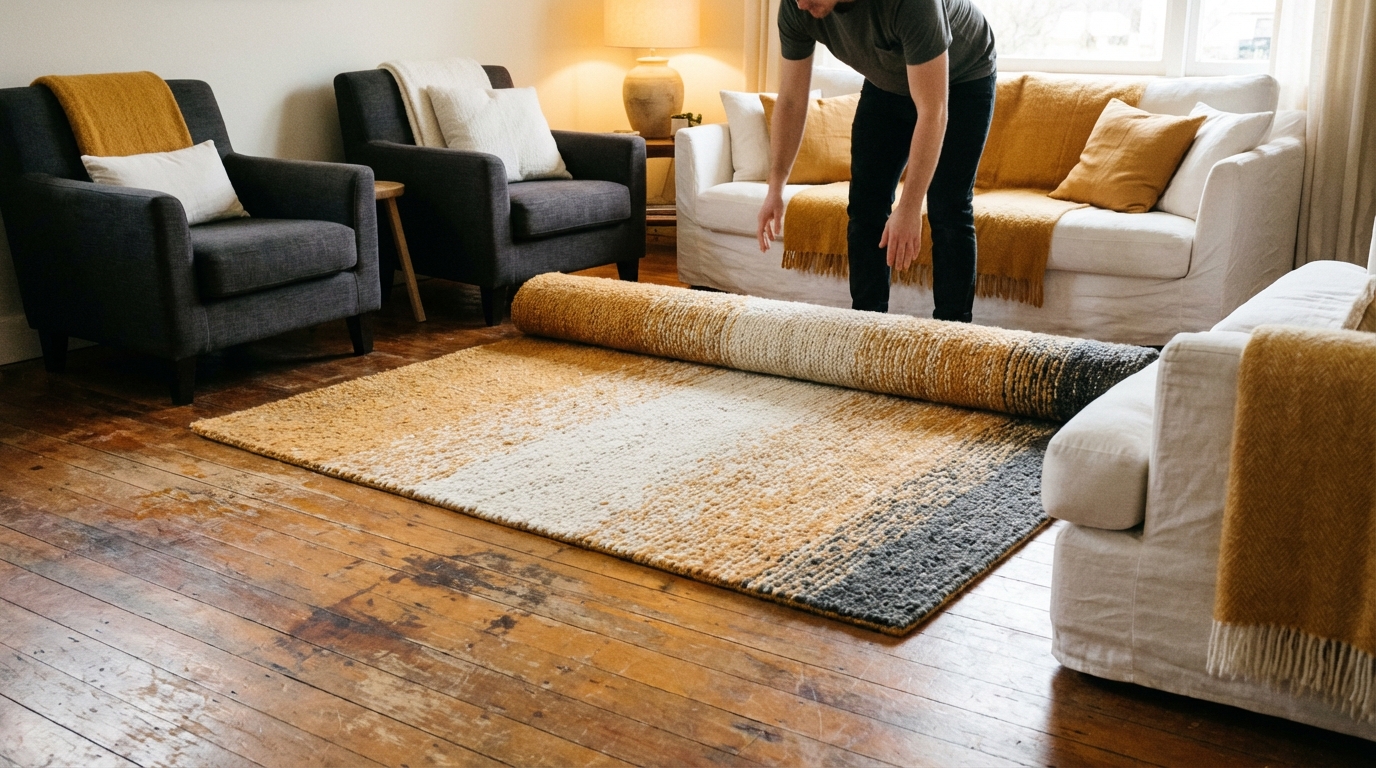
So, you are trying to stage your home and want rugs that hide imperfections on the floor. The simple answer is: pick the right size, color, pattern, and material, then place rugs in high-visibility spots that distract buyers from scratches, stains, and uneven areas.
You are not trying to fix the floor forever. You just need the place to show well in photos and during walkthroughs. Rugs do that extremely well when you treat them like tools, not just decor. Think of them as strategic cover that also makes rooms feel warmer and more finished.
Things you need to know:
- Large rugs hide more flaws than small ones, especially in living rooms and bedrooms.
- Patterns and medium tones hide scratches, stains, and dirt better than solid light colors.
- Flatweave and low-pile rugs sit better over uneven or damaged spots than thick shag.
- Rug placement can pull the eye away from imperfections and toward your best features.
- Always use a rug pad to keep rugs flat, safer, and better-looking in photos.
- Neutral, modern-looking rugs appeal to more buyers than bold, personal choices.
- You can cover a lot of floor issues without spending a huge amount.
How rugs actually help when staging a home
When buyers walk in, they do not see every scratch on your floor first. Their eyes lock on big shapes, light, and contrast. Rugs change what people notice in the first three seconds.
> Think of a rug as a giant photo filter for your floor: it hides flaws and sets the mood at the same time.
If you have:
- Old hardwood with patches or color changes
- Chipped tiles or cracked grout lines
- Stained carpet you cannot replace right now
- Uneven transitions between rooms
a rug can cover the worst parts and shift the focus to “this room feels cozy and put together.”
Of course, a rug will not fix real structural problems. If the floor is unsafe or extremely uneven, that needs more than staging. But for cosmetic issues, a smart rug plan is often enough to get you through listing photos and showings.
Types of floor imperfections rugs can hide
1. Scratches and worn finish on hardwood
Hardwood with surface scratches or dull finish still photographs well if the most damaged sections sit under a rug.
Good spots for rugs over worn hardwood:
- Under the living room seating area
- Under the bed and nightstands
- Under a dining table (if scratches are in the “chair zone”)
- In front of a sofa where traffic is heavy
> If 60 to 70 percent of the visible floor looks clean and consistent, buyers often accept that the rest just needs “normal” touch-up.
2. Stains or worn areas on carpet
You might have carpet that is not worth replacing right before listing. Maybe there is a stain where someone spilled coffee, or the fibers are crushed in one area.
Rugs help most when:
- The stain sits in the middle of the room
- There is a visible path worn into the carpet from foot traffic
- There is a color fade where sunlight hits a certain spot
Place a flat rug over that section and anchor it with furniture. Buyers will see a layered, styled look instead of “oh, that carpet is old.”
3. Cracked or chipped tile
Tiles near entryways, kitchens, or bathrooms can chip, crack, or lose grout. Replacing a few tiles sometimes stands out more than covering the area with something that looks intentional.
Rugs help with:
- Hairline cracks that look worse in photos than in real life
- Chipped corners on a few tiles in the same spot
- Discolored grout in a limited area
You do need to keep safety in mind. If the tile is badly uneven or raised, rugs can trip people. In that case, repair comes first.
4. Uneven or mismatched flooring transitions
Maybe you have:
- Old hardwood in one room and newer laminate in the next
- A metal threshold that looks worn
- A visible gap or step between spaces
A runner or doorway rug can soften that line. You are not pretending it is one continuous material, you are just making the transition feel planned instead of random.
5. Floor discoloration and patches
Sometimes owners patch a floor with slightly different wood or tile. Or sunlight fades a rectangular area. Rugs over those sections remove the “what happened here?” question from buyers minds.
> Buyers love a story, but not when the story is “we had to patch this floor after a leak.”
Rug size: how big is big enough to hide flaws?
Size is where many staging plans fail. If the rug is too small, it can make flaws stand out more. You want the rug to feel like it belongs, not like it is trying to hide something in a clumsy way.
Living room rug sizes for staging
You want the rug large enough that at least the front legs of the seating sit on it.
Basic size guidelines:
| Room size | Suggested rug size | Coverage goal |
|---|---|---|
| Small living room (10×12 ft) | 5×8 or 6×9 | Front legs of sofa + chairs on rug |
| Medium living room (12×15 ft) | 8×10 | Front legs of all seating on rug |
| Large living room (15×20 ft) | 9×12 | At least half of each piece of furniture on rug |
If the worst scratches or stains are in the center of the seating area, an 8×10 or larger often gives you enough coverage.
Bedroom rug sizes for staging
The usual staging trick is to slide a rug under the bed so it sticks out on three sides.
- For a queen bed: 8×10 works well.
- For a king bed: 9×12 looks more balanced.
- For a full bed: 6×9 can work in a small room.
Try to keep:
- At least 18 to 24 inches of rug showing from the sides of the bed.
- Enough rug at the foot so your feet land on it when getting up.
This covers worn traffic paths around the bed and any discoloration under old nightstands.
Dining room rug sizes
In dining rooms, buyers care about function. Chairs should sit fully on the rug even when pulled out.
| Table size | Seats | Suggested rug size |
|---|---|---|
| 3-4 ft round or square | 2-4 | 6×6 or 6×9 |
| 5-6 ft rectangular | 6 | 8×10 |
| 7-8 ft rectangular | 8 | 9×12 |
That extra border hides chair drag marks, scratches, and traffic lines near the table.
Entry and hallway runners
Entries usually show wear first. A runner masks:
- Scratches from shoes
- Salt or water stains
- Carpet wear near the door
Pick a runner that:
- Leaves 3 to 6 inches of floor visible on each side
- Extends through the main traffic line
- Stops before doors, so they open cleanly
> The path buyers walk during a showing is where you get the biggest visual payoff from rugs.
Best rug patterns for hiding imperfections
Pattern matters more than many sellers expect. Certain designs hide flaws and dirt far better than others.
Why high-contrast patterns are your friend
A floor with many small problems (tiny scratches, small stains) benefits from pattern. The eye has more to look at, so individual flaws get lost.
Good pattern types for staging:
- Subtle geometric (diamonds, lines, grids)
- Low-contrast oriental or Persian-style patterns
- Faded vintage-style designs with multiple tones
- Small to medium scale motifs
Patterns that can backfire:
- Very loud, multicolor “statement” rugs that distract from the room
- Gigantic motifs that look strange when partly hidden under furniture
- Themes that are too personal (sports, cartoon, etc.)
Remember, you want buyers to say “nice room,” not “interesting rug.”
Solid vs patterned: which hides more?
Here is a quick comparison:
| Feature | Solid light rug | Solid dark rug | Patterned rug |
|---|---|---|---|
| Hides floor scratches | Poor | Fair | Good |
| Hides stains on rug | Poor | Fair | Good |
| Makes room look larger in photos | Good | Fair | Good |
| Distracts from floor flaws | Poor | Fair | Good |
For staging, patterned rugs almost always win when your goal is to hide imperfections.
Best colors and tones for staging rugs
Color does two jobs here:
- It sets the mood in the photos.
- It hides or reveals flaws on the floor and rug.
Neutral, but not boring
You want the rug to blend with walls and furniture, but not disappear completely. Medium tones are ideal.
Good choices:
- Warm grays mixed with beige or taupe
- Soft blues or blue-grays
- Greige with cream and charcoal details
- Muted navy accents in a patterned rug
Colors that can cause problems:
- Very light cream or white (shows dirt, footprints, and every speck)
- Very dark black (shows lint and can make small rooms feel tight)
- Strong, saturated colors that fight with wall paint or furniture
> If you would not wear a pure white shirt to move furniture, do not pick a pure white rug for a staged listing.
Match the rug to the floor, not just the furniture
You want some contrast between rug and floor so the rug stands out and looks intentional.
Here are simple pairings:
| Floor type | Floor color | Rug color strategy |
|---|---|---|
| Hardwood | Light oak or maple | Medium warm gray, pattern with soft darker accents |
| Hardwood | Dark walnut or espresso | Lighter rug with gray-beige tones and low-contrast pattern |
| Tile | Beige or tan | Cooler tones like blue-gray to cut the yellow warmth |
| Carpet | Builder beige | Patterned rug 1-2 shades darker, so stains on the carpet vanish under it |
You do not need a perfect match. You just want the rug to feel like it belongs in that house.
Best materials for hiding flaws and surviving showings
Staging rugs need to do three things:
- Lay flat over less-than-perfect floors.
- Hide dirt and wear between cleaning sessions.
- Look decent in both photos and in person.
Flatweave and low-pile rugs
Flatweave (like kilim style) and low-pile rugs sit closer to the floor. They cover flaws without creating new trip hazards.
Pros:
- Lay flat over uneven areas better than thick rugs
- Easier to vacuum and spot-clean
- Work in high-traffic zones like halls and entries
Cons:
- Do not feel as plush underfoot
- Need a good pad to avoid slipping
Synthetic fibers (polypropylene, nylon)
For staging, synthetic rugs often make the most sense.
Why:
- They are often cheaper than wool, so you can buy larger sizes.
- They resist stains better for the price.
- They photograph well with most cameras and phones.
Natural fibers like wool look great but cost more. Jute and sisal look stylish but are not great for hiding stains and can be rough in bedrooms.
> Think of staging rugs as temporary marketing pieces, not long-term heirlooms.
Where to place rugs to hide the most imperfections
You want to place rugs where buyers eyes and feet go first. Work backward from the showing path.
1. Entryway
Most buyers step through the front door and pause. The floor right there gets noticed.
Use:
- A flat runner that fills most of the entry but stops before doors.
- A pattern that hides dirt, especially in wet or snowy areas.
You cover floor damage from years of foot traffic and set a clean first impression.
2. Living room traffic lines
Watch how you walk from the entry to the sofa. That path usually shows wear.
Place a rug so:
- The path crosses the rug, not the bare floor.
- The center of the room feels anchored.
- Any scratches in front of the sofa get covered.
Buyers focus on the seating area, not the floor edges.
3. Under beds in bedrooms
Bedrooms often have:
- Indent marks from old furniture
- Worn tracks from walking around the bed
- Color change under old rugs
Slide a large rug under the bed so it reaches past those worn tracks. The bed anchors the rug and keeps it from moving.
4. Dining area
Chairs scratch floors more than almost anything. Many dining rooms show a ring of wear.
Cover:
- The full area under the table and chairs.
- At least 24 inches beyond the table edge in all directions.
This hides scratches and prevents new ones during showings.
5. Hallways and connectors
Long halls show scuff marks and discoloration. Runners here do double work: they protect and they guide buyers through the layout.
Pick runners that:
- Leave a small border of floor on both sides.
- End before stairs or door thresholds.
> Think of rugs as arrows: they guide people where you want them to look and walk.
How to deal with uneven floors under rugs
You might be worried about putting a rug on top of a floor that is not perfectly flat. Fair concern. You want it to look good and feel safe.
Check how uneven the floor really is
Walk the area in socks and pay attention. Ask:
- Do you feel a sharp ridge or just a gentle slope?
- Is there a loose board that moves under pressure?
- Is there a gap you could trip on?
If the floor is structurally bad, fix that first. A rug should not hide safety issues.
For mild unevenness:
- Use a thicker felt pad under the rug to smooth out small dips.
- Avoid very stiff rugs that will “tent” over high spots.
- Use a low-pile rug that drapes better.
Use the right rug pads
Rug pads do three key jobs:
- Keep the rug from sliding or bunching up.
- Add a bit of softness and thickness where needed.
- Help the rug lie more evenly over small imperfections.
Types:
| Pad type | Best for | Notes |
|---|---|---|
| Felt-only pad | Large rugs, hardwood | Adds cushion, good for covering minor dips |
| Felt + rubber pad | High-traffic areas | Good grip plus some cushion |
| Rubber or latex grid | Small rugs, tile floors | Less cushion, but strong grip |
Avoid very thick spongy pads for staging. They can make furniture wobble or feel unstable.
How to avoid drawing attention to the imperfections you are hiding
You want rugs to look like a design choice, not like bandages for the floor.
Do not cut rugs around flaws
Sometimes people consider trimming a rug to fit around vents, odd corners, or damaged sections. That often backfires. Irregular cuts scream “cover up.”
Stick with:
- Standard rectangular or round shapes.
- Clean edges that line up with furniture, not with damage lines.
Let furniture “explain” the rug placement
Place rugs in ways buyers expect:
- Centered under the coffee table and seating area.
- Under the bed, symmetrical relative to the headboard.
- Centered under the dining table.
- Centered in halls, not offset over one damaged area.
If the rug lines up with furniture and room shape, people accept it. They think staging, not hiding.
> When rugs and furniture feel like one planned group, buyers focus on the group, not the floor.
Be consistent from room to room
Using six different rug styles in one small home can feel chaotic. Consistency gives buyers a sense that the house is cared for.
Try to repeat:
- Similar color families (for example, blues and grays).
- Similar pattern styles (geometric, vintage, or classic, not all three).
- Similar pile heights (flat or low in most spaces).
You can vary things a bit so it does not feel like a hotel, but keep the general look connected.
How much you should spend on staging rugs
You do not need luxury rugs to stage. For many homes, mid-range rugs from large online retailers or warehouse stores are enough.
Budget ranges and what you get
| Price range (per rug) | Typical size | Best use |
|---|---|---|
| $40 – $80 | 3×5, small runners | Entries, small halls, bathrooms |
| $80 – $200 | 5×8, 6×9 | Small living rooms, bedrooms |
| $150 – $350 | 8×10, 9×12 | Main living spaces, primary bedroom, dining room |
Think about the photos. The main living room and primary bedroom matter most online. If you are going to invest more in two rugs, start there.
Renting vs buying rugs for staging
Some staging companies rent rugs as part of a full package. If you work with a stager, they often handle all of this.
If you are DIY staging:
- Buying can be cheaper than renting if the home may sit on the market for months.
- You can always use the rugs again in your new place or resell them locally.
> Many sellers treat staging rugs as part of their moving budget, not as sunk costs.
Cleaning and maintenance during showings
Rugs that hide floor imperfections only help if they stay presentable. Dirt, fur, and debris can ruin photos fast.
Simple routine that works
Do a light reset before showings:
- Quick vacuum on high-traffic rugs, especially entry and living room.
- Spot-clean any visible spills right away with a mild cleaner.
- Straighten edges and smooth out any ripples.
For pet homes:
- Use a rubber brush or pet-hair tool before vacuuming.
- Keep a lint roller handy near the entry.
If a rug gets stained badly and you are short on time, move furniture slightly to cover that area if it still looks natural.
Staging with rugs to help photos look better
Most buyers first “see” your floors through listing photos. Rugs can make photos more forgiving.
Think about the camera angle
Photographers often shoot from corners to capture the whole room. Large rugs:
- Break up large empty floor zones that might show every scratch.
- Add visual interest without adding clutter.
- Help rooms feel more defined in wide shots.
Tell your photographer where the worst flaws are and ask them to check angles. A slight shift in position can hide things even better.
Use rugs to connect open-concept spaces
In open layouts, rugs define zones:
- One rug under the living area
- Another under the dining area
- Maybe a runner near the kitchen island
This breaks up long runs of floor where imperfections would be obvious in a wide photo.
> Buyers like open spaces, but not when the floor looks tired from end to end.
Common mistakes when using rugs to hide imperfections
There are a few traps that can make things worse.
Rugs that are too small
A tiny rug floating in the middle of the floor:
- Makes the room feel smaller.
- Draws attention to the edges where damage might show.
- Looks more like an afterthought than staging.
If you can only afford one larger rug or two small ones, pick the larger one for the most visible room.
High-pile rugs over uneven or damaged floors
Thick shag rugs may feel nice, but:
- They show footprints and vacuum marks.
- They can bunch up over uneven spots.
- They sometimes look heavy in listing photos.
Flat or low-pile rugs are more forgiving.
Rugs that clash with fixed finishes
You are not staging for your taste. You are staging for a wide pool of buyers.
Try to avoid:
- Very cool gray rugs with very warm orange-toned floors when the clash is harsh.
- Very busy patterns next to bold wall colors.
- Rugs that make permanent features (like tile color) look odd by comparison.
If you are unsure, lean on neutrals with soft patterns.
A simple step-by-step plan to use rugs to hide imperfections
Here is a straightforward process you can follow.
Step 1: Walk your home like a buyer
Walk in from the street, through the entry, into the main rooms, then upstairs or down halls. Notice:
- Where your eyes go first.
- Where the floors look the most tired.
- Which rooms show up most in your online listing photos.
Mark those spots.
Step 2: Rank your floor issues
Make a simple list:
- Severe: safety issues, big cracks, loose boards.
- Moderate: deep scratches, large stains, patchy finish.
- Light: small scuffs, minor discoloration.
Fix severe issues where you can. Plan rugs for moderate and light ones.
Step 3: Decide on rug sizes and placements
Match each problem area with a rug strategy:
- Living room center worn: 8×10 covering seating area.
- Entry scratches: 2.5×7 runner.
- Bedroom traffic path: 8×10 under bed.
- Dining room chair marks: 8×10 under table.
Sketch it if needed. This helps you shop with a clear plan.
Step 4: Choose patterns and colors that match your home
Look at your walls, floors, and main furniture:
- Pick 1 or 2 base colors to repeat (for example, gray and blue).
- Add a bit of variation with pattern, but keep it calm.
- Make sure each rug shares at least one color with something in the room.
This looks deliberate and reduces visual noise.
Step 5: Add pads, adjust, and test walk
Once the rugs arrive:
- Lay rug pads, then rugs, then place furniture.
- Walk across each rug several times, like a buyer.
- Watch for edges that flip up or slip.
Fix any issues with extra rug tape, trimming pads, or adjusting positions.
Step 6: Take your own photos before listing
Use your phone and take:
- Wide shots from the corners of each room.
- Photos from the entry and key doorways.
Look for:
- Visible imperfections that still show.
- Rugs that feel off-center or too small.
- Spots that feel cluttered or empty.
Small tweaks now will help buyers focus on the house, not the floors.
> Before your first showing, walk the path your buyers will walk and do a 60-second rug check: flat, clean, centered, and safe.