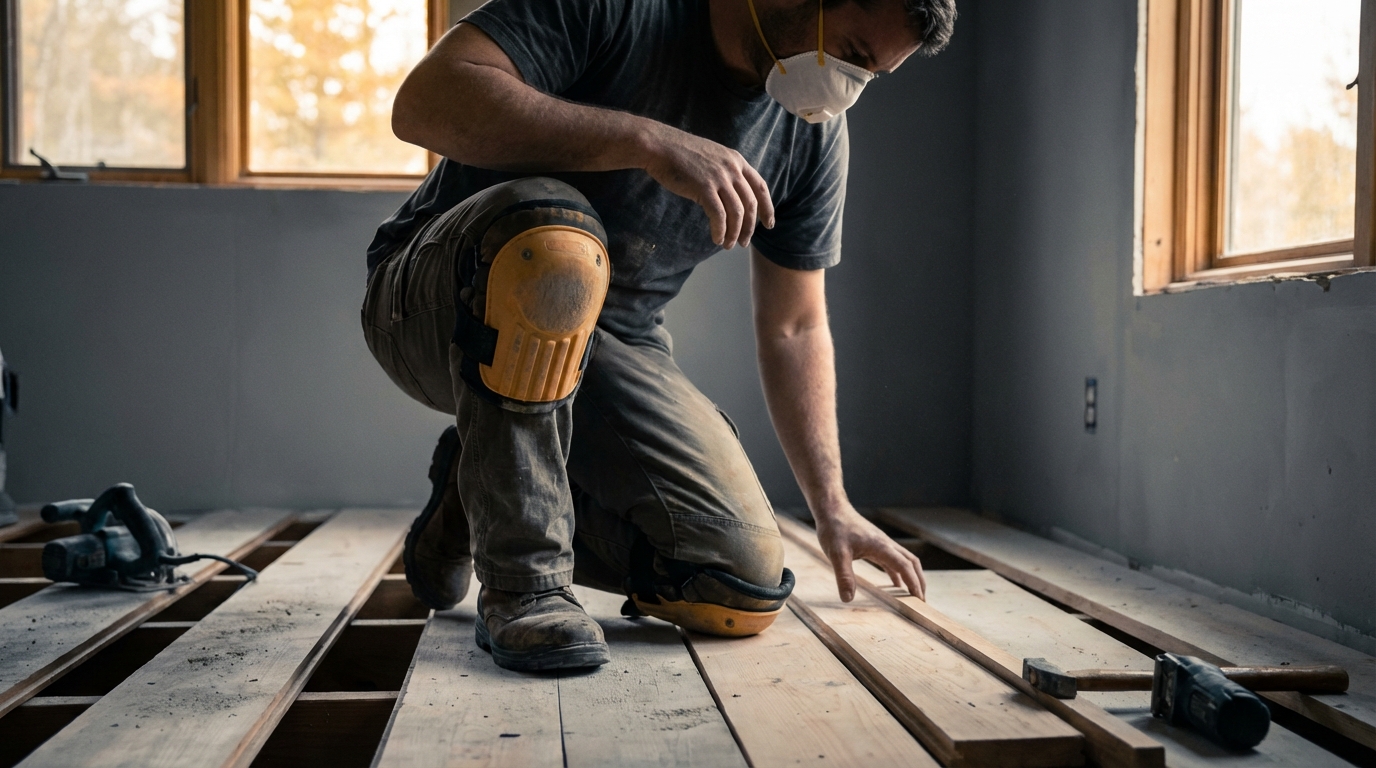
So, you are trying to figure out what safety gear you really need for flooring work, especially knee pads and masks. The short answer is: you need high quality knee pads and the right type of mask for dust and fumes, every single time you work on floors. No exceptions.
You spend hours on your knees, breathing in dust and sometimes fumes. That takes a toll. Good gear protects your joints, your lungs, and your long term health. Bad or wrong gear gives you a false sense of safety and still lets damage build up in the background.
Here is what you need to know before your next flooring job.
- You should treat knee pads and masks as mandatory gear, not “optional extras”.
- Different flooring jobs need different knee pads and different masks.
- Gel knee pads and thick, stable straps are usually better for long days on hard floors.
- For dust, you want at least N95 or FFP2 level filtration; for fumes, you need proper cartridges.
- If your gear is uncomfortable, you will not wear it; comfort and fit are as important as protection ratings.
- Cheap gear that you keep replacing often ends up more expensive than one or two solid products that last.
- Clean and inspect your pads and masks after each job; neglected gear fails faster and protects less.
- Think about how your body will feel in 10-20 years, not just how fast you finish today’s job.
Why flooring work is rough on your body
If you have ever done a full day of tile, laminate, vinyl plank, or hardwood, you know: flooring is not kind to your knees or lungs.
You are kneeling, crawling, twisting, leaning on one side, then the other. Your body weight presses down on a small area of your knee for hours. Your knees are not designed for that kind of direct, prolonged pressure.
At the same time, you cut boards, grind thinset, remove old flooring, sand subfloors, scrape adhesives. All of that throws dust and sometimes chemicals into the air. You may not see much, but your lungs feel it.
> Think less about “this one project” and more about “hundreds of hours of the same motion and pressure”. That is where injuries grow.
A lot of flooring pros develop knee bursitis, cartilage wear, and long term respiratory issues. Not because of one accident, but because of small, constant damage.
The good news: the right knee pads and masks slow that damage down, a lot. They will not make you invincible, but they shift the odds very strongly in your favor.
Knee pads for flooring work
What your knees actually need
Your knees need three basic things during flooring work:
- Cushioning to spread your body weight over a larger area
- Stability so your knee does not rock or twist on hard or uneven floor
- Freedom to move, crawl, and stand up without the pad digging in or sliding
If any of these three is missing, you start to feel it pretty fast. Sharp pressure points, burning skin on the back of your leg, or a strange wobble when you shift your weight. That is your body trying to tell you something.
Main types of knee pads for flooring
Let us look at the common types you will run into. I will keep it simple.
| Type | Best for | Pros | Cons |
|---|---|---|---|
| Foam knee pads | Short jobs, light DIY | Cheap, light, easy to find | Compress fast, weak protection on hard tile/concrete |
| Gel knee pads | Long days on tile, hardwood, laminate | Good weight distribution, comfortable over hours | Heavier, cost more, low quality gel can shift or leak |
| Hard shell knee pads | Rough subfloors, framing, outdoor work | Strong protection, good for debris and nails | Can slide on smooth tile, can mark delicate floors |
| Soft cap / flat cap pads | Finished floors, tile, delicate surfaces | Less sliding, kinder on finished surfaces | Not as rugged on rough concrete or gravel |
| Insertable knee pads (for work pants) | Light install, lots of walking & kneeling | Always “on”, nothing to strap on/off | Often too thin for full day on hard floors |
So which type should you choose for flooring?
Best knee pad styles for different flooring jobs
Let us tie this to the work you actually do.
- Tile setting on concrete or backer board
You are on hard, unforgiving surfaces. Go for gel knee pads with a broad, flat cap. The gel spreads your weight, and the flat cap gives you stability on uneven mortar ridges. - Hardwood or engineered wood install
You spend a lot of time in a kneeling or half-kneeling position while nailing or stapling boards. A soft or flat cap with gel interior often works best. You get comfort with less risk of scratching the finished surface. - Laminate and vinyl plank on underlayment
Surfaces are smoother, but you still kneel a lot, often moving backward row by row. Look for gel or thick foam with a soft, non-marking outer layer. - Demo work: tearing out tile, scraping thinset, removing adhesive
This is rough on gear. You deal with sharp debris and broken pieces. A hard shell pad with good inner cushioning can protect better here. You can switch to softer caps once the new floor goes in. - Quick repairs, punch lists, inspections
For quick in-and-out work, insert pads in work pants or slim foam pads might be fine. They are not enough for a 10-hour install, but they beat bare knees.
> A simple rule: the harder and rougher the surface, the more you should lean toward gel or thick foam, with enough cap to protect from chips or debris.
Straps, fit, and comfort (this is where most people go wrong)
The padding gets most of the attention. Straps and fit decide if you can stand wearing the pads all day.
If you have used cheap knee pads before, you probably know what sliding pads feel like. They start on your knees, then slowly ride down to your shins, so you keep stopping to pull them up. That breaks your focus and slows everything.
You want:
- Two straps per pad, one above and one below the knee
- Wide straps that spread pressure instead of digging in
- Elastic + non-elastic mix so you get a snug, stable fit
- Secure closure (hook-and-loop that actually holds, or buckles that stay put)
Try to avoid:
- Very thin straps that act like ropes behind your knee
- Pads that only strap below the knee (they slide fast)
- Straps that need constant re-tightening during the day
> The best knee pad is the one that stays exactly where you put it for hours while you crawl, stand, twist, and shuffle.
Knee pads and long term health
Let us be blunt. Jobsite culture often treats protective gear like a sign of weakness. “I do not need that, I am fine.”
Except you are not fine when you hit 45 or 50 and your knees swell after every job, or you cannot kneel without pain.
Some data to keep in mind:
- Occupational health studies have linked long term kneeling with higher rates of knee osteoarthritis and bursitis among floor layers and tilers.
- One study of building trades found people with 20+ years of heavy kneeling work had roughly double the rate of pain and cartilage issues compared to less kneeling trades.
You cannot remove every risk, but you can reduce it. Consistent use of good knee pads cuts the amount of direct pressure on your joint. Think of it as a discount on future surgery bills.
How to choose knee pads that you will actually wear
When you shop or pick between brands, ask yourself three simple questions:
- Can I wear these for 8-10 hours without constant adjustment?
- Do they stay in place when I crawl, twist, and stand repeatedly?
- Do they match the floor types I work on most of the time?
If the answer is “no” to any of those, you will start “forgetting” to wear them.
Try this quick test in the store or once you get them:
- Put them on over your normal work pants.
- Kneel down fully, one knee at a time, for at least 30 seconds.
- Crawl forward, backward, and sideways for 1-2 minutes.
- Stand up and squat repeatedly 10-15 times.
Notice if they pinch behind your knee, slide down, or dig into your thigh or shin bone. That small annoyance becomes a huge problem by midday.
Care and maintenance for knee pads
Knee pads get sweaty, dusty, and sometimes covered with thinset or adhesive. That is not just gross; it shortens their life.
A simple routine goes a long way:
- Brush or wipe off dust and loose mortar at the end of the day.
- If the covers are removable, wash them on a gentle cycle once a week.
- Do not leave them soaked in water or cleaner; foam and gel can break down faster.
- Inspect straps often; replace pads once straps are too worn to hold solidly.
> When your gear starts to look rough, ask: “Is this still protecting me the way it did when new?” If the answer is not clear, you probably need a new pair.
Masks for flooring work
Your knees complain loud and fast. Your lungs are quieter. That is part of the problem.
Dust and fumes do damage slowly. You breathe, your body handles what it can, and the rest stacks up over years.
What you are breathing on a flooring job
Different flooring jobs throw different stuff into the air:
- Tile and thinset removal: silica dust from mortar, grout, and sometimes concrete.
- Wood flooring sanding or cutting: fine wood dust; certain woods cause allergies or are classified as carcinogenic over long exposure.
- Old vinyl or glue removal: adhesive dust, possibly older chemicals that you do not want in your lungs.
- Grinding high spots in concrete: heavy silica dust again.
- Using certain adhesives, primers, or sealers: solvent vapors, isocyanates, or other chemicals from finishes and glues, especially in poor ventilation.
Silica dust is a big one. Long term exposure is linked to silicosis and increased risk of lung cancer. This is not scare talk; it is well documented.
> If you ever see a “silica warning” on a product, that is your cue that lung protection is not optional for that task.
Basic mask types you will see
Let us break masks into plain groups so you can map them to jobs.
| Type | Protection level | Best use | Weak points |
|---|---|---|---|
| Simple cloth face cover | Very low | Large dust pieces, non-hazardous dust | Not enough for fine dust, silica, fumes |
| Disposable “nuisance dust” mask (no rating) | Low | Garden work, harmless light dust | No tested filtration rating; not for jobsite hazards |
| N95 / FFP2 disposable respirator | Good for particles | Wood dust, silica dust, general jobsite dust (within limits) | No gas or vapor protection |
| Half-face respirator with replaceable particulate filters | Strong for particles | Extended grinding, heavy demo dust | Still no chemical vapor protection unless you add the right cartridges |
| Half-face respirator with combination cartridges (P100 + organic vapor) | Strong for dust and many fumes | Adhesives, solvents, finishes plus dust | Needs correct cartridge type; must change cartridges on schedule |
Choosing the right mask for the job
Think in terms of two main categories: dust and fumes.
- Dust (silica, wood, cement, grout, drywall)
For serious dust, you want at least:- N95 / FFP2 or higher disposable respirator, or
- Reusable half-face respirator with P2 or P100 level filters.
If you are cutting a few pieces of laminate outside, far from others, a basic disposable might be enough. If you are grinding a concrete slab indoors, that is a different game; use the half-face with high grade filters.
- Fumes (adhesives, primers, solvents, some finishes)
Here you need:- Half-face respirator with cartridges rated for organic vapors (often labeled as “OV”), sometimes combined with particulate filters.
This kind of cartridge contains material that adsorbs vapors so they do not reach your lungs in harmful amounts.
> One rule that saves you from mistakes: dust needs particle filters, smells and fumes need chemical cartridges. Many flooring jobs need both at the same time.
Fit and seal: where most masks fail
The best filter in the world does not help if air flows around the edges of the mask instead of through the filter.
Your focus should be on a tight but comfortable seal.
Here is a simple check you can do with reusable respirators:
- Put on the mask and tighten the straps, starting from the bottom.
- Cover the filters with your hands.
- Breathe in gently. The mask should pull in slightly toward your face and stay collapsed while you inhale.
- If you feel air leak around the edges, adjust the straps and try again.
For N95 style disposables:
- Make sure the metal nose clip is pressed and shaped to your nose.
- Use both straps correctly, one high on the head and one low on the neck.
- Do a quick “cup and breathe” test: cover the front with your hands and breathe out; feel for leaks.
Facial hair is a real problem for tight seals. A full beard under a half-face respirator often means leak paths. If you wear a beard and do a lot of dusty or fume-heavy work, you need to think carefully about protection and maybe adjust the style to allow a better seal.
Comfort and breathability
Just like knee pads, if the mask is miserable, you will not keep it on.
Things to pay attention to:
- Valves: Exhalation valves help with heat and moisture. Many good disposables and all decent half-face respirators have them.
- Strap design: Straps that dig into your head or neck will give you headaches and tempt you to “take a short break” from the mask.
- Weight: Heavier cartridges add weight. Usually worth it for real protection, but balance matters if you do overhead work along with flooring tasks.
> If you find yourself pulling the mask down “just for a moment” every few minutes, you either picked the wrong type or the fit is off.
Filter and cartridge life
Masks are not “set and forget”. Filters and cartridges have limits.
For particle filters:
- Replace when breathing becomes noticeably harder.
- Replace when filters look very dirty or damaged.
- Store in a sealed bag when not in use so they do not keep picking up dust from the air.
For vapor cartridges:
- Follow the manufacturer’s guidelines on service life.
- Replace if you start to smell or taste chemicals you are working with.
- Store in sealed bags or containers when not in use; open air exposure shortens life.
Think of cartridges like brake pads on a car. They are not a one-time purchase; they are a consumable part of your protection system.
Matching knee pads and masks to real flooring scenarios
Theory is one thing. Let us walk through some real job scenarios and match gear to them.
Scenario 1: Removing old ceramic tile over concrete indoors
Work steps:
- Chipping out tile with a demo hammer
- Scraping or grinding thinset
- Hauling broken tile out
Main risks:
- Silica dust from mortar and possible concrete exposure
- Sharp tile edges on floor
- Kneeling on broken fragments
Gear setup:
- Knee pads: Hard shell or very tough caps with thick inner padding. You want protection from sharp fragments and rough concrete. You can switch to softer caps later during install.
- Mask: Half-face respirator with P2 or P100 particle filters, especially if grinding thinset. Work with dust extraction if possible, but still treat the mask as required, not optional.
Scenario 2: Installing prefinished hardwood flooring in a lived-in home
Work steps:
- Laying underlayment
- Cutting boards (often with miter and table saws)
- Kneeling for nail-down or stapling
Main risks:
- Wood dust, especially in the cutting area
- Long hours of kneeling on boards and subfloor
- Protecting already finished wood surfaces
Gear setup:
- Knee pads: Gel knee pads with a soft, non-marking cap. You want stable cushioning and gentle contact with finished boards.
- Mask: At least N95 / FFP2 in the cutting area. If you use adhesives that emit strong fumes, switch to a half-face respirator with combination (particle + vapor) cartridges during adhesive work.
> A simple trick: keep a disposable N95 box near your saw station and a half-face respirator near your glue station. That visual cue nudges you to put the right mask on each time.
Scenario 3: Grinding high spots in a concrete slab before LVP install
Work steps:
- Using a concrete grinder on isolated high spots or across a room
- Vacuuming dust afterward
Main risks:
- High levels of silica dust from concrete grinding
- Long periods of kneeling or squatting, especially if you do detail work near edges
Gear setup:
- Knee pads: Gel or thick foam pads with solid caps; you are on bare concrete, so comfort and protection matter a lot.
- Mask: Half-face respirator with high-grade particulate filters (P2 or P100). Pair this with a grinder that connects to a HEPA vac if you can; the two together give a big drop in exposure.
Scenario 4: Installing LVP with high VOC adhesive in a small room
Work steps:
- Spreading adhesive
- Laying LVP planks
- Working close to the adhesive for extended time
Main risks:
- Fumes from adhesive, especially in poor airflow
- Kneeling in fresh adhesive, skin contact
Gear setup:
- Knee pads: Easy-to-clean pads with a smooth outer shell. You do not want foam that soaks up glue. Wipe them down right after the job.
- Mask: Half-face respirator with organic vapor cartridges (often combined with particulate filters). Open windows, run fans that move air out of the room, and follow adhesive data sheet instructions.
Cost vs value: what to spend on safety gear
I know the instinct: your profit on a job feels thin, and spending more on “yet another pair of knee pads” or a better mask stings.
Let us frame it in numbers.
Knee pads cost picture
Imagine two approaches:
| Approach | Per-pair cost | Average life per pair (heavy use) | Cost per year (heavy use) |
|---|---|---|---|
| Cheap pads | $15 | 2-3 months | About $75-$90 |
| Quality gel pads | $60 | 9-12 months | About $60 |
So the difference in yearly spend is not huge, but the comfort and protection difference is real. Plus, cheap straps stretch fast. Once they start sliding, you are tempted to skip wearing them.
Mask and filter cost picture
For masks:
- Box of decent N95 disposables: around $20-$30 for 20 units.
- Reusable half-face respirator body: often $25-$50.
- Pair of replacement P100 particulate filters: around $15-$25.
- Pair of combination filters (P100 + organic vapor): around $30-$40.
If you work floors full time, you will use up filters. Factor that into your job costing, the same way you budget blades, bits, and adhesive.
> One way to think about it: spread your yearly safety gear cost over the number of workdays. Even a pretty “expensive” setup often comes out to less than the cost of a cup of coffee per day.
Practical tips to build safety into your flooring routine
Gear only helps if you build habits around it. A few practical changes can lock this in.
Build a small safety kit for flooring days
Set aside a dedicated bag or box and stock it with:
- Two pairs of knee pads you trust (primary + backup)
- Half-face respirator with both particulate and combo cartridges
- Box of N95/FFP2 disposables
- Disposable coveralls or knee sleeves for very messy jobs
- Simple cleaning wipes for quick gear clean-up
Keep this kit in your work vehicle at all times. That way you are not “forgetting” gear at home.
Create a 2-minute start routine
Right before you start actual flooring work:
- Put on knee pads and adjust straps while you are still fresh.
- Choose your mask based on the first dusty or fume-heavy task of the day.
- Do a quick seal check for the mask.
Make this as automatic as putting on shoes. No debate, no “maybe later”. Just a standard start.
Use your phone as a reminder for cartridge and filter changes
Every time you put a new cartridge set on your respirator:
- Open your phone calendar.
- Set a reminder for a realistic use window; for many vapor cartridges that might be a few weeks of typical use, but follow the maker guidelines.
- Add notes on how often you use it (“daily dust” or “occasional adhesives”).
You do not need to be perfect, you just need to be better than “I will remember this in my head”. You probably will not.
One realistic change you can make today
If you do nothing else right now, do this on your next flooring job: put your best knee pads in your work area before you bring in any tools, and lay a good mask on top of them. You set up the expectation for yourself that kneeling and breathing protection come before saws and trowels.