
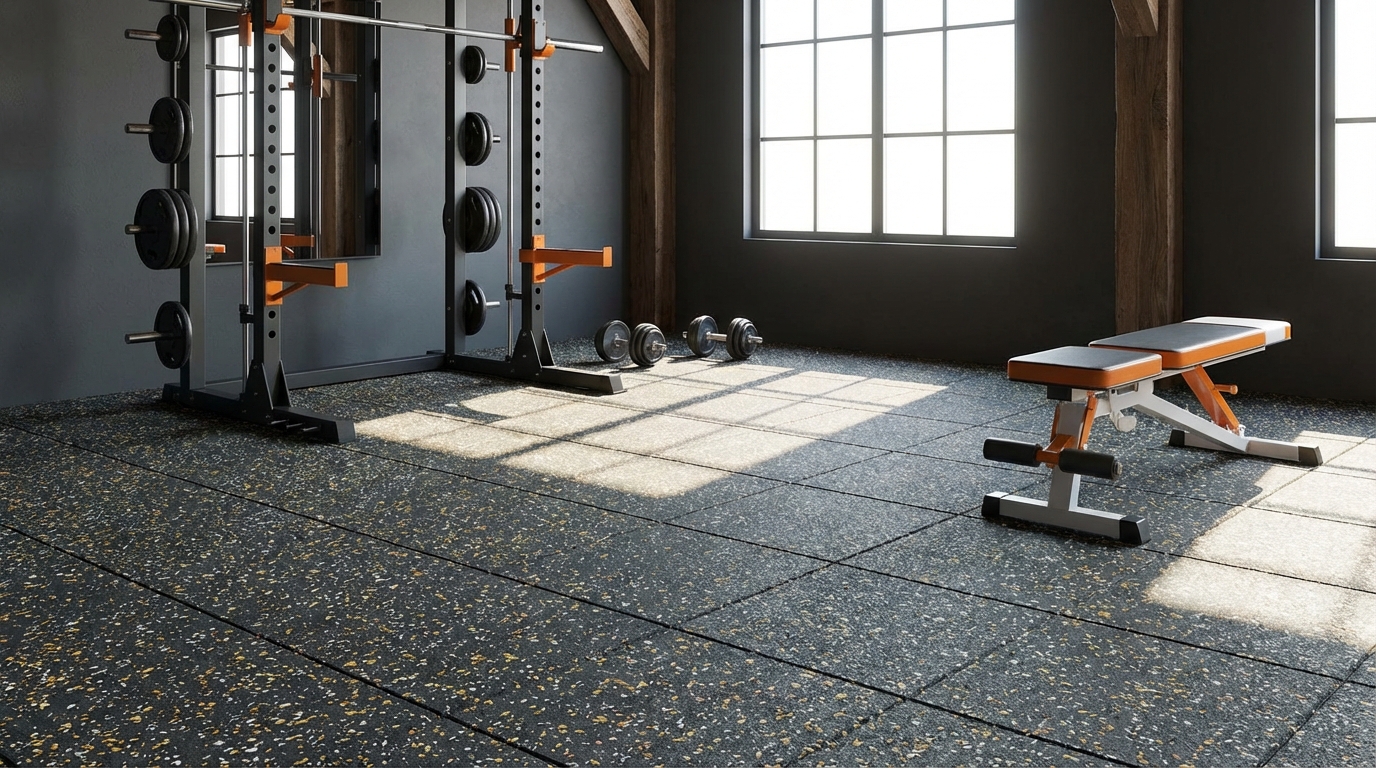
So, you are trying to figure out if rubber flooring made from recycled tires is a good idea for your home gym. The short answer is yes, recycled tire rubber flooring can be a strong, safe, and cost-effective choice for home gyms, as long as you understand thickness, smell, installation, and where it works best.
Most people jump into buying cheap foam tiles or a random “gym mat” from a marketplace, then regret it when a dropped dumbbell cracks the slab or the floor smells like chemicals for weeks. Recycled tire rubber is a step up. It is dense, absorbs impact, protects your subfloor, and tends to last years. But there are tradeoffs in smell, cleaning, sound, aesthetics, and different formats (rolls, tiles, mats).
Here are some quick checkpoints before we go deeper.
- Recycled tire rubber is one of the most common commercial gym floors, now widely used in home gyms.
- Thickness matters more than marketing; for most home gyms 3/8 inch to 1/2 inch works, heavy lifters may need 3/4 inch or more.
- Interlocking tiles are easiest for DIY, rolls look cleaner but are harder to handle, stall mats are heavy and very dense.
- Smell comes from VOCs; better products off-gas less and clear up faster.
- Rubber from tires protects concrete but does not fix weak structure underneath.
- Rubber can mark or stain light floors without a barrier.
- Sound and vibration are reduced, but not gone; neighbors will still hear dropped weights in many buildings.
- Water resistance is strong, but edges, seams, and subfloor prep still matter.
Let us walk through this like you are planning a real home gym, not just “throw some mats on the floor and hope it works.”
—
What is recycled tire rubber flooring, really
So, you are trying to understand what “recycled tire rubber” actually means for gym flooring. It sounds simple, but the details explain price, smell, and durability.
The direct answer: recycled tire rubber flooring is usually made from ground-up car or truck tires that are cleaned, shredded, and bonded together again using a binder, then cut into rolls, tiles, or mats.
In plain terms, you are buying chopped tire crumbs glued into a new sheet.
> “If you have ever seen a commercial gym’s black speckled floor, chances are you were walking on recycled tires.”
Here is how that process usually looks:
- Tires are collected from recycling streams.
- The steel belts are removed with industrial magnets.
- Rubber is shredded into granules or crumbs.
- Granules are cleaned and sorted by size.
- Rubber is mixed with a binder (usually polyurethane).
- The mix is pressed into sheets, cured, then cut into tiles, rolls, or mats.
SBR vs EPDM: what you are actually stepping on
Two rubber types show up a lot:
- SBR (Styrene Butadiene Rubber): This is the main tire rubber. Almost all black recycled rubber gym floors use SBR.
- EPDM (Ethylene Propylene Diene Monomer): These are the colored flecks you see (blue, red, gray). They are usually virgin rubber, not from tires.
So when a brand says “recycled rubber flooring with 20 percent color fleck”, it usually means:
- 80 percent ground-up tire (black SBR)
- 20 percent colored EPDM chips
That mix has some side effects:
- More SBR tends to mean stronger tire smell at first.
- More EPDM makes the surface a bit smoother and more colorful, sometimes slightly less dense.
> “If you see a very cheap, all-black gym roll, it is almost always high SBR content with minimal EPDM.”
—
Why recycled rubber works so well for home gyms
So, you are wondering why gyms everywhere use recycled rubber instead of foam or vinyl. The direct answer is: density and resilience. Tire rubber is heavy, firm, and springs back, which gives you impact absorption without that sinking feeling you get from soft foam.
Let us break it down in practical terms.
Impact protection for your floor
Dumbbells, kettlebells, and plates are heavy. On bare concrete or thin laminate, that leads to:
- Chips and cracks in concrete.
- Dents in wood or vinyl planks.
- Broken tiles and hollow sounds on ceramic.
Recycled rubber spreads the impact force over a larger area and extends the time of impact by compressing slightly. It is not magic, but it cuts the peak force that hits your slab or wood floor.
In lab tests, 3/8 inch to 1/2 inch rubber flooring can cut impact force by a big margin compared to bare concrete. For really heavy deadlifts or Olympic lifts, many lifters stack:
- Concrete slab
- Plywood platform (2 layers)
- Rubber mat or tiles on top
That might sound like overkill, yet for 400+ pounds, it saves both the floor and the plates.
> “Think of rubber as a shock absorber, not a shield. It reduces damage but does not ignore physics.”
Comfort and joint stress
Standing on concrete for an hour hurts. Knees, lower back, feet: they all protest. Rubber gives a slightly softer, grippier surface.
Key points for comfort:
- Rubber helps with standing exercises and reduces foot fatigue.
- It gives some cushion for floor work like burpees and push-ups.
- Yet it stays firm enough for stable lifting posture.
Foam feels soft and comfortable at first, but it compresses under weight and loses shape over time. You end up with uneven spots that hurt balance. Recycled rubber, especially dense SBR, handles thousands of compressions without permanent dents.
Grip and safety
Rubber has higher friction than many other options. That sounds technical, but it shows up as:
- Shoes do not slide as easily when you squat or lunge.
- Benches and racks move less if the floor is level.
- Sweat on the floor is still a slip risk, but rubber keeps more grip than tile.
Surface texture matters. Some rolls are smoother, some have a light texture. For a home gym, a light texture is usually better. Very rough surfaces collect dirt and are harder to mop.
—
Types of recycled rubber flooring for home gyms
So, you are trying to pick between tiles, rolls, and stall mats. The direct answer is: for most home gyms, interlocking tiles or stall mats are easiest, while rolls work best if you want a very clean, permanent look.
> “The format you choose affects cost, installation time, and how much you swear while cutting the pieces.”
Here is a quick comparison.
| Type | Common Thickness | Install Difficulty | Best Use |
|---|---|---|---|
| Interlocking tiles | 8 mm, 3/8 in, 1/2 in | Easy | Most home gyms, spare rooms, DIY on subfloor |
| Rubber rolls | 8 mm, 3/8 in | Medium to hard (heavy rolls) | Garage gyms, larger rooms, more permanent install |
| Horse stall mats | 3/4 in (about 19 mm) | Medium (very heavy pieces) | Heavy barbell areas, concrete garages, budget setups |
Interlocking rubber tiles
These look like giant puzzle pieces. They usually come in 2 ft x 2 ft or 2 ft x 4 ft sizes.
Pros:
- DIY friendly; you can install them without glue in most cases.
- Easy to cut with a sharp utility knife and straight edge.
- Simple to remove if you move homes or switch rooms.
- Seams are locked by the puzzle shape, so they separate less than square-cut tiles.
Cons:
- More seams than rolls, which can catch dirt.
- Not as “clean” looking for large, open spaces.
- Edge pieces sometimes curl up if stored wrong before install.
Use interlocking tiles when:
- You want a weekend project you can do alone.
- You are renting and may need to take the floor with you.
- The room is not perfectly square, so you will cut around closets and corners.
Rubber rolls
Rolls often come in 4 ft wide strips, with length from 10 ft up to 50 ft or so.
Pros:
- Fewer seams; looks closer to a commercial gym.
- Covers large areas quickly once unrolled.
- Can be taped or glued down for a very solid install.
Cons:
- Very heavy; a 4 ft x 25 ft roll at 8 mm can weigh 100+ pounds.
- Harder to cut; long straight cuts take patience.
- Trickier to fit in tight residential spaces.
Use rolls when:
- You have a wide open space like a double garage.
- You want fewer seams and a more permanent setup.
- You can get help moving and aligning the rolls.
Horse stall mats (often from recycled tires too)
Stall mats from farm stores are often the secret budget choice for heavy lifting. They are usually 3/4 inch thick, 4 ft x 6 ft, and made from very dense rubber, often recycled tires.
Pros:
- Very thick and heavy; great impact protection for barbell drops.
- Cheap per square foot compared to name-brand gym tiles.
- Durable and long lasting in harsh conditions.
Cons:
- Strong smell at first, especially in closed rooms.
- Surface can be rough or textured, harder to mop.
- Edges may not be perfectly square, leading to small gaps.
> “If your budget is tight and you are deadlifting heavy, stall mats over concrete are hard to beat.”
Use stall mats when:
- Your gym is in a well-ventilated garage or shed.
- You focus on barbell training and heavy lifts.
- You do not mind a farm-style industrial look.
—
How thick should your recycled rubber flooring be
So, you are trying to pick the right thickness for home gym rubber made from tires. The direct answer is: 8 mm is fine for light training, 3/8 inch works for most home gyms, and 1/2 inch or 3/4 inch is safer for heavy barbell work.
Think of thickness like insurance. More thickness improves impact absorption, but it costs more and adds weight.
Here is a rough guide.
| Thickness | Use case | Notes |
|---|---|---|
| 6 mm (about 1/4 in) | Cardio, light dumbbells, yoga | Too thin for heavy lifting, fine over strong subfloor |
| 8 mm (about 5/16 in) | General fitness, dumbbells up to ~50 lb | Common in budget home gym kits |
| 3/8 in (about 9.5 mm) | Most home gyms, moderate barbell work | Good balance of cost and protection |
| 1/2 in (about 12 mm) | Heavier lifting, more sound absorption | Better for multi-family buildings |
| 3/4 in (about 19 mm) | Heavy barbell drops, platforms, stall mats | Very heavy and firm, strong impact control |
> “For most home lifters, 3/8 inch recycled rubber over a solid slab is a sweet spot.”
If:
- You lift under 300 lb and never drop from overhead: 8 mm to 3/8 in.
- You deadlift and squat over 300 lb: 3/8 in to 1/2 in.
- You do Olympic lifting with drops: 1/2 in to 3/4 in with platform support.
Remember, if your subfloor is wood joists with plywood, not concrete, you want a bit more thickness and possibly an extra plywood layer under the rubber for safety.
—
Smell, VOCs, and air quality
So, you are worried that rubber flooring from recycled tires will smell up your home gym. The direct answer is: many products smell at first, but better brands manage VOCs well, and with airing, cleaning, and time, the smell drops sharply.
Recycled tire rubber has natural and synthetic compounds that can off-gas. That is why you sometimes open a box of new tiles and get that “tire store” smell.
Why some rubber smells more than others
Factors that influence smell:
- Rubber source: Higher tire content (pure SBR) tends to smell stronger than higher EPDM content.
- Binder quality: Cheaper glues give stronger chemical odor.
- Manufacturing process: Better cleaning and curing reduce VOCs.
- Storage: Flooring that sits in shrink wrap for months traps odor until you open it.
Products often list “low VOC” or have third-party certifications like FloorScore or GREENGUARD. Those are signals that off-gassing has been tested against some standard.
> “Not all rubber is equal. I have seen stall mats that smell for weeks and premium tiles that clear up in days.”
How to reduce smell in a home gym
Steps that help:
- Unbox outside or in a garage and let the tiles or rolls air out for 24 to 72 hours.
- Wipe the surface with a mix of mild detergent and water, then let dry.
- Keep windows open and a fan running for the first several days after install.
- Avoid strong cleaners that can react with rubber or leave residue.
If your gym is in a small spare bedroom with poor ventilation, lean toward:
- Higher quality, certified low-VOC products.
- Thinner tiles if heavy lifting is not your focus.
- Extra airing time before bringing them inside.
—
Subfloor compatibility: concrete, wood, and more
So, you are wondering if you can put recycled tire rubber directly on your existing floor. The direct answer is: yes on most concrete and plywood floors, with a few precautions for moisture and soft finishes.
On concrete slabs
Garages and basements usually have concrete. That is ideal for rubber:
- Strong and load-bearing.
- Handles heavy racks and plates.
- Flat enough in most cases.
Things to watch:
- Moisture: If your basement has dampness, test with a taped plastic sheet. If water collects under it in 24 to 48 hours, you have moisture issues to solve first.
- Cracks: Fill large cracks with patch compound before laying rubber.
- Dust: Sweep and vacuum well; dust under rubber makes it harder to stay in place if not glued.
Rubber is water resistant but not a guaranteed vapor barrier at the seams. For very damp basements, some people add a plastic membrane or special underlayment first, then rubber on top.
On wood or engineered floors
If you have a finished wood or laminate floor, be careful.
Pros:
- Wood has some natural give, which can feel nicer under rubber.
- Easy to lay rubber tiles directly on top without glue for floating installs.
Risks:
- Rubber can mark or discolor some finishes over time, especially light woods.
- Heavy racks can leave dents in softer wood under the rubber.
To protect the finish, many home gym owners add:
- A layer of plywood screwed together as a sacrificial floor.
- Then rubber tiles or mats on top of the plywood.
In apartments, check the building rules. Some buildings have guidelines on extra padding for gym equipment because of noise and vibration.
On tile floors
Ceramic or porcelain tile is hard and brittle. Heavy gym equipment or drops can crack it, even with rubber on top, if the rubber is thin.
If you must build over tile:
- Avoid heavy Olympic lifting directly over it.
- Use thicker rubber (1/2 in or more) under racks and weight areas.
- Consider extra plywood between tile and rubber in critical areas.
—
Sound and vibration control
So, you want rubber flooring from recycled tires to silence your home gym. The direct answer is: it helps a lot with vibration and some sound, but it will not make heavy drops silent, especially in shared buildings.
Rubber absorbs some of the energy that would otherwise move into the structure. That helps with:
- Low-frequency vibrations from dropping weights.
- Rattling noise from plates and racks.
- Footfall noise during cardio or HIIT.
But there are different kinds of sound:
- Airborne sound: Music, voices, clanks in the air. Rubber helps a little by damping echoes.
- Structure-borne sound: Vibrations travelling through the floor and walls. Rubber helps more here, but not fully.
> “If you live in an upstairs condo, expect your neighbors to hear overhead drops, even with good rubber. The goal is less, not zero.”
How to improve sound control beyond rubber
If noise is a big concern, combine rubber flooring with:
- Lifting platforms: Wood center with thick rubber on the sides for drops.
- Extra layers: Plywood under the rubber to spread load and change vibration patterns.
- Weight control: Lower the bar, do not free drop if you are in shared spaces.
For treadmill or rowing machines, thicker rubber tiles or isolation pads under the feet help reduce the low thump that travels through floors.
—
Installation: how to actually put this stuff down
So, you want a practical plan to install recycled tire rubber flooring in your home gym. The direct answer is: clean the subfloor, dry-fit the layout, cut pieces to fit, and either let them float or secure edges and seams with tape or adhesive based on how permanent you want it.
> “Installing rubber is more about patience and a sharp knife than skill.”
Basic tools you will need
- Sharp utility knife with extra blades.
- Straight edge (metal ruler or long level).
- Measuring tape.
- Chalk line or marker for cut lines.
- Double-sided carpet tape (for floating installs).
- Adhesive (if you go full glue-down, which many home gyms skip).
Step-by-step for interlocking tiles
1. Prep the floor
- Sweep and vacuum.
- Make sure the surface is dry and fairly level.
2. Plan the layout
- Start from a straight wall or the center, not from a random corner.
- Dry-lay a row of tiles to see how cuts will land at the edges.
3. Lock tiles together
- Connect the puzzle joints by hand, pressing down firmly.
- Tap with your fist or a rubber mallet if needed.
4. Cut edge pieces
- Flip the tile over, mark the cut line.
- Score several times with a sharp blade along a straight edge.
- Bend the tile along the cut and finish from the other side.
5. Handle edges
- For a floating floor, leave a small gap around the room for expansion.
- If tiles move, add double-sided tape at perimeter tiles.
Step-by-step for rolls
1. Unroll and relax
- Unroll in the room and let the rubber relax for a few hours.
- This helps reduce curling edges.
2. Rough cut and fit
- Lay the first roll along the longest wall.
- Leave a small gap at the wall for expansion.
3. Trim edges
- Use a straight edge and knife for long cuts.
- Cut around obstacles slowly; better to undercut and adjust.
4. Seams
- Butt seams tightly; do not overlap.
- Use double-sided tape under seams if you want extra stability.
5. Glue-down (optional)
- For permanent installs, apply adhesive with a notched trowel.
- Work one roll at a time to avoid drying before placement.
Glue-down is strong but makes removal harder later. Many home users choose floating or taped installs instead.
Tips for stall mats
Stall mats are heavy. A single 4 ft x 6 ft mat at 3/4 in can weigh 90 lb or more.
- Have a partner to move and set them.
- Use a long straight edge and a fresh blade for cuts; you might need many passes.
- Arrange mats in a brick pattern so seams do not line up in straight lines.
—
Maintenance and cleaning
So, you are wondering how hard recycled tire rubber flooring is to clean in a home gym. The direct answer is: sweep or vacuum often, mop with mild cleaner, avoid harsh chemicals, and deal with sweat and chalk quickly to keep it looking and smelling better.
Rubber is not hard to maintain, but it does collect dust and chalk. A simple routine helps a lot.
Daily or weekly tasks
- Sweep or vacuum to remove dust, hair, and chalk.
- Spot clean sweat or spills with a damp cloth.
If you use a vacuum, turn off the beater bar or use a hard-floor setting so you do not scuff the surface.
Deeper cleaning
Every 1 to 4 weeks, depending on how often you train:
- Mop with warm water and a small amount of neutral pH floor cleaner.
- Do not flood the floor; just damp mop.
- Let it dry fully before heavy use so it does not get slippery.
Avoid:
- Solvents like acetone or paint thinner.
- Strong degreasers or bleach on a regular basis.
- Wax or polish, which can make the floor slippery and odd looking.
> “Think of gym rubber like the tires on your car. Regular light cleaning is better than harsh rare scrubs.”
—
Cost breakdown: what you are really paying for
So, you are trying to budget for recycled tire rubber flooring in your home gym. The direct answer is: expect around 2 to 5 dollars per square foot for decent recycled rubber products, with stall mats often under 2 dollars per square foot, and premium tiles at the higher end.
Here is a simple sample range (actual prices change by region and year):
| Product type | Approx. price per sq ft | Notes |
|---|---|---|
| Budget 8 mm tiles/rolls | $2.00 – $3.00 | Good for basic setups, lighter lifting |
| 3/8 in tiles/rolls | $2.50 – $4.00 | Common for general home gyms |
| 1/2 in tiles | $3.50 – $5.00 | Heavier duty, often with color flecks |
| Horse stall mats (3/4 in) | $1.50 – $2.50 | Cheaper, but smellier, rougher |
Factors affecting cost:
- Thickness (more material = more cost).
- Color (plain black is cheaper than custom colors).
- Brand and certifications (low VOC, made in certain regions, etc.).
- Shipping; rubber is heavy, so freight can be a real line item.
A 200 sq ft single-car garage gym with 3/8 in tiles at 3 dollars per sq ft will cost around 600 dollars for flooring, plus some shipping. Stall mats could cut that almost in half for similar impact protection, at the cost of smell and finish.
—
Environmental angle: is recycled tire flooring really “green”?
So, you are asking if rubber flooring from recycled tires is better for the environment than other options. The direct answer is: using waste tires as gym flooring keeps them out of landfills and gives them a long second life, which is generally positive, but there are still chemicals involved, and it does not remove all environmental concerns.
Used tires are a huge waste stream. Many end up:
- In landfills.
- Burned as fuel.
- Dumped illegally.
Grinding them into crumb rubber for flooring turns a waste problem into a functional product.
> “Recycled does not mean perfect, but it can be a clear step up from single-use materials that get trashed fast.”
Still, some points matter:
- Binders are synthetic and need energy and chemicals to make.
- Products can release small amounts of VOCs, mainly at the beginning.
- End-of-life recycling of floor tiles is not always available in every city.
If environmental impact is a priority, look for:
- Products with recycled content percentages listed clearly.
- Manufacturers with certifications on indoor air quality.
- Regional production to cut transport distances.
—
When recycled tire rubber is not the right choice
So, you want to know where rubber from recycled tires might not work for home gyms. The direct answer is: it can be a poor fit in high-heat sunrooms, upscale living rooms where aesthetics are critical, or very small unventilated spaces sensitive to odor.
Cases where it might not be ideal:
- Sun-soaked rooms: Direct strong sunlight can fade color flecks and warm the rubber a lot.
- Luxury living areas: If the room doubles as a formal living room, you might want a wood platform look instead.
- Tiny closed spaces: If ventilation is poor, the initial smell period can be annoying.
- Very heavy equipment on weak floors: Rubber protects, but does not upgrade the floor structure below.
If you fall into one of those, options include:
- Wood lifting platforms with smaller rubber insets.
- High-density foam tiles for light or bodyweight training.
- Hybrid setups with a mix of rubber in some zones and other materials in others.
—
How to plan your layout step by step
So, you want a simple way to design your home gym layout before you buy rubber flooring from recycled tires. The direct answer is: sketch your room, mark your heaviest zones, choose thickness per zone, then order around 5 to 10 percent extra to cover cuts and future tweaks.
Here is a practical way to approach it.
1. Map your space
- Measure room length and width.
- Note doors, closets, and any pillars or fixed cabinets.
- Draw a rough sketch on paper or use a simple design tool.
2. Place major equipment
Draw where you plan to put:
- Power rack or squat stand.
- Bench and dumbbell rack.
- Cardio gear like a treadmill or bike.
- Open floor space for workouts.
> “You want heavy, high-impact zones on the thickest and most stable flooring.”
3. Apply thickness strategically
You do not need the same thickness for the entire room.
- Under rack and deadlift area: 3/8 in to 3/4 in.
- General training area: 8 mm to 3/8 in.
- Cardio-only corners: 6 mm to 8 mm may be enough.
Sometimes people use stall mats just under the rack and lifting area, with thinner tiles in the rest of the room.
4. Choose format and count pieces
Example: you have a 12 ft x 16 ft room.
- Area is 192 sq ft.
- 2 ft x 2 ft tiles cover 4 sq ft each.
- 192 / 4 = 48 tiles, plus 5 to 10 percent extra (about 3 to 5 extra).
Order at least 51 to 53 tiles. Extra tiles help when:
- You miscut a piece.
- You change layout later.
- A tile gets damaged after a few years.
—
Real-world examples and lessons
So, you want a sense of how this works outside of theory. The direct answer is: real home users tend to land on 3/8 in recycled rubber tiles or stall mats in the high-impact zone, and they usually mention smell, weight, and cutting as their main surprises.
Example 1: Small spare room gym
- Room: 10 ft x 12 ft spare bedroom.
- Floor: Laminate on concrete slab.
- Gear: Adjustable bench, dumbbells to 60 lb, rowing machine.
- Flooring: 8 mm interlocking recycled rubber tiles with light gray flecks.
Results:
- Tiles installed in an afternoon with no glue.
- Some smell for the first week, gone after mopping and open windows.
- Laminate preserved, no visible marks after a year.
Example 2: Garage barbell setup
- Space: Single-car garage used partly for storage.
- Floor: Standard concrete slab.
- Gear: Power rack, barbell, plates up to 400 lb.
- Flooring: 3/4 in horse stall mats in a 8 ft x 8 ft lifting zone, bare concrete elsewhere.
Results:
- Mats were hard to move but rock-solid once down.
- Smell strong for about 2 weeks, then manageable.
- Concrete protected; plates and bar fine after repeated deadlifts.
Example 3: Apartment living room corner
- Space: Corner of a living room in an upper-floor apartment.
- Floor: Engineered hardwood.
- Gear: Adjustable dumbbells, foldable bench, resistance bands.
- Flooring: 3/8 in recycled rubber tiles with plywood layer underneath.
Results:
- Sound reduced, but downstairs neighbor still heard heavy sets if dropped.
- Wood floor stayed unmarked under plywood.
- Tiles lifted cleanly when the person moved out.
> “When you talk to many home gym owners, the pattern is the same: they regret foam, not rubber.”
—
One practical tip to apply right now
If you are still unsure about smell, thickness, or feel, order one sample tile or a single stall mat first, throw it in your space for a week, train on it, and see how your nose, your joints, and your floor react before committing to the full room.