
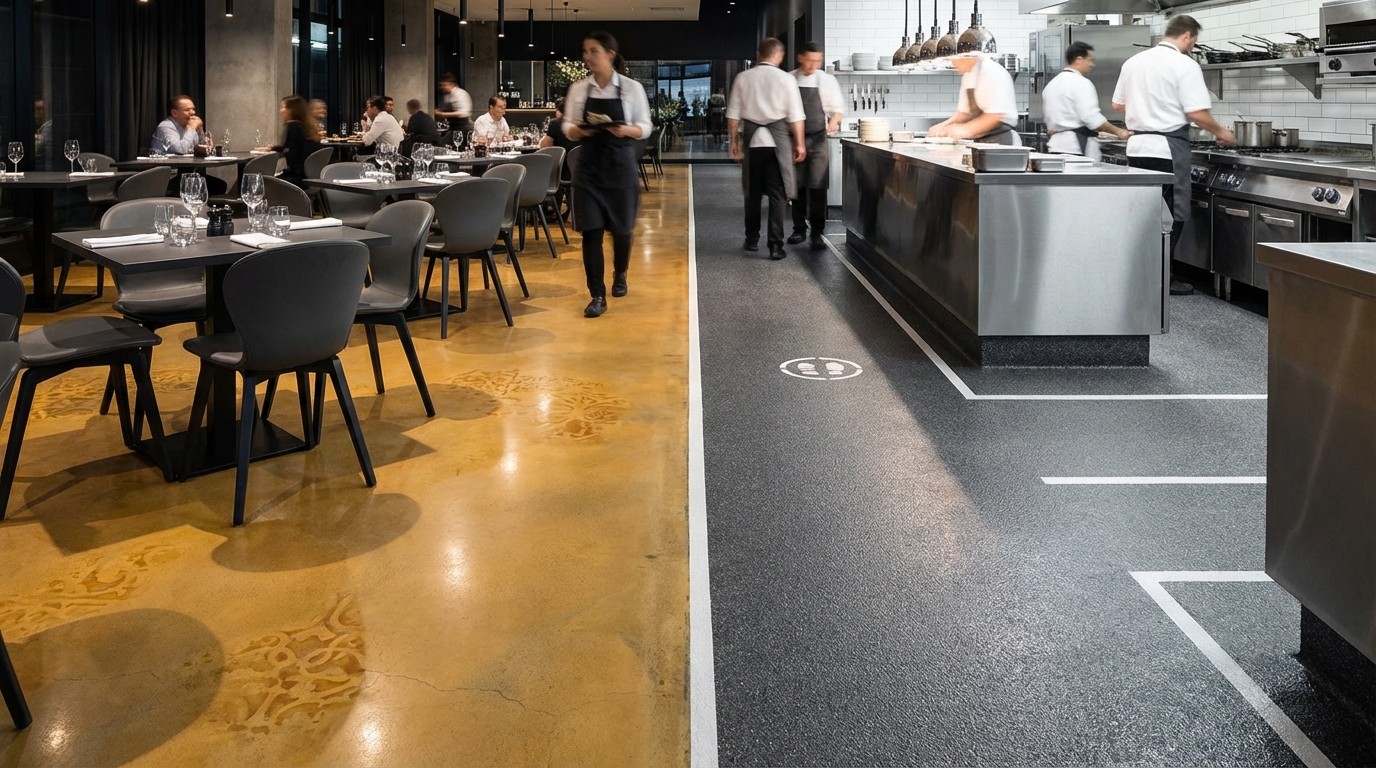
So, you are trying to figure out how to choose restaurant flooring that looks good but still meets safety codes and keeps people from slipping and suing you.
The answer: pick flooring zone by zone, start from safety and code, then layer aesthetics on top, not the other way around.
If you lead with looks, you almost always pay twice. First when you install the wrong material. Second when the inspector, your insurance adjuster, or a lawsuit tells you it was the wrong call.
You are not just picking a pretty surface. You are solving for slip resistance, cleanability, fire, moisture, fatigue, sound, cost over time, and yes, brand. All at once. The only way this works is to break the restaurant into zones and match each zone to flooring that hits code and still fits your design story.
Here is what you need to know before you sign any flooring quote:
- Safety and building codes are the baseline, not a feature. If flooring fails code, it is the wrong flooring, no matter how good it looks.
- Slip resistance numbers (coefficient of friction) matter more than marketing labels like “non-slip” or “commercial grade.”
- Every zone (kitchen, bar, dining, restrooms, entry, patio) needs its own flooring spec and sometimes its own substrate prep.
- Cleaning chemicals, grease, and moisture change how flooring behaves over time, not just on day one.
- Acoustics, staff fatigue, and wheelchair access are part of safety, not just guest comfort.
- Long-term cost per year often beats low upfront price. Cheap floors in a commercial kitchen can fail in 18-36 months.
- There are ways to make safe floors look great: patterns, color blocking, inlays, transitions, and lighting do a lot of work for you.
Why restaurant flooring decisions feel harder than they look on Pinterest
You scroll through photos. Polished concrete, warm wood, sleek tiles, cool terrazzo. All of them look clean and brand aligned.
Then you talk to your contractor and hear things like: slope to drain, coefficient of friction, cove base, thermal shock, epoxy, quarry tile, ASTM tests. At that point, it stops feeling like a design project and starts feeling like homework.
Here is the catch: residential flooring rules do not apply to restaurants. You have:
- Much higher foot traffic.
- Hot liquids, grease, and food spills.
- Servers moving fast, often carrying heavy trays.
- Cleaning with harsher chemicals and hot water.
- Code inspectors and health inspections.
- Fire and slip-and-fall liability.
So if you simply copy “cool looking loft” flooring ideas, you set yourself up for failures that are both expensive and stressful.
> Commercial restaurant flooring is less about what looks good on opening night and more about what still performs on a busy Saturday two years later.
Key codes and standards that shape your choices
You do not need to memorize code language. You just need enough to ask smarter questions and spot red flags in proposals.
Slip resistance: the non-negotiable number
Most flooring product data sheets will give you a coefficient of friction (COF). There are a few ways this shows up:
- Static COF (SCOF).
- Dynamic COF (DCOF), measured with the ANSI A326.3 test on hard surfaces.
For restaurants, you often hear numbers like:
- DCOF ≥ 0.42 for level interior floors that will be walked on when wet (common benchmark for tile).
- Higher values (0.55-0.60+) for ramps and very wet or greasy back-of-house areas.
Do not settle for “non-slip” on a brochure. Ask:
- “What is the wet DCOF for this product?”
- “Is that value tested with the surface finish and sealer we will actually use?”
> If a sales rep cannot or will not give you a COF number and a test reference, treat that as a warning.
Fire, egress, and building code basics
Restaurant flooring touches fire safety in two key ways:
- Flame spread and smoke development: Many codes reference ASTM E84 test results, especially for corridors and exit paths.
- Trip hazards in egress routes: Height differences at transitions, loose flooring, or raised thresholds can be flagged.
Ask for documentation that flooring is approved for commercial assembly use, not just “commercial rated.” The category matters.
ADA and accessibility
You also need:
- Slip-resistant flooring on accessible routes.
- Transitions with very small height differences (often no more than 1/4 inch without a bevel, up to 1/2 inch with a bevel).
- No flooring with very deep grooves or joints that catch wheels or canes.
Grout joints, plank gaps, and expansion joints can all affect wheelchair and cane movement, especially near entrances and restrooms.
Think in zones, not “one floor for the whole restaurant”
Almost every successful restaurant spec treats flooring as a set of layers:
- Front of house (FOH): looks, comfort, acoustics, still safe when wet.
- Back of house (BOH): aggressive safety, cleanability, chemical resistance, drainage.
- Transitions and back corridors: often mix of the two.
Typical zones you should define
- Entry / vestibule.
- Main dining room.
- Bar and bar aisles.
- Server paths and POS stations.
- Restrooms.
- Kitchen line and prep.
- Dish area and washdown zones.
- Outdoor patio, if you have one.
For each zone you want to answer five questions:
- How wet or greasy does this area get in real life?
- How fast do staff move here and what do they carry?
- What cleaning methods and chemicals will we use here?
- How much noise is created in this area?
- What feeling do we want to give guests looking at or walking on this floor?
> Once you map zones, the “balancing aesthetics with safety” problem stops being a vague idea and turns into a set of clear choices.
Common restaurant flooring materials: pros, cons, and where they actually work
Here is a comparison table to ground the discussion. It is simplified, but it gives you a quick view.
| Material | Best zones | Slip risk when wet | Cleanability | Upfront cost | Typical lifespan in restaurants |
|---|---|---|---|---|---|
| Commercial quarry tile | Kitchen, dish, some bars | Low with texture & proper shoes | High, but grout needs care | Medium | 10-20 years with good maintenance |
| Epoxy / urethane cement | Kitchens, dish, walk-in thresholds | Low with correct broadcast | Very high, few joints | Medium to high | 8-15 years, heavy duty |
| Porcelain tile | Dining, entry, restrooms | Varies by texture; select high-grip | High, stain resistant | Medium to high | 10-20 years |
| Luxury vinyl tile/plank (LVT/LVP) | Dining, corridors, some bars | Moderate, depends on wear layer/texture | High, but careful with hot grease | Medium | 7-12 years in FOH |
| Polished or sealed concrete | Dining, bar, some entries | Higher if too smooth or with spills | High, but needs regular sealing | Low to medium | 10+ years, but performance changes with wear |
| Natural wood | Dining only, away from moisture | Moderate to high when wet | More maintenance, sensitive to water | High | 7-15 years with strong care |
Quarry tile: the old workhorse of commercial kitchens
Quarry tile has been in commercial kitchens for decades. It is unglazed, dense, and made for heavy traffic. With the right texture and shoes, it gives grip even with some grease exposure.
Pros:
- Good slip resistance when paired with proper cleaning.
- Handles hot water and many degreasers.
- Works with slopes to floor drains.
- Known to inspectors and insurance carriers.
Cons:
- Grout joints can trap grease and bacteria if cleaning is weak.
- Hard underfoot for staff; fatigue tends to rise on long shifts.
- Tiles can crack if substrate is not prepared correctly.
For kitchens and dish areas, quarry tile remains a strong choice, especially when paired with ergonomic mats at key stations.
Epoxy and urethane cement systems: fewer joints, strong safety
Epoxy and urethane cement floors are poured or troweled in place. You can broadcast aggregate (small sand or flakes) into the surface for grip.
Pros:
- Very few joints, easier to clean and sanitize.
- Excellent chemical resistance with the right system.
- Can form coved bases up the wall for better hygiene.
- Can be tuned for more or less texture by changing the broadcast.
Cons:
- Surface can be too rough if you overdo the aggregate, which makes mopping harder and tires shoes fast.
- Installation is technique-sensitive; poor prep leads to peeling or bubbles.
- You need shutdown time for curing.
> If you are running a kitchen that does frequent hot water washdowns and uses strong degreasers, epoxy or urethane cement often outperforms tile over the long run.
Porcelain tile: front-of-house workhorse if you pick the right finish
Porcelain tile gives you a huge design range. Concrete looks, stone looks, wood looks, patterns, large format, you name it.
From a safety view, the key variable is surface finish:
- Polished porcelain looks beautiful but gets slick when wet.
- Matte or textured finishes with high wet DCOF are far better for entries, restrooms, and near bar areas.
You also need to think about:
- Grout width and texture; narrow, dense grout lines are easier to keep clean.
- Slip resistance at cleaning time; certain sealers and waxes reduce friction.
Porcelain works very well in dining rooms and corridors where you want a premium look but can manage moisture.
Luxury vinyl (LVT/LVP): warm look, quiet, but know the limits
LVT and LVP have exploded in restaurants because they can mimic wood or stone at lower cost and with better scratch resistance than many natural materials. They also help with noise and are softer underfoot than tile.
The questions to ask:
- Is it rated for commercial heavy traffic, not just “light commercial”?
- What is the thickness of the wear layer?
- What is the wet slip rating?
- How does it handle hot grease or dropped pans?
LVT shines in dining zones and circulation areas where you want a warmer look and better acoustics. It is weaker in kitchen and dish areas because of hot water, standing water, and potential delamination when edges are hit repeatedly.
Concrete (sealed or polished): modern feel, careful with slip
Exposed concrete floors can look clean and direct. They cut out a layer of material, so they fit budgets that are tight, and they are strong under heavy loads.
Risk comes from:
- Over-polishing, which makes the surface like glass under a thin film of water or oil.
- Sealers that reduce texture and friction.
If you want concrete in FOH, you can:
- Choose a light grind with a satin finish instead of a mirror polish.
- Use traction sealers designed for wet slip resistance.
- Add area rugs or runners at entries, but secure them to avoid trip hazards.
Wood and engineered wood: visual warmth, high maintenance
Many upscale restaurants love the warmth and character of real wood. It does help with acoustics, and it tells a strong brand story.
The tradeoffs:
- Water and wood never fully get along. Standing water can cause cupping.
- Refinishing in a restaurant schedule is painful and often expensive.
- Slip resistance drops when you add some finishes, especially high-gloss ones.
If you want a wood look, asking whether you need real wood or a high-quality LVT is a good step. Guests often cannot tell the difference in low restaurant lighting, but your maintenance budget will feel it.
Balancing aesthetics and safety: the sequence that works
If you start with “We want this exact pretty floor,” you back yourself into corners. Instead, use this sequence:
Step 1: Set non-negotiable safety and code specs per zone
For each zone, write down:
- Minimum wet slip rating needed.
- Exposure to grease, heat, and chemicals.
- Drainage needs and slope.
- Comfort and fatigue needs for staff.
- Any specific health or building code items called out by your locality.
Think of this as your “flooring filter.” Any product that cannot meet those items is out before you fall in love with the samples.
Step 2: Shortlist materials that pass the filter
Next, you build a small set of options per zone. For example:
- Kitchen: quarry tile, epoxy/urethane cement.
- Dining: porcelain tile with DCOF ≥ 0.42 wet, commercial LVT, sealed concrete with traction sealer.
- Bar: textured porcelain, LVT with higher slip rating, small epoxy zones behind the bar line.
> At this point, you are choosing from a pool of “safe enough” options, so design conversations are almost always more productive.
Step 3: Use design tools that do not hurt safety
Many of the visual effects you want can come from layout and details, not from fragile or slick materials.
Some ideas:
- Patterns: Herringbone or chevron layouts in LVT, mixed plank widths, or tile patterns that zone areas.
- Color blocking: Darker band near the bar, lighter tone in the main dining, using the same material family.
- Borders and insets: Different color tiles to frame seating areas or pathways.
- Transitions as design: A strip of brass or stone at the transition between bar and dining, while still keeping heights aligned.
Lighting is another overlooked part. Strong directional light on a very shiny floor can make wet spots hard to see, which raises risk. Softer, diffused light with moderate reflectance helps guests and staff read the surface better.
Practical code and inspection angles you cannot ignore
There are some patterns that keep coming up in restaurants that run into trouble. You can avoid most of them with a few checks.
Slopes and drains in back-of-house
Water on any kitchen floor is your enemy. If it cannot find a drain, it usually finds the path to the server’s shoes.
Common problems:
- Insufficient slope toward floor drains.
- Drains placed in low-traffic corners instead of at the real spill zones (under dish tables, near mop sinks, near ice machines).
- Using flooring materials that do not bond well around drains.
During design, ask to see:
- A plan showing drain locations.
- The intended floor slope numbers (for example, 1/8 inch per foot minimum in washdown zones, sometimes steeper at dish areas).
Then, when flooring is installed, physically test with a bucket of water before you accept the job.
> A small test with a bucket is cheaper than years of staff slipping in standing puddles.
Transitions that pass both safety and ADA
Front of house transitions often create problems because you want to change materials between zones. Typical issues:
- Height differences more than 1/4 inch without a bevel.
- Loose or poorly fastened transition strips that create trip hazards.
- Thresholds at doors that are too tall.
Keep transitions as flat as you can. Where height differences are unavoidable, specify beveled edges and ramps that meet ADA slope limits.
Restrooms: small zone, big risk
Restrooms are where spills and water on the floor are guaranteed. They are also where guests may rush, and where lighting is sometimes lower.
Good practices:
- Use floor finishes with high wet slip resistance, not glossy tile.
- Carry wall tile down to floor with a cove or a tight joint for easier cleaning.
- Plan for urinal splash zones using denser, stain resistant flooring and grout.
- Keep mats non-slip and secured if you use them near sinks.
Comfort, noise, and staff safety as part of the flooring decision
While codes focus on slip, fire, and accessibility, your daily operations add other demands.
Staff fatigue and injury risk
Standing on hard tile or concrete for 8-10 hours can lead to:
- Leg and back pain.
- More missed shifts over time.
- Higher workers’ compensation claims.
You can mitigate this in a few ways:
- Anti-fatigue mats at line stations, dish stations, and POS stations.
- Choosing flooring with more give in FOH where staff walk and stand a lot (for example, LVT instead of tile).
- Proper non-slip shoes as part of uniform standards.
Acoustics and guest experience
Many restaurant spaces start as bare shells with concrete floors and hard walls. Hard flooring everywhere can push reverberation times up, which makes conversation harder.
If you are set on tile or concrete in dining areas, you can:
- Add acoustic treatments to ceiling and walls.
- Use rugs or runners in low-risk zones, secured to the floor.
- Mix softer flooring (LVT, carpet tiles in some private rooms) where it makes sense.
Guests rarely think “This floor is noisy,” but they feel the impact when they have to lean forward and shout.
Maintenance plans: where many “safe” floors turn unsafe
Your flooring is only as safe as your cleaning routine keeps it.
Cleaning chemicals and slip resistance
Degreasers and general cleaners can leave residues if mixed or rinsed poorly. That film attracts more dirt and oil, dropping friction.
Some practical steps:
- Use cleaning products approved for your flooring material and finish.
- Follow dilution ratios. Stronger mix does not always clean better; it can just leave more residue.
- Rinse with clean water as required and allow full drying time before traffic.
- Train staff and post simple, clear cleaning procedures per zone.
> Most “our floor got slippery over time” stories are actually “our cleaning process slowly reduced our slip resistance.”
Sealers, waxes, and finishes
Sometimes a maintenance contractor will suggest a shiny finish to refresh tile, concrete, or LVT. If you approve this without checking the slip impact, you might trade looks for risk.
When someone wants to put any finish on your floors, ask:
- “Does this product maintain or improve wet slip resistance?”
- “Do you have test data or certifications on that?”
- “How often does it need reapplication, and what happens between coats?”
Monitoring and spot testing
Large operations sometimes bring in third parties to measure slip resistance. For a single restaurant, that might feel like overkill, but you can still:
- Walk critical paths in the shoes your staff wear, right after cleaning and during peak.
- Pay attention to near-miss reports or any comments staff make about slippery spots.
- Mark and adjust any chronic slick areas near fryers, dish machines, and entries.
Design tricks to keep your visuals strong without breaking safety
Balancing safety with aesthetics is not about compromise in every direction. It is more about putting the right creative energy in the right place.
Use texture intentionally
Texture increases friction but also changes how floors feel and look.
Some ideas:
- Higher texture near doors and drink service stations where spills are common.
- Smoother but still safe textures in low-spill areas to aid cleaning and give a more refined look.
- Directional textures on ramps and slopes to give shoes a better grip.
Color and value choices
Floor color does more than match your palette. It affects:
- Perceived cleanliness (very light floors show every speck, very dark ones show dust and streaks).
- Ability to see spills quickly.
- Visual cues for level changes and steps.
For safety, clear contrast at stair edges, ramps, and level changes helps everyone read the floor better.
Branding without sacrificing safety
You can integrate brand colors and shapes through:
- Tile patterns in your brand colors.
- Inlaid logos near the host stand using non-slip materials.
- Color bands that guide guests from entry to bar or dining.
Avoid any glossy inlays or metal pieces that sit proud of the surrounding floor in high-traffic zones.
Digital tools and tech that can help with flooring decisions
Since your site is in the technology niche, it is worth touching on how tech can support smarter flooring choices and management.
3D visualization and VR walk-throughs
Modern design tools let you:
- Render different flooring materials and patterns under realistic restaurant lighting.
- See how color and reflectivity change the mood.
- Test transitions and zoning visually.
You will not see slip resistance in VR, but you will catch glare issues, color contrast, and layout mistakes before they are poured or glued.
Facility management software and maintenance logging
Over time, flooring issues show up as:
- More slip complaints in certain areas.
- Higher maintenance hours or repeated repairs.
- Incidents logged in safety reports.
If you track these in a simple maintenance or incident system, you can spot:
- Patterns in where slips occur.
- Impact of changing cleaning products.
- Zones that need resurfacing sooner than planned.
> Data from your own restaurant is often more useful than generic advice, because it reflects your menu, layout, and traffic patterns.
How to talk to vendors and contractors so you get what you actually need
Your flooring is only as good as the spec and the install. The way you brief vendors makes a big difference.
Questions to ask flooring reps
When a rep shows you a product, run through:
- “What is the wet slip resistance and what test method was used?”
- “Where is this product in service in other restaurants like mine?”
- “How does this flooring hold up with degreasers, oil, and hot water?”
- “What are the cleaning and maintenance instructions, and what voids the warranty?”
- “Is this approved for commercial kitchen / assembly use in my region?”
If they answer with vague marketing statements rather than concrete data or references, keep moving.
Details to include in your construction documents
To avoid misalignment, your plans and specs should spell out:
- Exact product names, colors, finishes, and slip ratings.
- Substrate prep requirements.
- Slopes to drains in kitchens and wet areas.
- Cove base heights and materials in BOH.
- Transition details, including profiles and height limits.
Contractors often default to what they know or what is cheapest if the spec is vague. Clear documents protect your design and your safety targets.
Balancing aesthetics with safety codes in real scenarios
It helps to see how this plays out in practice.
Scenario 1: Casual fast-casual restaurant with open kitchen
Goals:
- Guests see the kitchen, so BOH visuals matter.
- High turnover, moderate ticket prices.
- Lots of carry-out traffic at the entry.
A balanced flooring plan might be:
- Kitchen and dish: Urethane cement with medium broadcast aggregate, 4-6 inch cove base, sloped to stainless drains.
- Front counter and visible kitchen front: Same urethane cement brought through the line area, so guests see a clean, industrial surface that still grips.
- Dining: Commercial LVT in wood look, chosen for high wear layer and decent wet slip rating, laid in a pattern that leads the eye from entry to seating.
- Entry: Porcelain tile with strong texture and walk-off mats recessed into the floor so guests wipe shoes on the way in.
This way, you keep a consistent visual story with materials that hold up, while meeting slip and cleaning needs.
Scenario 2: High-end dining with bar and lounge
Goals:
- Warm, rich look with low noise.
- Guests dress up, heels show up.
- Lounge and bar have heavy drink traffic.
Balanced approach:
- Main dining: Large-format porcelain tile in a stone look, matte finish with high DCOF, warm tone. Acoustic treatments on ceilings to offset the hard surface.
- Bar lounge: Commercial broadloom carpet tiles or very high quality LVT for warmth and noise control. Behind the bar line, textured quartz-based tile or epoxy for maximum grip.
- Restrooms: Smaller format porcelain with matte finish and darker tones, contrasting border at walls to help guests read the room edges.
- Entry: Stone-look porcelain with high traction, clear walk-off area, and no glossy sealer.
Guests still feel the premium experience, but you lower fall risk in heels and with spilled cocktails.
A quick checklist you can use before you sign anything
Before you approve your flooring package, run through this short list:
- Each zone has at least two qualified material options, all meeting your safety and code filter.
- You have slip resistance numbers (not just marketing terms) for each product in wet conditions.
- Kitchen and dish areas have slopes and drains planned and checked.
- Transitions between materials meet height and slope rules and are drawn in detail.
- You have cleaning and maintenance instructions for every material and finish.
- Your insurance provider and local inspector are comfortable with your back-of-house flooring choices.
One practical tip: ask your flooring contractor to leave you a small box of spare tiles or planks from each batch and a copy of all product data sheets and maintenance recommendations in a single folder. This makes repairs, replacements, and safety reviews much easier later.