
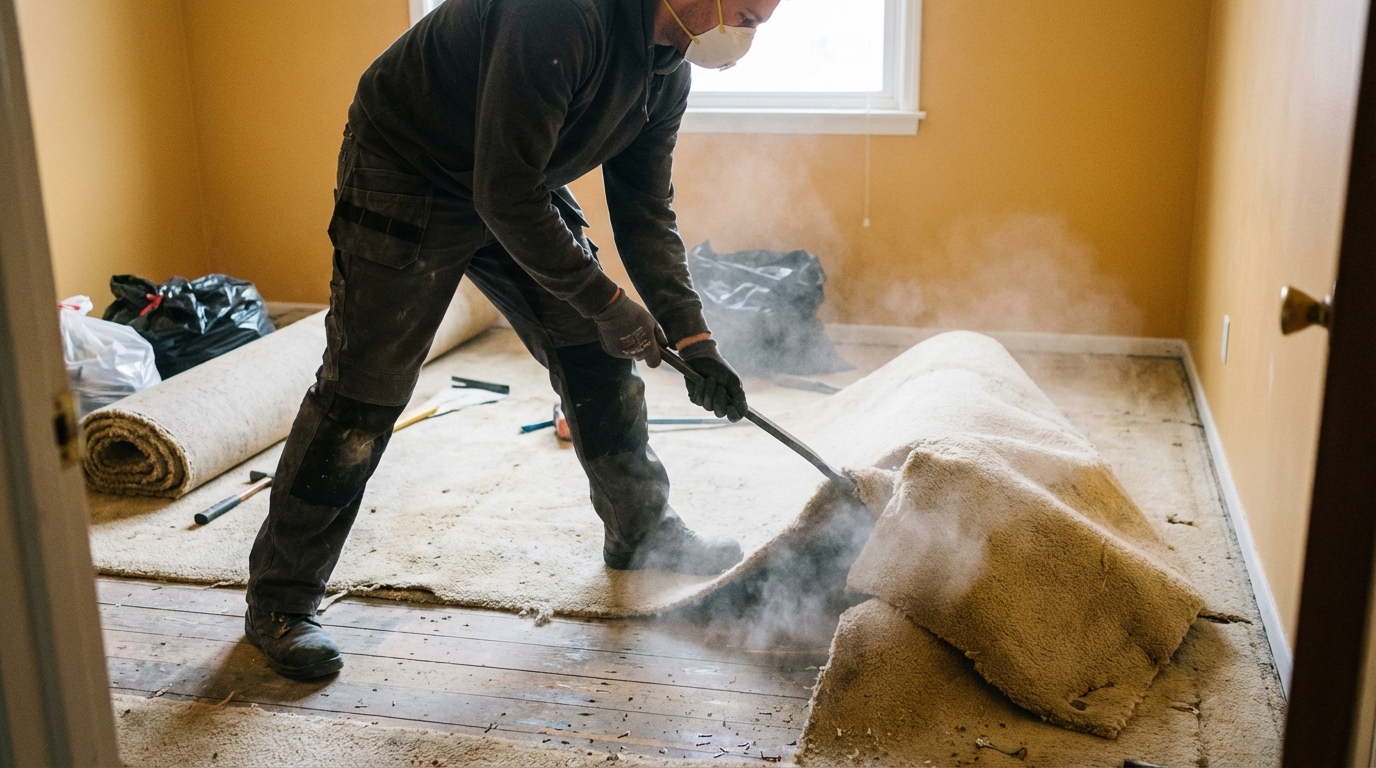
So, you are trying to remove old carpet and you want this dusty job to be easier, safer, and not total chaos in your home.
You can make carpet removal much easier by planning the cuts, containing dust, using the right basic tools, and working in a simple step-by-step order.
Old carpet removal looks messy, but once you break it into stages, you can get it done without destroying your back, your lungs, or your schedule. You do not need pro-level tools. You need a plan, a knife, some safety gear, and a way to move trash out of the house fast.
Things you need to know:
- Most of the work is prep and dust control, not brute strength.
- Short, narrow strips of carpet are easier and safer to carry.
- Sharp blades and gloves matter more than fancy tools.
- Dust travels, so close doors, cover vents, and wear a mask.
- Carpet hides staples, tacks, and sometimes mold, so work slow.
- Disposal rules for carpet differ by city, so check before you start.
- Photos of each stage help if you plan to install new flooring later.
Why old carpet removal feels so hard (but does not have to be)
Let me say this straight: removing carpet is not skilled work, but it is physical and dirty. The confusion comes from three things:
- You cannot see what is under the carpet.
- Dust and fibers kick up right in your face.
- The rolls get heavy and awkward fast.
If you fix those three, the project turns into a repeatable routine.
> When jobs feel overwhelming, it is almost always because the steps are blurry. Make the steps simple and boring, and the job shrinks.
For context, flooring installers do this every single day on tight schedules. They are not superheroes. They follow a predictable pattern:
- Protect the space.
- Slice carpet into lanes.
- Roll, tape, and remove.
- Pull pad, tack strips, and staples.
- Check the subfloor.
- Clean and haul away.
You can mirror that pattern and save money, or just prep the room before pros arrive so they spend less time and you pay less.
Gear you actually need (and what is optional)
You do not need a truck full of tools. You do need a small set of helpful items.
| Item | Why you need it | Pro tip |
|---|---|---|
| Utility knife with sharp blades | To cut carpet into strips | Change the blade as soon as cutting feels harder. |
| Work gloves | Protects hands from tacks and rough backing | Leather or heavy fabric, not thin latex. |
| Dust mask or respirator | Keeps dust, fibers, and dander out of your lungs | Use at least a basic N95-style mask. |
| Safety glasses | Stops dust and bits from hitting your eyes | Especially helpful when pulling staples. |
| Pry bar or flat bar | To lift tack strips and stubborn nails | Pair with a hammer for leverage. |
| Pliers | For staples and odd nails | Needle-nose work well for tiny staples. |
| Contractor trash bags | Handle heavy, sharp carpet pieces | Look for 3 mil or thicker bags. |
| Duct tape or packing tape | To secure rolled carpet and pad | Tape each roll in at least two places. |
| Knee pads (optional) | Protects knees on hard subfloor | Simple foam straps work fine. |
| Shop vac | For cleaning dust and staples | Use a fine dust filter if available. |
> The most underrated tool for this job is not a knife. It is a mask. Dust from old carpet can hang in the air for hours.
Step 1: Prep the room so the dust stays put
This is where many people rush and then regret it later. You can cut your cleanup time in half by spending 15 to 30 minutes on prep.
Clear as much as you can
Get furniture, rugs, and small items out of the room. If something is too big or heavy to move out, push it to one side of the room and you will work in two phases: one side, then the other.
- Remove lamps and low-hanging items.
- Take art off walls near the floor if you care about dust.
- Stack light items in another room, not in the hallway.
Control air and dust movement
Turn off any ceiling fans. If your HVAC system is running, set it to off while you do the dustiest cuts, or at least close vents and returns in that room with painter’s tape and plastic.
You can hang plastic sheeting or an old sheet over open doorways to limit dust spread.
> Think of dust like water. If there is a path, it will find it. Your goal is to block or narrow the paths.
Take quick “before” pictures
Use your phone and get:
- Wide shots of the room.
- Close-ups near doorways and transitions.
- Any areas where the floor feels soft or squeaky.
These shots help later when you talk to installers or if you spot damage under the carpet and need a record.
Step 2: Start with a test corner or edge
You do not need to attack the whole room at once. Start small.
Pick a corner of the room. Put on gloves, mask, and eye protection. Use pliers or your fingers to grab the carpet near the wall and pull up. You want to:
- See how strongly the carpet is attached to tack strips.
- Check if the padding is glued or just stapled.
- Get a first sense of dust level and smell.
If it feels stuck, slide a flat bar under the edge and lift gently. Try not to yank straight up. That is how you catch a hand on a tack strip.
Many older carpets will release with a steady pull because they are hooked onto the tacks, not glued.
Watch for these early warning signs
While that first corner is up, look underneath:
- Black or dark staining on the pad or subfloor near doors or windows can suggest old moisture problems.
- Strong musty odor can suggest mold; if it is intense, pause and think about bringing in a pro.
- Cracked concrete or soft wood under that area means you will want to patch before new flooring.
> Do not ignore a strong musty smell. The carpet might be hiding more than dust.
If everything looks normal, you can move to full removal.
Step 3: Cut carpet into manageable sections
This is the trick that makes the job feel easier.
Mark your cutting lanes
You want strips that you can roll and carry without strain. For most people:
- Width: 2 to 3 feet wide.
- Length: the full room length is often fine, but adjust to what you can lift.
Think of it like slicing the room into long “carpet lanes.”
A simple pattern:
- Pull up a strip at the edge, maybe 2 to 3 feet wide.
- Fold that strip back on itself to expose the backing.
- Cut from the back side with the utility knife along your lane.
Cutting from the back reduces fibers flying everywhere and gives your blade a smoother surface.
Use your body, not just your arms
When you pull the carpet up along a wall:
- Keep your back straight.
- Use your legs to shift weight backwards.
- Pull with both hands close to your body, not with outstretched arms.
Short bursts are better than long, intense pulls.
> Professionals do not try to be heroes. They cut smaller, carry smaller, and work steadily.
Keep a blade-change habit
Carpet dulls blades very fast. A dull blade:
- Takes more effort and time.
- Slips more easily, which can lead to cuts.
- Creates ragged edges that shed more fibers.
Change blades:
- Every 50 to 75 square feet, or
- As soon as you feel yourself pressing harder.
Blades are cheaper than injuries or frustration.
Step 4: Rolling, taping, and hauling strips
Once you have a strip cut, roll it up immediately. Do not wait until the whole room is stripped to start rolling. That is a recipe for tripping and confusion.
How to roll carpet strips
- Start rolling from one end, backing up as you go.
- Keep the roll tight so it takes less space.
- Use duct tape to wrap the roll in two or three places.
If the carpet is thick or stiff, you might find it easier to roll with the backing facing out. Test both ways and choose what feels easier to handle.
Weight matters more than size
Do not aim for the largest rolls you can make. Aim for rolls you can:
- Lift without holding your breath.
- Carry through doorways without bumping everything.
- Set down gently without dropping.
If in doubt, cut shorter strips. Many cities accept carpet rolled into 4-foot lengths, sometimes shorter. Check your local rule before you start.
> One extra cut now is easier than nursing a pulled muscle later.
Create a mini “staging zone”
Plan where each roll goes before it heads outside:
- Near the front or back door if you can.
- Stack no more than two rolls high so they do not topple.
- Keep a clear path so you are not stepping over rolls while carrying others.
This is more about workflow than strength. A clean path saves time and keeps you from tripping with a heavy roll in your hands.
Step 5: Dealing with the carpet pad
Once the carpet is up, the pad underneath usually feels much lighter, but it can be tricky in different ways.
How the pad is attached
You will see one of these:
- Pad stapled to a wood subfloor.
- Pad glued to a concrete slab.
- A mix of both.
If it is stapled:
- Grab a corner and pull up in sections.
- It often rips into smaller pieces as you pull.
- Roll or fold the pad sections and bag them.
If it is glued:
- Pull up what comes off easily.
- Use a floor scraper or flat shovel to lift the rest.
- Expect some stubborn areas that need more scraping.
Sometimes you will see chunks of foam stuck to the slab. Those can stay if you are putting down new carpet, but if you want a smooth hard surface later, you will want the slab fairly clean.
Pad rolls vs bagging
Carpet padding is lighter than carpet but bulkier.
Two common methods:
- Roll and tape larger pieces, same as carpet.
- Fold and bag into contractor bags in smaller chunks.
If your city has strict bulk trash limits, bagging can be easier to measure and manage.
> Do not skip the pad thinking you can slice carpet and leave pad. A clean subfloor is what makes the next floor last longer.
Step 6: Tack strips and staples (the “hidden” time sink)
This is the part that many people forget to budget time for. Carpet removal feels done once the big pieces are gone, but the floor still has small hazards everywhere.
Removing tack strips
Tack strips are narrow wooden strips with small nails that hold the carpet edge. They sit around the perimeter of the room.
To remove them:
- Wear gloves and eye protection.
- Place a flat bar under the strip near a nail.
- Tap the bar gently with a hammer to get under.
- Pry up a little at each nail along the strip.
Try not to pry straight upwards in the middle of a strip. That can crack the wood into shards with sharp nails.
Stack removed strips in one place, with nails facing inward or down. Many people wrap them in plastic or tape before trash day, so the nails do not poke through bags.
Pulling staples (do not rush this)
Look across the floor at a low angle. You will often see:
- Rows of small staples where the pad was attached.
- Random single staples or nails left from old repairs.
Use pliers or a small scraper to loosen and remove them. This part feels slow, but it matters, especially if you plan to install:
- Luxury vinyl planks.
- Laminates.
- Engineered wood floors.
Those need a flat, clean surface. A single staple left behind can create an annoying bump or even damage underlayment.
> The fastest way to find missed staples is with your socks. The worst way is with bare feet.
A magnet on a stick is handy in some rooms; it grabs loose nails and staples that your eyes miss.
Step 7: Inspecting the subfloor like a pro
With everything up, you now see what was hidden. This is your chance to fix small issues before they become big ones.
What to check on a wood subfloor
Walk slowly around the room and pay attention to:
- Squeaks or creaks when you step.
- Soft spots that feel spongy.
- Gaps between sheets of plywood or OSB.
- Dark stains from past leaks or spills.
Simple fixes you can do yourself before new flooring:
- Drive deck screws into squeaky areas to tighten boards to joists.
- Sand small high spots so planks or tile sit flatter.
- Fill small gaps or holes with wood filler suitable for subfloors.
If you see major rot or a large soft area, that is a good moment to call a flooring contractor or carpenter for that spot before you cover it again.
What to check on a concrete slab
Look for:
- Cracks that are wider than a hairline.
- Areas where the slab seems to slope sharply.
- Old adhesive that forms ridges.
Small hairline cracks are common and usually not a big deal. Wider cracks might need patching compounds or a consult with a pro, depending on what you plan to install.
Scrape off any high blobs of glue. Your goal is not perfection, just a reasonably flat surface that will not telegraph through the new floor.
> Think of this step as cheap insurance. You have the floor exposed, so small fixes now can extend the life of the next floor.
Managing dust, allergens, and air quality
Old carpet often holds years of dust, pollen, pet dander, and whatever else got tracked in. If someone in your home has allergies or asthma, this part matters a lot.
Before you start cutting
Two easy moves:
- Vacuum the carpet with a vacuum that has a HEPA filter.
- Spot-vac corners and along baseboards where dust builds up.
This step alone can reduce airborne debris when you start pulling.
During removal
Keep your mask on, even if the air “looks” clear. Fibers and fine dust are hard to see.
You can also:
- Open windows on mild days to create light cross-ventilation.
- Run an air purifier outside the room to catch what escapes.
- Take short breaks to step outside and get fresh air.
After the carpet is out
Once the bare floor is exposed:
- Use a shop vac to collect all loose dust, staples, and small scraps.
- Vacuum baseboards and low parts of the walls.
- Wipe hard surfaces with a damp cloth to catch remaining dust.
You can run your home’s HVAC fan with a fresh filter afterward to capture lingering airborne particles.
> The job ends not when the last strip is out, but when the room feels clean enough that you do not taste dust in the air.
Disposal: getting rid of carpet without drama
Disposal rules can change by city, and sometimes by neighborhood. This is where a 5-minute phone call saves a lot of headaches.
Check local rules before you cut
Look up:
- City sanitation or solid waste website.
- County waste center or transfer station rules.
- Any size or weight limits for bulky trash pickup.
You might find things like:
- Carpet must be cut in 4-foot or shorter lengths.
- Each roll must weigh under a set limit.
- Pickup is only on certain days or by appointment.
> When you know the rules first, you cut strips to match and you do not re-cut rolls later.
Options for getting it out of your life
Common routes:
- Regular trash pickup if allowed by your service.
- Bulk pickup scheduled with your city.
- Drop-off at a landfill or transfer station.
- Private junk removal service, especially for big jobs.
If you are removing carpet from several rooms or a full house, consider a small dumpster. The cost per room often drops compared to hiring out each load.
Safety shortcuts that are not worth it
It is tempting to skip some steps to “save time.” Some shortcuts are harmless. Some are not.
Working without basic protection
Common risky moves:
- Skipping the dust mask because it feels annoying.
- Pulling carpet barefoot or in soft house shoes.
- Not wearing gloves around tack strips.
These often lead to:
- Coughing fits or headaches later.
- Small punctures or cuts that can get infected.
- Eye irritation from airborne fibers.
> Personal protective gear looks simple, but it acts like a filter between you and the parts of the job you cannot see.
Overloading bags and rolls
If you load bags or rolls to the limit:
- Bags split while you carry them.
- You strain your back or shoulders.
- Trash crews may refuse overloaded items.
Aim for bags you can lift with one hand without strain. That small change makes trips to the curb or truck less of a workout.
When you should call in a pro
Most standard carpet removal is DIY-friendly. Still, there are red flags where professional help is smart.
Health and material concerns
Pause and think about a pro if:
- The carpet or pad is soaked or was recently flooded.
- You see heavy mold growth on the pad or subfloor.
- Your home was built before the mid-1980s and you suspect old adhesives or tiles under the carpet contain asbestos.
In those cases, a flooring contractor or an environmental specialist can advise on safe removal procedures. Some materials need special handling, not just regular trash.
Scale and time limits
If you have:
- Multiple floors of a house to strip.
- Very limited time before new flooring install.
- Limited ability to lift and carry heavy items.
Hiring removal help for the heavy lifting can make sense. You can still manage planning, layout decisions, and follow-up cleaning.
> Sometimes the right move is to do the parts you can handle and pay for the rest, not force yourself through every step.
Getting ready for the next floor
If you are putting in new flooring soon, a few extra steps now make that install smoother.
Document the subfloor condition
Take new photos:
- Wide shots of the entire bare floor.
- Close-ups of problem areas, cracks, or stains.
- Any spots where you added screws or filler.
If a contractor comes later and has questions, you can show what you saw and what you already fixed.
Clarify your installation plan
Before you forget the details:
- Note which direction you want new planks or boards to run.
- List any squeaks that still remain.
- Write down room dimensions and any odd angles.
These small notes help you order the right amount of material and talk clearly with installers or store staff.
Simple project plan you can follow
If you like structure, here is a straightforward one-room plan you can adapt.
Day-before checklist
- Confirm disposal rules with your city or waste company.
- Buy blades, gloves, bags, tape, and a mask.
- Clear as much furniture as possible from the room.
Day-of flow
- Spend 15 to 30 minutes on prep and dust control.
- Test a corner and look under the carpet.
- Slice the carpet into 2 to 3 foot lanes and roll as you go.
- Remove padding, then tack strips, then staples.
- Vacuum the bare floor and inspect it.
- Stage all rolls and bags for disposal in one area.
If the room is large or you are working solo, do not hesitate to split the job over two days. One for cutting and rolling, one for detailed cleanup and inspection.
> The best practical tip: set a timer for short work blocks, like 25 or 30 minutes, with short breaks. It keeps your focus sharp and your body from getting too tired too fast.