
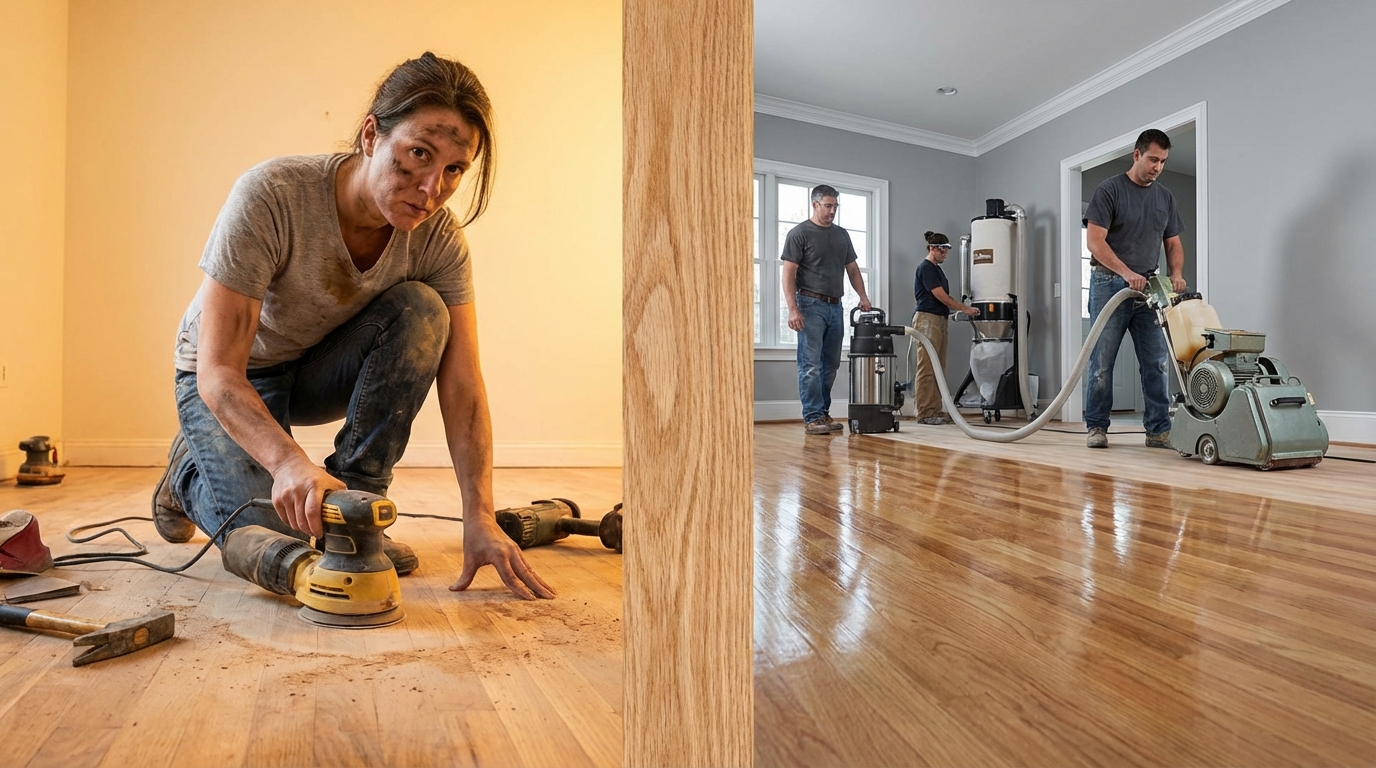
So, you are trying to decide whether to refinish your hardwood floors yourself or hire a pro.
You should hire a pro if you care about the finish quality, your time, and your resale value; DIY makes sense only if you have patience, basic skills, the right tools, and you accept some risk.
Here is the short version: refinishing hardwood looks simple on YouTube, but it is noisy, dusty, physical work with a lot of small steps that can go wrong. That said, if your floors are not in terrible shape and you like hands-on projects, a DIY refinish can save you a big chunk of money and still look good enough for most homes.
Things you need to know:
- The main cost difference is labor; materials are similar for DIY and pro jobs.
- DIY sanding mistakes can permanently damage floors and lower home value.
- Choosing the right sander type is more important than most people expect.
- Oil-based vs water-based finishes change cost, smell, and durability.
- Time without access to rooms matters a lot if you live in the house during the job.
- Not every floor should be sanded; sometimes a screen-and-recoat is better.
- Dust control and ventilation affect both health and finish quality.
- A pro’s warranty and insurance protect you if something goes wrong.
What “refinishing” hardwood really means
When people say “refinish hardwood,” they usually mean one of two things:
- Full sand and refinish: sanding down to bare wood, fixing defects, then applying stain (optional) and clear finish.
- Screen and recoat: light abrasion of the existing finish and a fresh topcoat, without going down to bare wood.
Most of the time, the DIY vs pro struggle is about the full sand and refinish. A screen-and-recoat is much more DIY friendly, so keep that in mind.
Let me break down what the full process actually includes, because this is what separates “looks good on pictures” from “looks like a pro did it.”
Core steps of a full refinish
- Room prep: move everything, remove base shoe or quarter round if needed, cover vents and doorways.
- Rough sanding: remove old finish, stains, and surface damage.
- Progressive sanding: move through finer grits to remove scratches and swirls.
- Edging and corners: handle spots big machines can’t reach.
- Repairs: fill gaps, nail holes, cracks; replace damaged boards when needed.
- Cleaning: vacuuming and tack cloth to remove dust between steps.
- Staining (optional): apply stain evenly and wipe back correctly.
- Finish coats: 2-4 coats of polyurethane or hardwax, with light abrasion between coats.
- Cure time: waiting before walking on, moving furniture, or putting rugs down.
Each of those steps has its own way to mess up. That is where the DIY vs pro choice gets real.
Cost comparison: DIY vs hiring a pro
Let us look at real numbers. Assume you have about 600 square feet of hardwood (a common size for a living room plus hallway and maybe a dining room).
Typical cost ranges
| Option | Approx cost per sq ft | 600 sq ft estimate | What is included |
|---|---|---|---|
| Professional, sand & refinish (oil-based poly) | $4 – $6 | $2,400 – $3,600 | Sanding, basic repairs, 2-3 coats finish |
| Professional, sand & refinish (water-based poly) | $5 – $8 | $3,000 – $4,800 | Faster cure, lower odor, more coats |
| Professional, screen & recoat | $1.50 – $3 | $900 – $1,800 | No full sanding, surface refresh |
| DIY full sand & refinish (rental gear) | $1 – $2.50 (effective) | $600 – $1,500 | Rentals, materials, some extras |
| DIY screen & recoat | $0.50 – $1.25 | $300 – $750 | Screen discs, finish, applicators |
Typical DIY cost breakdown (600 sq ft)
- Drum or orbital sander rental: $60 – $80 per day, often 2-3 days.
- Edge sander rental: $40 – $60 per day.
- Sandpaper (several grits, lots of sheets): $100 – $200.
- Shop vacuum / dust control gear: maybe $40 – $150 if you need better filters or to rent a vacuum.
- Stain (if used): $40 – $100.
- Finish (polyurethane or similar): $150 – $300 depending on type and brand.
- Applicators, pads, tack cloths, rags, plastic sheeting, tape: $50 – $100.
- Safety gear (mask with proper filters, knee pads, ear protection): $50 – $150 if you do not have it.
By the time you are done, you often land somewhere around $700 to $1,200 for a “typical” DIY job on 600 square feet. So yes, you can save a couple of thousand dollars. The tradeoff is risk and time.
Time & effort: how long it really takes
A standard pro crew (2-3 people, with their own gear) can handle 600 square feet in:
- Day 1: full sanding and repairs.
- Day 2: stain (if needed) + first coat of finish.
- Day 3: more coats of finish and detail work.
There is still cure time after that, but your active disruption is a few days.
For a DIYer, the same 600 square feet tends to look more like:
- Evening 1: clear rooms, plastic up openings, pull vents, nail down squeaks.
- Day 1: rough sand. You are learning the machine, fixing mistakes, dealing with dust.
- Day 2: medium and fine sanding, edge sanding, corners.
- Day 3: detail, cleaning, and staining (if used).
- Day 4: first coat of finish.
- Day 5: second coat of finish.
- Day 6: third coat if needed.
You can overlap some steps, but if you have a job or kids, these days may stretch into two weekends plus evenings.
One more thing: during finishing days, you are walking carefully, managing pets, trying not to kick dust up, and you may not be able to sleep in certain rooms.
Risk: what can actually go wrong
This is where most people underestimate the difference between DIY and pro.
Common DIY sanding problems
- Gutters or dips in the floor
If you stop moving while the drum is down, the sander eats a groove into the wood. These are hard to fix and very visible in sunlight. - Waves or chatter marks
Cheap or poorly handled machines leave visible patterns that show up once the finish goes on. You rarely notice them until it is too late. - Uneven sanding near walls
The big machine cannot reach right up to the baseboard. If your edge sander work does not match the rest of the floor, you get a “halo” zone with different color or sheen. - Swirl marks from edgers
Holding the edger wrong or using the wrong grit leaves circles, which stain will highlight.
Finish and stain problems
- Lap marks
If finish overlaps and starts to set before you blend it, you get visible lines. Water-based products set quicker, so this is common for first-time DIYers. - Bubbles, dust, and debris
Inadequate cleaning or poor technique can leave bumps in the finish. Those bumps snag socks, collect dirt, and look unprofessional. - Blotchy stain
Some woods (like maple or birch) take stain unevenly. If you do not pretreat or test, you can end up with dark patches. - Wrong product combo
Not every stain works well under every finish. Some combinations peel or do not bond well, which shortens the life of your refinish.
Structural and safety concerns
- Over-sanding thin floors
Older homes sometimes have hardwood that has already been sanded several times. You can literally sand down to nails or tongues if you go too far. - Dust explosion hazard
In extreme cases, fine wood dust in a closed space plus a spark can cause a flash fire. Pros know how to manage dust and static; DIYers often do not think about this. - Fumes and health
Oil-based finishes give off strong VOCs. Using them without proper ventilation and respirators can lead to headaches and worse.
A pro is not magic. They can make mistakes too. The difference is experience, better gear, and usually some type of warranty and insurance if they damage your home.
When DIY refinishing makes sense
Let us talk about conditions where a DIY refinish is a reasonable choice.
You have moderate wear, not deep damage
DIY is more realistic if:
- The finish is worn, dull, or lightly scratched, but boards are still flat.
- You do not have deep pet stains, water damage, or cupped boards.
- The floor is mostly one type of wood, without lots of patchwork repairs.
If your floor just looks tired or yellow and you want a cleaner, more modern finish, that is closer to ideal for DIY.
You are patient and fairly handy
You do not need to be a contractor, but you should be comfortable with:
- Using power tools safely.
- Following multi-step instructions without skipping prep.
- Accepting that your first attempt will not be perfect.
If assembling IKEA furniture feels overwhelming, a full sand and refinish might be a stretch.
You can live with imperfections
This is a big one. A DIY refinish can look very good from normal standing height, but if you get down on the floor with a flashlight, you may see:
- Small waves in the reflection.
- Minor swirling near edges.
- A dust nib or two in high light areas.
If that kind of thing bothers you every time you walk in the room, you might be happier paying for a pro.
Your budget really needs the savings
There are times where the math drives the decision. If paying a pro means going into heavy debt, and you have some basic skills, a careful DIY job can be a smart trade.
Here is where a middle path often works: do a screen and recoat yourself instead of a full sand, if your floor allows it.
When hiring a pro is the smarter move
Now, let us flip it. Certain conditions strongly favor hiring a pro.
Your floors have serious damage
You should lean toward a pro if you see:
- Large black pet stains that go deep.
- Cupped or warped boards.
- Loose boards or big gaps.
- Areas where finish has worn fully to bare, gray, fuzzy wood.
These are not just cosmetic issues; they can need board replacement, moisture evaluation, and more experience with sanding patterns.
You are selling or renting the property soon
Buyers and renters judge floors quickly. A high quality finish can:
- Help your listing photos stand out.
- Support a higher price or rent.
- Cut questions about “what else is DIY in this house.”
Here, pro work is part of your marketing. A bad DIY job can cost more than it saves if it drags the perceived value down.
You have limited time and a full household
If you have:
- Kids running around.
- Pets that cannot be boarded.
- No easy way to clear large rooms for several days.
- A job that leaves you exhausted in the evenings.
Then the extra time needed for DIY can be too much. A pro crew moves faster, brings extra hands, and knows how to sequence the job to minimize disruption.
You want a specific color or high-end finish
Tricky finishes are not friendly to first timers:
- Very dark stains that highlight every sanding mark.
- Whitewashed or gray finishes on woods that blotch.
- Ultra-matte or very high-gloss topcoats where every defect shows.
- Two-part commercial finishes with short working time.
If you care about a particular look you saw on Pinterest or in a showroom, there is a good chance a pro has already done that exact thing many times.
Types of sanders: big difference for DIY
One key technical choice for DIYers is the type of sander you rent. This decision changes your learning curve and your risk level.
Drum sander vs random orbital vs square buff
| Machine type | Skill level needed | Pros | Cons |
|---|---|---|---|
| Traditional drum sander | High | Very fast at removing finish and leveling floors. | High risk of gouges; steep learning curve. |
| Random orbital floor sander | Medium | More forgiving; less risk of deep damage; easier for DIY. | Slower; might struggle with thick old finishes. |
| Square buff (oscillating) sander | Low | Gentle; good for screen and recoat or light sanding. | Very slow for full refinish; might not remove all finish. |
If you are set on DIY, a rental random orbital floor sander is usually the best compromise. It is slower than a drum but much more forgiving.
You still need an edge sander and lots of sandpaper. Do not skimp there.
Finishes: oil-based vs water-based vs hardwax
Choosing finish is not just about shine. It affects smell, durability, and time out of your house.
Oil-based polyurethane
- Color: tends to amber over time, giving a warm tone.
- Durability: tough, good for busy homes.
- Smell: strong odor while curing; VOCs are higher.
- Dry time: slower; often 8-24 hours between coats.
- DIY complexity: forgiving; longer open time lets you fix minor mistakes.
- Cost: usually cheaper per gallon.
Water-based polyurethane
- Color: more clear; better if you like a natural or light look.
- Durability: newer products are strong, especially 2-part commercial grades.
- Smell: much lower odor; better if you live in the house.
- Dry time: fast; can do multiple coats in a day.
- DIY complexity: less open time, so you have to move faster.
- Cost: more expensive, especially higher-end brands.
Hardwax oils and similar products
- Feel: more natural, less “plastic” than thick poly coats.
- Repair: easier to spot-repair small areas.
- Durability: can be strong but needs more routine care.
- DIY: application is different; more rubbing, wiping, and buffing.
For most DIYers, oil-based or a good consumer-grade water-based poly offers the best mix of durability and ease.
Technique differences: what pros do that DIYers often skip
Let me walk through a few details that separate pro work from a typical first DIY attempt.
Pro sanding sequences
Pros rarely jump from very coarse to very fine grits. A typical sequence on a damaged floor might look like:
- 36 grit: remove finish and flatten.
- 60 grit: remove 36-grit scratches.
- 80 grit: refine scratches.
- 100 or 120 grit: final smoothing, depending on wood and finish.
They match this on both the big machine and the edger, then often use a buffer with a fine screen to blend everything.
DIYers often try to save time and money by skipping grits or using too few sheets. Then scratches show up after stain or under raking light.
Dust control and cleaning
Professionals:
- Use better vacuums and dust shrouds.
- Vacuum between every grit change.
- Vacuum plus tack cloth or damp microfiber before each finish coat.
- Control airflow so dust does not blow into wet finish.
A small bit of dust does not ruin a job, but cleaner surfaces give you a smoother, more even sheen.
Stain and finish layout planning
Pros plan how they will move through the room so they do not paint themselves into a corner. They:
- Maintain a wet edge, especially with faster drying products.
- Work with the grain as much as possible.
- Use lighting at low angles to see missed spots and drips.
DIYers sometimes work in random patches or stop for long breaks mid-coat. That is when lap marks and uneven sheen show up.
Impact on home value and resale
Floor condition is one of the first things buyers notice after curb appeal and kitchen. Nicely finished hardwood often signals that a house has been maintained.
Refinished floors can:
- Pay for themselves in higher offers in competitive markets.
- Make listing photos look brighter and cleaner.
- Help older homes feel fresh without full remodels.
On the flip side, obvious sanding gouges, uneven stain, or visible bubbles in finish can raise questions about other DIY work in the house.
If you plan to sell soon and your market is price sensitive, paying for a pro refinish can be similar to paying for good photography: it is part of your marketing package.
Screen and recoat: the overlooked middle option
Before you commit to a full sand, ask one question: do you actually need to sand to bare wood?
If your finish is worn but not completely gone, and you do not want a new stain color, a screen and recoat often does the job.
What a screen and recoat involves
- Lightly abrading the existing finish with a screen or sanding pads to give the new coat something to grip.
- Thorough cleaning and vacuuming.
- Applying 1-2 coats of finish on top.
You do not remove all scratches, especially deep ones, but you:
- Refresh the sheen.
- Add protection against future wear.
- Extend the life of the floor before a full refinish is needed.
For many homeowners, this is a better DIY starting point. Risk is lower, dust is lighter, and the learning curve is smaller.
How to decide: a simple decision guide
Let us put this into a simple structure you can actually use.
Step 1: Assess your floor condition honestly
Ask yourself:
- Are there deep stains, big gaps, or warped boards?
- Is the existing finish mostly intact or worn off in many large areas?
- Do you like the current color, or do you want a big change?
If your floor is structurally rough or you want a drastic color shift, lean toward a pro.
Step 2: Check your time, space, and stress levels
Consider:
- Do you have at least 3-5 days where rooms can be mostly off-limits?
- Can pets and kids stay away from wet finish areas?
- Are you OK with dust, noise, and some physical strain?
If any of those is a hard “no,” hiring a pro is safer.
Step 3: Run the money numbers
Take your square footage and plug in:
- Pro quotes from at least 2-3 companies.
- Your estimate for DIY rentals and materials.
Look at the difference. If DIY saves you $1,500 or more, ask:
“Is that savings worth several days of work and the risk of imperfections?”
For some people, yes. For others, not at all.
Step 4: Decide if you care more about perfect or good-enough
You might think you want perfect, but you live with “good enough” in other parts of your home. Be honest:
- If every tiny flaw will frustrate you, go pro.
- If you like saying “I did this myself” and do not mind small issues, DIY might be satisfying.
Tech perspective: where technology helps you decide smarter
Since this is a technology-focused blog, let us talk about some tools that can tilt the balance a bit toward DIY or at least reduce risk.
Moisture meters and inspection tools
Inexpensive moisture meters let you:
- Check whether boards are too wet or dry for finishing.
- Identify problem zones before you start.
Simple phone cameras with strong flash and low-angle shots can reveal:
- Waves and dips when you test a small practice area.
- Leftover scratches between sanding passes.
Online calculators and simulators
Many finish manufacturers offer:
- Coverage calculators so you buy the right amount of product.
- Color visualizers and photo tools to preview stain choices.
These do not remove the manual work, but they reduce guesswork and waste.
Rental gear upgrades
Some rental centers now stock:
- Better dust collection attachments for sanders.
- Random orbital floor machines that are more forgiving.
- HEPA vacuums that handle fine dust better.
Asking for newer or higher quality machines can significantly improve your DIY odds.
Realistic expectations for each path
Let me put the likely outcomes side by side in plain language.
| Aspect | DIY refinish (first timer) | Professional refinish |
|---|---|---|
| Look from 6 feet away | Often “good”, sometimes very good. | Consistently very good to excellent. |
| Look in raking sunlight | Often shows minor waves or swirls. | Much smoother and more even. |
| Risk of serious damage | Moderate to high if using drum sander. | Low; pros know floor thickness and limits. |
| Total money out of pocket | Low to medium. | Medium to high. |
| Time and physical effort | High. | Low (for you). |
| Stress during project | Medium to high. | Low to medium. |
| Bragging rights | High if you like DIY projects. | Low, but you get peace of mind. |
Three sample scenarios
Sometimes examples make the choice easier.
Scenario 1: Young couple, first home, limited budget
They have:
- 800 square feet of oak with worn finish.
- No deep pet stains, just scratches.
- A tight budget after closing costs.
Here, a DIY screen and recoat is very attractive. It keeps costs down, risk is low, and they can always pay for a full pro refinish several years later.
Scenario 2: Family of four, busy schedule, selling soon
They have:
- 600 square feet in main living space.
- Visible wear, pet stains, and some cupped boards.
- Plans to list the house in 3 months.
Best choice: hire a reputable pro. The finish quality affects listing photos and buyer impressions, and they do not have the time or risk tolerance for a big DIY experiment.
Scenario 3: Handy homeowner, likes projects, staying long-term
They have:
- 500 square feet in a bedroom wing.
- Some scratches and fading but no serious damage.
- Experience with other woodworking projects.
Good path: DIY refinish with a random orbital floor sander or screen and recoat first. If it turns out well, they can decide later whether to tackle the more visible main living area or call a pro.
How to talk to contractors if you lean pro
If you decide to hire out the work, technology can still help you get better results. When you speak with contractors, ask clear, specific questions.
Helpful questions include:
- “What sanding sequence do you typically use on oak / maple / my wood type?”
- “Do you use dustless equipment or standard sanders?”
- “Which finish brand and type do you prefer and why?”
- “Can I see before-and-after photos of similar jobs?”
- “What is your warranty on peeling or finish failure?”
- “How do you handle furniture moving and baseboard or shoe molding?”
The answers tell you not just their method but how they think about quality.
How to reduce DIY risk if you still want to try
If you are leaning DIY but nervous, here are a few ways to lower the stakes.
- Start with a closet or small bedroom
Practice your sanding and finishing there first. - Choose forgiving finishes
Satin sheen hides more imperfections than semi-gloss or gloss. - Use a random orbital floor sander instead of a drum if possible
It is slower but safer. - Do more test spots than you think you need
Test stain and finish in areas that will be under furniture. - Read the product instructions carefully
Especially for dry times and coat thickness. - Watch multiple tutorial videos from different sources
Look for consistent advice across channels.
> Aim for “solid and durable” over “showroom perfect” on your first DIY job.
> Your first refinish is also a training ground for future projects.
> Focus on clean prep, gentle sanding, and thin, even coats.
> Do not rush cure time just because the floor “feels” dry.
One small, practical tip to end with: before you commit to anything, take a bright flashlight at night, hold it low across the floor, and study what you see. That lighting angle will reveal scratches, dips, and dust that normal daylight hides. Use what you see to decide whether you are comfortable taking this on yourself or if it makes more sense to hand it to a pro.