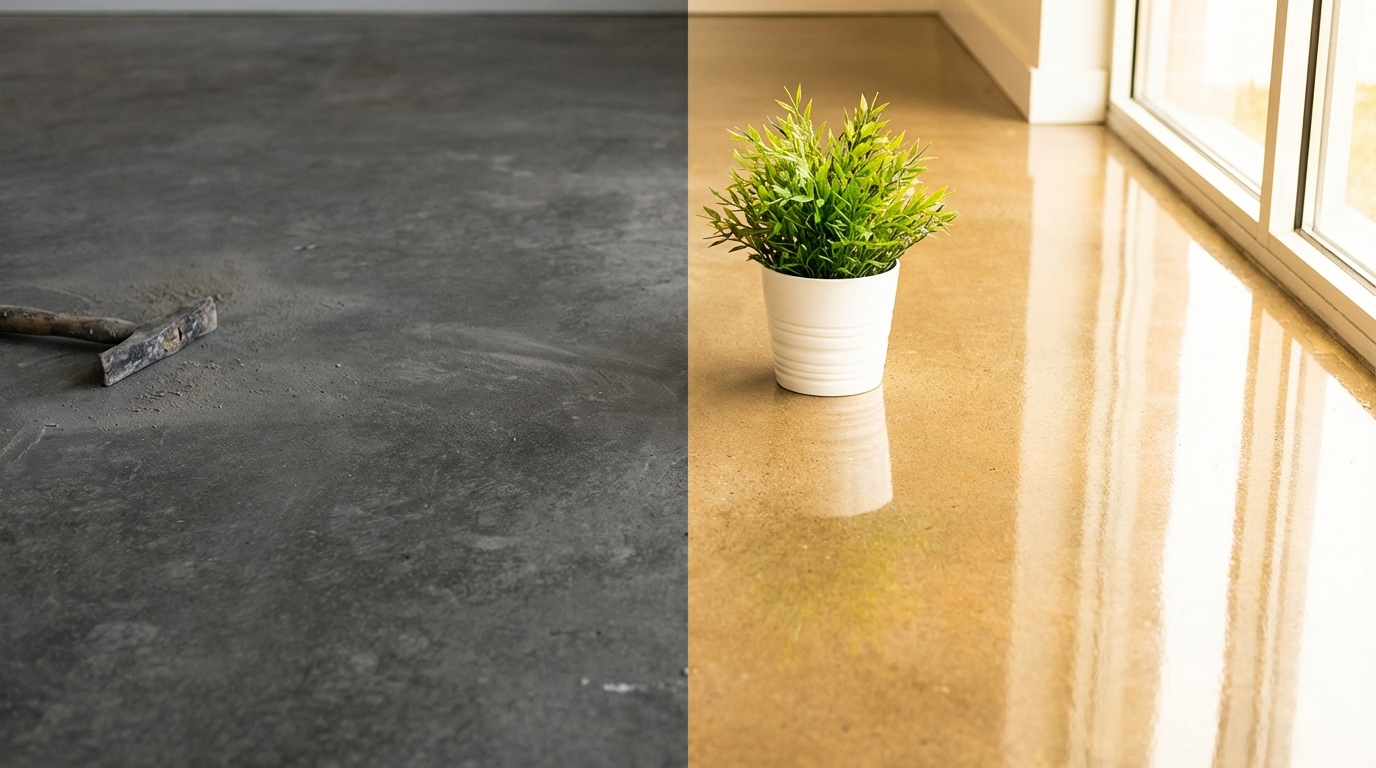
So, you are trying to figure out if polishing concrete is really the most eco friendly floor because “the greenest floor is the one you already have.”
Yes, for most buildings that already have a concrete slab, polishing that existing concrete is often one of the lowest impact flooring choices you can make.
You avoid new materials, you avoid a lot of transport and manufacturing, and you extend the life of what is already there instead of sending anything to landfill. It is not perfect, it still uses energy and chemicals, but compared to tearing out and replacing flooring, the footprint can drop a lot.
Things you need to know:
- Polishing concrete usually has a lower carbon footprint than installing new tile, vinyl, or hardwood on top of a slab.
- You are reusing an existing structural material instead of adding new finish layers.
- Most of the impact comes from the original cement in the slab, not the polishing work.
- Good dust control, low VOC densifiers, and efficient grinders make a real difference.
- Thermal mass, high reflectivity, and long life all help the building run with less energy.
- Polished concrete still needs maintenance: dust mopping, periodic burnishing, and sometimes re-sealing.
- Moisture, cracks, and weak concrete can limit how far you can polish.
Why the most eco friendly floor is often the one you already have
When people talk about “green flooring”, they tend to jump right to bamboo, cork, or recycled-content carpet tiles. Those products can be helpful, but they all share one thing: they must be made, packaged, shipped, installed, and then removed someday.
Concrete is already there in most buildings. The slab is doing the structural work whether you like its look or not.
So when you polish concrete, you are not adding a new floor. You are exposing and finishing the structural one. From a material use point of view, that is a very different story from rolling out vinyl or gluing down hardwood.
> You save the biggest chunk of environmental cost not by buying a “green” product, but by not buying a new product at all.
Where the carbon really comes from in floors
To understand why polishing existing concrete scores well, you need to look at where emissions come from.
Most floors have three main parts:
- The structural slab (often concrete).
- The finish layer (vinyl, tile, wood, carpet, etc.).
- The adhesives, underlayments, and sealers.
For a typical commercial building on a concrete slab:
- The slab is already poured and part of the building.
- Any new finish is extra weight: more raw material, more transport, more chemicals.
There is some public data you can look at. For example, common order-of-magnitude values from environmental product declarations and building studies show:
| Floor type (finish on existing slab) | Approx. embodied carbon of finish (kg CO₂e/m² over life cycle) |
Typical service life |
|---|---|---|
| Vinyl (LVT) | 15 – 25 | 10 – 20 years |
| Ceramic/porcelain tile | 18 – 35 | 30+ years |
| Engineered wood | 10 – 20 | 15 – 25 years |
| Carpet tile | 25 – 40 | 10 – 15 years |
| Polished existing concrete slab | 3 – 8 (polish, densifiers, sealers, energy) | 30+ years |
These are ballpark numbers. Your building will vary. But they tell a clear story: when you already have a slab, polishing it usually adds a lot less new carbon than installing a full new floor on top.
> The major climate hit with concrete comes when cement is made. Polishing does not add more cement, it just refines the surface.
What concrete polishing actually is
If you search “polished concrete”, you will see beautiful glossy floors in airports, galleries, and tech offices. None of that shine comes from wax piles or thick coatings.
Polishing concrete is closer to stone polishing than to painting.
The basic process in plain language
Here is how a typical contractor will handle it:
- Assessment: They inspect the slab, test hardness, and look for coatings, adhesives, and cracks.
- Surface prep: Old glues, paints, or epoxies get ground off. Joints and cracks might be filled.
- Grinding: They start with coarse diamond segments to flatten and open the surface.
- Densifying: A chemical densifier (often a silicate) is applied to harden the surface.
- Progressive polishing: They move to finer grits, step by step, to get the level of sheen you want.
- Sealing/guard: A thin guard or penetrating sealer helps with stain resistance.
- Burnishing: A high-speed burnisher sometimes heats and buffs the surface for extra gloss.
You can stop at a low sheen “honed” finish or go to a mirror-like finish that reflects light.
Each step uses tools, abrasives, chemicals, and energy. So the work is not impact-free. But again, compare that to manufacturing and shipping tons of new material.
What you do not need with polished concrete
Polished concrete typically avoids:
- Subfloor panels or sleepers.
- Plastic vapor barriers above the slab (unless you add another layer).
- Large volumes of glue, mastic, or grout for a full extra finish system.
- Thick resin coatings, except in special industrial cases.
> The eco benefit is not in perfection, it is in subtraction. You are removing layers, not stacking them.
Environmental benefits of polishing the slab you already own
Let us walk through the main angles one by one.
1. Material savings and waste reduction
When you do not install a new finish on top of the slab, you skip:
- Raw materials for the finish: PVC, additives, ceramic, wood, backing, and so on.
- Backing boards or underlayments that some floors need.
- Packaging waste for pallets of new materials.
- Future tear-out waste when that finish fails or goes out of style.
Think of a 10,000 square foot office.
If you put down new vinyl tile at, say, 2.5 kg of material per square meter, that is over 23 metric tons of extra material. Then glue, scrap, and trim. That is a lot of stuff leaving a factory, moving on trucks, sitting in a dumpster at the end of its life.
With polishing, the biggest waste stream is usually:
- Dust and slurry from grinding.
- Old adhesives and thin coatings you strip off.
Those can still be messy, but they tend to be much lighter than a full new floor system.
2. Lower embodied carbon for the finish
You cannot undo the carbon that went into the original slab. That cement was fired in a kiln a long time ago. So you work with what you have.
For the new work on top:
- Diamond abrasives, silicate densifiers, and thin guards have some embodied carbon, but far less per square meter than bulk floor coverings.
- The biggest variable is usually the electricity or fuel used by grinding machines and dust collectors.
If your site uses a cleaner power mix, that energy footprint drops even more.
> Polishing is one of the few finish options where labor and energy outweigh new material mass.
3. Longer service life and lower replacement frequency
Floor finishes wear. They scratch, dent, fade, and then get replaced. Every cycle brings new production, shipping, and landfill.
Polished concrete has a different pattern:
- The slab itself can last for the life of the building.
- Surface wear can be renewed with re-polishing instead of full removal.
- Well-maintained polished floors in retail and airports have run for 15 to 20+ years with only periodic touch-ups.
If you think over a 40-year horizon, replacing vinyl or carpet two or three times can have a larger footprint than a single polish plus minor renewals.
4. Lower lighting energy through reflectivity
Shiny floors are not just about looks.
Polished concrete can have a high light reflectance value (LRV). In practice, this can:
- Help bounce daylight deeper into a space.
- Allow lower artificial lighting levels for the same visual comfort.
- Support lighting control strategies, like dimming or task tuning, more effectively.
Several building studies have reported lighting energy savings in the 10 percent range when moving from dark, light-absorbing floors to lighter and more reflective surfaces paired with good lighting design.
You do not get that effect with every color or finish, but a medium or light gray polished surface can contribute.
5. Thermal mass and comfort
Concrete holds heat and coolth. That thermal mass can help in:
- Spaces with large swings in solar gain, such as those with big windows.
- Buildings that use night ventilation or off-peak cooling.
If you cover the slab with carpet or thick underlayments, you reduce how much the slab can interact with the room air.
Exposed polished concrete keeps more of that mass “available” to smooth temperature swings. You still need good design: shading, controls, and comfort strategies, especially in cold climates.
6. Indoor air quality and VOCs
Traditional floors can off-gas:
- Volatile organic compounds from adhesives.
- Plasticizers and residual monomers in some vinyl products.
- Formaldehyde in some woods and underlayments.
Polished concrete can avoid many of those, if you choose products carefully. You want:
- Low VOC densifiers and guards with independent certification.
- Good ventilation during application and early use.
You may still have small amounts of chemicals present, but usually far fewer categories of compounds than with multi-layer systems.
> Fewer layers often mean fewer hidden chemical sources, which makes indoor air easier to control.
Where polished concrete is not perfect
Now, none of this means polished concrete is some kind of miracle material that always wins.
There are trade-offs you need to look at honestly.
Comfort, acoustics, and slip resistance
Polished concrete has some known drawbacks:
- Hardness underfoot: Standing all day on polished concrete can be tough on joints. Staff areas may need mats or resilient zones.
- Acoustics: Bare hard floors reflect sound. You will likely need acoustic ceilings, wall treatments, or rugs in some areas.
- Slip resistance: High gloss plus water or oil can get slippery. You can choose lower sheen, etched finishes, or additives in wet zones.
From a sustainability angle, that means you might still bring in some materials: rugs, acoustic panels, mats. Even then, the total is often less than a full extra floor.
Moisture, cracks, and poor concrete
Not every slab is a good candidate for polishing.
Common issues:
- Moisture vapor: If your slab has high moisture, you can see dark spots, efflorescence, or sealer failures.
- Structural cracks: Hairline cracks can be filled and blended; major movement may show regardless of polishing.
- Soft or weak concrete: Low-strength surfaces can “ravel” under grinding, leading to a patchy look.
- Heavy contamination: Old oils, adhesives, or unknown chemicals can migrate up and stain or weaken the top layer.
Concrete testing before you commit is not a luxury, it is the base for a sound decision. Sometimes the right call really is to encapsulate with a different system.
Energy use and dust in the polishing process
Polishing needs:
- Grinders and vacuums, often 480V or gas powered on big jobs.
- Multiple passes with different grits.
- Dust collection and sometimes water for wet grinding.
From an environmental point of view:
- Dust must be captured with HEPA vacuums to avoid respiratory issues and site contamination.
- Slurry from wet grinding must be collected and handled properly, not washed into drains.
- Running on cleaner grid electricity or diesel alternatives can reduce emissions further.
That might feel like a lot of effort, but compare it to the chain of steps for making vinyl from oil or firing ceramic in kilns. The relative footprint is still much smaller, especially at scale.
Comparing polished concrete to other popular floors
Let us put polished concrete side by side with some common choices. The exact numbers will shift project by project, but the pattern stays pretty stable.
| Floor type | Main materials | Typical pros | Typical cons | Relative environmental impact (finish layer only) |
|---|---|---|---|---|
| Polished concrete (existing slab) | Existing concrete, densifier, guard | Very durable, low material use, easy cleaning, reflective | Hard, can be noisy, may crack, needs skilled crew | Low |
| Vinyl (LVT) | PVC, plasticizers, fillers | Many patterns, softer, easy to install | Plastics, VOCs, shorter life, landfill at end | High |
| Carpet tile | Fiber (nylon, PET, etc.), backing | Comfort, acoustics, modular replacement | Frequent replacement, dust, cleaning chemicals | High |
| Ceramic or porcelain tile | Clay tile, grout, thinset | Very durable, moisture resistant | Labor heavy, brittle, cold underfoot | Medium to high |
| Engineered wood | Wood veneer, composite core | Warm look, more comfortable | Susceptible to water, refinishing limits | Medium |
> If you already own a slab, you start the race halfway done. Most other systems are asking you to start again from the beginning.
When polishing concrete is a strong ecological choice
Polishing stands out in certain situations more than others.
1. Commercial renovations on slab-on-grade
Think offices, retail, warehouses, schools:
- The concrete slab is already there and usually thick enough.
- Many old finishes are worn and headed for a dumpster anyway.
- You can expose, repair, and polish instead of adding another full system.
Conversion projects are especially good candidates. Old retail units turning into studios, warehouses turning into coworking, that kind of thing.
2. High-traffic spaces
Entry lobbies, corridors, airports, grocery stores:
- These spaces punish many finishes.
- You would probably replace softer floors several times over the building life.
- Polished concrete handles carts, foot traffic, and cleaning machines well.
Lifecycle modeling often shows that the first cost of polishing can be higher than, say, a basic vinyl, but the total cost of ownership drops because you are not swapping floors every 12 to 15 years.
3. Buildings pursuing certifications or low-carbon goals
If you are targeting lower embodied carbon in a new build or major fit-out, leaving more things exposed is one of the most practical levers.
You can:
- Specify a higher-quality, low-slag, or blended cement concrete for the slab.
- Plan from day one for that slab to be your finished surface.
- Coordinate with mechanical, electrical, and lighting so they respect that decision.
That is different from trying to fix a basic old slab after the fact, but the principle stays: one element, many functions.
When polished concrete might not be the best option
It is worth being clear about cases where “the floor you have” is not a good candidate.
1. Severe moisture and contamination issues
If your slab has an active moisture problem, salt deposits, or deep oil penetration from industrial use, a polished finish might not hold up visually or mechanically.
In that case, options include:
- Moisture mitigation systems and then another finish.
- Localized removal and re-pouring of damaged slab sections.
- Thicker epoxy or urethane systems designed to handle contaminants.
Those are more material heavy, but they might be necessary to keep the building usable.
2. Sensitive spaces with special needs
For example:
- Healthcare areas that need very specific slip, static, or hygiene performance.
- Recording studios or libraries that need very quiet floors.
- Childcare areas where softness and warmth are a higher priority.
You can still expose and polish some zones (corridors, public areas) and combine with other floors where needed. Hybrid strategies often bring a lot of benefit while meeting functional needs.
3. Heritage or aesthetic constraints
In some projects, the design direction is very fixed. A certain wood, stone, or pattern might be non-negotiable. Or the slab may be visually inconsistent in a way the client cannot accept.
In those cases, you can treat polished concrete as a reference point: a benchmark for low-impact finish. Then you try to pull your chosen system closer to that benchmark with careful product selection.
How to make polished concrete as eco friendly as possible
If you decide to polish the slab you have, there are specific choices that push the impact down further.
1. Evaluate the slab first, not last
Bring a knowledgeable concrete or polishing contractor in at the start.
Ask them to:
- Do hardness and moisture tests.
- Check for surface contamination, laitance, or scaling.
- Show you realistic sample areas, not just brochure photos.
That early insight can save you from over-promising a perfect finish when the concrete will only support a mid-sheen industrial look.
> The most sustainable floor that fails and gets replaced in five years is not actually sustainable.
2. Choose low-emission chemicals and guards
Talk with your contractor about:
- VOC content and certifications for densifiers and sealers.
- Water-based vs solvent-based formulations.
- Local supply vs products shipped from very far away.
The chemistry world has moved forward. You do not need to accept high-odor, high-VOC formulas in most markets anymore.
3. Plan your sheen and aggregate exposure realistically
Going from a matte hone to a high-gloss mirror usually requires more grinding steps and sometimes more passes, which means more energy.
You have a few common levels:
- Cream finish: Minimal aggregate exposure, smoother look.
- Salt-and-pepper: Light aggregate exposure, speckled.
- Full aggregate: Deep grinding, lots of stone visible.
Full aggregate can look great, but it takes more work and may expose more imperfections. From an environmental view, fewer passes and a sensible sheen may use less energy while still giving a clean, modern look.
4. Use efficient equipment and dust control
Ask how the contractor handles:
- Power: Are they using modern, efficient grinders and vacuums sized for the job.
- Dust: Are they using HEPA filtration, sealed systems, and regular maintenance of filters.
- Slurry: Do they have a plan to capture, separate, and dispose of wet waste properly.
This matters for worker health, site neighbors, and your overall impact.
5. Design maintenance to protect the finish
Eco performance is not just about installation; it is also about cleaning and care over time.
Better maintenance choices:
- Use microfiber dust mops to capture fine grit before it scratches.
- Pick neutral cleaners rather than harsh, high-pH chemicals where possible.
- Protect entrance zones with walk-off mats so sand does not act like sandpaper.
- Schedule periodic burnishing and, if needed, re-guarding high-wear paths.
The goal is simple: keep the floor serviceable for decades without heavy rework. The longer it lasts, the more the initial environmental cost is spread out.
Stories from real projects
Let us ground this with some simple examples.
Office retrofit: carpet to polished concrete
An 1,800 m² tech office decided to remove aging carpet tile. The slab underneath had old adhesive and a few cracks.
They had two main options:
- New carpet tile, similar to the old one.
- Polish the existing slab and use area rugs where needed.
After testing:
- The slab moisture was acceptable with minor remediation.
- Densifiers and a mid-sheen polish gave a clean, “loft” feel.
- Acoustic ceiling panels and wall treatments handled the extra echo.
A lifecycle estimate showed:
- Embodied carbon for new carpet system over 20 years: roughly 50,000 – 60,000 kg CO₂e.
- Embodied carbon for polishing plus area rugs: roughly 15,000 – 20,000 kg CO₂e.
There were also measurable reductions in cleaning chemicals and vacuum energy. Staff feedback was mixed on day one, as expected, but settled after rugs and acoustic fixes went in.
Retail space: vinyl to polished concrete
A 700 m² grocery store with heavy cart traffic had worn vinyl with many patch repairs.
They chose to:
- Strip the vinyl and glue.
- Grind and polish to a medium gloss with stain protection.
- Add textured mats in high-risk wet areas.
The change:
- Eliminated frequent strip-and-wax cycles, which used chemicals and hot water.
- Reduced slip incidents recorded in wet weather after mat upgrades.
- Cut floor maintenance labor by several hours per week.
From an environmental angle, the key win was avoiding fresh vinyl every 10 to 12 years.
> Real gains often come not from fancy labels, but from removing the cycle of “install, wear, rip out, landfill.”
How this ties into broader sustainability goals
You might be thinking: this is just about floors. How much does that really matter in the bigger picture.
Floors are a meaningful share of a building’s interior impact. Some studies of tenant fit-outs have shown that finishes and furniture can account for 20 to 30 percent of a building’s embodied carbon over a 10 to 20 year period of changes.
If you can:
- Keep the slab exposed and polished.
- Use simple, durable walls and ceilings.
- Pick furniture that lasts and can be repaired.
The combination can cut the footprint of each renovation cycle in half or better.
Polished concrete is just one example of a general rule:
> Before you buy anything new, ask: can I restore, reveal, or reuse what I already have.
Sometimes the answer is yes for floors, sometimes for ceilings, sometimes for brick walls or structure.
Practical checklist before you decide to polish
If you are at the point of choosing a floor strategy, use this as a simple checklist.
1. Assess suitability
- Get slab hardness and moisture tests.
- Check for contamination, spalling, and major cracking.
- Decide honestly what level of visual variation you can accept.
2. Run a basic environmental and cost comparison
Ask your team or consultant to compare:
- Embodied carbon of polishing vs planned alternative floor.
- Installation cost per square meter.
- Expected life and maintenance costs over at least 15 to 20 years.
Even rough numbers can highlight large differences.
3. Coordinate with design and acoustics
Do not treat the floor in isolation:
- Review acoustic targets and see what extra treatment is needed.
- Adjust lighting design to benefit from reflectivity.
- Plan soft zones with rugs or mats where comfort is key.
4. Set clear performance and appearance standards
Work with your contractor to define:
- Target gloss level or measurement (if used).
- Slip resistance targets, particularly when wet.
- Acceptance criteria for cracks, patches, and color variation.
This avoids rework, which saves both time and environmental cost.
5. Plan maintenance from day one
Document:
- Approved cleaners and tools.
- Frequency of dust mopping and auto-scrubbing.
- Inspection schedule for high wear areas.
Hand that to operations so they do not default back to harsh chemicals or unnecessary coatings.
> One of the fastest ways to waste your green effort is to let poor maintenance grind down a good floor long before its time.
For your very next step, walk your building, find an area of exposed or nearly exposed concrete, and test-polish a small patch with a professional. Seeing how your actual slab behaves will tell you more than any brochure or blog.