So, you are trying to figure out when to install heated floors for a luxury flip.
You should install heated floors when they actually influence perceived luxury and resale value: mainly in primary bathrooms, high-end master suites, and cold-climate properties where buyers expect comfort features.
You are not wiring in a “wow” feature just because it is fancy. You are using heated floors as a strategic upgrade that helps your listing photos stand out, justifies a higher price bracket, and survives scrutiny during showings and inspections. When you think like that, heated floors stop being a toy and start being a calculated investment.
- Heated floors are a high-impact luxury signal in primary bathrooms and spa-style suites.
- They work best in cold climates or regions with real winters.
- Electric systems are usually better for flips than hydronic systems.
- ROI is more about perceived value and pricing power than direct energy savings.
- Installation is easiest when you are already replacing floors or doing full gut work.
- Avoid installing them under cheap tile or in low-priority rooms where buyers will not care.
- Always do a quick cost vs resale analysis by room and by price tier.
Luxury buyers do not pay for “features.” They pay for how a home makes them feel the moment they walk in barefoot onto that warm bathroom tile.
Heated floors in luxury flips: what luxury buyers really notice
So, when does a heated floor actually matter to a luxury buyer, and when is it wasted money?
You are not just flipping a house. You are building a story around comfort, status, and “this feels nicer than the last three houses we saw.”
Heated floors plug right into that story when:
- The property sits in a higher price band for the area.
- Your buyers are already expecting spa-like bathrooms and high-end finishes.
- The climate makes cold floors a daily annoyance.
If your flip is sitting in the top 10 to 20 percent of prices for that neighborhood, buyers will start mentally checking off “luxury cues” during showings. Things like:
- Steam shower or at least a large frameless glass shower
- Standalone tub
- Heated floor in the primary bath
- High-end vanity, stone counters, designer lighting
For a buyer walking through a 1.2M home, a cold tile floor in the main bathroom feels off, even if they never say it out loud.
In lower tiers, heated floors can still help, but you need to be more careful because the project budget is tighter and your margin is smaller. In some markets, heated floors in a 350k flip are a “nice surprise” but not something that moves the sale price.
Where heated floors matter most in a flip
If you remember only one rule, make it this:
If you cannot feel it barefoot during a normal daily routine, it probably is not worth putting heated floors there for a flip.
So you prioritize:
- Primary / master bathroom
- Any “spa retreat” area off the bedroom
- Occasionally: lower-level family room in a cold climate with hard floors
And you usually skip:
- Secondary bedrooms
- Guest bathrooms in smaller flips
- Laundry rooms that are already heated and rarely used barefoot
- Closets, hallways, and random corners
You want buyers to connect “luxury” with spaces they actually use.
Electric vs hydronic: which heated floor system is better for flips
There are two main types of heated floors:
| Type | How it works | Best for | Typical use in flips |
|---|---|---|---|
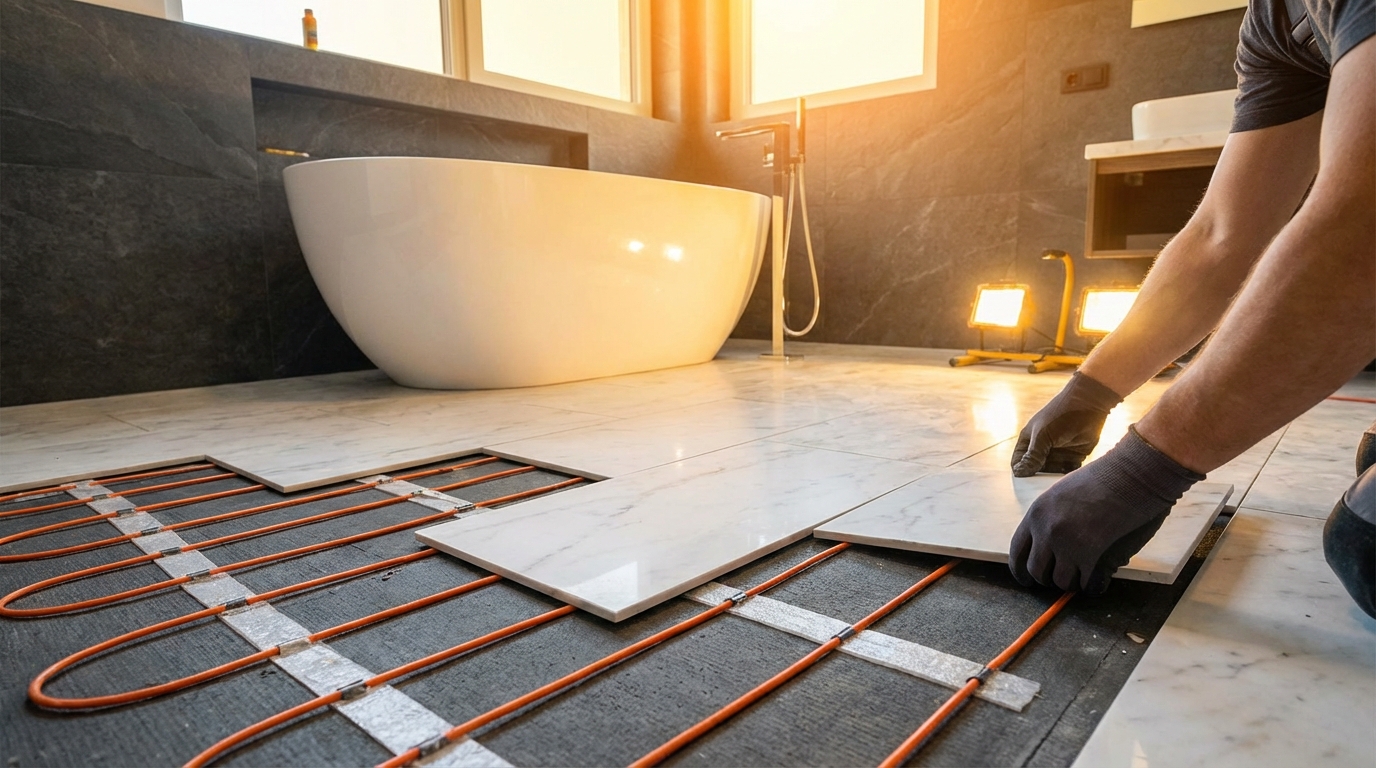
| Electric radiant | Heating cables or mats under the flooring powered by electricity | Small to medium rooms, spot luxury upgrades | Primary bathrooms, small powder rooms in higher price flips |
| Hydronic radiant | Hot water pipes under the floor connected to a boiler | Whole-house heat, big projects, long-term ownership | Rare in flips, used in major gut rehabs or new builds |
Why electric systems usually make more sense for luxury flips
Electric radiant floors check these boxes for flippers:
- Lower upfront cost for small rooms
- Faster install, especially when you already have tile work planned
- Simple to control with a wall thermostat (and smart options)
- Easier to explain to buyers during showings
Hydronic systems do have advantages for custom homes or long-term holds, but they are complex and expensive to design, and they usually only make sense if you are doing:
- Full gut renovation with all new mechanicals
- New construction luxury builds
- Very large high-end projects where the heating system is part of the marketing story
For a typical luxury flip, electric radiant in key rooms is the move.
Climate: when heated floors actually raise perceived value
Climate is one of the biggest factors. In some areas, cold tile floors are a real complaint. In others, buyers barely think about it.
Markets where heated floors are strong selling points
Heated floors carry more weight in places with real winters and prolonged cold weather, such as:
- Northern US states (Great Lakes, Northeast, upper Midwest)
- Canada
- Mountain regions
- Parts of Europe with long winters
In those markets, agents and buyers often mention heated floors in listing descriptions and searches. Phrases such as “heated primary bath floor” can actually get attention in MLS filters or property remarks.
You can treat it in your listing copy as a highlighted feature:
“Wake up and step onto a warm heated tile floor in your spa-inspired primary suite.”
That single detail can anchor a buyer’s emotional response to the bathroom.
Warm climates: when heated floors are not worth it
In warm or mild climates:
- Southern US (especially coastal areas)
- Most tropical or sub-tropical regions
Heated floors do not get the same reaction. The tile may be cool, but not painfully cold. In these markets, you often get more bang for your budget with things like:
- Better tile design or layout
- Higher grade fixtures
- Upgraded lighting and mirrors
If you still want heated floors in a warm climate, keep them limited to your highest-impact bathroom only, and make sure your total renovation budget can absorb the cost without squeezing essentials.
Room-by-room: when to install heated floors
Let us break this down by room, because that is how budgets and decisions actually work on real projects.
Primary / master bathroom
This is almost always the top candidate. It is the room where heated floors:
- Get used daily
- Show up clearly in buyer perception
- Support higher pricing and better photos
If your flip hits a certain price tier in a cold or moderate climate, you can treat heated floors in the primary bath as a standard line item, not a bonus.
A simple decision rule:
- Under 400k: Only if you have strong margins and a very cold market.
- 400k to 800k: Consider it strongly, especially north of mild climates.
- 800k to 1.5M: In colder markets, it should almost always be in the primary bath.
- 1.5M and up: Buyers will quietly expect it in most luxury markets.
Secondary bathrooms
Heated floors in secondary baths are more about messaging than daily use. They tell the buyer, “We did not cut corners; we carried the luxury through.”
Use them when:
- You are flipping in an upper-tier neighborhood where buyers compare you against builder-grade but expensive new builds.
- The secondary bathroom is close to the entrance or is used as a guest bath where buyers pay more attention to finishes.
Skip them when:
- You already stretched the budget on a big primary suite upgrade.
- The secondary bath is very small and functional, not a focal point.
Kitchen and living areas
Heated floors in kitchens are less common in flips, but not unheard of. They can make sense in:
- Open-plan great rooms with large tile or stone flooring
- Ground-level or slab-on-grade homes in cold climates
The reality, though: kitchens already eat a large part of your budget. Cabinet upgrades, counters, appliances, and lighting often bring more visible impact than radiant heat underfoot.
So, for flips, heated floors in kitchens usually rank below:
- Better appliance packages
- Higher quality counters
- Quality backsplash and tile work
Living areas are similar. Heated floors work best in long-term personal homes. For a flip, electric systems over large square footage can be expensive and might not translate into proportionate resale value.
Basements and lower levels
Basements in cold regions are a unique case. They often feel colder by nature, especially on concrete slabs, and buyers sense that during showings.
Heated floors in a finished basement family room or home gym can:
- Offset that “cold cave” feeling.
- Help the space feel like real living space, not an afterthought.
- Support marketing phrases such as “comfortable year-round lower level.”
If your flip converts a dark basement into a full family zone with hard floors, pricing out radiant heat in key areas can be worth a look.
Cost vs value: does it really pay off?
You probably want to know: does this actually return money on resale, or is it a vanity upgrade?
The answer typically lands in the middle. Heated floors are rarely a direct dollar-for-dollar return item the way more square footage or an extra bathroom can be. Instead, they work through:
- Higher perceived quality of the home.
- Stronger emotional connection during showings.
- Smoother negotiations because buyers see fewer reasons to “discount” the property.
Typical cost ranges
For electric radiant floor heating in a bathroom (numbers will vary by region and product, but ballpark):
| Room size (approx.) | Material cost (mats/cables, thermostat) | Install cost (labor) | Total typical range |
|---|---|---|---|
| Small bath (25-35 sq ft of heated area) | $300 – $600 | $300 – $700 | $600 – $1,300 |
| Medium bath (40-60 sq ft heated) | $500 – $900 | $500 – $1,000 | $1,000 – $1,900 |
| Large primary bath (70-120 sq ft heated) | $800 – $1,500 | $800 – $1,800 | $1,600 – $3,300 |
You usually do not heat every square inch. You avoid areas under built-in cabinets, under a soaking tub, and other permanently covered spots.
If your labor is already on site and familiar with radiant installs, you can often drive the per-room cost down a bit.
How heated floors affect resale value
Instead of thinking, “Heated floors will add 10k to the sale price,” think in terms of how they:
- Help your property compete against similar listings.
- Support a higher top-end price within the buyers comfort zone.
- Reduce reasons for buyers to ask for concessions.
For example:
- In a 900k listing where two other homes at similar prices have strong primary suites but no heated floors, your heated floor might help justify 915k or 925k if the rest of the package supports it.
- In a 500k listing, heated floors might not boost the price much, but they can help the home sell faster or help it stand out online.
Buyers usually will not say, “We will pay 15k more because the floor is warm.” What they will say is, “This one just feels better than the others.”
Timing: when to install heated floors during the flip
Heated floors are easiest to do when you already have full control over the flooring plan. That usually means:
- You are fully renovating the bathroom from subfloor up.
- You are already planning to tile or re-tile the space.
- You have an electrician on the job pulling permits.
Trying to add radiant heat late in the project causes headaches:
- Rework on subfloors and tile layout.
- Electrical changes after drywall is finished.
- Schedule delays while you coordinate last-minute inspections.
Ideal project sequence including heated floors
Here is a simplified sequence for a bathroom that will get a heated floor:
- Demo to subfloor.
- Rough plumbing and electrical, including a dedicated circuit for the heated floor if needed.
- Subfloor inspection and repair; prep for tile (cement board, self-leveling compound, etc.).
- Layout for the heated mat/cable and thermostat location.
- Electrician tests the heating elements before covering.
- Install heating mat/cable and embed in thinset or self-leveling compound.
- Tile installed over cured layer.
- Final electrical connection and thermostat mounting.
- System test and any final inspector sign-off.
The key is that the heated floor install falls right before tile goes in, not after, and the electrical support is planned from the start.
Installation decisions that matter for resale
Many buyers do not know the difference between one brand of radiant heat and another. They will not ask which mesh system you used.
They will care about:
- Is it reliable and safe?
- Is it easy to control?
- Does it heat the parts of the floor they actually use?
Thermostats and controls
The thermostat is what the buyer sees every day, so it is worth a little attention.
You have a few options:
| Type | Pros | Cons |
|---|---|---|
| Basic programmable thermostat | Lower cost, reliable, simple schedule | Less “wow” factor, no app integration |
| Touchscreen thermostat | Modern look, easier to explain visually | Higher cost |
| WiFi/smart thermostat (brand-matched) | Marketing appeal, integrates with smart home systems | Highest cost, more setup during handoff |
In a luxury flip, especially in higher price ranges, a clean-looking touchscreen or smart thermostat for the floor heat gives you one more bullet point for your listing description and your agent’s showing script.
“Your primary bath has a heated floor with a smart thermostat so you can warm it up before you even get out of bed.”
That is the kind of line buyers remember.
Where exactly to place the heating elements
For bathrooms, focus the heating on:
- In front of the vanity.
- In front of the shower entrance.
- Pathways you actually walk.
Avoid installing under:
- Built-in tubs.
- Toilets.
- Permanent cabinets or vanities that go all the way to the floor.
You get better use of the system and lower material costs.
Flooring types and heated floor compatibility
Not every floor surface works equally well with radiant heat. If you are planning luxury finishes, you can coordinate both choices.
Best matches for heated floors in luxury flips
- Porcelain or ceramic tile
Great heat conductor, stable, very common in baths. - Natural stone (marble, slate, etc.)
Excellent conductor, feels premium; just be ready for sealing and maintenance education for buyers. - Engineered wood rated for radiant heat
Works in some high-end projects, but check manufacturer guidelines carefully.
More caution required
- Luxury vinyl plank (LVP)
Some products are rated for radiant heat, some are not. Always check temp limits and guidelines from the manufacturer. - Solid hardwood
Can have expansion and contraction issues with temperature swings. Usually not the first choice with radiant unless carefully designed.
For flips, tile and stone in bathrooms are usually your best friends. They pair naturally with radiant systems and are easier to explain to buyers.
Permits, inspectors, and avoiding deal-killing problems
Heated floors sound simple, but they add a couple of things that can cause trouble if you rush:
- Electrical load and circuit planning.
- Product warranties and required installation methods.
- Inspection sign-offs, depending on your jurisdiction.
Electrical considerations
Things to confirm with your electrician:
- Is there enough capacity in the panel for another dedicated circuit if needed?
- Does local code require GFCI protection on the circuit or just at the thermostat?
- Are we pulling the right permit category and documenting the heated floor circuit clearly?
A common mistake is to load up a bathroom circuit with too many demands, then fail inspection or, worse, cause breaker trips for the future owner.
Warranty and inspections
Many radiant floor products require:
- Resistance testing of the heating wire before, during, and after install.
- Recording these test results on a warranty card.
- Possibly a photo of the layout or even a small as-built drawing.
If you skip this, you may void the product warranty, which can be a problem during inspection or buyer due diligence if they ask for documentation.
If something goes wrong with the radiant heat after closing, you want a clear warranty path, not guesswork.
So have your installer:
- Follow the manufacturer instructions step-by-step.
- Keep receipts, manuals, and test results.
- Provide you with a simple folder or PDF you can pass to the buyer.
This helps your agent answer questions confidently and avoids giving buyers any reason to doubt the quality of the work.
Marketing your heated floors the right way
Installing heated floors is only half of the value. The other half is how you present them.
Listing photos and description
You cannot photograph “warmth,” but you can hint at it.
A few simple tactics:
- Close-up shots of the thermostat with a clean wall background.
- Wide shots of the bathroom that show the tile layout clearly.
- Subtle mention in the first or second bullet point of key features.
Example listing language:
“Primary suite with spa-level bath featuring heated tile floors, walk-in shower, and soaking tub.”
You do not need a long paragraph about it. Just tie it to the bigger story of the primary suite.
Showings and buyer walkthroughs
If your climate allows, have the floor heat turned on before showings. Agents and buyers will notice the difference as they step in, especially on a cold day.
Coaching your agent helps. Give them a simple line such as:
“By the way, the tile you’re standing on is heated. There is a smart thermostat on the wall that controls it.”
That is a short, clear moment of delight for the buyer.
When not to install heated floors in a luxury flip
Sometimes the smartest luxury move is to skip a feature.
You should not install heated floors when:
- Your renovation budget is already under pressure and core structural or mechanical work needs cash.
- The neighborhood price ceiling is low, and buyers focus more on number of bedrooms and basic finishes than on comfort features.
- Your timeline is tight and adding another trade or inspection could risk a delay that costs you interest or holding costs.
You want every upgrade in a flip to have a reason. Heated floors earn their spot when they help you:
- Outperform nearby comps.
- Hold firm on your asking price.
- Sell faster in a crowded market.
Practical rules of thumb for “when to install” decisions
When you are walking a potential luxury flip, you can run through a quick checklist.
Ask yourself:
- Will this house likely sell in the top slice of the neighborhood price range?
- Does this market have real winters or chilly seasons?
- Are we already planning a full tile replacement in the primary bath?
- Is the buyer profile someone who values comfort and details, not just square footage?
If you can answer “yes” to most of those, heated floors in the primary bath probably belong in your scope.
If you answer “no” to most, spend the money on:
- Better layout improvements.
- Higher quality finishes where eyes go first (kitchens, entry, main bath).
A simple mini-matrix you can reference
| Price tier (local) | Climate | Room | Heated floor recommendation |
|---|---|---|---|
| High | Cold | Primary bath | Strong yes |
| High | Cold | Secondary bath | Consider yes, budget-dependent |
| High | Warm | Primary bath | Case-by-case; yes if competing homes are strong |
| Mid | Cold | Primary bath | Good if margins allow and bath is a key selling point |
| Mid | Warm | Primary bath | Probably no; focus on visual upgrades |
| Low | Any | Any room | Usually no for flips; budget better spent elsewhere |
A quick process you can reuse for every luxury flip
To make this practical, turn heated floor decisions into a repeatable mini-process for each project:
- Step 1: Define your target buyer
What price range? What expectations for comfort and luxury? - Step 2: Look at top comps
Do competing listings mention radiant or heated floors? How strong are their primary suites? - Step 3: Check climate reality
Will a buyer actually feel cold floors as a negative in this market? - Step 4: Evaluate your bathroom scope
Are you already gutting and retile-ing the primary bath? If yes, radiant adds less friction. - Step 5: Run rough numbers
Estimate 1k to 3k per main bathroom and weigh that against your target resale and margin. - Step 6: Decide per room
Start with primary bath. Then see if secondary baths or key lower-level spaces justify the upgrade.
If you build that into your early planning, you will stop treating heated floors as an impulse upgrade and start treating them like a tool.
One last practical tip: keep a simple template sheet where you list room name, square footage, radiant cost estimate, and a quick “yes/no” reasoning. Review it before you lock your budget so every heated floor you install has a clear, written business case.