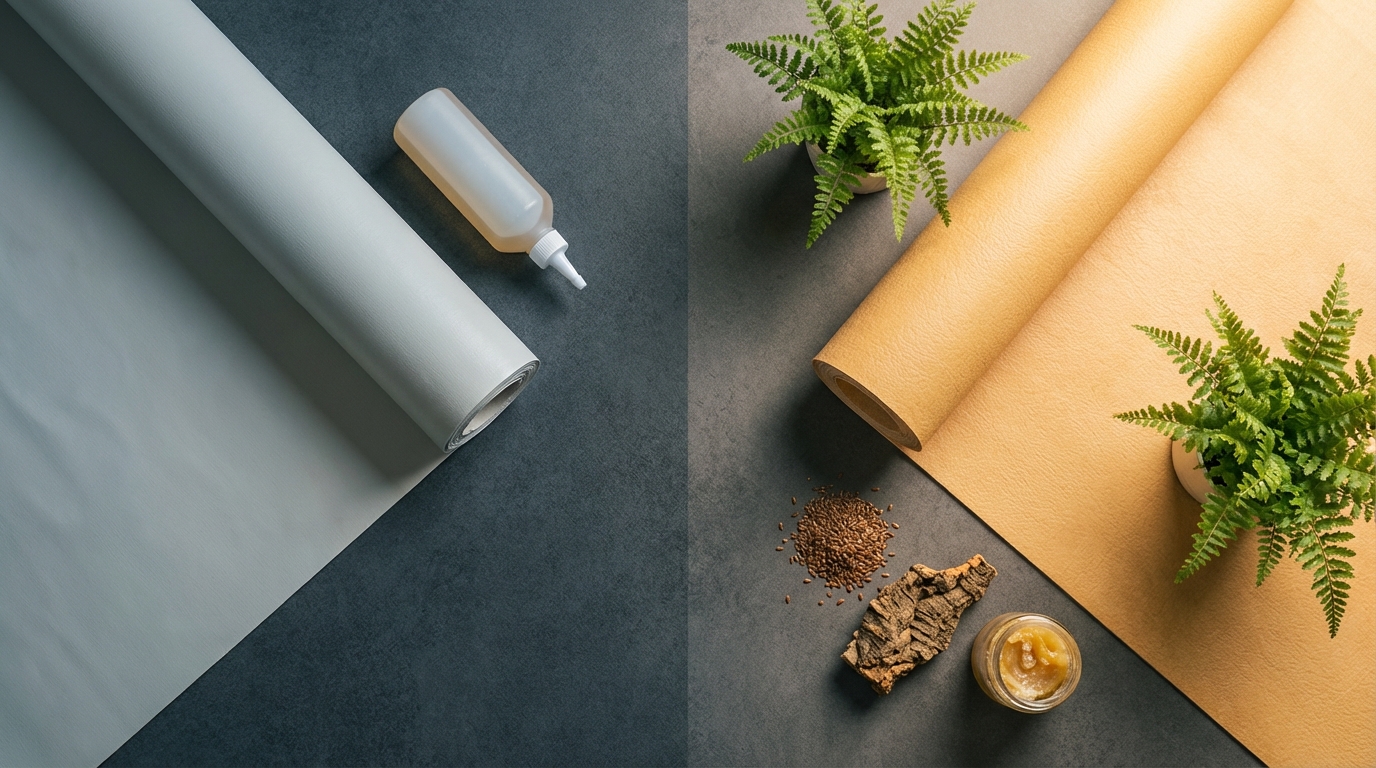
So, you want to compare linoleum vs. vinyl and figure out why linoleum is the green choice for flooring in your home or project. Linoleum is the greener choice because it is made from natural, renewable, and largely biodegradable materials, while vinyl is made from petroleum and chlorine-based plastics that create more pollution across their life cycle.
Linoleum has a very different “behind the scenes” story than vinyl. You get two surfaces that can look similar in a photo or on a showroom sample board, but the way they are made, how they age, what they emit into your indoor air, and what happens when you tear them out are all very different. If you care about health, carbon, and long-term impact, linoleum tends to come out ahead.
Things you need to know:
- Linoleum is made from linseed oil, wood flour, cork dust, natural resins, and jute; vinyl is made from PVC (polyvinyl chloride) and plasticizers from fossil fuels.
- Linoleum is mostly biodegradable and often compostable at end of life; PVC is not biodegradable and is tough to recycle.
- Vinyl flooring production and disposal can release hazardous chemicals like dioxins and phthalates.
- Linoleum usually has lower embodied carbon than vinyl and can support better indoor air quality.
- Both are water resistant surface floors, but vinyl handles standing water better; linoleum needs more care with moisture.
- Linoleum tends to last longer than entry-level vinyl, which spreads the environmental impact over more years.
- Linoleum often costs more up front, but the cost over its full life can be competitive because of durability.
What Linoleum Actually Is (And Why That Matters)
So, what is linoleum beyond a retro-sounding word from your grandparents kitchen?
Traditional linoleum is made from:
- Oxidized linseed oil (from flax seeds)
- Wood flour
- Cork dust
- Pine or other natural resins
- Ground limestone
- Natural pigments
- A jute fiber backing
Those ingredients are pressed and cured to make a dense, flexible sheet or tile. The color usually goes all the way through the material, not just on the surface.
This recipe matters for “green” performance for three reasons:
- You are drawing from renewable sources like flax, wood byproducts, cork, and jute.
- Most of the material can break down again in nature, under the right conditions.
- You avoid chlorine-based plastics and many petroleum chemicals that come with extra pollution.
> Linoleum is closer to “fancy compressed plant material” than plastic. That is the key difference.
Compare that to vinyl, which we will dig into in a second, and you start to see why linoleum has such a strong environmental story.
What Vinyl Flooring Is Made Of
Vinyl flooring, whether sheet, plank, or tile, is based on PVC, or polyvinyl chloride. That alone changes the whole picture.
A typical vinyl floor includes:
- PVC resin (from petroleum and chlorine)
- Plasticizers (often phthalates or alternatives) to make it flexible
- Fillers like limestone
- Stabilizers (for heat and UV resistance)
- Color pigments and print layers
- Wear layers of tougher PVC or urethane on top
- Backing layers: fiberglass, PVC foam, or similar
PVC production uses chlorine chemistry and creates toxic byproducts. When PVC is burned, either in accidents or at disposal, it can release dioxins and other dangerous compounds.
> PVC is not just “another plastic.” It is linked to some of the most scrutinized industrial chemicals we have.
So when you choose vinyl instead of linoleum, you are not just choosing a different style. You are choosing a completely different chemical story.
Side‑by‑Side: Linoleum vs. Vinyl at a Glance
| Feature | Linoleum | Vinyl (PVC) |
|---|---|---|
| Main ingredients | Linseed oil, wood flour, cork dust, resins, jute | PVC resin, plasticizers, stabilizers, synthetic layers |
| Source of materials | Mostly plant-based and renewable | Fossil fuels and chlorine chemistry |
| Biodegradability | Mostly biodegradable under proper conditions | Not biodegradable |
| End-of-life options | Composting or controlled incineration, some take-back | Landfill or incineration; limited recycling |
| Indoor air (VOCs) | Very low, especially with reputable brands | Ranges from low to higher; may include plasticizer emissions |
| Moisture handling | Good surface resistance; sensitive to standing water at seams | Excellent resistance to spills and standing water |
| Durability | 20-40 years with good care | 10-25 years, longer for high-end commercial products |
| Carbon footprint | Generally lower; partly biogenic carbon | Higher; fully fossil-based |
| Installation | Often glued; can be more technical | Many click-lock and DIY-friendly options |
| Price | Mid to upper range, above cheap vinyl | Wide range; can be very cheap at entry level |
Why Linoleum Is Considered the Green Choice
So why do green building guides keep steering you toward linoleum when the samples in your hand might look almost the same?
1. Renewable Ingredients vs. Fossil Fuels
With linoleum, most of what you are paying for grew in a field or came from tree byproducts:
- Flax for linseed oil grows back each season.
- Jute for the backing is also a plant fiber crop.
- Wood flour and cork often come from sawdust or bark that might otherwise be waste.
These plants absorb CO₂ as they grow. Part of that carbon ends up stored in your floor for decades.
Vinyl, in contrast, comes from:
- Petroleum or natural gas for the ethylene portion of PVC.
- Chlorine from salt and energy‑intensive electrolysis.
That means locked‑in fossil carbon and energy use right from the start.
> If you want your building materials to come from a field, not a wellhead, linoleum fits that better than vinyl.
2. Biodegradability and End‑of‑Life
Linoleum is mostly made from organic matter. Under the right industrial composting or controlled conditions, it can break down.
That does not mean you can throw old linoleum into your backyard compost bin. But it does mean:
- Some manufacturers and facilities can compost or energy‑recover linoleum more cleanly.
- It does not persist in the environment in the same way as PVC.
Vinyl, on the other hand:
- Does not biodegrade.
- Breaks down into smaller plastic fragments over a very long time.
- Is hard to recycle because of the mix of additives and layers.
Recycling of vinyl flooring exists in some regions, but volumes are still low and sorting is tough. A lot of it still ends up in landfills or incinerators.
3. Chemical Emissions and Health Perspective
Indoor air is an area where linoleum tends to shine.
Quality linoleum products usually:
- Have very low VOC emissions once the initial curing smell is gone.
- Do not rely on phthalate plasticizers for flexibility.
- Are certified by third‑party labels (like GreenGuard Gold or similar regional labels) for low emissions.
Vinyl flooring used to be closely tied to phthalates such as DEHP, which raised health concerns. Many brands have moved to “phthalate‑free” formulas or alternative plasticizers, but not all products are equal.
You also have:
- Potential VOCs from plasticizers and stabilizers, especially right after installation.
- Concerns about small amounts of emissions over time, which matter in tightly sealed homes.
> If you are sensitive to smells or have asthma in the house, a low‑emission linoleum from a known brand is often a safer bet.
4. Production and Pollution
Linoleum factories have their own footprint, of course. They use energy, and there are emissions from oxidizing linseed oil and other processes.
But PVC production is linked to:
- Chlorine chemistry plants that can release hazardous byproducts.
- Vinyl chloride monomer (VCM), a known carcinogen, during production stages.
- Formation of dioxins and similar compounds when PVC is burned or not handled well.
The difference here is not just “a bit more” or “a bit less” pollution. It is about the types of chemicals involved.
When green building standards like LEED or BREEAM weigh materials, PVC flooring often raises more red flags than linoleum.
5. Durability and Life Span
If you want a lower impact floor, you also want a longer life. Replacing floors frequently multiplies the footprint.
Linoleum can last 20 to 40 years in commercial buildings with:
- Regular cleaning and proper maintenance.
- Occasional polishing to renew the surface.
There are schools and hospitals with linoleum floors that have been down for decades.
Vinyl is a bit more fragmented:
- Cheap residential sheet vinyl might last 5 to 10 years before it wears through or looks tired.
- Good quality LVT (luxury vinyl tile/plank) can last 15 to 25 years.
- High‑end commercial vinyl can also reach long service lives, but that is a narrower slice of the market.
If you compare linoleum to bargain vinyl, linoleum wins on life span. That longer life spreads its production footprint across more years.
6. Carbon Footprint
Different producers publish Environmental Product Declarations (EPDs) that show cradle‑to‑grave greenhouse gas numbers.
While the exact figure depends on brand and thickness, a pattern usually appears:
- Linoleum has a lower global warming potential per square meter, partly because of biobased content.
- Vinyl has higher emissions per square meter, driven by fossil‑based PVC and process energy.
Some manufacturers of linoleum even publish products with near‑neutral cradle‑to‑gate carbon by using renewable energy and counting biogenic carbon stored in the floor for decades.
> When your architect or designer talks about low‑carbon materials, linoleum often comes up on the short list.
Where Vinyl Still Has Advantages
Even with all of that, vinyl flooring is not going away. There are reasons many people still choose it.
1. Better Tolerance of Water and Flooding
Vinyl is basically plastic. Water does not bother it much.
That gives vinyl some real‑world plus points:
- It can handle standing water from leaks or spills better.
- It is popular in basements, bathrooms, and laundry rooms.
- Some click‑lock vinyl planks can even be removed, dried, and reinstalled after minor flooding.
Linoleum, while water resistant on the surface, has limits:
- Jute backing can swell or weaken if soaked.
- Standing water at seams or edges can cause damage.
- Excess moisture from below (like a damp slab) can lead to problems.
So if your space is at high risk for flooding or constant moisture, vinyl still has a practical advantage.
2. Lower Upfront Cost (In Many Markets)
At the budget end of the market, vinyl is hard to beat:
- Sheet vinyl can be cheap per square foot.
- DIY‑friendly planks reduce labor cost.
- There are a lot of promotions and wide distribution.
Linoleum tends to:
- Sit in the mid to upper price tier compared to standard vinyl.
- Require pro installation more often, which adds to cost.
If you are flipping a rental and plan to replace floors every few years, the green choice might lose out to short‑term cost thinking. That is the honest tension here.
3. Design Variety and Realistic Wood/Stone Looks
Vinyl, especially LVT and LVP, dominates the “fake wood” and “fake stone” space. Large prints, textured surfaces, and deep embossing give it a realistic look.
Linoleum:
- Works best with solid colors, marbled patterns, and graphic designs.
- Does not try to imitate wood grain as convincingly.
If your client insists on a perfect oak plank look in the kitchen but wants something more water friendly than real hardwood, vinyl is the product they see everywhere.
4. Ease of Installation
Vinyl planks with click systems:
- Float over existing floors.
- Work for many DIYers.
- Can go in fairly fast.
Linoleum:
- Usually needs glue‑down installation.
- Often needs careful seam welding in commercial spaces.
- Benefits from experienced installers, especially on big jobs.
So if you want a weekend project and do not want to hire an installer, vinyl is attractive.
Health and Indoor Air: A Closer Look
When people say “green,” they often really mean “better for my family’s health.” These two goals overlap but are not the same. Let us break down some health‑related angles.
VOC Emissions
VOCs (volatile organic compounds) are the chemicals that give off smells from new products. Floors, adhesives, and finishes can all emit VOCs.
Linoleum:
- Can have a linseed oil smell during and shortly after installation.
- That smell tends to fade as the product cures fully.
- Reputable brands publish low VOC test results and meet strict labels.
Vinyl:
- Can emit VOCs from plasticizers, residual solvents, and other additives.
- Quality brands have improved this and often carry low‑emission labels.
- Lower-cost products may have weaker quality control and more variable emissions.
If you are extra cautious:
- Ask for third‑party emission certificates.
- Install flooring early and ventilate the space before moving in.
> Between a certified linoleum and a bargain vinyl with no data, the linoleum is usually the safer air choice.
Plasticizers and Additives
Vinyl’s flexibility comes from plasticizers. Historically, many of these were phthalates, which have been studied for endocrine effects.
The market has shifted:
- Many brands now market “phthalate‑free” or “no ortho‑phthalates” vinyl.
- Those use alternative plasticizers with less data behind them.
Linoleum does not rely on these plasticizers:
- Its flexibility comes from linseed oil and the blend of natural ingredients.
- No phthalates are needed to keep it from cracking.
From a simplicity standpoint, fewer synthetic additives usually means fewer unknowns.
Allergy and Microbial Aspects
Smooth resilient floors, whether linoleum or vinyl, are easier to clean than carpets. That helps with dust, allergens, and mold if cleaned regularly.
Linoleum has an interesting bonus:
- Linseed oil has some natural antibacterial properties on the surface.
- Some manufacturers report reduced bacterial growth compared to other surfaces in lab tests.
This is one reason linoleum is common in healthcare and school settings in some countries.
Life Cycle: From Cradle to Grave
If you think like a product designer, you want to follow a floor through each stage.
1. Raw Materials
Linoleum:
- Flax, jute, wood, cork: grown or harvested materials.
- Fillers like limestone and pigments.
- Impacts tied to farming, water, and land use.
Vinyl:
- Oil or gas extraction, refining, and cracking for ethylene.
- Chlorine from brine through energy‑intensive processes.
- Production of PVC resin and a mix of additives.
Carbon and pollution numbers are usually higher on the PVC side at this stage.
2. Manufacturing
Modern linoleum plants:
- Oxidize linseed oil into a thick resin.
- Mix in wood flour, cork, and fillers.
- Press and cure sheets on jute backing.
- Use controlled ovens for long curing times.
Vinyl plants:
- Produce PVC resin or buy it from PVC makers.
- Blend it with plasticizers and additives.
- Cast or press sheets, layers, and wear surfaces.
- Laminate printed films, backing, and top coats.
Both require energy, but PVC production includes higher‑risk chemicals that need strict controls.
3. Use Phase
Once on your floor, what happens?
Linoleum:
- Holds color through the thickness, so scratches are less visible.
- Needs pH‑neutral cleaners and may need occasional polish.
- Can slowly amber (yellow slightly) with low light but often brightens again with exposure.
Vinyl:
- Relies on printed layers and a wear coat; deep scratches can expose the print.
- Generally easy to mop and clean with most common products.
- May show pattern wear in high-traffic paths if the wear layer is thin.
From a green angle, both can serve well if maintained. Longer life means better total performance.
4. End of Life
This is where the gap shows up again.
Linoleum can go to:
- Dedicated recycling or recovery programs from some brands.
- Controlled incineration with energy recovery, with lower risk of toxic byproducts than PVC.
- Industrial composting in some pilot cases.
Vinyl usually goes to:
- Landfill, where it sits for a very long time.
- Incineration, where careful controls are needed to limit dioxins and acid gases.
- Occasional recycling into low‑grade uses, with limits from mixed layers and contamination.
From a circular economy perspective, linoleum has a clearer path.
> When you pull up 10,000 square feet of flooring from a building renovation, the difference between sending plant-based sheets to controlled composting vs. PVC to landfill starts to feel very real.
Common Myths About Linoleum and Vinyl
This topic is full of confusion. Let us clear out a few myths.
Myth 1: “All Resilient Floors Are Vinyl”
Many people call any non‑wood, non‑tile sheet floor “vinyl.” That is how linoleum sometimes gets mislabelled.
Quick ways to check:
- Ask the salesperson, “Is this linoleum or PVC/vinyl?”
- Look at the back: linoleum has a jute or natural fiber backing; vinyl often has foam or synthetic backing.
- Check the brand; only a few global brands still make real linoleum.
Myth 2: “Linoleum Cannot Handle Kitchens at All”
Linoleum can work in kitchens, but not in the exact same way as fully waterproof vinyl.
Yes, you need to:
- Wipe up standing water quickly.
- Protect it from long-term leaks like a slow dishwasher drip.
- Seal seams well and use a stable subfloor.
Many European kitchens use linoleum without constant problems. It just needs more care than a “mop and forget” plastic floor.
Myth 3: “Vinyl Is So Advanced Now That It Is Green Too”
Vinyl has improved:
- Lower VOC adhesives.
- Better wear layers so you replace it less often.
- Phthalate‑free options in many brands.
That helps, but the base material is still PVC:
- Non‑renewable feedstock.
- Chlorine chemistry.
- Persistent plastic at end of life.
So while you can buy “better” vinyl compared to older versions, the structural gap with linoleum remains.
Real‑World Scenarios: Which Should You Choose?
Let us walk through a few realistic situations and how this plays out.
Scenario 1: Family with Young Kids, Focus on Health
You want:
- Low emissions.
- Easy cleaning for spills and crumbs.
- Long life so you do not redo it after five years of rough play.
Linoleum is a strong fit for:
- Living rooms.
- Bedrooms.
- Hallways and playrooms.
You might still pick a different material or a very careful installation approach in:
- Full bathrooms with showers.
- Basements with moisture issues.
Vinyl could still appear in a bathroom as a compromise, but if your priority is “green and healthy,” the main living areas are perfect for linoleum.
Scenario 2: Rental Property with Short Turnover
Landlords often think:
- Lowest upfront cost.
- Fast replacement between tenants.
- Decent looks for listing photos.
Here, cheap vinyl usually wins on cost and speed. The green choice loses to economics.
If you want to tilt greener without breaking your numbers:
- Move up from the absolute cheapest vinyl to a mid‑range low‑VOC option.
- Use click‑lock products so you can replace individual planks instead of whole rooms.
- Keep subfloors intact so future upgrades to greener floors are easier.
Scenario 3: School or Office Targeting Green Certification
The project team wants credits for materials and healthy interiors.
In that case:
- Linoleum is often on the recommended product lists.
- EPDs and health product declarations from linoleum makers help with documentation.
- Life cycle studies favor linoleum over PVC in many rating tools.
Some schools have already run this experiment: one wing with vinyl, another with linoleum, same cleaning regime. Over time, linoleum often holds up better in busy corridors and looks less “tired.”
> For projects where green building labels matter for marketing and policy, linoleum gives you a clearer story to tell.
How to Choose a Green Linoleum Product
Picking linoleum is not just about saying “no vinyl.” You still want to filter within linoleum options.
Look for Transparent Certifications
Aim for:
- Independent VOC emission labels.
- EPDs from verified programs.
- Any regional eco‑labels your country recognizes.
This gives you a way to compare brands beyond just marketing claims.
Check the Backing and Adhesives
Backing:
- Traditional jute backing is common and plant based.
- Avoid any variant that sneaks in PVC backing, if your goal is fully green content.
Adhesives:
- Ask for low‑VOC, solvent‑free adhesives.
- Follow manufacturer instructions on trowel size and open time; using more glue than needed just adds emissions.
Sometimes the glue can be a bigger source of VOCs than the floor itself, so this detail really matters.
Ask About End‑of‑Life Programs
Some manufacturers:
- Offer take‑back programs for clean installation offcuts.
- Are piloting programs to take back old floors from renovations.
If your project is big, this can significantly reduce waste.
Plan for Durable Design
Green flooring is not just about material. It is about keeping that material on the floor for a long time.
Think about:
- Choosing colors and patterns that age well and hide minor scars.
- Installing mats at entrances to reduce tracked grit.
- Planning a maintenance cycle with cleaning staff so the floor is protected instead of abused.
A well‑chose, well‑kept linoleum floor can still look good when the walls have been painted three or four times.
Key Takeaways: Why Linoleum Wins the Green Comparison
Let us bring the main threads together so you can use this in your own planning or content.
- Material origin: Linoleum comes mostly from plants and natural fillers; vinyl comes from fossil fuels and chlorine chemistry.
- End of life: Linoleum can be broken down or energy‑recovered more cleanly; PVC tends to persist and is tougher to recycle.
- Chemical profile: Linoleum avoids plasticizers like phthalates; vinyl relies on them, even if formulas are changing.
- Carbon: Linoleum usually carries a lower carbon footprint over its life, helped by biobased content.
- Durability: Linoleum can last decades when cared for; cheap vinyl often needs replacement far sooner.
- Indoor environment: Both can reach low VOC levels, but linoleum has an edge in simpler, more natural content.
Vinyl does have solid wins in:
- Wet rooms and flood‑prone areas.
- Upfront cost in budget‑driven projects.
- DIY installation and realistic wood visuals.
So the real decision is not “vinyl is evil, linoleum is perfect.” It is more about picking linoleum wherever conditions allow, then using the best possible vinyl only where you really need its water tolerance or cost profile.
> If you want one simple move to make your next renovation greener without sacrificing function, put linoleum at the top of your shortlist for any dry area floor.
A practical tip to end with: when you visit a showroom, do not just say “no vinyl.” Ask the salesperson for “real linoleum with jute backing, low‑VOC glue, and an EPD,” then take home samples, lay them on your floor, and live with them for a few days to see how they look and smell in your actual space before you order.