
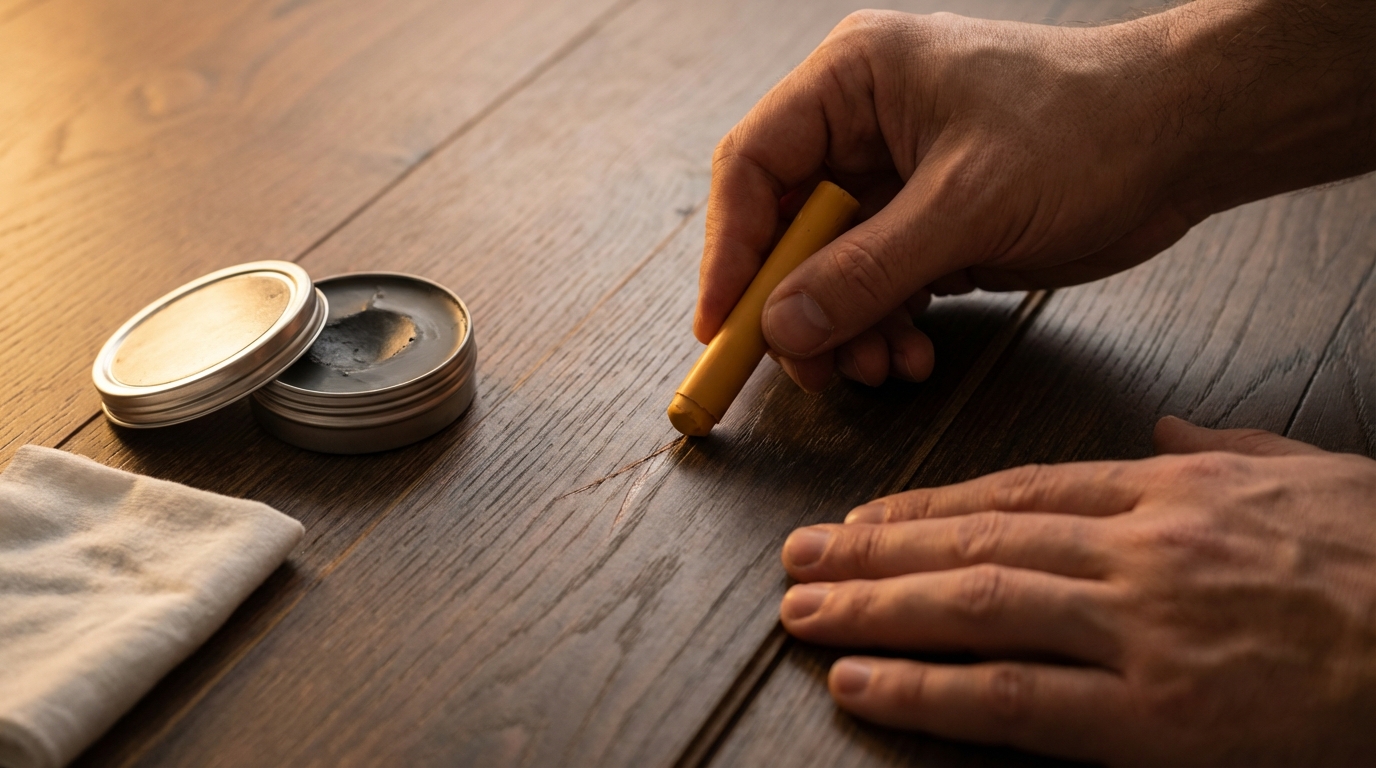
So, you are trying to fix a scratch in hardwood in 5 minutes and wondering if that is even realistic. Yes, you can hide or fix most light to medium scratches in hardwood in about 5 minutes with the right product and a simple process.
For deep gouges or structural damage, you will not repair the floor in 5 minutes, but you can still make it look much better very fast. The key is matching the color, cleaning the area, and filling or blending the scratch so it disappears from normal viewing distance.
Things you need to know:
- Light surface scratches can usually be fixed in 5 minutes with a marker, wax stick, or finish restorer.
- Deeper scratches and small gouges need filler or a wax repair stick plus a bit more care.
- You must match the color of your hardwood finish, not just the wood species.
- Always clean the scratch area first or you will trap dirt and make it look worse.
- Most quick fixes are about making the scratch invisible, not restoring the original wood fibers.
- Prefinished floors need slightly different products than site-finished floors.
- Good lighting and a dry floor help more than people think.
> If you can make the color of the exposed wood match the floor around it, your eye stops seeing the scratch.
Understand what kind of scratch you are dealing with
Before you touch any product, you need to figure out what type of damage you have. That decides if the 5 minute fix is realistic or if this is more of a “5 minute improvement, longer repair later” situation.
Three basic scratch levels
| Scratch type | What it looks like | 5-minute goal | Typical fix |
|---|---|---|---|
| Light surface scratch | Only in the finish, no raw wood exposed, often from chairs or small grit | Blend shine and color so the line does not catch your eye | Finish restorer, buffing pad, sometimes a marker |
| Medium scratch | Finish broken, raw wood or lighter line visible, but not very deep | Color the scratch and hide the contrast | Stain marker, wax stick, blending pencil |
| Deep scratch / gouge | Visible groove, you can feel it with your fingernail, wood fibers crushed or missing | Visually reduce the damage quickly, plan a better repair if needed | Hard wax repair kit, filler, possibly sanding later |
A quick way to check what you have:
- Run your fingertip across the scratch. If you cannot feel it, it is probably just in the finish.
- If your nail catches, you are in medium or deep territory.
- Look at the color in the scratch. Very light line on dark flooring usually means the finish is gone and you see bare wood.
> You are not fixing “hardwood” in general; you are fixing one small line that either broke the finish, the wood, or both.
What you actually need for a 5 minute hardwood scratch fix
If you have the right kit ready, 5 minutes is realistic. If you have to drive to the store, not so much. So think about building a small “floor emergency kit.”
Basic 5 minute scratch repair kit
For most homes, this simple kit covers 80 percent of scratches:
- Microfiber cloth (one dry, one slightly damp)
- Mild hardwood floor cleaner or a couple drops of dish soap in water
- Pre-tinted wood stain markers in a few common shades (light oak, medium brown, dark walnut)
- Wax repair sticks or blending pencils for hardwood floors
- Fine buffing pad or non-scratch kitchen sponge pad
- Clear finish restorer or polish made for your type of floor (polyurethane-safe)
Optional but helpful:
- Hair dryer or heat gun on low (for wax sticks that soften with heat)
- Blue painter’s tape for protecting nearby boards if you are new to this
- Small plastic scraper (even an old credit card works)
You do not need all of this for every scratch. Think of it as a small toolbox. The 5 minute trick is picking the one or two right tools for that one scratch.
> The most common problem is not the scratch itself; it is the wrong color choice that makes the repair look fake.
Step by step: Fix a light surface scratch in 5 minutes
If your scratch is only in the finish, this is the easiest and fastest situation. You are dealing with the clear topcoat, not the wood.
Step 1: Clean the scratch area (about 1 minute)
You cannot skip cleaning. Dirt in a scratch makes it stand out more and can block your repair product.
1. Lightly mist a microfiber cloth with hardwood cleaner or a small amount of water and a drop of dish soap.
2. Wipe the scratch and about 6 inches around it.
3. Dry with another clean cloth.
You want the area dry before you move on, so give it 20 to 30 seconds, or quickly go over it with a dry cloth.
Step 2: Buff the scratch (about 1 minute)
Take a fine buffing pad or non-scratch sponge and gently rub along the grain of the wood over the scratch. You are trying to level out tiny ridges in the finish and spread the light reflection.
- Use light pressure; you are not sanding.
- Buff for 20 to 30 seconds, then wipe and look from a low angle.
Often, light scratches fade a lot just with this step.
Step 3: Apply finish restorer or polish (2 to 3 minutes)
Now you want to even out the shine so the scratch line does not catch the light.
1. Put a small amount of floor finish restorer on a soft cloth.
2. Wipe a thin layer over the scratched area and blend outward.
3. Let it sit for a minute or two, then buff gently with a dry cloth.
The key here is thin layers. Too much product can look cloudy.
> Light scratches live in the top coat; if you fix the top coat reflection, most people will never notice the line again.
This whole process, from cleaning to buffing, usually fits inside 5 minutes once you know what you are doing.
Step by step: Fix a medium scratch in 5 minutes
Medium scratches are where you can see bare wood or a light line, but the groove is shallow. These are the classic “dog nail” or “chair drag” marks.
Your 5 minute goal: match the color and reduce the contrast.
Step 1: Clean and dry (about 1 minute)
Same as before:
- Wipe with damp cloth and cleaner.
- Dry completely.
If you see any white dust or loose fibers in the scratch, wipe them out with the tip of the cloth.
Step 2: Test your color match (1 to 2 minutes)
Take your wood stain marker or wax stick.
1. Find a hidden area of the same floor, like under a couch or behind a door.
2. Make a short line with the marker or rub a tiny bit of wax.
3. Wipe off after a second.
4. Compare color and shine.
You are not trying to match the raw wood; you need to match what the finished surface looks like.
If one marker is slightly too dark and another too light, sometimes you layer them:
- Light color first, wipe, then add a thin line of darker tone, wipe again.
Step 3: Color the scratch (1 to 2 minutes)
Now you work on the actual scratch.
For a stain marker:
1. Shake the marker if needed.
2. Run the tip gently along the scratch, staying inside the groove.
3. Immediately wipe across (not along) the scratch with a clean cloth to remove extra stain from the surface.
4. Let it dry for 30 to 60 seconds.
For a wax stick:
1. Rub the wax along the scratch until the groove looks filled and colored.
2. Press it in with your finger (you can warm the wax a bit with a hair dryer on low if it is hard).
3. Scrape off extra with a plastic card.
4. Buff with a cloth.
The main trick is not to leave product sitting on the surrounding finish. It should live mostly in the scratch.
> If you can get the color inside the scratch to match within one shade of the floor around it, the line almost always disappears from normal standing height.
Step 4: Blend the shine (about 1 minute)
Sometimes the color is right, but the spot looks dull or too glossy. That is where a very thin layer of finish restorer over the area helps.
1. Dab a tiny drop on a cloth.
2. Buff over the repair and about 4 to 6 inches around it.
3. Let it sit, then lightly buff again.
You do not need to coat the whole room, just blend locally.
Total time, once you have the right marker ready: about 4 to 5 minutes.
Step by step: Make a deep scratch or gouge less visible in 5 minutes
Deep scratches and gouges are damage to the wood fibers. You will not “fix” the structure in 5 minutes, but you can often improve how it looks quickly.
Your 5 minute goal: fill enough and color enough that you stop staring at that spot every time you walk by.
Step 1: Clean and inspect (1 to 2 minutes)
You want the groove free of debris.
1. Vacuum the area with a brush attachment or blow out dust with a can of air.
2. Wipe with a slightly damp cloth and cleaner.
3. Dry well.
Look closely:
- If wood fibers are sticking up, do not rip them out. Press them down gently with your finger or the back of a spoon.
- Note if the gouge crosses over more than one board; that sometimes happens with heavy furniture drags.
Step 2: Quick fill with hard wax or soft wax stick (2 to 3 minutes)
For a true pro repair, people use hot-melt hard wax kits with a small heating tool. That takes more than 5 minutes if you are new. For a homeowner quick fix, a soft wax stick or colored filler crayon is faster.
1. Choose a stick close to your floor color or go slightly lighter; you can darken later with a marker.
2. Rub the stick firmly along the gouge to pack wax into the void.
3. Use a plastic card at a shallow angle to scrape off extra so the surface is level with the floor.
4. Buff with a cloth.
If the gouge is long, work in small sections, 2 to 3 inches at a time. You are basically “smearing” colored wax into the damaged channel and then shaving off the extra.
Step 3: Adjust color if needed (1 to 2 minutes)
If the filled area is a bit too light:
- Touch it with a stain marker, then wipe quickly to avoid a solid stripe.
- Sometimes a light tap of a darker marker at one edge breaks up the uniform look so it matches nearby grain.
If it is too dark:
- You can rub gently with a clean cloth or buffing pad to thin the wax.
- In some cases, mixing a bit of lighter wax stick into the groove helps.
> Deep damage almost always needs more than one pass to get right, but even a rough first pass often makes a huge visual difference.
If you plan to fully repair the board later, this 5 minute trick at least keeps your eye from going to that white gouge line every day.
Choose the right product for your hardwood type
Not all hardwood flooring has the same finish. The finish type matters more than the wood species when you pick products.
Prefinished vs site-finished floors
| Floor type | How to tell | What to use | What to avoid |
|---|---|---|---|
| Prefinished hardwood | Small bevels between boards, slight dips, very consistent factory look | Factory repair kits, stain markers, wax sticks, light finish restorers made for urethane | Heavy sanding, harsh solvents, unknown polishes that can leave residue |
| Site-finished hardwood | Flat, smooth field of boards with little or no bevel, finish runs across multiple boards | Stain markers, wax sticks, compatible touch-up poly or finish restorer | Oily products on water-based finishes, mixing oil and water products randomly |
Many brands sell touch-up kits that match their prefinished floors. If you know your floor brand and color name, check their site. Those kits often include:
- Color-matched marker or filler
- Small bottle of finish or topcoat
- Instructions for that exact line of flooring
> The more exactly you match the factory color and gloss, the less your eye will see the repair.
Use color like a pro: tips from furniture repair
If you ever watch furniture repair techs, they spend more time on color than anything else. Same idea here.
Break the color down
Your floor is not “brown.” It is usually:
- A base wood tone (yellow, red, or grayish)
- A stain tone (warm brown, cool brown, espresso, etc.)
- A final gloss level (matte, satin, semi-gloss, glossy)
When you pick a marker or wax:
- Match the undertone first: yellowish floors need warm tones, gray floors need cooler tones.
- Go slightly lighter rather than darker. Dark repair lines look like drawn lines; light ones blend better once you layer.
Layer colors instead of trying to nail it in one pass
You can get closer to your floor with two colors than with one “almost there” color.
Example:
- Base layer: light oak marker to match the wood fiber.
- Second layer: medium walnut dabbed and wiped quickly to match the stain depth.
If you see fake-looking solid lines, break them up:
- Dot, do not draw: tap the marker in tiny dots and then wipe. This mimics grain.
> Good color work does more for invisibility than fancy tools. The eye notices contrast before it notices depth.
A real 5 minute workflow you can follow
Here is a simple flow you can mentally run through every time you see a scratch.
1. Check the scratch level (30 seconds)
- Finger test: Can you feel it?
- Color test: Is it lighter or just dull?
2. Pick your path (15 seconds)
- Only in finish: clean + buff + finish restorer.
- Finish broken, shallow: clean + marker or wax + blend.
- Deep groove: clean + wax fill + quick color adjust.
3. Work fast but not rushed (3 to 4 minutes)
- Spend 30 to 60 seconds cleaning and drying.
- Spend most of your time on color matching and wiping extra product.
- Use the last minute to check from different angles and adjust shine with a tiny bit of restorer.
4. Step back and check from standing height (30 seconds)
Do not judge your repair only with your nose 4 inches from the floor. Stand where you normally walk and see if the scratch still jumps out. Often it does not.
> Your standard is “not obvious at a glance,” not “perfect under a spotlight.”
Common mistakes that make scratches look worse
Sometimes the scratch is not the problem; the repair attempt is. Avoid these common issues.
Using the wrong cleaning method first
Many people grab whatever is under the sink.
Problems:
- Oil soaps can leave residues that make markers and wax beads up instead of bonding.
- Steam mops can cloud finishes and even raise grain around scratches.
- Vinegar and water can dull finishes and increase the contrast around the scratch.
Stick to a cleaner that is labeled for hardwood flooring with urethane finishes, or use a tiny bit of dish soap and water, very sparingly.
Going too dark with the repair color
A dark line across your floor, even if it matches the stain in theory, stands out.
Better approach:
- Start light. You can always darken in tiny steps.
- Wipe extra aggressively on the first pass. You do not want a solid marker line.
Leaving a hump of wax or filler
If you overfill without scraping level, your foot will feel a bump, and light will reflect differently.
Always:
- Scrape with a flat card held low to the floor.
- Buff with a cloth in small circles, then along the grain.
> A small underfill that is flat is often less visible than a perfect color fill that sits above the surface.
When a 5 minute fix is not enough
Sometimes honesty helps. A deep gouge from moving a fridge or a long drag across multiple boards may need more than a quick touch-up.
Signs you need more than a fast repair:
- The scratch runs across several boards and varies in depth.
- There is splintering and loose wood fibers that keep catching your socks.
- The area has water damage along with the scratch.
Options beyond the 5 minute fix:
- Board replacement for severe single-board damage.
- Spot sanding and refinishing for stubborn worn paths.
- Full floor sanding and refinishing if you see widespread issues.
That said, a quick color and wax fill can still buy you time and preserve your sanity while you plan a bigger project.
Prevent scratches so you do not need to fix them all the time
You asked about fixing in 5 minutes, but it is easier to reduce how many times you need to do that.
Simple habits that cut scratches drastically
- Add felt pads under chairs and tables, and actually replace them when they wear off.
- Use entry mats at every door and vacuum grit regularly.
- Trim pet nails to reduce deep claw marks.
- Lift heavy items instead of dragging them across the floor.
Not very glamorous, but this is where most of the protection comes from.
Use the right maintenance products
Choose:
- Cleaner made for hardwood finishes.
- A periodic refresh product that adds a thin wear layer, if your floor brand recommends one.
Avoid:
- Wax over polyurethane floors if the manufacturer warns against it. Wax can block future refinishing.
- Homemade blends with vinegar, oils, or polishes that promise miracles but leave residue.
> Think of your finish like the screen protector on your phone. If you keep that protector in good shape, the “screen” underneath stays safer.
Quick product cheat sheet for your toolbox
Below is a simple reference you can save.
| Problem | Good 5-minute product types | Main action |
|---|---|---|
| Light swirl marks or dull path | Finish restorer, microfiber pad | Refresh topcoat shine and blend marks |
| Fine white scratch line | Stain marker, buffing pad | Color and blend so line disappears |
| Shallow gouge you can feel | Wax repair stick, plastic scraper, marker | Fill and color groove |
| Multiple tiny scratches in one area | Cleaner, restorer, light buff | Remove embedded grit, smooth finish reflection |
How this connects back to your daily life
You do not want to become a floor repair expert. You just want to stop staring at that annoying scratch by the couch or in the hallway.
Here is a realistic way to handle it:
Build a small “hardwood first aid kit”
Set aside a small box in a closet with:
- Two microfiber cloths
- Small bottle of hardwood floor cleaner
- Two or three wood stain markers close to your floor color
- One wax repair stick set with a couple of shades
- Plastic card and a small buffing pad
Next time you see a scratch:
- Take the kit to the scratch.
- Start a timer for 5 minutes.
- Run through clean, color, blend.
You will get faster after the first few tries, and your anxiety around small floor damage will drop a lot.
> The real win is not a perfect floor; it is a floor that looks good enough that you stop worrying about every small mark.
As a simple practical tip, take a clear photo of your floor in good daylight and bring it to the hardware store when you buy markers or wax sticks. Matching colors in the aisle with a photo saves you from random guessing later at home.