
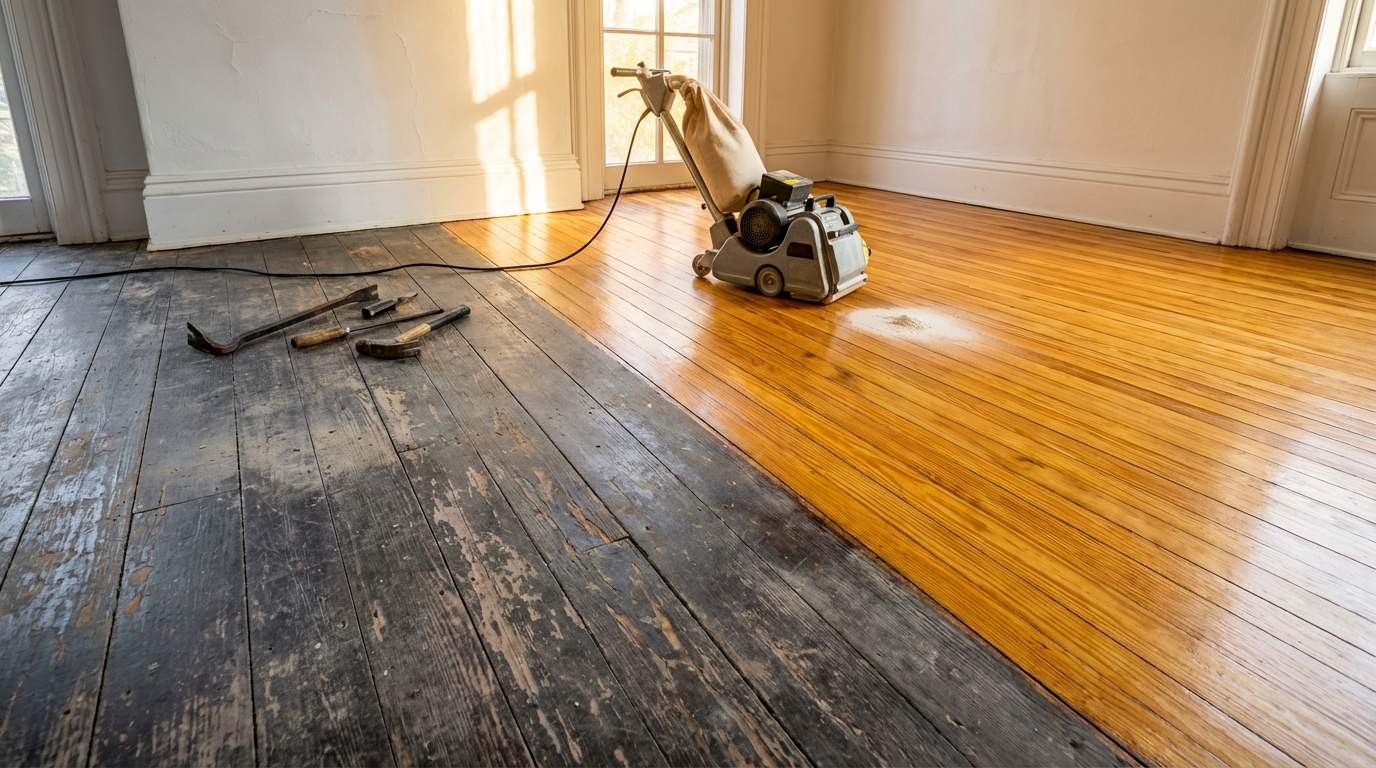
So, you are trying to decide between refinishing vs. replacing the original floors in a historic home. You should almost always refinish original floors first and only replace when the wood is structurally gone or too thin to sand again.
You are not just dealing with a design choice. You are dealing with structure, future resale value, and the character that makes an old house feel like an old house. Many owners rip out perfectly good floors because a contractor says “new is easier,” then regret it when they realize they removed something they can never really get back.
Things you need to know:
- Original floors almost always add resale value if they are stable.
- Refinishing is cheaper than replacement in most cases.
- Old floors can often be repaired in sections instead of fully replaced.
- Thickness of the wood and number of past sandings decide if you can refinish again.
- Moisture, rot, insect damage, and subfloor issues can force replacement.
- New floors rarely match old trim, doors, and room proportions perfectly.
- Historic review boards often prefer repair and refinish instead of replacement.
- Comfort, sound, and maintenance change with both choices.
> Original floors are like original windows: people often want to toss them, but buyers and preservation pros often wish they had stayed.
> Once you replace original boards across an entire level, that part of the home is no longer truly original, no matter how close the match.
> Contractors are rewarded for finishing jobs quickly, not for protecting history. You have to be the one who protects it.
> In many cases, the “worst looking” floors are the easiest to save because they are thick, old-growth boards under ugly finish.
> If you ever plan to sell, listing photos with “original hardwood floors” get more clicks and more showings.
Refinish vs. Replace: Quick comparison
Before going deeper, here is a quick side-by-side to help you get oriented.
| Factor | Refinishing Original Floors | Replacing Floors |
|---|---|---|
| Average cost (per sq ft, US) | $3 to $7 | $8 to $20+ (materials + labor) |
| Impact on historic value | Usually positive; keeps authenticity | Neutral to negative for purists |
| Project mess and disruption | Dust, fumes, 2 to 5 days per area | More demolition, more noise, 5+ days |
| Structural risk | Low if subfloor is sound | Higher; may reveal or create subfloor issues |
| Longevity | Can last decades with proper finish | Can last decades if installed and maintained well |
| Design flexibility | Limited to stain/finish and minor repairs | Full control over species, width, pattern |
| Impact on future buyers | Often a selling point | Mixed; some like new, some want original |
What “historic” really means for your floors
Historic does not always mean museum-level, but it does mean the floors are part of the story of the house. That story has three pieces you should think about before you tear anything out.
1. Age and type of wood
Many older homes have wood you almost never see in new construction today:
- Old-growth heart pine
- Quarter-sawn oak
- Wide plank fir or pine (6 to 12 inches wide)
- Maple in kitchens or service areas
These boards have tighter grain and different color tones than new boards from modern lumber. An 1890s heart pine floor can have growth rings so tight you can hardly count them. New “pine” boards from a big-box store have wide, soft grain, and they dent fast.
When you keep these floors, you keep that grain and patina. When you replace them, you get something different, even if it is technically the same species.
2. Construction and thickness
Most original hardwood floors in older homes fall into a few patterns:
- 3/4 inch thick tongue and groove over joists or subfloor
- 1 inch plus plank floors in very old homes (pre-1900 in some regions)
- Face-nailed wide planks in farmhouses or early structures
This thickness is your “sanding budget.” Each full professional sanding usually takes around 1/32 to 1/16 of an inch. If your floor has never been sanded or only once, you probably have several refinishes left.
If you see nail heads just under the surface, that is a warning. The thinner the wood, the higher the chance a new sanding goes through the wear layer, exposes nails, or weakens joints.
3. Historic districts and rules
If your home sits in a designated historic district, exterior changes usually face more rules than interior ones. That said, some local boards and preservation groups have guidance around interior finishes if you apply for grants or tax credits.
They often favor:
- Repair and refinish instead of full replacement
- Like-for-like replacement where boards are rotten
- Keeping original width and species where possible
If you are going for tax credits or doing a major renovation, call your local historic office before starting. A quick phone call can save you from doing work you later have to redo.
How to evaluate your current floors before deciding
You should not decide based on looks alone. Scratches and ugly stain rarely justify replacement. Structural problems and extreme wear might. Here is a simple process you can follow, room by room.
Step 1: Look for structural red flags
Walk each room slowly. Watch and listen.
- Do you feel soft spots where your foot sinks?
- Do boards move up and down more than a few millimeters?
- Do you hear hollow sounds over large areas?
- Do you see boards that crumble at the edges?
If you have soft, spongy areas, this often points to:
- Rot from past leaks
- Subfloor decay
- Insect damage
Cosmetic damage can be fixed. Structural damage can too, but it sometimes means pulling boards, fixing joists, and then reinstalling or replacing sections.
Step 2: Check thickness and past sandings
You want to know how much wood is left.
Here are a few ways to check:
- Look at a floor vent cutout. Measure the exposed board thickness.
- Inspect at a plumbing penetration or radiator pipe where the floor is cut.
- Look along stairs where floorboards meet nosing or trim.
If you see:
- Less than 1/4 inch above the tongue: refinishing becomes risky.
- Plenty of thickness (3/8 inch or more): refinishing is often safe.
If you see deep waves or “dished” boards, that is a sign of aggressive past sanding with older machines. That does not always rule out another refinish, but it means you need a careful floor pro, not the cheapest bid.
Step 3: Look for moisture and insect issues
Pay close attention around:
- Exterior doors
- Old radiators
- Kitchens and bathrooms
- Areas near chimneys
Look for:
- Dark stains that feel soft or crumbly
- Powdery wood or small exit holes (can signal insects)
- Persistent cupping or crowning months after a water event
Localized damage in a corner can often be fixed by splicing in new boards, then refinishing the whole surface. Widespread rot across many joists or extensive insect damage can push you toward partial or full replacement.
Step 4: Assess appearance with future stain in mind
Many people judge their floors by the current color and finish, not by what they could look like. An orange, high-gloss, 1970s polyurethane can hide beautiful grain.
Ask a floor contractor to sand a small test patch in a closet or corner and apply a sample of a modern waterborne finish or a lighter stain. That 2 foot by 2 foot sample can change your whole decision.
You might find:
- The boards have amazing grain and depth you never saw.
- Old pet stains are shallow and sand out easily.
- Color variation looks good once the old finish is gone.
When refinishing original floors makes the most sense
In historic homes, refinishing is the right move in a high percentage of cases. It keeps the house’s character, and it usually costs less than full replacement.
Here are clear situations where you should lean hard toward refinishing.
1. Floors are structurally sound but look worn
These are the classic symptoms of a refinish job:
- Surface scratches across traffic paths
- Finish worn off near doorways
- Dull, patchy sheen
- Light cupping that has stabilized
In this case, a standard process works:
- Sanding down to bare wood
- Filling gaps or nail holes
- Applying stain if you want a different tone
- Adding two to three coats of finish
That can make 100 year old floors look current without losing the subtle imperfections that signal age.
2. Floors have localized damage
Say you have:
- One area under an old fridge with water stains
- A section near a radiator that rotted
- Several boards with deep gouges
You can often:
- Remove damaged boards in that area
- Patch with reclaimed boards of the same species and width
- Sand and finish the entire room
Reclaimed lumber yards or architectural salvage shops often carry old-growth boards pulled from barns or demolished buildings. These match better than new stock in both grain and density.
3. You care about resale and buyer perception
Real-world data points:
- Many listing agents mention “original hardwood floors” in online descriptions because it attracts more showings.
- National Remodeling Impact surveys often rank wood floor refinishing as one of the projects with high “joy score” for owners and high perceived resale benefits.
- Preservation-minded buyers often pay a premium for homes that keep original features intact.
If your market includes a lot of people who care about historic character, those floors are one of the first details they will notice.
4. You want continuity between rooms
If you start ripping out floors in some rooms and leaving others, you can end up with:
- Different board widths between spaces
- Visible transitions at door thresholds
- Uneven heights causing trip edges
Sanding and refinishing the same original floor across several rooms gives a more unified feel and often makes spaces look larger.
When replacing floors is the better option
There are cases where replacement is not only reasonable but smart. The key is to be honest about the level of damage and the long-term plan for the house.
1. Structural failure or extensive rot
If you see:
- Large soft zones across an entire room
- Joists that are sagging or eaten away
- Boards that crumble when probed with a screwdriver
At that point you are not dealing with a finish problem. You are dealing with a structural repair. You often need to:
- Pull up boards to access joists
- Repair or sister joists
- Install new subfloor where needed
- Reinstall saved boards or lay new floor
If you can save and reinstall at least part of the original surface, do that. If not, then replacement is justified.
2. Extremely thin floors with nails showing
If:
- Nail heads are at or above the wood surface in many places
- Board tongues are exposed along edges
- The surface has already been sanded so much that it feels “wavy”
Another full sanding could break tongues, loosen boards, or reveal fasteners across large sections. In this scenario:
- You can sometimes buff and recoat without heavy sanding.
- If that is not enough, full or partial replacement may be needed.
A good floor pro can test with a small, careful pass of the machine in an out-of-the-way area. If nails show quickly, that is your answer.
3. Severe insect damage
In some older homes, powderpost beetles or termites have done real harm over decades. Signs include:
- Flour-like powder near boards
- Small, consistent pinholes
- Boards that break apart under little pressure
If insects were active in the past, you first want a pest company to confirm that the infestation is no longer live. Then you can decide how much material you have to remove.
Finish will not fix this. Sometimes refinishing can even expose more hidden voids. In that case, new boards are safer.
4. You are changing the floor plan heavily
If you are:
- Moving walls
- Combining small rooms into one large space
- Extending the home with an addition that opens into old rooms
The old board layout may have:
- Seams where walls used to be
- Direction changes that now look odd in a large open space
- Areas with no flooring where walls once sat
You can sometimes stitch in matching boards and refinish everything. But if the layout is chaotic or too much of the surface is missing, a full re-floor across that level can give you a coherent pattern.
Cost, time, and disruption: real-world tradeoffs
Let us talk through what both choices actually feel like when you live in the house.
Typical costs for refinishing
Average numbers in many US markets:
- $3 to $5 per square foot for sanding and oil-based poly
- $4 to $7 per square foot for sanding and a higher-end waterborne finish
Extra charges often include:
- Board repair and patching
- Stair treads (usually priced separately)
- Furniture moving
So, for a 600 square foot first floor:
- Standard refinish: about $1,800 to $4,200
That is still usually less than new hardwood across the same area.
Typical costs for replacement
Replacement numbers swing more, because material choices vary:
- Pre-finished solid hardwood: $5 to $12 per square foot (material)
- Engineered hardwood: $3 to $10 per square foot (material)
- Labor for tear-out and install: $4 to $8+ per square foot
So that same 600 square foot area:
- Mid-range total: maybe $6,000 to $12,000+
If you go with custom millwork, reclaimed wide planks, or special patterns (like herringbone), you can double those numbers quickly.
Time and disruption
Refinishing:
- Usually 2 to 5 days for one level.
- You often cannot walk on floors for sections of each day.
- Odor from finishes can be strong with oil-based products.
Replacement:
- Demolition phase is loud and dusty.
- Install plus finishing (if site-finished) can take a week or more.
- Subfloor repair, if needed, adds days.
If you live in the home, refinishing is annoying but often more manageable than full tear-out across multiple rooms.
If you are already moving out for a full renovation, either path disrupts you less.
Historic character vs. convenience: how to balance
You are probably dealing with a tension: you want the home to function for your life today, but you do not want to erase what makes it special.
What you keep when you refinish
Refinishing keeps:
- The original board widths and lengths.
- The subtle gaps and micro-variations that signal age.
- The way floors relate to baseboards, doors, and stair trim.
Small dents, faint shadows where old walls once were, color changes near old radiators. These are the marks that tell you the house has lived.
New floors can look great, but they rarely carry that same layered history.
Where modern products help original floors
You do not have to live like it is 1905 to keep the floors. Modern finishes can give you:
- Better scratch resistance than older polys.
- Lower odor and shorter cure times with waterborne urethanes.
- More stable sheen levels that suit current design tastes.
So you can keep the boards and still get practical benefits like easier cleaning and better light reflection.
Common myths that push owners toward replacement
You might have heard some of these:
- “These old floors cannot be saved.” Often said without measurements.
- “Refinishing costs almost as much as new.” Usually not accurate at scale.
- “New floors will be indestructible.” All wood is vulnerable to moisture and abuse.
- “Buyers only want perfect floors.” Many buyers accept small imperfections in a historic home.
Before accepting those statements, ask for:
- Actual measurements of thickness.
- Two or three itemized bids: refinish vs. replace.
- References for projects where original floors were kept.
Partial replacement: a middle path
You are not locked into an all-or-nothing choice. You can often mix repair, partial replacement, and refinishing.
Replacing boards only where needed
Here is a simple pattern that works in many historic projects:
- Identify damaged sections (for example, 10 to 20 percent of a room).
- Cut out only boards that are too far gone.
- Install matching reclaimed or new boards in those areas.
- Sand and finish the entire surface together.
The eye reads the room as one consistent floor. Over time, the new boards age and blend more.
Using reclaimed wood to keep character
If you care about authenticity, reclaimed material helps. Sources include:
- Salvage from your own house (pull from closets or less visible rooms).
- Architectural salvage yards.
- Reclaimed flooring mills that resaw beams or old planks.
You match:
- Species
- Width
- Thickness
- Grain pattern if possible
This gives you repairs that are much closer in feel than new plantation-grown wood.
Refinishing one level, replacing in non-historic additions
If your house has:
- An original core from, say, 1910
- A 1990s addition with low-grade flooring
You might choose to:
- Refinish original floors in the old section.
- Replace floors only in the newer addition.
This keeps the core historic while still letting you upgrade parts that were never original in the first place.
Design choices when refinishing old floors
If you have decided to refinish, your next big choices are color, sheen, and finish type.
Choosing stain color that respects the house
You do not need to recreate a museum. But the style and age of your home can guide you.
For example:
- Early 1900s craftsman or foursquare: mid to dark brown tones often fit well.
- Victorian with heavy trim: richer, deeper stains can support the trim color.
- Mid-century: lighter natural tones or clear finishes on oak or maple feel right.
If your trim is stained rather than painted, bring a scrap of it to the floor company and ask them to sample stains that work with it instead of fighting it.
Sheen level and how it changes the look
Common sheen options:
- Matte
- Satin
- Semi-gloss
For historic homes, many owners pick satin:
- It hides scratches better than semi-gloss.
- It still reflects light a bit, which helps rooms feel brighter.
Matte can look great too, especially if you want the floor to “disappear” and let trim and furnishings stand out.
Oil-based vs. waterborne vs. hardwax oils
Each has tradeoffs.
Oil-based poly:
- Warm tone, tends to amber over time.
- Longer cure times and stronger odor.
- Usually lower material cost.
Waterborne poly:
- Stays clearer, less ambering.
- Lower odor, faster dry times.
- Often higher material cost.
Hardwax oil:
- Natural, low sheen look that highlights grain.
- Spot repairable without full resand.
- More frequent maintenance than poly in busy households.
Ask your floor pro to show real samples of each on your actual wood, not just on a brochure photo.
Design choices when replacing floors
If you decide you must replace all or part of the floors, you still have choices that can respect the house.
Solid vs. engineered in a historic home
Solid hardwood:
- 3/4 inch thick boards.
- Can be refinished multiple times.
- Works well on joists or over plywood subfloor.
Engineered hardwood:
- Thin wear layer over a plywood or composite core.
- More stable in humidity swings (useful over basements or radiant heat).
- Refinishing options depend on wear layer thickness.
If your house has big seasonal humidity changes and you are laying floors over a basement or slab, engineered can move less and gap less. Just pick a product with a decent wear layer so you are not locked out of future refinishes.
Board width, pattern, and how “historic” they feel
Trying to stay in character:
- Match the width and pattern of any remaining original floors.
- In a 19th century style, consider narrower boards (2 to 3 inches) or traditional wide planks, not extra-wide 7 to 9 inch modern boards.
- Patterns like herringbone or parquet were used in some historic homes, especially formal rooms.
If you do go wider, just understand you are making more of a modern design move. That is fine if you are clear about your goal.
Transitions between old and new
Where new floors meet original ones, you want:
- Flush height alignment (no step or lip if you can avoid it).
- Thoughtful direction changes at doorways if grain direction shifts.
- Stain and finish choices that keep the home from feeling “patchy.”
Sometimes it is worth refinishing the original floor near the junction so the color match is closer, even if you are not touching the whole original area.
How to talk to contractors so you do not lose your original floors by accident
A lot of historic floors are lost in one conversation:
> “These are in bad shape. I would just rip them out and put in new pre-finished. It will be easier.”
“Easier” usually means easier for the installer, not better for your house. You do not need to argue, but you do need to be clear.
Questions to ask refinishing contractors
When you bring someone in to bid:
- “How many original floor projects have you worked on in the last year?”
- “Can you show me before and after photos of floors that looked like mine?”
- “What do you think about saving these boards where possible?”
- “Can you do a small test sanding and sample stains?”
If you hear quick talk about tearing everything out without measurement, or if they seem impatient about repair, that is a sign you might want another opinion.
Questions to ask replacement-focused contractors
Even if you think you need new floors, ask:
- “Is there any way to save and reinstall at least some of this original wood?”
- “Can we use reclaimed boards to keep the look closer to original?”
- “How will you protect original trim and baseboards during demo?”
- “What will transitions look like where new floors meet old?”
Contractors who respect old houses will have detailed answers, not vague reassurances.
Common scenarios and practical recommendations
To make this more concrete, let us walk through a few examples.
Scenario 1: 1920s bungalow with worn oak floors
Symptoms:
- Finish worn in hallways and near the front door.
- Light scratches across living and dining rooms.
- No soft spots; boards feel firm.
- Vents reveal nice thickness left.
Recommendation:
- Refinish throughout.
- Repair any loose boards with fasteners from below if possible.
- Test a few satin waterborne finishes to keep color more stable over time.
Scenario 2: 1890 farmhouse with wide plank pine
Symptoms:
- Several boards near an exterior wall are dark and soft from past leaks.
- The rest of the floor is scratched but solid.
- Some gaps between planks.
Recommendation:
- Remove only the damaged boards near the leak.
- Patch with reclaimed pine of similar width and grain.
- Lightly fill larger gaps or leave them if you like the rustic look.
- Sand and finish with a product that brings out grain but does not create a plastic look, such as hardwax oil or low-sheen poly.
Scenario 3: 1905 rowhouse, top floor with thin maple
Symptoms:
- Nail heads visible across large areas.
- Floors feel solid but very thin.
- Past refinish left visible waves in the boards.
Recommendation:
- Skip full sanding. Consider a screen and recoat if the finish still has some life.
- If looks are unacceptable and you want a long-term solution, plan for careful removal and replacement.
- Save any boards that are thicker or less worn for patching another area or future projects.
Scenario 4: Historic home with a major addition
Symptoms:
- Original core (front parlor, dining room) has thick, restorable floors.
- Back part (added in the 1980s) has cheap, damaged strip flooring.
Recommendation:
- Refinish and repair the original core floors.
- Replace only the addition floors with a product that respects the style but acknowledges it is newer (for example, similar species and tone).
- Coordinate stain so transitions feel calm, not jarring.
Practical tip: simple test before you commit
Before you sign a contract to rip out historic floors anywhere, have a floor pro you trust:
- Measure the thickness at a vent or edge.
- Sand a 1 foot by 1 foot test area down to bare wood in an out-of-the-way spot.
- Apply two or three small stain or finish samples on that bare patch.
Stand back, look at that small patch in natural light, and ask yourself if you really want to throw that material in a dumpster.