
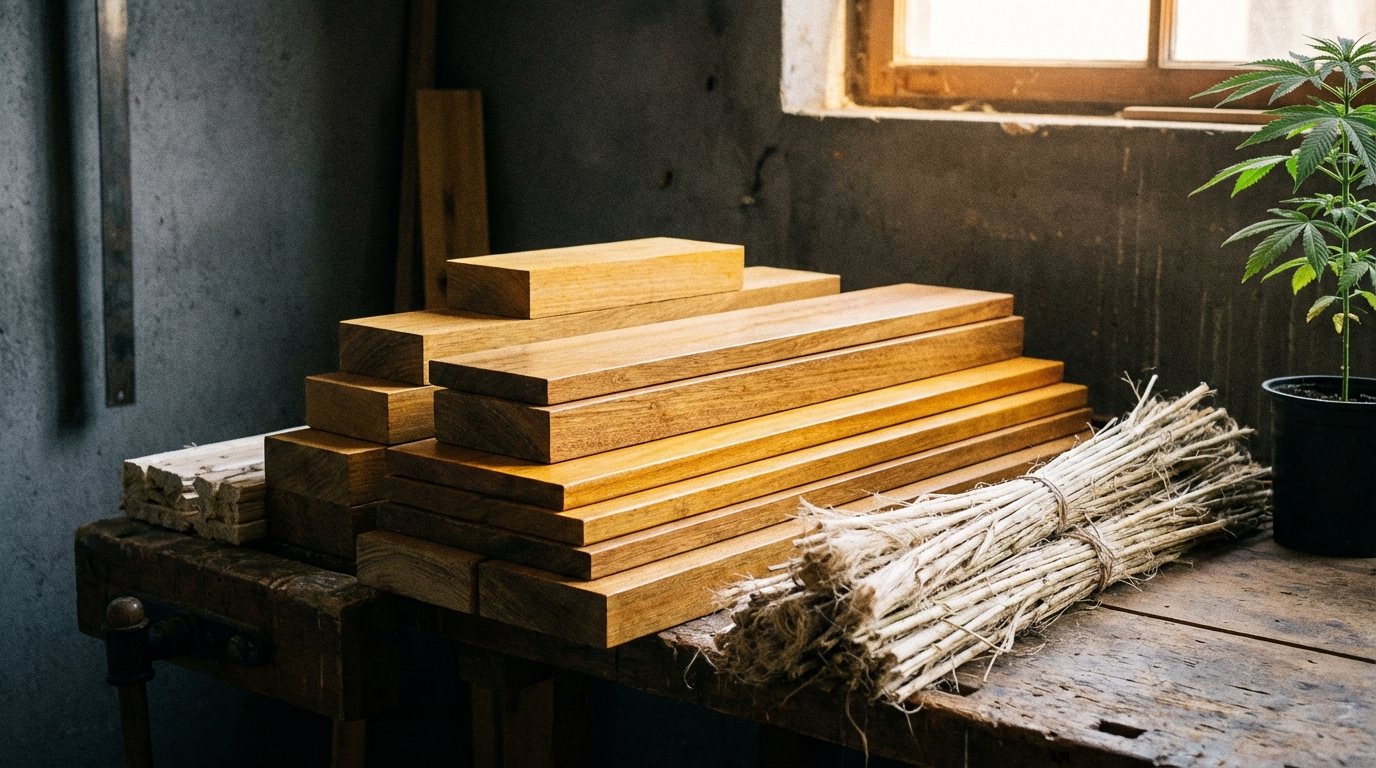
So, you are trying to figure out if HempWood is really a new sustainable contender or just another buzzword in the building materials space. The short answer: yes, HempWood is a real contender, but it has clear strengths, clear limits, and you should treat it like a niche engineered material, not a magic fix.
Think of HempWood as a high‑density, engineered wood alternative made from hemp fibers and soy-based binders. It is fast to grow, it locks in carbon, and it gives you hardwood‑like performance in many indoor uses. It is not going to replace every plywood sheet or every structural beam in a house, but it can replace a lot of oak, hickory, and some tropical hardwoods in flooring, furniture, and interior finishes.
Here is what you need to keep in mind before you start pitching HempWood to your team, your clients, or using it in your own projects.
- HempWood is an engineered wood product made from hemp stalks and bio‑based binders.
- It grows far faster than trees, so the raw fiber source is highly renewable.
- It can match or beat many hardwoods on hardness and dimensional stability.
- Right now it is best used for flooring, furniture, and interior millwork, not main structure.
- It can help reduce use of slow‑growth hardwoods and some imported species.
- The supply chain is small, so pricing, availability, and color consistency vary.
- It finishes like wood, can be machined with standard tools, and has a similar learning curve to dense hardwood.
- LCA data is promising but still limited; treat sustainability claims with healthy skepticism.
If you are treating HempWood like a classic hardwood, you will be frustrated. If you treat it like engineered bamboo or LVL for interiors, it starts to make sense.
What is HempWood, in practical terms?
HempWood is an engineered board made from the stalks of industrial hemp plants. The fibers are chopped, aligned, and pressed together under high pressure with a soy‑based adhesive. The result is a dense, block‑like product that can be cut into boards, planks, or panels.
You can think of it as a cousin of:
- Engineered bamboo flooring.
- Laminated veneer lumber (LVL).
- Edge‑glued hardwood panels.
But instead of long tree veneers, HempWood uses short hemp fibers. The manufacturing process is closer to a “fiber densification” approach than a traditional sawn lumber line.
How it is made, step by step
Not the marketing version, the practical one:
- Farmers grow industrial hemp, harvest the stalks, and separate them from the leaves and seeds.
- The stalks are processed into fiber segments and dried.
- Fibers are coated with a soy‑based binder.
- The coated fibers are oriented and laid into a mold to encourage grain direction.
- The mold goes into a hot press that applies heat and pressure to cure the adhesive.
- The compressed “log” that comes out is sawn into boards or sliced for flooring blanks.
- Boards get planed, sanded, and finished or shipped raw.
The key idea: you are not buying a plant. You are buying a carefully controlled press cycle wrapped in a sustainability story.
Why people care about HempWood right now
You are seeing HempWood in blog posts and product catalogues for three main reasons:
- Hemp grows in months, not decades, so it offers fast fiber supply.
- There is pressure to cut down on slow‑growth hardwood consumption.
- Indoor air quality and chemical content are under a stronger microscope.
Hemp lines up nicely with all three.
Hemp growth vs tree growth
You already know trees take time. A simple comparison helps frame it:
| Material source | Typical harvest cycle | Yield profile |
|---|---|---|
| Industrial hemp | 4-6 months | Several tons of dry fiber per acre per year |
| Fast‑growing softwood (pine) | 15-25 years | High volume, lower density lumber |
| Hardwood (oak, maple, hickory) | 30-60+ years | Lower volume, higher density lumber |
A single acre of hemp can be planted and harvested again and again while one stand of oak is still maturing. From a raw fiber supply perspective, that is appealing if you want to lock in carbon fast and reduce pressure on long‑rotation forests.
Carbon and sustainability angle (with caveats)
Hemp captures CO₂ rapidly while it grows. That carbon stays in the fibers, and if you turn them into a solid board that ends up in a home or office and stays there for 20 or 40 years, you are delaying that carbon going back into the air.
That looks good on a lifecycle chart, but there are a few questions you should ask any HempWood vendor:
- How far do the stalks travel from farm to factory?
- What energy source powers the hot press line?
- How much resin per cubic foot is being used?
- Is there independent LCA data for that specific line, not generic hemp data?
The sustainability story is strong, but like any engineered product, the factory energy mix and logistics matter.
Hemp itself is not a silver bullet. It is a fast‑growing fiber crop. The real gain comes from how you integrate it into your material mix and your region’s energy grid.
How strong is HempWood, really?
On paper, HempWood often looks impressive. You will see hardness numbers that rival hickory and maple, and claims that it is stronger than oak.
Let us anchor this with more tangible comparisons.
| Material | Janka hardness (lbf) | Type |
|---|---|---|
| Hemlock (reference softwood) | ~500 | Softwood |
| Red oak | ~1,290 | Hardwood |
| White oak | ~1,360 | Hardwood |
| Maple (hard) | ~1,450 | Hardwood |
| Hickory | ~1,820 | Hardwood |
| HempWood (published range) | ~2,000-2,500 | Engineered hemp |
These numbers vary across labs and product lines, but the pattern is clear: HempWood sits at the high end of the residential hardwood spectrum in hardness.
What hardness means for you
Hardness shows how well a board resists dents and wear from things like:
- Chairs sliding across a floor.
- Pet claws.
- Dropped tools in a shop environment.
A high hardness rating sounds great for flooring and countertops. It also hints at a few trade‑offs:
- Tough on cutting edges: your saw blades and router bits will wear faster.
- More force needed for nailing or screwing; pre‑drilling might be a good idea.
- Less forgiveness when you try to “bend” or tweak a board into place.
So while you get good surface durability, you also get some of the same challenges that come with very dense hardwoods.
Bending strength, shear, and stability
Most HempWood makers position it for non‑structural uses, so they do not always publish full structural design values. When they do, you will see:
- Bending strength that can meet or beat many hardwoods along the grain direction created during pressing.
- Good dimensional stability because the engineered structure reduces large growth rings and grain changes.
- Stable moisture movement if boards are sealed and installed correctly.
From a practical standpoint: for shelves, furniture parts, stair treads, and flooring, the structural performance is usually more than enough.
I would not treat HempWood as a direct substitute for structural LVL, glulam, or dimensional lumber in critical load paths unless you are working with an engineer, have certified values, and are in a code environment that actually allows it.
The technology angle: where HempWood fits in your material stack
If you build digital products or tech hardware, you may be wondering why a blog that talks about technology should care about something as “physical” as HempWood.
There are a few natural intersections:
- Smart homes and green building materials.
- Consumer hardware with natural material skins or enclosures.
- Office and data center interiors.
- Furniture and fixtures in retail and coworking spaces.
HempWood in smart homes
Smart homes are not just about sensors and apps. The physical envelope matters: floors, doors, trim, cabinets. All of those can use HempWood.
Pairing low‑VOC engineered materials with connected building systems gives you:
- Better indoor air quality metrics for health dashboards.
- Stronger sustainability claims for marketing green properties.
- Data‑driven experiments where you track humidity, temperature, and material movement over time.
You can even imagine a “material passport” inside a home’s digital twin: a record that shows where HempWood panels are used, what their expected service life is, and how they could be recovered.
Device and hardware enclosures
If you design consumer hardware, you have probably looked at wood veneers, bamboo, or recycled plastics for enclosures, docks, and stands.
HempWood could slot into that same space:
- Docking stations and monitor stands.
- Laptop risers and keyboard trays.
- Smart speaker housings where you want a wood aesthetic.
The key advantage over traditional wood veneers is:
- Consistent density for CNC machining.
- Predictable grain pattern (although more “busy” than oak).
- Marketing story tied to regenerative agriculture and carbon capture.
The downside is weight: HempWood is dense. For handheld devices, that can be a problem. For stationary stands or furnishings, that mass can even feel premium.
If you would not use hickory or dense maple for that enclosure, HempWood will feel very similar in your design process.
HempWood vs other “green” materials
You probably see HempWood compared to bamboo, MDF, OSB, and traditional hardwood. Side‑by‑side helps.
| Material | Base fiber source | Growth / renewal rate | Common uses | Binder / VOC profile |
|---|---|---|---|---|
| HempWood | Industrial hemp stalks | 4-6 months per crop | Flooring, furniture, interior trim | Soy‑based resin, low‑VOC |
| Engineered bamboo | Bamboo stems | 3-5 years to harvest | Flooring, panels, furniture | Often urea or phenol formaldehyde |
| MDF | Wood fibers | Depends on species | Cabinet boxes, furniture cores | Often higher formaldehyde content |
| Plywood | Wood veneers | Depends on species | Sheathing, furniture, cabinets | Varies, can be low‑formaldehyde |
| Solid hardwood (oak, maple) | Logs from hardwood trees | 30+ years | Flooring, furniture, millwork | No binder, only finish VOCs |
The stand‑out combination here is:
- Very fast fiber growth.
- Low‑VOC binder system.
- Hardwood‑grade mechanical performance.
That is the triangle where HempWood competes well.
Real‑world use cases where HempWood makes sense
If you are trying to decide where to test HempWood, you need practical contexts, not just lab numbers.
1. Residential flooring
This is one of the strongest fits.
Why:
- High hardness for wear resistance.
- Predictable boards that behave like dense hardwood.
- Green story that homeowners can understand quickly.
What to watch:
- Moisture: like any wood‑like product, it does not like standing water or wild humidity swings.
- Installer familiarity: your crew needs guidance on acclimation and fastening.
- Finish system: use finishes compatible with the binder and density (many vendors offer prefinished lines).
If you are in tech, not construction, the angle is different: HempWood flooring shows up in physical offices, coworking spaces, or retail stores you design or manage. It can support brand positioning around climate commitments and can be featured in virtual tours and AR experiences.
2. Furniture and fixtures
For furniture companies, custom shops, and even direct‑to‑consumer brands, HempWood can be turned into:
- Table tops.
- Desk surfaces.
- Shelving systems.
- Cabinet faces and drawer fronts.
Pros:
- Distinct visual grain pattern that stands out from standard oak and ash.
- Strong marketing hook tied to hemp and regenerative farming.
- Compatibility with CNC workflows and digital fabrication.
Cons:
- Heavier boards can drive up shipping cost for direct‑to‑consumer.
- Tool wear and machining times may be higher than with softwoods.
- Less long‑term field data than classic hardwoods.
If your brand story leans into climate or regenerative agriculture, HempWood front panels or tabletops can become part of the unboxing story, not just the tech spec sheet.
3. Interior millwork and branding elements
Think about reception desks, wall panels, sign backers, and trim in tech offices, labs, and retail‑tech spaces.
HempWood fits here because:
- You can standardize panel sizes for fabrication.
- Traffic is moderate, not heavy industrial, so wear is manageable.
- Environmental certifications and sustainability reports often cover interiors in detail.
This is also where you can combine HempWood with digital fabrication and smart lighting to create interactive features: for example, branded wall panels with integrated LEDs and sensors, cut precisely with CNC routers from HempWood panels.
Limitations and risks you should not ignore
Every new material has hype. Your job is to separate hype from risk.
Limited supply chain scale
Right now, HempWood is not produced at the same scale as MDF or plywood. That has a few ripple effects:
- Price volatility: when demand spikes, prices can jump.
- Lead times: large commercial orders may face longer lead times.
- Geographical gaps: outside certain regions, freight cost is higher.
If you are specifying HempWood for a big project, get a firm handle on:
- Confirmed production capacity during your build window.
- Backup sourcing strategies or alternate materials.
- Color and grain consistency across batches.
Building code and certification hurdles
For internal finishes, HempWood is easier to adopt. For structural roles, local building codes and standards get strict.
You will need answers on:
- Fire ratings for panels and flooring systems.
- Slip resistance for flooring in public areas.
- VOC emissions testing (for WELL, LEED, or other certifications).
Many tech clients now care deeply about these certifications because they connect to employee health, ESG reports, and investor questions. So you cannot rely only on marketing pamphlets; you want test reports and code evaluation documents.
Moisture and water exposure
HempWood behaves more like hardwood than plastic. That means:
- Short‑term spills are fine if wiped up quickly.
- Long‑term exposure to standing water will cause swelling and damage.
- High humidity swings can cause movement, though the engineered structure moderates this.
You probably do not want HempWood in:
- Steam showers.
- Exposed exterior cladding without protection.
- Ground‑contact applications.
For tech offices, labs, and homes, that is manageable. Standard best practice for hardwood floors and panels still applies.
Cost and economics: does HempWood make financial sense?
HempWood often prices in the same range as mid‑ to upper‑tier hardwood flooring and furniture panels, sometimes higher. It is not a budget MDF replacement.
A simple way to think through cost:
| Material | Relative cost (retail) | Typical segment |
|---|---|---|
| OSB / basic plywood | Low | Sheathing, utility |
| MDF | Low-medium | Cabinet boxes, paint‑grade panels |
| Standard oak/maple flooring | Medium | Mid‑market residential |
| High‑end hardwood / bamboo flooring | Medium-high | Premium residential, commercial |
| HempWood flooring / panels | Medium-high, sometimes high | Green premium, niche commercial |
You should justify the extra cost with one or more of these:
- Brand differentiation for your product or property.
- Sustainability targets (carbon, forestry impact) that move you closer to stated goals.
- Marketing value: photos, videos, and messaging around hemp‑based interiors.
If you treat HempWood as a simple commodity and compare it only on price per square foot, you will probably walk away. If you anchor it in your brand strategy and sustainability roadmap, the cost story changes.
Working with HempWood: fabrication and installation basics
From a shop or jobsite perspective, HempWood is less mysterious than it might seem.
Tools and machining
You can work HempWood with common woodworking tools:
- Table saws and miter saws.
- Routers and CNC routers.
- Sanders and planers rated for dense hardwood.
Some practical tips:
- Use sharp carbide blades and bits to counter tool wear.
- Plan for slower feed speeds than with pine or poplar.
- Collect dust and chips properly; the density can create heavy dust load.
If your shop is already set up to handle hard maple or hickory, HempWood will feel like a different flavor of the same challenge.
Fastening and joining
You can join HempWood with:
- Wood screws (preferably with pre‑drilling for edge locations).
- Pocket screws for furniture and panels.
- Standard wood glues that bond well to dense fibers (check compatibility with the resin if you are worried).
For flooring:
- Either staple / nail‑down or glue‑down systems are common.
- Follow the vendor’s recommendations for subfloor prep and adhesives.
Finishing and appearance
The visual pattern of HempWood tends to look “busier” than oak. You get a mosaic of short fiber ends and grain pattern.
That can be:
- A feature for modern, bold interiors.
- A mismatch if you were expecting a quiet, linear grain.
Finishing tips:
- Test stains and sealers on offcuts; absorption can differ from solid wood.
- Use finishes with low VOCs if you want to maintain the indoor air story.
- Expect the color to deepen a bit over time, like many hardwoods.
Sustainability metrics: what you should ask for
If you are integrating HempWood into tech office builds, product lines, or real estate portfolios, your sustainability or ESG team will ask for numbers, not just claims.
You want to gather:
- Lifecycle assessment (LCA) reports for the specific product line.
- Environmental Product Declarations (EPDs) if available.
- VOC emissions test reports for indoor air standards.
- Forestry or agricultural certifications on the hemp supply (where applicable).
Questions to put in writing to a vendor:
- What share of your resin content is bio‑based versus fossil‑based?
- What is your factory energy mix, and are you tracking emissions per cubic foot of product?
- Do you have third‑party audits for emissions and product safety?
This is where using HempWood can push your vendors to improve. Many of them are still small and open to feedback.
Where the technology might go next
Looking forward a few years, there are several directions for HempWood and related hemp composites that matter for anyone building tech‑heavy spaces or products.
Hybrid hemp panels and composites
You can expect more:
- Hemp‑based MDF or particleboard with lower resin content.
- Hybrid panels that mix hemp fibers with recycled wood or agricultural residues.
- Bio‑resin systems tuned for fire performance and durability.
That could give you HempWood aesthetics on the surface with lighter, cheaper cores for furniture and fixtures.
Material tracking and digital twins
Tech teams are already building digital twins of buildings and products. HempWood and similar materials fit nicely into that model:
- Each panel or batch can be tagged with production data and carbon content.
- IoT sensors in smart buildings can track humidity and temperature where panels are installed.
- You can connect long‑term performance data back to material choices.
That feedback loop will separate marketing claims from long‑term truth.
End‑of‑life and circularity
One big question with any engineered material is: what happens when you are done with it?
With HempWood, potential paths include:
- Re‑machining and reuse in lower‑grade products.
- Grinding for composite cores or filler.
- Energy recovery in facilities set up to handle engineered products safely.
If you are designing now, you can help by:
- Using mechanical fasteners where possible instead of permanent adhesives.
- Avoiding heavy contamination with non‑recyclable finishes and coverings.
- Documenting material locations for future deconstruction.
The more you design for disassembly today, the more useful all that sequestered carbon becomes tomorrow.
How to decide if HempWood belongs in your next project
You can walk through a simple decision filter.
1. Where will the material live?
Good matches:
- Indoor environments with controlled humidity.
- Spaces where visitors see and touch the surface.
- Applications where hardness and durability matter.
Weak matches:
- High‑moisture or exterior environments without good protection.
- Hidden structural elements where cost and code approvals are critical.
2. Does the sustainability story support your goals?
Check how HempWood fits into:
- Your carbon reduction targets.
- Your indoor air quality standards.
- Your brand position around materials and environmental impact.
If you already talk publicly about regenerative agriculture, circular design, or low‑carbon construction, HempWood aligns well. If you have not built that narrative at all, it might still help you start.
3. Can your teams actually work with it?
Ask your:
- Fabrication partners if they are comfortable with dense, engineered materials.
- Installers if they have handled hard bamboo or dense hardwood flooring before.
- Procurement team if they can manage smaller, younger supply chains.
If the answer is yes, the learning curve is managed. If the answer is no, pilot on a small, low‑risk space first.
A practical tip before you commit
Before you specify HempWood across an office floor, a product line, or a store concept, order a batch of sample boards or planks and run a small, real test:
- Install a few square meters in a high‑traffic area in your office.
- Place sample boards in your shop and machine them using your normal tooling.
- Have your design and marketing teams look at the grain and color under real lighting.
Give it 60 to 90 days. Track wear, movement, and feedback from people who walk on it or touch it every day. That short pilot tells you more than any spec sheet and makes your final decision on HempWood much more grounded.