So, you are trying to find epoxy Denver flooring ideas to transform your home. The simple answer is this: focus on a few clear concepts like metallic finishes, flake systems, solid color floors, and custom patterns, then match each one to the room, your lifestyle, and your budget.
Epoxy is one of those things that looks simple on the surface, but it changes how a space feels. It turns plain concrete into flooring that resists stains, cleans up quickly, and holds up to kids, pets, cars, and all the random stuff that happens in a house. If you plan it well, it also ties your rooms together visually, which is something many people only realize after they see it installed.
If you are just starting your research, it helps to look at local examples and suppliers. A good starting point for epoxy Denver products and ideas is a local decorative concrete shop that knows how epoxy behaves in Colorado’s dry climate and temperature swings.
Here are some things you need to know before you go all in.
- Epoxy is not just for garages; it works in living rooms, basements, kitchens, and even small bathrooms.
- Preparation is everything. Poor prep means peeling, bubbles, or hot tire marks later.
- You need to match epoxy type and finish to how the room is used, not just how it looks on Pinterest.
- Denver’s climate matters. Concrete moves with temperature and moisture, so product choice and prep must account for that.
- Gloss level, texture, and color affect daily cleaning more than most people expect.
- You do not have to do it all at once. Many homeowners phase projects room by room.
- Professional installs usually last longer, but a careful DIY job can still work for some spaces.
Why epoxy makes sense in a Denver home
In Denver, you get dry air, freeze and thaw cycles, and strong sun. All of that hits your concrete first.
Epoxy works well here because it seals the surface and helps protect against:
- Road salt from winter that drips off your car in the garage
- Dust that collects on bare concrete and ends up all over your house
- Water spills in basements from small leaks or kids leaving the faucet on
- Hot tire pickup that can tear weak coatings off the floor
It also gives you a chance to fix the look of older slabs. Many Denver homes have patchy, stained, or cracked concrete in the garage and basement. Epoxy cannot fix structure problems, but it can cover old discoloration and blend repairs into a smooth, unified floor.
If your concrete is structurally sound, epoxy can make an ugly slab look like a clean, finished floor that matches the rest of your home.
I think the main shift is mental. People see epoxy as a “garage upgrade,” but once you see it in a living room, it feels very different. More like a custom surface than a typical utility coating.
Epoxy flooring options by room
Instead of starting with products, it is easier to start with rooms. Each space has different needs.
Garage epoxy ideas
Most Denver homeowners start with the garage. It usually has the worst looking concrete, and it takes a beating in winter.
Common goals:
- Resist road salt and oil stains
- Reduce dust so it does not blow into the house
- Make the space bright enough to actually work in
- Create a floor that does not feel like a dirty afterthought
Good epoxy ideas for garages:
Full flake epoxy system
This is the classic “garage makeover” look: a base coat of tinted epoxy, vinyl flakes broadcast across the surface, then a clear topcoat.
Benefits:
- Flakes hide dirt, small chips, and hairline cracks.
- Texture gives better grip when the floor is wet.
- You can pick flake blends that match your car color, walls, or cabinets.
Common color combos that work in Denver garages:
| Flake blend | Base color | What it suits |
|---|---|---|
| Gray / white / black | Light gray | Modern homes, keeps the space neutral |
| Tan / brown / cream | Warm beige | Homes with warm wood cabinets and trim |
| Blue / gray / white | Medium gray | People who like a cooler, cleaner look |
Solid color high build epoxy
If you want a simple, clean, almost industrial look, one solid color works well. Light gray and medium gray are common because they hide dust but still reflect light.
Pros:
- Easy to sweep and mop.
- Looks very crisp when you keep it clean.
- Less visual noise than flake floors.
Cons:
- Scratches and chips are easier to notice.
- Oil spills or dirt sit on top and stand out more.
I like this option when the garage is used as a workshop or gym. It feels more like a room and less like a car bay.
Metallic epoxy for show garages
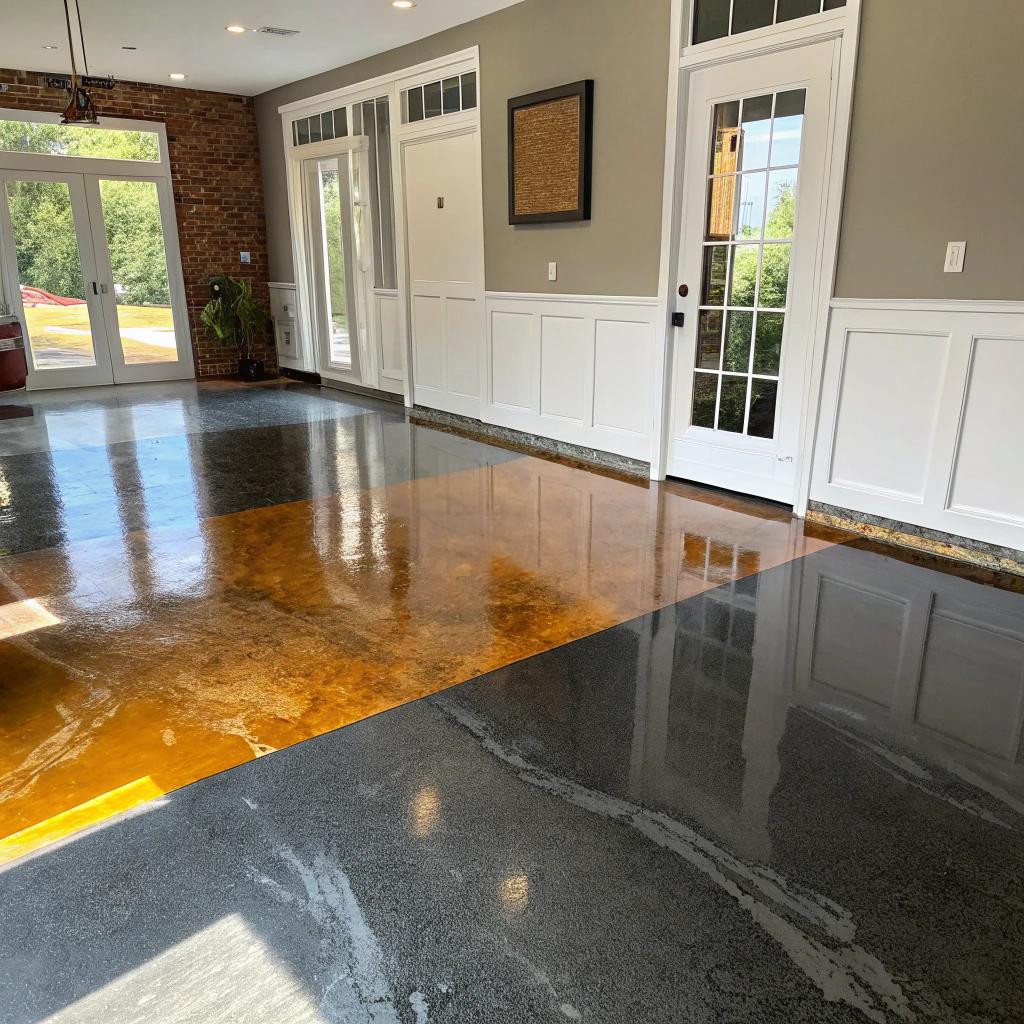
For people who treat the garage like an extension of the living space, a metallic epoxy can look almost like polished stone.
Swirled tones of silver, black, copper, or blue move across the floor in soft patterns. It is not for everyone. Some people find it too busy for a garage, but if you have a collector car or a home studio, it can look impressive.
If you want the garage to feel like a showroom, metallic epoxy is the finish that gets the most “wow” reactions.
Basement epoxy flooring ideas
Basements in Denver vary a lot. Some are finished and bright. Others are half storage, half hangout. Epoxy can work in both.
Key problems it helps with:
- Musty smells trapped in carpet
- Old tile adhesive or paint that looks patchy
- Moisture from small leaks or condensation
Of course, if you have serious water intrusion, that has to be fixed before any coating. Epoxy will not magically stop water pressure from the outside.
Here are a few styles that fit basements well.
Warm tone solid or flake floors
Many basements feel cold because of low light and concrete walls. Warmer floor colors can balance that.
Warm options:
- Beige or taupe solid color epoxy
- Flake floors with tan, cream, and soft brown
- Soft gray with warm beige flakes for a mixed look
These pair well with:
- Off white or light tan walls
- Warm LED lighting
- Area rugs in seating areas
You can still add texture to prevent slipping, especially near stairs.
Epoxy for home gyms and hobby rooms
If part of your basement is a home gym, art studio, or woodshop, epoxy gives you a surface that handles traffic and spills better than carpet or cheap vinyl.
Ideas:
- Medium gray solid epoxy with a satin topcoat to reduce glare.
- Flake system with a subtle, small flake that hides chalk, sawdust, or scuffs.
- Colored zones painted or taped on top for workout areas.
If you lift heavy weights, you still want rubber mats in drop zones. Epoxy handles impact, but repeated drops in the same spot can chip any coating.
Decorative metallic basements
Metallic epoxy in basements can look elegant when combined with modern lighting and minimal furniture. It reflects light and can make a low ceiling space feel taller, which surprised me the first time I saw it.
Color ideas:
| Metallic blend | Room style | Comment |
|---|---|---|
| Silver / charcoal | Modern media room | Pairs well with black trim and large screens |
| Bronze / brown | Cozy lounge | Feels rich without being too flashy |
| Pearl / light gray | Art or craft space | Bright, reflective, good for seeing details |
You will want a good anti slip additive in traffic lanes, especially if kids use the space.
Kitchen and living area epoxy ideas
Not everyone wants epoxy in main living areas, but in modern or industrial style homes, it can look very clean and intentional.
There are two common approaches.
Polished concrete look with clear epoxy
If your concrete slab is in decent shape, you can grind it smooth, stain or tint it slightly, then use clear epoxy as a sealer and finish. The concrete still shows, but it has depth and a consistent sheen.
Pros:
- Very low profile. No visible pattern if you keep it subtle.
- Works with minimalist furniture and open floor plans.
- Easy to sweep and vacuum.
Cons:
- Imperfections in the slab will show. Some people like that; others do not.
- Clear, glossy finish can show streaks from mopping.
If you prefer a softer look, a satin or matte topcoat over the epoxy can tone down the shine.
Soft solid color floors for modern interiors
In some Denver homes, especially newer builds with open kitchens and living rooms, people choose a soft gray or warm white epoxy floor across the main level.
Paired with:
- White or light wood cabinets
- Black fixtures
- Simple, solid color rugs
This type of floor looks intentional and quite current, but it does require that you keep clutter under control, because everything is visible on that clean surface.
If you like clean lines and simple spaces, a neutral epoxy floor can make the whole main level feel more cohesive than a patchwork of tile, carpet, and laminate.
Bathroom and laundry epoxy ideas
Bathrooms and laundry rooms get water, soap, and cleaning chemicals. Epoxy handles all of that well, as long as you pick the right texture.
Ideas:
- Small flake floors for laundry rooms to hide lint and dirt.
- Solid light gray or beige epoxy in bathrooms with a fine anti slip additive.
- Stone look epoxy patterns that imitate tile but without grout lines.
One thing to watch: some people want a glassy reflective finish in bathrooms. It looks good in photos, but it can feel slick when wet. You need to balance looks with grip.
How Denver’s climate affects epoxy flooring
Denver is dry, but you still have to think about moisture. Concrete absorbs water from below and releases it slowly. If that moisture is trapped under epoxy, it can cause problems.
Here are a few climate related points you cannot ignore.
Freeze and thaw movement
Garage and exterior slabs expand and contract during cold snaps and warm spells. If the wrong products or prep methods are used, the coating can crack or peel where the slab moves.
Things that help:
- Proper grinding, not just acid etching, for prep.
- Moisture testing before coating basements or old slabs.
- Flexible primer layers in certain systems.
UV exposure
Denver has strong sun. Some epoxies yellow when exposed to UV. This is most obvious in:
- Garage door thresholds
- Rooms with large south facing windows
- Outdoor or semi outdoor spaces
To deal with this, many installers use polyaspartic or polyurethane topcoats that resist UV better than plain epoxy. This is one of those details that matter more here than in cloudier areas.
Planning your epoxy project: questions to ask yourself
Before you pick colors or finishes, it helps to answer a few direct questions. Not big design theory. Just basic daily life.
Ask yourself:
- What is this room used for most of the time?
- Who uses it? Adults only, or kids and pets?
- How often are you willing to sweep or mop?
- Do you drop tools, weights, or heavy objects on the floor?
- Do you prefer a floor that hides dirt or one that shows everything so you can clean it?
Your answers change the right choice.
For example:
- If you have a busy family with kids and a dog, a mid tone flake floor in the garage hides muddy footprints better than a pure white or black floor.
- If you are a clean freak who likes seeing every spec of dust, a lighter solid color might make you happier.
There is no perfect floor. Just one that fits your habits better.
DIY epoxy vs professional install in Denver
People often ask whether they should tackle epoxy as a DIY project or pay a pro. The honest answer is that both can work, but not in every situation.
When DIY epoxy can make sense
DIY is more realistic in:
- Small, low risk spaces like garden sheds, small workshops, or storage rooms.
- Areas where appearance is less critical.
- Homes where you are comfortable with grinders, mixing chemicals, and working quickly.
Trade offs:
- Big box kits are usually thinner and less durable than pro systems.
- Surface prep tools (grinders, vacuums) can be expensive to rent, but skipping them causes failures.
- Timing matters. Many products have short working times.
One honest point: if you hate rushing or working on floors for hours, DIY epoxy may be more frustrating than it looks in videos. Those before and after clips leave out the dusty, noisy prep work.
When a pro installer is worth it
Professional epoxy installers usually make more sense for:
- Garages used daily
- Large basements
- Main living areas where appearance matters
- Places with known moisture issues
Reasons:
- They have industrial grinders and vacuums to get a proper surface profile.
- They can test for moisture and pick the right primers or coatings.
- They lay material faster, which reduces risk of roller marks and bubbles.
If the room is important to you and you want the floor to last many years, a professional install often saves headaches, even if the upfront cost is higher.
Still, you should ask questions, not just sign. Ask what products they use, how they handle moisture, and what the prep process looks like. If someone says “we just sweep and coat,” that is a red flag.
Color and texture choices that work in real homes
Color is where people either get stuck or overreach. They pick something trendy, then regret it later.
Here are a few practical pointers.
Stick to neutrals for most floors
Bright red or lime green floors look fun for a week. After that, they can feel dated. Neutrals also make it easier to sell your home later.
Good neutral options:
- Light to medium gray
- Warm beige or taupe
- Charcoal for modern, high contrast spaces
You can add personality with flake blends or metallic accents, while keeping the base color simple.
Think about how dirt shows
This sounds dull, but it matters. How do you react when you see dust on the floor?
If it bothers you, pick a color and pattern that does not highlight every speck. Mid tone grays and flake systems are forgiving. Pure white or black floors are the hardest to keep visually clean.
Texture and slip resistance
Every epoxy system can be adjusted for grip. Additives like fine sand or special non slip grains mix into topcoats.
Basic rule:
- More texture = better grip but harder to mop.
- Less texture = easier to clean but more slippery when wet.
In Denver, you track in snow and slush, at least part of the year. In garages and entry zones, err slightly toward more grip. In living rooms and bedrooms, you can go smoother.
How epoxy compares to other flooring in Denver homes
Sometimes it helps to see epoxy next to other common choices.
| Floor type | Where it fits | Pros | Cons |
|---|---|---|---|
| Epoxy over concrete | Garage, basement, some living areas | Durable, easy to clean, custom looks | Surface prep is critical, can feel hard and cool |
| Tile | Bathrooms, kitchens | Good with water, lots of choices | Grout stains, harder underfoot, more labor to install |
| Engineered wood | Living rooms, bedrooms | Warm look, comfortable | Not ideal with moisture, scratches easier than epoxy |
| Carpet | Bedrooms, some basements | Soft, warm | Holds dust, stains, can feel musty in basements |
| LVP (luxury vinyl plank) | Basements, living areas | Water resistant, softer feel | Can fade or gap in strong sun, less durable than epoxy under heavy loads |
Epoxy will not replace all other floors in a house, and it should not. But in areas where you already have concrete, it is worth a serious look.
Common mistakes with epoxy floors in Denver
It is easy to find polished portfolio photos online. You see less of the failures. Here are some mistakes that pop up again and again.
Skipping or rushing surface prep
This is by far the most common problem.
Signs of bad prep:
- Peeling near car tires within the first year
- Coating flaking along expansion joints
- Sections where epoxy lifts in sheets when scratched
Good prep usually includes:
- Grinding to open up the concrete surface
- Thorough vacuuming with a good dust collection system
- Repairing cracks and spalls with suitable materials
Acid etching alone is often not enough on older or mechanically finished Denver slabs.
Using the wrong product for the conditions
There are many epoxy types and related coatings. Not all are equal.
Problem matches:
- Thin water based kits in high traffic garages
- Non UV stable epoxy in sun filled rooms or door thresholds
- Coatings without moisture tolerance on damp slabs
A good installer or supplier will ask about your space, not just hand you a random kit.
Ignoring joints and cracks
Expansion joints and cracks in concrete move. Some can be filled and coated over. Others need to be honored, meaning left as functional joints with flexible fillers on top.
If movement is ignored:
- Cracks reappear through the coating.
- Edges of joints chip over time.
This is one area where local experience matters. Denver soil and slabs have their own quirks, especially in older neighborhoods.
Simple design ideas that look good long term
You do not need wild colors or patterns for a floor to feel special. In fact, the simpler choices often age better.
Here are a few calm, repeatable ideas.
Two tone garage with a “parking zone”
Instead of covering the whole garage in one color, you can:
- Use a flake floor in the main car area.
- Apply a solid darker color band near the walls where tools or shelves sit.
This makes the space feel intentional and can help hide future scuffs around workbenches.
Basement “concrete loft” look
If you like a more urban style, you can:
- Grind the basement slab.
- Apply a subtle gray stain.
- Seal it with clear or lightly tinted epoxy and a matte topcoat.
Then bring in soft textures with furniture, plants, and rugs. The hard floor becomes a backdrop, not the whole story.
Consistent color from garage entry into mudroom
Many Denver homes have a door from the garage into a mudroom or small hallway. Using one coordinated color or finish between these spaces makes the transition smoother.
For example:
- Garage: gray flake floor.
- Mudroom: same gray base tone, but solid epoxy with fine texture.
It looks connected, but each room still suits its use.
Q&A: Common questions about epoxy floors in Denver homes
How long does a good epoxy floor last?
In a typical Denver garage with proper prep and a quality system, you can expect many years of service. Some floors go 10 years or more before they need a refresh, especially if you clean up spills and avoid dragging sharp metal across them.
Basements and living areas usually see less abuse, so coatings there can last even longer.
Will epoxy make my floors feel colder?
Epoxy itself does not add warmth, and concrete is naturally cool. On a slab, epoxy will feel similar in temperature to bare concrete, just smoother. In basements and living areas, many people use area rugs or runners in seating zones. If you are very sensitive to cold floors, you might want radiant heat or another flooring type in bedrooms.
Is epoxy safe for pets and kids?
Once fully cured, most residential epoxy systems are inert and safe to walk on. During application and curing, there can be fumes, so children and pets should stay out of the area until the floor is ready for use. For daily use, the main concern is slip resistance. If you have older dogs or very active kids, ask for a texture level that balances grip with easy cleaning.
Can epoxy fix cracks in my concrete?
Epoxy can fill and hide minor cracks and small pits, but it does not fix structural movement. If the slab is still moving or has significant settlement, cracks can return. For big structural issues, you need a concrete or foundation specialist before thinking about coatings.
How do I clean an epoxy floor?
Most of the time, simple methods work:
- Sweep or vacuum dust and grit so it does not scratch the surface.
- Mop with warm water and a mild, non abrasive cleaner.
- Clean up oil or chemical spills sooner rather than later.
Avoid harsh acids or stiff metal tools that can damage the finish. If you notice dull areas, a professional can sometimes recoat or refresh the top layer.
Is epoxy the right choice for every room?
Not really. It is strong and flexible in terms of looks, but it is still a hard surface. Bedrooms and playrooms sometimes benefit more from warmer, softer materials. Think of epoxy as a great choice for concrete based spaces, high traffic areas, and any room where you want durability and easier cleanup.
If you walk through your own house right now, which room would feel the most different if the floor was cleaner, brighter, and easier to maintain? That is probably where an epoxy floor makes the most sense to start.