
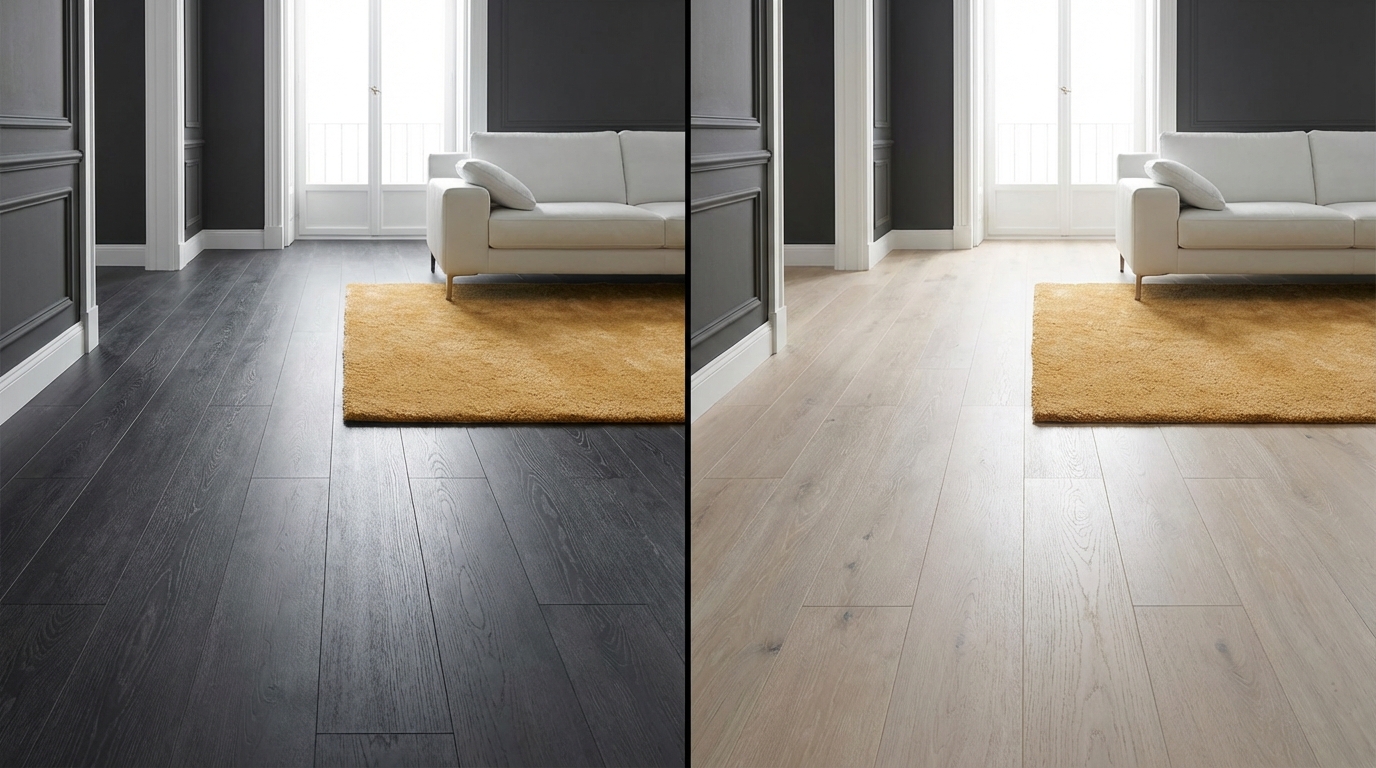
So, you are trying to figure out whether dark or light floors make a room look bigger.
Light floors usually make a room feel larger, but dark floors can work too if you balance them with the right walls, furniture, and lighting.
Here is the short version: your eye reads brightness, contrast, and lines. Light floors bounce more light and blur the floor-to-wall line, which opens the space up. Dark floors pull the eye down, which can feel heavier, but if the walls and ceilings are bright and the room gets good light, dark floors can still feel open and very clean. The trick is not just the floor color, but how everything in the room works together.
Things you need to know:
- Light floors reflect more light and usually feel more open.
- Dark floors absorb more light and can feel smaller if walls and ceilings are also dark.
- Contrast between floor and wall color changes how big the room looks.
- Natural light and artificial light change how both dark and light floors feel.
- Plank width, pattern, and direction affect how long or wide a room feels.
- Furniture color and clutter can undo the effect of any floor color.
- Finish (matte vs glossy) changes how much light bounces around the room.
- Your camera and social feeds lie a bit; real spaces do not look exactly like staged photos.
How your eye reads space: why floors change room size
Before you pick a floor sample, you need to know why a room feels big or small to your brain. It is less about square footage and more about what your eye does in the first few seconds.
Your brain is watching three things:
- Light and shadow
- Contrast between surfaces
- Lines and where they lead
When the floor is light, it reflects more light upward. The line between floor and wall looks softer. That makes the edges of the room feel farther away.
When the floor is dark, the edge between floor and wall is stronger. Your eye sees a clear “stop” at the bottom of the wall. If walls are also dark, the room feels like it closes in.
> A good rule of thumb: the more continuous and bright your largest surfaces are (floor, walls, ceiling), the bigger the room feels.
Floor color is a big lever, but it is not the only one.
Do light floors make a room look bigger?
Short answer: in most normal homes, yes.
Light floors tend to:
- Reflect more light
- Blend with light walls and ceilings
- Hide dust and small scratches better
- Pull your eye across the entire space instead of down at the ground
If you walk into a small studio with pale oak or light maple floors, off-white walls, and sheer curtains, your brain often reads it as bigger than it is. The boundary between surfaces almost disappears.
Why light floors open up small rooms
Let us break it down with a simple chain you can picture.
- Light floor = higher reflectance.
- Higher reflectance = more brightness hitting your walls and furniture.
- More even brightness = fewer harsh edges.
- Fewer harsh edges = space feels more continuous.
If you have a narrow hallway or a small bedroom, something like a natural oak, whitewashed wood, light vinyl plank, or pale tile will usually make the space feel less tight.
> Think of a light floor as adding an extra “soft light” in the room without any fixture.
That is one reason you see so many light floors in real estate listings. In photos, brighter rooms almost always look bigger on screen.
Light floor colors that help rooms feel bigger
Here are common color groups that tend to open up rooms:
| Floor Type | Light Color Range | Effect on Room Size |
|---|---|---|
| Wood / Laminate | Natural oak, light maple, ash, white oak, light hickory | Makes rooms feel airy, blends with many wall colors |
| Vinyl / LVP | Blonde, whitewashed, light greige planks | Feels modern and open, works well in small condos |
| Tile | Off-white, light beige, pale gray, soft sand | Reflects a lot of light, good for baths and kitchens |
| Carpet | Light taupe, oatmeal, light gray, cream | Makes bedrooms feel bigger and softer, hides some wear |
You do not need pure white floors. In fact, pure white often feels harsh, and it shows every crumb. A soft, slightly warm light tone is easier to live with day to day.
Where light floors work best
Light floors are strong in:
- Small apartments or condos with limited windows
- Basements that feel low or a bit closed in
- Hallways and entryways that you want to open up visually
- Rooms where you want freedom to change wall colors over time
If your room has a low ceiling, lighter floors help pull attention upward. Pair them with light walls and a ceiling that is at least one shade lighter than the walls.
> If you do only one thing in a low room, paint the ceiling lighter and keep the floor on the light side. That pair does more than most decor tricks combined.
Do dark floors make a room look smaller?
Often yes, but not always.
Dark floors can:
- Make a space feel more intimate and grounded
- Create strong contrast that looks clean and neat
- Show dust, footprints, and pet hair more quickly
- Visually “lower” the room if walls and ceilings are not balanced
If your room is already small and you paint the walls a deeper color, then add a dark walnut or espresso floor, the whole space can feel tighter, especially at night.
But that is only half the story.
When dark floors do not shrink the room
Dark floors do not always mean a cramped space. They can still feel open if you do three things:
- Keep walls and ceilings bright
- Bring in strong, layered lighting
- Use lighter furniture and rugs to break up the dark surface
Picture a living room with:
- Dark chocolate wide plank floor
- Warm white walls
- White or light beige sofa
- Large light rug in the seating area
- Plenty of lamps and a big window
That room will not read as small. It will read as clear and grounded. The dark floor becomes a base, not a black hole.
> Think of a dark floor as a “frame.” If everything else is lighter and continuous, the frame makes the picture pop without making the picture smaller.
Dark floor colors and their effect
| Color Group | Examples | Space Effect |
|---|---|---|
| Rich browns | Walnut, espresso, coffee, dark chestnut | Feels grounded, can look smaller with dark walls |
| Deep grays | Charcoal, slate, iron | Modern look, sharper contrast with white walls |
| Black tones | Ebony, almost-black stains, black tile | Very strong statement, risky in small, low-light rooms |
| Dark patterned tile | Black and white checks, dark encaustic, bold prints | Draws attention to the floor, can shorten the room |
The deeper the shade, the more your eye locks on the floor. That is where people get into trouble in small spaces.
Where dark floors can still feel open
Dark floors work better when you have:
- High ceilings or at least normal 8 to 9 foot ceilings
- Large windows with natural light
- Light wall colors and trim
- Minimal clutter and simple furniture lines
In a long, open-plan living and dining area, a darker floor can anchor the space so it does not feel empty, as long as the surrounding surfaces stay bright.
> If your room already has great light, you have more room to “spend” on dark floors without shrinking it visually.
How contrast changes the way you feel the room size
Color alone does not decide everything. The contrast between floor, walls, and ceiling matters just as much.
Here are four common setups:
- Light floor + light walls
- Light floor + dark walls
- Dark floor + light walls
- Dark floor + dark walls
Each one feels different in the same sized room.
Light floor + light walls
This is the classic “larger room” combination.
- Edges between surfaces are softer.
- Light spreads more evenly.
- Visual breaks are limited, so the space feels continuous.
If you want a small space to feel big and simple, this setup is the safest choice.
> To push the effect, make the ceiling a bit lighter than the walls. That makes the room feel taller.
Light floor + darker walls
This can work when you want a bit more contrast but still keep the floor helping the room feel open.
- The floor still bounces light up.
- The darker walls wrap the space a bit more.
- The room can feel wide but slightly lower if the wall color is very strong.
This is useful if your room feels too “blank” with everything light, but you do not want to risk a dark floor.
Dark floor + light walls
This is one of the most popular looks in modern homes.
- The dark floor outlines the room.
- The light walls and ceiling keep the volume feeling open.
- The room feels grounded at the bottom but not heavy above eye level.
If you already have dark floors and you are worried about size, one of the fastest fixes is to repaint the walls and trim lighter.
> If your floor is dark and your room feels small, do not start by ripping out the floor. Brighten the walls and ceiling first.
Dark floor + dark walls
This is where spaces tend to feel smaller unless they are large to begin with.
- Low reflectance on floor and walls.
- Strong boundaries at every edge.
- Room can feel like a box, especially at night.
This setup works better in big rooms where you want a cozy, enclosed feel. In a small room you want to open up, it often has the opposite effect.
The role of natural and artificial light
You cannot judge floor color without thinking about light. The same plank can look almost white in a bright south-facing room and quite dull in a north-facing room.
Rooms with strong natural light
If you have large windows or glass doors:
- Light floors will look brighter and may show less difference between shades.
- Dark floors will still feel solid, but sunlight will help them not feel too heavy.
- Contrast between sunlit patches and shade will be stronger on dark floors.
You have more flexibility. Dark floors can still feel open if you keep most walls light.
Rooms with weak or no natural light
In rooms with small windows, deep overhangs, or in basements:
- Dark floors absorb limited light, which can make the whole room feel dull.
- Light floors are easier to keep looking bright with moderate artificial lighting.
- Very cool white lighting can make light gray floors feel cold.
> For low-light rooms, favor lighter floors and warm white lighting. That combination feels larger and more comfortable to live in.
Artificial lighting and floor sheen
Two other factors:
- Color temperature of bulbs (warm vs cool)
- Sheen or gloss of the floor
Warm white bulbs (2700K to 3000K) make wood tones and warm light floors feel more inviting. Cool white bulbs (4000K and up) can make grays appear sharper and sometimes a bit flat.
Gloss level:
- High gloss reflects more light but also more glare and footprints.
- Matte and satin reflect softer light, which often feels larger because you do not see harsh reflections.
A very glossy dark floor can look dramatic in photos but be hard to maintain and can show every streak. In real life, a satin finish is usually more forgiving and still bright enough.
Plank size, direction, and pattern: not just color
Even with the perfect shade, you can change how big your room feels by changing the plank width and direction.
Plank width and room size
In general:
- Wider planks = fewer lines = cleaner, more open look.
- Narrow planks = more lines = busier floor that can feel smaller.
Combine this with color:
| Floor Color | Plank Width | Perceived Effect |
|---|---|---|
| Light | Wide (6 to 9 inches) | Feels open and modern, great for small rooms |
| Light | Narrow (2 to 3 inches) | Still bright but can look busier in large areas |
| Dark | Wide | Grounded but calmer, less visually crowded |
| Dark | Narrow | Can feel cramped and busy, risky in small rooms |
> If you are stuck between two floor options, pick the one with fewer seams showing. That alone often helps the room feel larger.
Plank direction and room shape
The way you run planks or tiles also changes perceived size.
Simple rules:
- Run planks along the longest wall to stretch the room further in that direction.
- In a narrow hallway, run planks lengthwise with the hall, not side to side.
- In open plans, follow the main light source or main traffic direction.
If you cannot change direction because of structural reasons or an existing subfloor, color and width become even more important.
Patterns: herringbone, chevron, and tile layouts
Patterns draw attention. That is good when you want the floor to be a feature, but it can make a room feel smaller.
- Herringbone and chevron can shorten a room if the pattern runs across the narrow side.
- Small tiles with lots of grout lines can feel busy and break up the floor plane.
- Large format tiles (24×24 and up) tend to make floors feel more continuous.
If your main goal is to make a room look bigger, keep patterns simple and joints minimal, especially with darker colors.
The role of rugs, furniture, and clutter
You can pick the perfect floor and then cancel the effect with what you put on top of it.
Rugs over light or dark floors
Rugs are basically “paint” for the floor. They change how much floor you see and what parts of it stand out.
On light floors:
- Use medium or light rugs to keep things open.
- Very dark rugs can create heavy “spots” that break the room up.
On dark floors:
- Use lighter rugs to break up the dark surface and expand the room.
- Match your rug too close to the floor color and the whole bottom half can feel like one heavy block.
> If your dark floors feel too heavy, dropping a large, light rug under the main seating area is one of the fastest visual fixes.
Furniture color and leg style
Furniture can either strengthen the “large room” feeling or weaken it.
Helpful choices:
- Light or mid-tone furniture on dark floors
- Furniture with visible legs, so you can see more floor under and around it
- Glass or light wood tables that do not read as big blocks
Choices that can make a room feel smaller:
- Dark, boxy furniture on dark floors
- Overstuffed pieces that sit low and wide
- Too many small pieces creating clutter
If your floor is darker and you already own dark furniture, one simple fix is adding light throws, pillows, and a big, light rug to break up the dark mass.
Clutter and visual noise
Every object your eye stops on shrinks the room a little. That does not mean your room has to be empty. It just means many small items crowd the view.
To keep the “big room” effect from your floor:
- Group decor instead of scattering single items everywhere.
- Keep floor space clear, especially around walkways.
- Avoid too many different wood tones fighting with the floor.
> Treat floor space like white space on a web page. The more open it is, the easier the whole thing feels.
How gloss, texture, and grain affect size
We touched on gloss briefly. You also want to think about texture and grain pattern.
Gloss level and reflections
Short guide:
- High gloss: very reflective, shows streaks and dust, can feel glamorous but tough daily.
- Satin: soft reflection, still bounces light, usually the best balance for homes.
- Matte: low reflection, hides scratches, can feel calmer and less busy.
In a small room, a very glossy dark floor can start to feel like a mirror at night, especially with ceiling lights. That tension can make the room feel tighter. A satin finish often lets you keep depth without that harsh reflection.
Texture and grain
Strong grain or heavy hand-scraped texture adds movement. Movement adds interest, but also a bit of busyness.
On light floors:
- Soft, even grain usually feels bigger.
- Heavy contrast grain can start to look stripey.
On dark floors:
- Visible grain can lighten the effect a bit.
- Completely flat, uniform dark floors can look like blank slabs.
If you want your room to feel bigger, pick floors where the pattern is present but not shouting at you. When you squint, you want to see a smooth field, not a tangle of lines.
Common questions: picking dark vs light floors for real rooms
Let us go through some real world cases.
Small living room, average ceiling, north-facing windows
Goal: make it feel larger and brighter.
Safe approach:
- Pick a light floor: natural oak, light greige, pale maple.
- Use warm off-white walls and a ceiling a shade lighter.
- Keep furniture legs visible and not too dark.
- Use at least two lamps in addition to overhead lighting.
Dark floors here would likely need more lamps and a very careful wall color to avoid a closed-in feeling.
Open plan kitchen and living, good south light, 9 foot ceilings
Goal: open but grounded.
Two strong options:
- Light floor path: blonde or white oak, very airy, everything feels large, furniture becomes the focus.
- Dark floor path: medium-dark brown with light walls, gives weight under the kitchen cabinets and defines the space.
Here, dark floors will not automatically shrink things, because the ceiling height and window area give you more room to play.
Small bedroom with dark furniture already
If you already own a dark bed and dresser:
- Light floors will reduce total dark area and reflect more light.
- Put a light rug under the bed to break up the furniture mass.
- Keep walls light and avoid heavy window treatments.
Dark floors plus dark furniture plus heavy bedding is where the room starts to compress.
Narrow hallway or entry
Hallways are tricky because you see them from one angle most of the time.
Best bets:
- Run planks lengthwise to pull your eye down the hall.
- Pick a light or mid-tone floor to stop the hall feeling like a tunnel.
- Light walls and mirrors help more than pattern here.
A very dark floor in a narrow, low-lit hall can quickly feel like a channel, especially with heavy doors.
Dark vs light floors in photos vs real life
You have probably seen dark floors in pictures and thought they looked perfect, then worried they might feel small at home. There is a reason: cameras and editing.
What online photos do to floor color
Common tricks in staged photos:
- Wide-angle lenses that stretch the room.
- Bright editing to lighten shadows on walls and ceilings.
- Minimal furniture and no cords, toys, or everyday mess.
All of these make the space look bigger, even with dark floors. Then you bring the same floor into a room with:
- Normal lenses (your eyes)
- Average lights
- Normal life clutter
And the space reads differently.
> When you look at a photo with dark floors, pay attention to ceiling height, number of windows, and how little stuff is in the room before you copy it.
How to test before you commit
Do not trust a tiny sample under store lights.
Practical steps:
- Get bigger samples (or several planks) of both light and dark options.
- Lay them in your room during morning, midday, and night.
- Turn on all your normal lights and stand in the doorway. Ask yourself which one makes the wall edges feel farther away.
- Take a photo from the doorway and from the corner. Your phone exaggerates like listing photos, but it is still useful for comparison.
Take your time. Floor color is not as easy to change as paint.
Pros and cons of dark vs light floors for room size and daily life
Size is one factor. Cleaning, wear, and future style changes matter too.
| Light Floors | Dark Floors | |
|---|---|---|
| Room size feel | Usually feel larger, brighter | Can feel smaller if walls are not balanced |
| Dust and hair | Hides light dust and pet hair better | Shows dust, light hair, footprints more |
| Scratches | Small scratches blend more easily | Scratches in lighter core can stand out |
| Style flexibility | Works with many wall colors and trends | Very dark tones can feel more specific in style |
| Cozy vs airy | Feels airier, sometimes less “grounded” | Feels more grounded, sometimes heavier |
If your number one goal is a bigger looking room, the scale tips toward light floors. If you want a room that feels calm but not small, a mid-tone can be a sweet spot.
Choosing a middle ground: not really dark, not really light
You do not have to choose between very dark and very light. Medium tones often balance room size and practicality.
Why mid-tone floors work well
Mid-tone woods like classic oak, mid-brown, or greige:
- Do not show dust as much as very dark floors.
- Still reflect a fair amount of light.
- Work with both light and darker walls.
If your room is small but you are afraid very light floors will look washed out, a light to mid-tone warm floor can still help it feel big while hiding some daily wear.
> In many real homes, the best “big room” look comes from a light to mid-tone floor, light walls, and controlled contrast, not from pure white floors.
A simple decision guide you can apply
To wrap the ideas into something you can act on, ask yourself these questions:
- How much natural light does the room get during the day?
- Is the ceiling height low, average, or high?
- Do you already own dark or light furniture that will stay?
- Is your top goal more about size, comfort, or a specific style?
Then use this rough guide:
- Small room + low or average ceiling + limited light: lean clearly to light floors.
- Medium room + decent light: light or mid-tone floors; dark floors only with light walls and ceilings.
- Large room + strong light + high ceilings: you can choose light, mid, or dark; focus on the mood you want.
If you are on the fence, put your energy into keeping strong contrast low, using bigger planks, and making your floor, walls, and ceiling feel like a simple, calm base.
> Practical tip: before you buy anything, grab painter’s tape, mark out your main furniture on the floor, drop your samples inside those outlines, and stand in the doorway. You will see very quickly which floor shade actually makes the space feel bigger to your eyes, in your light, with your layout.