
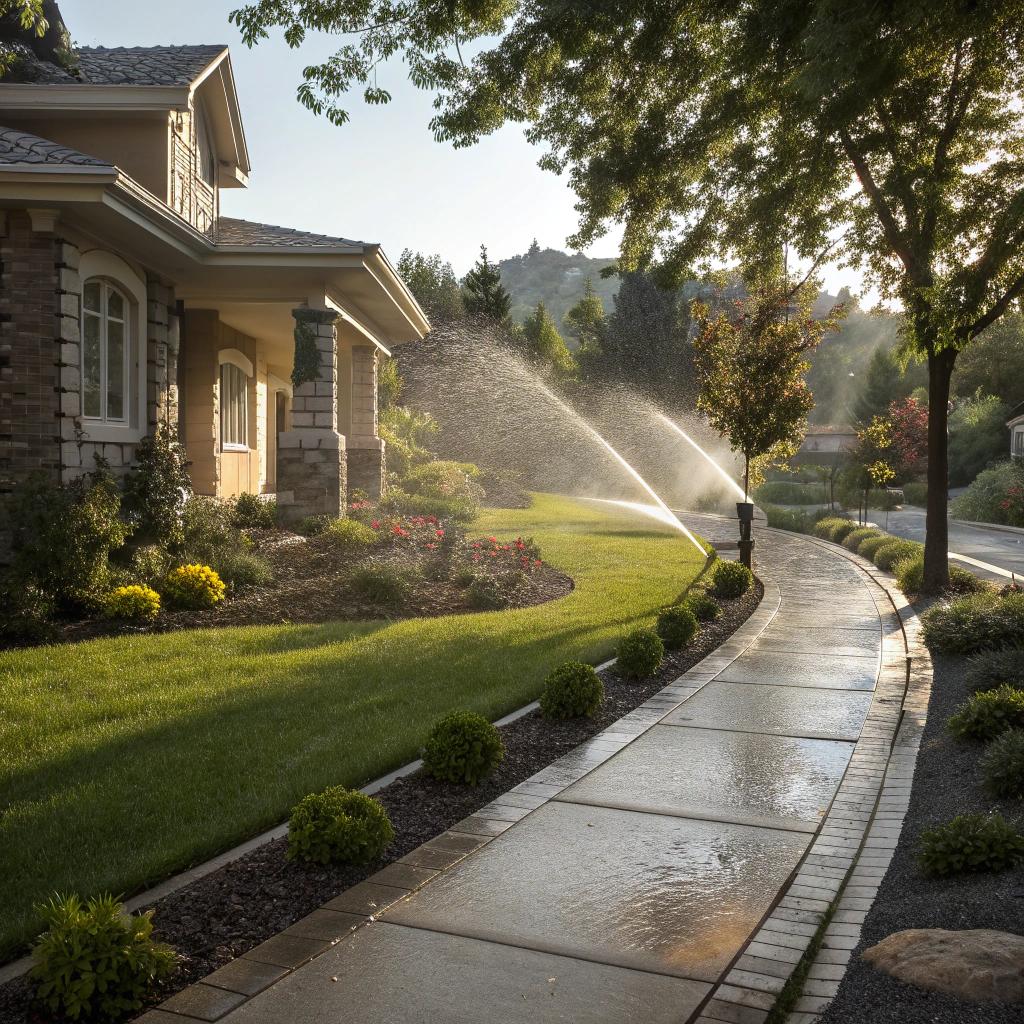
So, you are trying to find Colorado Springs irrigation tips to elevate curb appeal. The short answer is that you need a smart watering plan that fits our dry climate, supports healthy grass and plants, and protects your home exterior and hard surfaces.
In Colorado Springs, irrigation is not just about keeping things green. The way you water can affect your concrete, your outdoor flooring, your foundation, your walkways, and even how clean your front entry feels. A yard with brown spots, overspray on the sidewalk, and muddy edges near the porch pulls the whole house down visually, no matter how nice the floors and renovations are inside.
If you are already investing in new flooring, paint, or a remodel, it makes sense to think about how the outside looks when people walk up. Curb appeal starts at the street. The irrigation system is often the quiet part in the background that decides if everything looks bright and intentional, or tired and patchy.
Here are the main ideas to keep in mind before we get into the details.
- Colorado Springs is dry and sunny, so you need deeper, less frequent watering rather than quick daily sprays.
- Your irrigation layout should match your lawn size, plant beds, and hard surfaces, so you are not watering the sidewalk or your garage door.
- Good irrigation protects patios, walkways, and outdoor flooring materials from staining, cracking, and heaving.
- Smart controllers and seasonal adjustments matter more here than in wetter climates.
- Maintenance is not optional: clogged nozzles, leaks, and poor coverage show up fast in this climate.
For trusted local help, many homeowners use Colorado Springs irrigation specialists for layout and seasonal setup, then manage small tweaks on their own.
How irrigation connects to curb appeal and home finishes
Irrigation is usually treated as a backyard problem. People focus on the front door paint color, new steps, or maybe a stamped concrete walkway. The water system comes later, if at all. That is backwards.
A clean, even lawn color and sharp edges around walkways make everything else in front of the house look more expensive, even if you did not change the structure at all.
If you care about flooring, tile, or any finishing detail inside, it probably means you notice details outside too. Poor watering can work against your renovation in a few quiet ways.
How bad irrigation makes a nice house look cheaper
Here are some simple signs that the irrigation system is hurting your curb appeal:
- Brown crescents in the grass where sprinkler heads do not reach.
- Wet streaks on the garage door from misaligned heads.
- Soaked mulch washing onto your paver walkway after each cycle.
- Efflorescence stains on concrete from constant water contact.
- Algae or slippery patches on front steps from overspray.
You can spend a lot on new entryway tile or luxury vinyl planks just inside the front door. If guests walk over a muddy, uneven patch of grass to get there, the impression is mixed at best.
Why the Colorado Springs climate changes the rules
Colorado Springs has:
- Strong sun with many bright days.
- Low humidity most of the year.
- Rapid swings in temperature from day to night.
- Cold winters with freeze and thaw cycles.
Those conditions mean:
- Water evaporates fast from shallow soil.
- Overwatering is almost as common as underwatering, because people panic when grass looks dull.
- Water that pools on hard surfaces can freeze and damage concrete, stone, and grout.
So irrigation here is really a building protection tool as much as a plant-care tool.
Setting clear irrigation goals for curb appeal
Before adjusting a single head, it helps to decide what “good” looks like for your front yard. Not everyone needs a golf course.
Ask yourself a few blunt questions:
- Do you want a fully green lawn or a mix of lawn and water-wise beds?
- Are you willing to walk the yard once a month and adjust heads and times?
- Do you plan to add or change hardscaping, like a new walkway or patio, in the next year?
- Is your main concern grass, or do you care more about shrubs, trees, and foundation plantings?
A realistic goal might be “even color from the street and no obvious wet spots on concrete,” not “perfect emerald lawn at all costs.”
For many homeowners, a good basic target is:
- No bare dirt visible from the street.
- Defined edges between turf, mulch, and walkways.
- No consistent puddles or water stains on any hard surface.
- Front trees and shrubs that do not show stress mid-summer.
Basic irrigation strategy for Colorado Springs
A lot of irrigation advice online is written for wetter or more humid regions. It does not transfer very well. Here is a simple pattern that tends to work in Colorado Springs for cool-season turf like Kentucky bluegrass and tall fescue.
Water deeper, not all the time
You want the roots to grow deep into the soil. That gives the lawn more strength in heat and helps it recover after winter. Shallow watering keeps roots near the surface, which is not what you want.
As a rough starting point for spring and early summer:
- Water 2 to 3 days per week.
- Aim for a total of about 1 to 1.5 inches of water per week, including rain.
- Run times depend on your heads and soil, so you need to test.
You can check how much water reaches the soil with a simple “tuna can” test.
Use the tuna can test
Put a few shallow, straight-sided containers in different parts of the lawn. Run your system for a normal cycle. Measure how much water collects in the containers.
If you find:
- Some cans with almost no water and others nearly full, coverage is uneven.
- All cans show less than 0.25 inch after the cycle, you probably need longer run times or more cycles.
This simple test shows what is actually happening, not what you hope the system is doing.
Water early, not late
Morning watering is usually best:
- Less wind, so spray hits the ground where you want it.
- Less evaporation than mid-day.
- Grass blades dry out after sunrise, which helps reduce fungal issues.
Evening watering can leave surfaces wet for many hours. On walkways or steps, that can also mean icy patches in shoulder seasons.
How irrigation affects hardscaping, concrete, and outdoor flooring
This is where the link to home renovation and flooring is strongest. Outside ground surfaces near your front door are part of your “flooring story,” even if they are pavers or concrete instead of wood or tile.
Water and concrete do not always get along
Persistent water on concrete can cause:
- Surface spalling from freeze and thaw cycles.
- White mineral deposits that are hard to clean.
- Dark, dirty tracks where water runs off the lawn.
If you plan to stain or seal your concrete, or if you already have decorative concrete, spraying it every morning with irrigation water is not ideal.
A well set sprinkler head should water up to the edge of the walkway, not across it.
How irrigation layout interacts with walkways and patios
Look at the line where grass meets your path, driveway, or porch. The quality of that edge has a huge impact on how neat everything feels.
Poor irrigation around hard surfaces usually shows up in these ways:
- Mushy strip of grass right along the walkway.
- Grass creeping over the edge since it loves the extra water.
- Soil and mulch washing onto pavers in heavy cycles.
When that happens, homeowners often blame the edging or the hardscape. Sometimes the real problem is that one head is set too close to the concrete or at the wrong angle.
Simple table to match irrigation and surface material
Here is a rough guide that connects common front-yard surfaces to irrigation concerns and fixes.
| Surface type | Common irrigation problem | Simple adjustment |
|---|---|---|
| Broom-finished concrete driveway | Water stains and white mineral lines | Change head angle so spray just meets the edge, not the surface |
| Paver walkway | Sand washing out of joints, shifting pavers | Reduce run time for nearby zone, change nozzle to lower output |
| Stamped or stained concrete | Color fading where water hits daily | Use nozzle with tighter spray pattern, create a buffer strip with rock |
| Gravel or decorative rock beds | Rock displacement and muddy patches underneath | Switch to drip line in those areas instead of spray heads |
| Wood or composite steps | Slippery treads, rot at edges | Relocate heads farther out, adjust arc away from structure |
Planning irrigation zones with curb appeal in mind
Many systems are installed to “cover the yard” and nothing more. For better curb appeal, break the front into intentional visual pieces.
Common front yard zones:
- Primary front lawn area seen from the street.
- Entry path and steps zone.
- Foundation beds near the front of the house.
- Driveway edges and side strips.
Try to water these areas in ways that match how they are seen.
Front lawn: the “stage” for everything else
The front lawn is the backdrop that makes your front door and facade stand out. You want:
- Even color from left to right.
- No visible spray gaps or narrow dry strips.
- Uniform grass height, which starts with uniform watering.
Tips:
- Overlap spray patterns slightly so there are no dead triangles near corners.
- Use consistent head types within the same zone.
- If one corner always looks weaker, check for a clogged or sunken head first, not just “thirsty” soil.
Entry and front steps: keep it dry and clean
Curb appeal here is about both look and safety.
You do not want:
- Spray hitting the front door or any siding.
- Moisture soaking planter boxes against the house.
- Water on tile, stone, or composite steps.
Consider drip or micro-spray near the front door plants instead of standard spray heads. This focuses water at the soil and keeps your walking area dry. It also helps any indoor flooring just inside the door, since people bring in less water and dirt on their shoes.
Foundation beds: protect both plants and the house
Front foundation beds have two jobs:
- Softening the edge of the house visually.
- Shielding the foundation from harsh temperature swings and water extremes.
Good irrigation in these beds should:
- Water deeper at the root zones of shrubs and perennials.
- Avoid consistent soaking of the foundation wall.
- Work with mulch, not against it.
Drip systems are often a better choice here than sprays. They respect the shape of the bed and avoid overspray onto nearby siding, windows, and concrete.
Soil, slope, and microclimates near your house
Not every part of the yard needs the same water, even in the same city. Front areas near the house and walkways often have different soil and sun patterns.
Soil type and water behavior
Many neighborhoods in Colorado Springs have soils that are clay-heavy, or at least partially so. That soil holds water but does not like to take it in fast.
That means:
- Heavy, long watering can cause runoff before the water soaks in.
- Thin layers near the surface can crack if they get soaked and then dried too strongly.
If you see water moving down your driveway during a cycle, try “cycle and soak”:
- Run each zone for a shorter time, such as 7 to 10 minutes.
- Let it rest for 20 to 30 minutes.
- Run it again, and maybe again, until you reach your total run time.
This lets the soil absorb water gradually without sending it onto your concrete or down the street.
Slope and water movement around hardscapes
Look at any slope from your front yard toward the street or toward your house.
Ask:
- Does water tend to move toward the house or away?
- Does it funnel through one narrow gap between walkway and driveway?
- Are there visible erosion marks after storms or long cycles?
If water gathers against the foundation or low point of a patio, your irrigation pattern might be making that worse. Adjusting heads or splitting a zone can direct less water toward those weak spots.
Microclimates created by buildings and hard surfaces
Surfaces like driveways, stone walls, and dark siding collect heat. Areas near them can dry out faster than more open lawn sections.
This leads to a common mistake: people raise watering times on the whole zone to help a strip next to the driveway, and then they overwater everything else.
Better options:
- Convert the driest strip to rock or drought-tolerant plantings with drip.
- Move or add a head that covers just that edge, on a shorter or separate zone if possible.
Smart controllers and seasonal adjustments
You do not need a fancy system, but some kind of seasonal thinking is very helpful.
Why one schedule for all seasons fails in Colorado Springs
If you set a schedule in May and never touch it again, you will probably:
- Underwater in the hottest part of summer.
- Overwater in spring and early fall.
That means:
- Brown spots when guests visit in July.
- Unnecessary water on hard surfaces in shoulder seasons when nights get colder.
A more careful pattern would be:
- Spring: Start low, maybe twice a week, and increase slowly.
- Summer: Three days a week, deeper cycles, focus on early morning.
- Fall: Gradually reduce days and time, keeping roots healthy without waste.
Using basic smart features without overcomplicating life
Many controllers now have:
- Seasonal percentage adjustment.
- Rain sensors or skip days based on weather.
- Separate programs for front and back.
You do not have to use every feature. Even something as simple as:
“Front yard on Program A, back yard on Program B, and I change the percentage at the start of each month”
can make a big difference in both water use and yard appearance.
Drip irrigation for beds and borders
Drip lines and emitters are not just for large gardens. They are especially helpful in those tricky zones where grass, hardscape, and plants meet.
Why drip helps curb appeal
Drip irrigation:
- Reduces water on mulch and rock surfaces.
- Limits overspray on siding, windows, and walkways.
- Targets plant roots instead of empty space.
In front foundation beds and narrow side strips, drip helps you keep plants lush without making everything around them wet and messy.
Potential issues with drip and how to avoid them
There are some tradeoffs. Drip systems can clog or get chewed by animals, and they need to be checked a bit more often.
To keep things simple:
- Use pressure-compensating tubing if possible, so water output is more even.
- Keep drip lines slightly away from the base of the house to avoid soaking the foundation.
- Cover lines with mulch, but not too deep so you can still spot problems.
Maintenance habits that protect both yard and hard surfaces
Curb appeal does not stay fixed. Irrigation parts shift, heads sink, and plants grow over emitters. A few small habits keep systems working.
Monthly walk-through routine
Once a month during watering season, walk the front yard while the system runs. It sounds tedious, but it is usually a 15 minute task.
Look for:
- Heads that spray the sidewalk or street.
- Water bubbling from the base of a head or valve box.
- Grass that is taller or shorter in certain arcs, which often signals uneven watering.
- Debris around heads that limits spray distance.
Carry a small flat-head screwdriver to adjust arcs and a plastic trowel to scrape away dirt around sunken heads.
Cleaning and realigning heads
Over time, dirt, mulch, and even rocks can press against sprinkler heads. They start to lean or sit too low.
Fix steps:
- Turn off the system.
- Dig a small ring around the head.
- Lift and straighten the body carefully.
- Backfill and compact soil so the top sits slightly above grade.
Then run the system and adjust the spray pattern so it just covers the desired area and stops at hard edges.
Checking for leaks and wasted water
Leaks are not always dramatic fountains. Sometimes they look like:
- A patch of greener, faster-growing grass near a pipe path.
- Constant dampness along a walkway edge.
- Zones that take longer to “charge” before heads pop up.
If your water bill climbs without a clear reason, or you see frequent small puddles on hard surfaces, it may be worth having a pro test the system once a season.
Seasonal care: spring start-up and fall shutdown
Irrigation in Colorado Springs has a real on/off rhythm because of winter. How you start and stop the system affects not just performance, but also how your yard looks at key times of the year.
Spring start-up for a clean look
When you first start watering for the season:
- Turn on water slowly and check for loud noises or water hammer in the pipes.
- Run each zone and note where grass has not come back well.
- Check for split heads or broken risers that may have cracked over winter.
This is a good time to:
- Reseed small bare spots.
- Edge along walkways and driveways.
- Adjust zones for any new hardscape you installed over winter, such as a new front path.
If you did any flooring or doorway work, pay close attention to any change in grade. A new step or threshold can change how water flows near the house.
Fall shutdown and winter protection
You already know that irrigation pipes can freeze in Colorado Springs. People talk about that a lot. What relates more to curb appeal is where leftover water ends up before freeze.
If lines are not cleared correctly, residual water might seep slowly toward low points, like the base of driveways or near front walkways, and then freeze. That can chip edges and create small cracks that grow over years.
Having lines blown out and valves drained protects both the system and nearby concrete or pavers. The process itself is usually quick, but missing it even once can mean an ugly fix in spring.
Choosing plants that match your irrigation habits
You can fight your yard, or you can make it easier on yourself. If you know you do not want to adjust irrigation often, pick plants that forgive that habit.
Lawn type and water use
Cool-season grasses used in Colorado Springs need more water than some warm-season types, but they also handle cooler nights better.
Within cool-season options, some blends are more water-thrifty than others. A lawn mix with more fescue might use less water than a heavy bluegrass mix. Ask what is in your current lawn before making assumptions about how much water it should need.
Foundation and entry plants
Plants near your front door should:
- Handle reflected heat from walkways and walls.
- Not require constant overhead watering on leaves and flowers.
- Look good from a distance, not just up close.
Shrubs and perennials that accept drip irrigation and deep watering fit well here. They reduce the temptation to run short daily sprinkler cycles that also soak your front path.
Rock and mulch beds as irrigation helpers
Mulch and rock are not just for looks. They:
- Slow evaporation from the soil.
- Protect drip lines from UV and physical damage.
- Reduce mud splashing on hard surfaces during storms or long cycles.
If you use dark rock near concrete, keep in mind it can get hot and dry out nearby plants faster. Your irrigation around those beds might need slightly higher output or more frequent cycles than the open lawn.
Connecting inside and out: how entries and thresholds relate to irrigation
Because this article is aimed at people who care about flooring and renovation, it is worth talking about the transition area from outside to inside.
Keeping entry surfaces dry protects indoor flooring
Think about the path from the street to your front door:
- Street or sidewalk
- Driveway or front walk
- Front steps or stoop
- Door threshold
- Entry mat and first few feet of interior flooring
If irrigation cycles leave water on any of the outdoor pieces, people are more likely to track it inside.
Problems that follow:
- Warping or cupping of hardwood floors near the entry.
- Grout discoloration on tile and stone.
- Wear marks on vinyl or laminate from grit stuck in wet shoes.
Careful irrigation adjustment near the entry can help keep your inside investment in better shape.
Front porch and stoop materials
Concrete, stone, or tile on the porch can age faster if exposed to regular irrigation spray. Sealed surfaces might last longer, but they still benefit from staying drier.
If you notice damp corners or stains forming near the porch:
- Watch a full irrigation cycle while standing on the porch.
- Note any fine mist drifting onto surfaces, not just direct spray.
- Adjust heads or change nozzle types to focus the water lower and closer to the soil.
Putting it all together: a simple front yard irrigation checklist
This is not a perfect formula, but it is a practical starting point for many Colorado Springs homes.
Design and layout
- Front lawn zones water lawn only, not walkways, driveway, or siding.
- Beds near the house rely more on drip or low, targeted spray.
- Edges between lawn and hardscape are clear and not constantly wet.
Schedule
- Early morning watering, usually 2 to 3 times per week in main season.
- Use cycle-and-soak on slopes or heavy clay sections.
- Adjust time and days as seasons change, not just once a year.
Maintenance
- Monthly walk-through during watering season.
- Check for spray hitting concrete, steps, doors, or windows.
- Clean and realign heads, fix sunken or leaning ones.
Protection of surfaces and structures
- Keep regular irrigation off porous concrete and decorative finishes.
- Watch for runoff paths that might damage pavers or steps.
- Handle fall blowout and spring start-up with your surfaces in mind, not just the pipes.
If your lawn looks okay but your concrete and walkways stay clean and dry, that balance usually signals a healthier, more thoughtful irrigation setup.
Q & A: Common Colorado Springs irrigation questions for curb appeal
Q: How often should I water my front lawn in Colorado Springs for a neat look?
A: Many people find that 2 to 3 days a week in the growing season is enough, with deeper watering rather than quick daily cycles. Use the tuna can test to adjust run times so the lawn gets about 1 to 1.5 inches of water a week, counting rain.
Q: My sprinklers spray the sidewalk and driveway. Is that really a big deal?
A: Yes, over time it is. Regular water on concrete can leave stains, cause small surface damage with freeze and thaw, and make the front of the house feel less tidy. It also wastes water. Simple head adjustments or different nozzles often fix this.
Q: Can irrigation patterns affect my interior floors?
A: Indirectly, yes. If your entry steps, porch, or front walk are wet from irrigation, people track more moisture and grit inside. That can damage wood, tile, and other flooring faster than you expect, especially over a few winters.
Q: Do I really need drip for front beds, or can I just spray everything?
A: You can spray everything, but drip in front beds protects siding, windows, and hard surfaces from overspray and usually keeps plants healthier at the roots. It looks cleaner and is easier to pair with neat edges and new walkways.
Q: What is one simple change that often gives the biggest curb appeal boost?
A: For many homes, it is correcting the edges. Adjusting heads so they water up to, but not across, walkways and driveways, combined with a clean edge trim, often makes the front yard look newly upgraded even if you did not replace the system or the plants.