
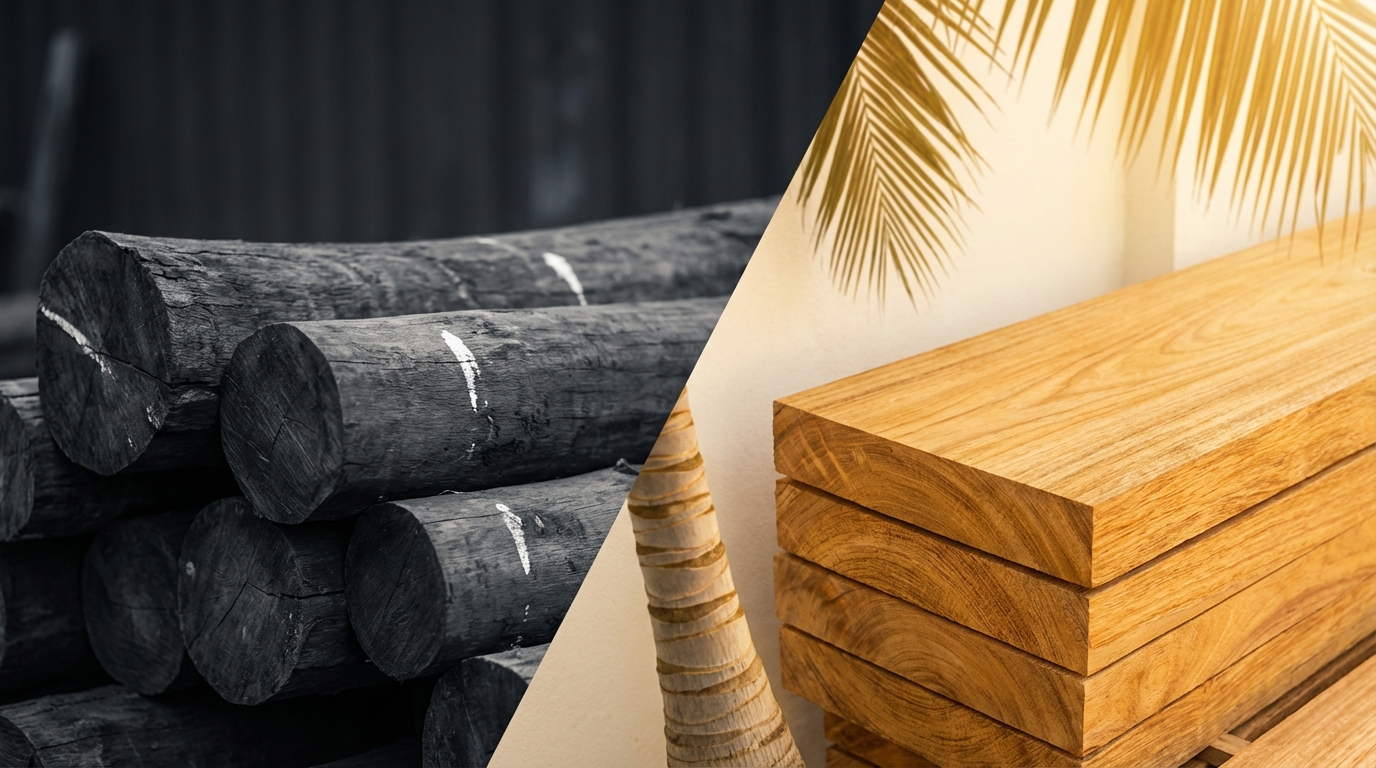
So, you are trying to figure out if coconut timber is a real hardwood alternative or just marketing spin.
Yes, coconut timber can be a serious alternative to traditional hardwoods for some uses, but it is not a perfect swap in every situation.
Here is the short version: coconut timber (sometimes called coco lumber or coconut wood) comes from old, unproductive coconut palms. Instead of burning or dumping those palms, they get turned into boards, flooring, panels, and furniture. The wood has a unique structure, decent strength (especially the outer part of the trunk), and a nice appearance. Still, it needs careful processing and is not a like‑for‑like replacement for oak, teak, or maple across the board.
Things get interesting when you add tech: drying schedules, grading with scanners, engineered products, and better treatments all make coconut timber more useful than it was 20 years ago.
Here are some things you need to know before you bet on it as a hardwood alternative:
- Coconut timber is monocot wood with a very different structure from hardwoods.
- Density and strength vary a lot across one trunk.
- The outer “high density” zone can match some hardwoods.
- It needs careful drying and treatment to resist decay and insects.
- It works best in flooring, paneling, furniture, and interior joinery.
- It is weaker for long structural spans and heavy loads.
- It supports coconut farmers by giving value to old palms.
- Processing quality is the line between success and disappointment.
- New engineered products can fix some of the natural limits.
> Coconut timber is not a magic wood. It is a smart use of a wasted resource if you respect its limits.
> Think of it less as “a new teak” and more as “a graded, engineered material from coconut palms.”
> The technology around selection, sawing, drying, and bonding makes or breaks its value.
> When a project fails with coconut timber, it is almost always a process failure, not a material curse.
> If you are in tech, think of coconut timber as “hardware from legacy devices turned into something useful.”
What coconut timber actually is (and what it is not)
So, what is coconut timber as a hardwood alternative, in practical terms?
Coconut palms are monocots. That means they do not grow the way trees like oak, ash, or mahogany grow. There is no annual ring structure. No clear heartwood vs sapwood. No rays. Instead, you get:
- A soft, spongy central core with low density.
- A mid-density zone around that core.
- A very dense outer shell made of tightly packed vascular bundles.
That outer shell is where the interesting stuff happens. The density of that zone can reach:
- About 600 to 900 kg/m³ (sometimes more for very dense parts).
This is in the range of many hardwoods used for flooring and furniture. The inner zone can be as light as 300 kg/m³ or less.
So one trunk is not one consistent “species” in the way you might think of oak or maple. It is more like a layered material.
How this compares with traditional hardwoods
If you are thinking of coconut timber as a straight drop-in hardwood alternative, set that aside. The comparison is more nuanced.
Here is a simple table with rough ranges:
| Material | Typical density (kg/m³) | Janka hardness (N) | Notes |
|---|---|---|---|
| Coconut (outer high-density zone) | 650 – 900 | 5,000 – 9,000 | Strong and hard, but very variable even within one trunk |
| Coconut (inner low-density zone) | 250 – 450 | 1,500 – 3,000 | Too soft for wear surfaces; niche uses, cores, or not used |
| Teak | 600 – 750 | 4,000 – 5,000 | Durable, stable, premium price |
| Oak (white) | 700 – 770 | 5,000 – 6,000 | Very common in flooring and furniture |
| Merbau | 800 – 900 | 7,000 – 8,000 | Heavy, strong decking hardwood |
| Bamboo (strand-woven, engineered) | 900 – 1,200 | > 7,000 | Engineered product; strong, hard, resin-based |
The takeaway: the outer zone of a well-processed coconut palm trunk can act like many medium to high-density hardwoods in terms of hardness and density.
The inner part is not a real hardwood alternative. It is more like filler or core material, if used at all.
Why coconut timber even exists as a product
If coconut palms are all over the tropics, why did we not see coconut flooring in every home 50 years ago?
Two reasons:
- Coconut palms were seen as “fruit plants,” not wood trees.
- The wood structure is tricky to handle with traditional sawmill habits.
A coconut palm produces fruit for around 60 to 80 years, sometimes more. After that, yield drops. Historically, farmers cut and burned old palms to replant new ones.
Now add three pressures:
- Pressure on tropical hardwood forests.
- Rising wood demand for furniture, flooring, and interiors.
- Interest in materials with lower environmental impact and traceable supply.
Suddenly, those millions of aging coconut palms look like a resource.
Some countries started looking harder:
- Philippines
- Indonesia
- Sri Lanka
- India
- Pacific Islands (Fiji, Samoa, etc.)
Researchers and small mills learned that:
- Old palms (50+ years) have a thicker high-density outer zone.
- Careful sawing, drying, and grading can make boards with consistent mechanical performance.
- Treatments can fix natural limits like low natural decay resistance.
Now you see brands selling “coco lumber” or “coconut flooring” with marketing language that sounds almost too cheerful. Underneath that, there is real material science and some practical success, but also lots of bad products where corners were cut.
Where coconut timber works well as a hardwood alternative
1. Flooring and decking (with boundaries)
For flooring, the outer high-density coconut timber is the star.
You get:
- High hardness, good for wear resistance.
- Attractive grain, very different from ring-porous hardwoods.
- Rich colors from light brown to deep chocolate with streaks.
Well-processed coconut flooring can stand up next to oak or merbau in home and light commercial settings.
Key conditions:
- Only high-density outer wood used for wear layer.
- Proper kiln drying to a stable moisture content (often 8 to 12 percent for interiors).
- Correct machining for tongue-and-groove or click profiles.
- Protective finishes for wear and moisture.
For outdoor decking, things get more tricky.
Coconut timber does not naturally resist decay the way teak or ipe does. Without treatment, it is vulnerable to fungi and insects, especially in humid, warm regions.
So, coconut decking only really works when:
- The high-density zone is pressure treated or impregnated with suitable preservatives.
- Good design details handle drainage and ventilation under the deck.
- Regular maintenance is planned, not ignored.
> If you want a “no maintenance for 30 years” deck, coconut is not that product. If you want a treated hardwood-like surface with a sustainability story, it can fit.
2. Furniture and interior joinery
This is where coconut timber makes a lot of sense.
For furniture:
- The high-density strips can be laminated into panels or frames.
- The grain pattern gives a distinct visual identity, like a cross between palm and bamboo.
- Routing, carving, and shaping can produce interesting textures.
You can use it for:
- Chairs and tables.
- Cabinet fronts and carcasses (with engineered cores).
- Bed frames and headboards.
- Accent furniture like consoles and benches.
For interior joinery:
- Door frames and sometimes door leaves (often as veneers on a core).
- Window trim, skirting, and wall cladding.
- Stair treads and risers in residential projects.
The main things you need to control:
- Movement due to moisture changes (like any wood, especially in air‑conditioned vs humid spaces).
- Correct joinery design to handle its anisotropic behavior.
- Tooling wear, because dense coconut can be more abrasive than typical hardwoods.
> When furniture makers complain about coconut timber, they usually complain about blunted tools and inconsistent density in a single board. That is a processing and selection problem, not a material death sentence.
3. Panels, veneers, and engineered coconut products
If you think like a tech founder, the real potential of coconut timber is in engineered forms, not raw lumber.
Examples include:
- Laminated panels: narrow strips of high-density coconut glued into panels.
- Veneers: thin slices used on plywood or MDF cores.
- Engineered flooring: coconut wear layer on a birch, rubberwood, or HDF core.
- Glulam-type members: glued laminated beams from graded coconut strips.
The logic here:
- You control variability by cutting, grading, and recombining strips.
- You can remove defects and low-density segments at the strip level.
- Glue lines can improve stiffness and dimensional stability.
This is similar to how strand-woven bamboo became accepted: not as a raw stalk product, but as an engineered resin-bonded composite.
Coconut timber is moving in that direction too, though slower and mostly in regional markets so far.
Where coconut timber struggles as a hardwood alternative
So far, this all sounds promising. Now the honest side: there are clear areas where coconut timber is not a strong hardwood alternative.
1. Heavy structural use
Long-span beams, main support columns, heavily loaded trusses: this is not coconut timber’s sweet spot.
Reasons:
- The trunk’s variable density weakens predictable mechanical performance for solid sawn structural sizes.
- The weak inner core limits cross-section effectiveness if not removed.
- Design codes and standards for structural coconut wood are still limited and regional.
Engineered coconut glulam beams could cover some of this gap, but that demands:
- Reliable grading equipment.
- Industrial-scale adhesive processes.
- Testing, certification, and code inclusion.
Some research projects show promise, yet this is early stage compared to, say, glued laminated softwood or cross laminated timber from spruce.
2. High-exposure outdoor environments
Think marine docks, boardwalks near the ocean, heavy wet/dry cycling.
Coconut timber will need:
- Strong preservative systems.
- Design that keeps water from pooling.
- Strict maintenance schedules.
If your goal is a “set and forget” pier with minimal care, tropical hardwoods with natural durability still hold the advantage.
3. Uniform, generic commodity lumber
If you want to buy mixed hardwood 2x4s in bulk with wide tolerance, coconut is hard to industrialize that way.
The palms:
- Vary in age, growing conditions, and trunk geometry.
- Offer shorter straight lengths than many timber trees.
This makes commodity framing lumber from coconut less appealing than from softwoods like spruce or pine, which already have huge, optimized supply chains.
The tech story: how processing turns a palm into a hardwood alternative
Here is where your tech lens helps. Think of coconut timber as “raw data.” Processing and selection are the algorithms that pull out a reliable product.
1. Grading and selection
Not every palm is equal. Two main factors matter:
- Age of the palm (older gives more dense outer wood).
- Trunk diameter and height (larger trunks deliver more usable volume).
Simple field grading can already filter:
- Reject palms younger than about 50 years for high-grade lumber.
- Reject trunks with major decay, severe leaning, or heavy insect damage.
Inside the mill, more tech can help:
- Color scanning to map density zones visually.
- Sonic or X-ray tools to estimate internal defects and density.
- Machine strength grading of strips or boards.
This grading is similar to how engineered wood producers sort softwood lamellas before building glulam beams.
2. Sawing patterns
Sawing coconut logs is not like sawing a pine log.
The goal: maximize recovery of the high-density outer zone and avoid mixing low and high-density wood in one board.
Common strategies:
- Peeling the log into thick “shell” boards that only contain the outer band.
- Rejecting the inner core early and using it only as low-value material, if at all.
- Cutting narrow strips from the best parts for lamination.
If a mill ignores this and saws like a normal log, the result is:
- Boards with soft centers and hard edges.
- Non-uniform machining and finishing.
- High breakage under load and unhappy customers.
> Process discipline is a bigger predictor of coconut timber success than any single property.
3. Drying and conditioning
Water movement through coconut timber is uneven because of the vascular bundle structure.
Problems if drying is not handled well:
- Surface checking and splitting.
- Internal stresses causing warping later.
- Case hardening that ruins machining quality.
Improved approaches:
- Pre-air-drying to a mid-level moisture before kiln drying.
- Gentle initial kiln schedules with lower temperatures and slower drying rates.
- Conditioning and equalization steps to release internal stresses.
Drying tech has quietly been one of the key enablers behind higher-quality coconut products over the last decade.
4. Preservation and modification
Because coconut timber does not contain the same natural extractives as many hardwoods, decay and insects are a real risk, especially in humid climates.
Two main treatments:
- Pressure impregnation with preservatives (like copper-based systems).
- Surface treatments, coatings, and sealants that keep moisture away.
Research is ongoing into:
- Thermal modification (heat treatment) to improve stability and resistance.
- Resin impregnation to improve hardness and durability for premium products.
There is a tradeoff: heavier treatments raise cost and sometimes darken or change the color.
5. Engineered bonding and product design
Lamination solves a lot of the natural variation problems.
Elements:
- Finger-jointing short strips into longer pieces.
- Gluing those strips into slabs or panels with structural adhesives.
- Designing layups that alternate grain direction for stability.
This is where modern wood adhesives and press technology come into play.
We see similar tech in:
- Engineered bamboo products.
- Cross-laminated timber from softwoods.
- LVL (laminated veneer lumber) for beams.
Coconut timber can ride this wave, using its outer high-density fibers as a feedstock rather than trying to compete as raw sawn lumber everywhere.
Environmental and economic angles: why people care
1. Using what is already there
There are millions of hectares of coconut plantations across Asia and the Pacific. Many palms are old.
When palms pass their prime fruit years, farmers usually:
- Cut them down for replanting.
- Burn the trunks or leave them to rot.
Coconut timber turns a waste stream into a product.
Environmental benefits:
- Less pressure to harvest natural forests for some wood needs.
- Lower net carbon impact compared to new tree plantations, since the land is already under coconuts.
- Less open burning of biomass, which can reduce local air pollution.
2. Income for smallholders
Most coconut farms are small plots, not huge estates.
If old palms become valuable as timber, farmers gain:
- An extra income source during replanting cycles.
- More incentive to manage the crop well and replant consistently.
The catch: they need access to buyers or local processing. Without:
- Collection chains
- Transport
- Basic mill capacity
The idea stays on paper.
Tech here can mean:
- Digital marketplaces linking farmers and mills.
- Traceability systems (QR codes, blockchains) to prove source and age.
- Simple mobile scanning tools for quick field grading.
3. Certification and traceability
For export markets, coconut timber products will face the same questions as hardwood:
- Where did this come from?
- Is it legal?
- Is it part of a credible sustainability story?
Unlike wild forest logging, coconut timber starts from planted palms, often decades old.
Certification bodies can:
- Design standards for coconut timber chains.
- Give labels that help architects and consumers trust the material.
This is still maturing, but the core narrative is strong: using old agricultural plants instead of cutting fresh forest.
Coconut timber vs other alternative materials
If you are choosing materials today, coconut timber competes with more than hardwoods.
Here is a simple comparison:
| Material | Main feedstock | Key strengths | Key limitations | Typical uses |
|---|---|---|---|---|
| Coconut timber | Old coconut palms | Good hardness, unique look, uses waste palms | High variability, needs treatment, less known | Flooring, furniture, interior joinery |
| Strand-woven bamboo | Bamboo culms | Very hard, strong, consistent, engineered | High resin content, industrial process, not “solid wood” | Flooring, panels, stairs |
| Engineered hardwood (multi-layer) | Hardwood veneer on soft core | Stable, familiar, wide supply | Still depends on hardwood forests | Flooring, furniture panels |
| Plastic composites (WPC) | Wood fiber + plastic | Moisture-resistant, low maintenance outdoors | Heat expansion, plastic look, non-bio-based portion | Decking, fencing |
| Softwood CLT / glulam | Spruce, pine, fir | Structural performance, codified, industrial | Not as hard for wear surfaces, visual style | Structural elements, mass timber buildings |
> Coconut timber sits in a middle zone: more “natural” than composites, more circular than some hardwoods, more variable than fully engineered materials like WPC or stranded bamboo.
What this means for architects, builders, and product designers
If you are in any role that picks materials, you do not need a romantic story here. You need a clear use map.
When coconut timber is a strong choice
Use coconut timber as a hardwood alternative when:
- You want a low to medium volume solution for flooring or interior finishes, not heavy structure.
- You care about sourcing from agricultural waste, not fresh forest.
- You can work with suppliers who show actual process control (drying curves, grading data, treatment records).
- You are ready to explain to clients that the look and behavior is distinct, not just “like oak but cheaper.”
Sample scenarios:
- Boutique hotels in tropical countries that want a local wood story for floors and furniture.
- Residential projects with a focus on circular materials and a warm, natural interior.
- Furniture collections that celebrate unusual grain and “story” materials.
When to stay with more conventional hardwoods or other options
Stick with established materials when:
- You need long-span, code-approved structural components.
- Your climate is harsh outdoors and maintenance will be low.
- Your project scale is huge and supply consistency over years is critical.
- Your local building ecosystem has minimal exposure to coconut timber, and risk tolerance is low.
Key questions to ask coconut timber suppliers
If you are considering coconut timber, your questions should sound less like “Is it sustainable?” and more like “Show me your process.”
Some prompts:
- How old are the palms you source, on average?
- Do you separate inner and outer zones? How?
- What are your drying schedules? Do you kiln-dry to a target moisture content?
- Do you machine grade for density or strength?
- What preservation or modification treatments do you apply?
- Can you share test data for hardness, bending strength, and dimensional stability?
- What product failures have you seen, and what changes did you make after?
A good supplier will not gloss over variability. They will show you how they manage it.
Tech opportunities around coconut timber
You are reading a tech blog, so let us touch on where technology can push coconut timber forward.
1. Better data for every trunk
Think about a “digital twin” of every palm trunk entering a mill.
Tools:
- 3D scanning of logs to assess volume and shape.
- Non-destructive density and defect mapping using ultrasound or X-ray.
- Moisture mapping across sections during drying.
With that data, mills can:
- Route each strip to an optimal product category (flooring, panel, core, or reject).
- Predict yield and mechanical properties more accurately.
- Build traceable product histories: which plantation, age, processing steps.
2. Process automation in small mills
Coconut timber often comes from regions with smaller mills, not giant factories.
“Right-sized” tech matters:
- Simple inline grading cameras.
- Affordable moisture meters with logging.
- Drying controllers tuned to coconut’s behavior.
Think of it as bringing some of the smart factory logic used in big engineered wood plants into a lighter, modular form.
3. Design tools and education
Architects and designers need confidence to specify coconut timber.
Helpful tools:
- Material property libraries that include coconut in structural and thermal simulations.
- Plugins for BIM tools with coconut timber components and details.
- Design guides that show safe uses, not just glossy photos.
If coconut timber is easy to spec, with honest constraints visible upfront, adoption improves.
Practical guidance if you are considering coconut timber now
Let us get specific and walk through how you might act on this.
Scenario 1: You want coconut timber flooring in a residential project
Steps:
- Shortlist suppliers who offer documented kiln-dried, high-density coconut flooring.
- Ask for:
- Moisture content range at delivery.
- Janka hardness test values.
- Photos of end-grain and surface.
- Details on finishes compatible with their product.
- Request a physical sample and perform a small wear and water test:
- Drop water on the surface and see how it behaves after 24 hours.
- Scratch with a common object (like a coin) to feel hardness.
- Plan for acclimation on site:
- Store boards in the building for several days before installation.
- Use installers who are comfortable with hardwood flooring, not just laminate.
Scenario 2: You want coconut timber furniture for a product line
Steps:
- Decide if you want solid, laminated, or veneer-faced panels.
- For solid components:
- Keep cross-sections modest to reduce movement risks.
- Use joints that allow seasonal movement.
- Ask the supplier about lamination:
- What adhesives are used?
- Are pieces finger-jointed?
- What press cycles and quality checks are in place?
- Prototype several designs and track:
- Movement across seasons.
- Finish stability.
- Customer reactions to the visual texture.
Scenario 3: You are a developer in a coconut-growing country
If you are closer to the source, you have more influence.
Ideas:
- Partner with an existing sawmill to add:
- Better grading routines.
- Simple digital tracking per batch.
- Improved drying control using low-cost controllers and sensors.
- Build a brand around:
- Traceable coconut timber from local farmers.
- Standardized product specs for exporters.
- Focus on 1 to 2 product families first, like:
- Flooring and stair parts.
- Panels for furniture makers.
Common myths and how they stack up
Let us address a few statements you might see in marketing or casual discussions.
“Coconut timber is as strong and durable as the best hardwoods”
Partly true, partly not.
- High-density outer coconut can match hardness and strength of many hardwoods in small dimensions.
- Durability depends heavily on treatment and design, not just density.
- The material is less predictable in big sections due to internal variation.
So you can say: “For flooring and small elements, high-grade coconut can match or exceed many hardwoods in hardness. For durability, you must look at treatment and use case.”
“Coconut timber is always sustainable”
This needs nuance.
- Using old palms from existing plantations clearly avoids new deforestation.
- Transport, processing energy, treatments, and waste also count in a full footprint.
- Poorly managed operations can still harm local environments or communities.
Good practice includes:
- Clear sourcing policies (age, location, replanting plans).
- Local benefit sharing with farmers.
- Efficient use of logs to limit waste.
“Coconut timber is too inconsistent to be useful”
This was closer to reality when:
- Mills did not grade or separate zones.
- Drying was crude or skipped.
With proper grading, lamination, and drying, you can get consistent products from a variable raw resource. The same logic already supports huge engineered wood industries worldwide.
A simple mental model you can use
If you want a quick way to think about coconut timber as a hardwood alternative, use this rough rule:
- High-density coconut timber is like a “specialist” hardwood: strong performance in wear surfaces and small to medium elements, provided the process is controlled.
- It is not a universal structural workhorse like spruce or a “set and forget” outdoor champion like teak.
- It shines when paired with modern grading, drying, and engineering, especially in regions where palms are already plentiful.
If you keep that model in your head when reading marketing sheets or talking with suppliers, you will ask sharper questions and pick the right applications.
A simple tip to close with: the next time you evaluate a sample of coconut timber, start by looking at the end grain under good light. You should see a tight band of dense, dark vascular bundles without a large, soft central zone. If the sample looks mixed or spongy in the middle, do not use it for any wear or load-bearing role.