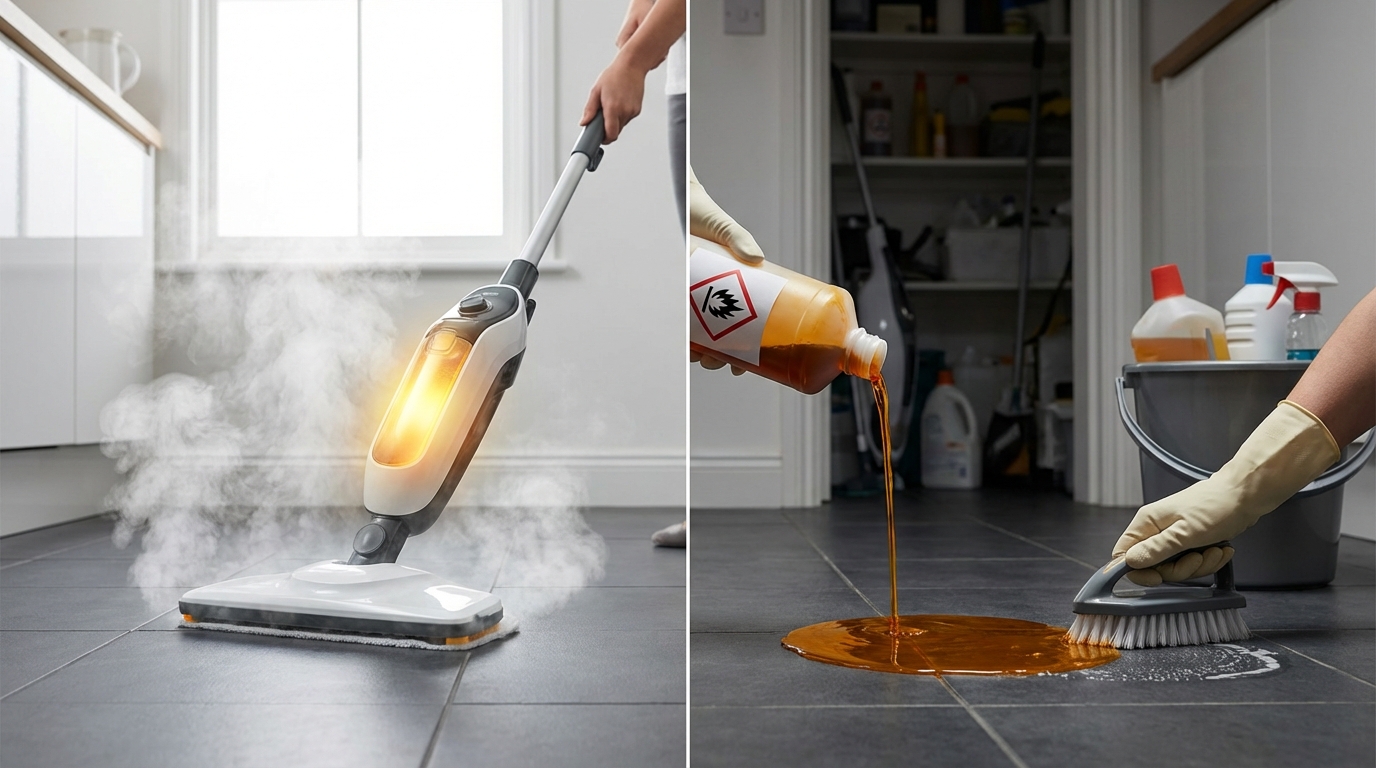
So you want to clean without chemicals and you are wondering if steam mops can really replace harsh detergents on your floors and hard surfaces. The short answer is: yes, for a lot of everyday cleaning jobs, a good steam mop can replace harsh detergents, but there are limits and you still need some products for certain messes and surfaces.
The real story is a bit more nuanced. Steam mops clean by using very hot water to loosen dirt and kill many types of germs. Harsh detergents clean by breaking down grease and grime with chemicals and then you rinse or wipe them away. One is about heat, the other is about chemistry. Your decision comes down to your surfaces, the type of messes in your home, your health concerns, and how much maintenance you are willing to handle.
Things you need to know:
- Steam mops can kill many germs, but not every single one in every situation.
- Harsh detergents are strong on grease and stains, but can irritate skin, lungs, and trigger allergies.
- Heat from steam can damage some floors and finishes if you use it wrong.
- You need to understand your floor type (sealed wood, laminate, tile, vinyl, stone) before picking a method.
- Plain water plus good tools solves more cleaning problems than most people think.
- For disinfecting vomit, raw meat spills, or mold, you still need proper disinfectant chemistry.
- Good technique (slow passes, clean pads, correct dilution) matters more than the brand of product.
How steam mops actually work vs harsh detergents
Let us start with the basics so you are not just trusting a label or an ad.
What a steam mop really does
A steam mop heats water to roughly 100-120°C at the boiler. Once the steam reaches the pad and the floor, it is cooler, but still hot enough to:
- Loosen dried-on dirt and light grease
- Soften sticky residues like sugary drinks
- Lift some bacteria and dust mites from the surface
- Break down light soap film or cleaning product residue
You push that hot moisture across the floor with a microfiber pad, which actually does the heavy lifting by grabbing the loosened dirt.
Key thing: the magic is in the combination of heat plus microfiber, not just the steam alone.
Now compare that to harsh detergents.
What harsh detergents really do
Harsh detergents rely on:
- Surfactants that break surface tension and grab grease
- Alkaline builders that attack organic soils and some finishes
- Solvents that dissolve oils and glue-like residues
- Fragrances to mask odors
- Dyes and stabilizers so the product looks and pours a certain way
You mix the detergent with water, apply it, scrub, then rinse or wipe. If you do not rinse, a thin film tends to stay on your floor. Over time, that film traps more dirt, so floors can look dull even when you mop a lot.
How each one “disinfects”
Here is where many people get misled by packaging.
A consumer steam mop does not usually meet official disinfectant standards. It can still reduce germs, but you cannot treat it like hospital-level sterilization.
Harsh detergents also are not always disinfectants. Many floor cleaners are just cleaners. For real disinfection, you need a product registered as a disinfectant (for example, based on bleach, quats, hydrogen peroxide, or alcohol) and you need to follow the dwell time on the label.
> Steam on its own is mostly about cleaning and lowering microbe counts, not guaranteed disinfection in every corner of your floor.
> Regular detergents are mostly about removing dirt and oil; only some of them actually disinfect.
Health tradeoffs: lungs, skin, kids, and pets
This part is where “cleaning without chemicals” goes from a trend to a real concern.
What harsh detergents can do to your body
Reactions vary by person, but common issues from frequent exposure include:
- Asthma flare-ups from strong scents and aerosol mists
- Headaches from fragrances and solvents
- Skin irritation or dermatitis from surfactants and preservatives
- Eye irritation from fumes
There is a 2023 paper in the journal “Building and Environment” that linked regular use of scented cleaning products with increased indoor VOC levels (volatile organic compounds). VOCs contribute to poor indoor air quality and can affect sensitive people.
If you have a baby crawling on the floor, pets licking paws, or someone in the house with asthma, this is not a small issue.
Health and safety with steam
Steam mops remove the chemical exposure from typical floor cleaning, which is what you are aiming for. But they bring their own safety issues:
- Risk of burns from hot steam or touching the pad too soon
- Condensation can make floors slippery until fully dry
- High humidity in a small room with poor ventilation
The difference is that with steam, the main risk is heat and moisture, not long-term chemical buildup in the air or on surfaces.
> For day-to-day maintenance cleaning in a home with kids or pets, steam often gives you a nicer balance of “clean enough” with less chemical load.
What steam mops clean well and where they fall short
Steam is great, but it is not magic. Let us break this down by mess type.
Tasks that steam mops handle very well
You will see the best results on:
- General dust and tracked-in dirt on sealed hard floors
- Dried food spills on tile, vinyl, or sealed wood
- Sticky spots from juice, soda, or light sauces
- Water-soluble stains on tile grout (with repeated passes)
- Bathroom floor maintenance between deeper scrubs
- Fresh pet accidents (after you blot and remove solids)
If your home has mostly sealed tile, vinyl plank, or sealed hardwood, a steam mop can cover 70-80 percent of your daily and weekly floor cleaning.
> The biggest win with steam mops is consistency: quick, frequent, low-chemical cleaning keeps grime from building up in the first place.
Jobs where harsh detergents still matter
There are cleaning scenarios where steam alone is a weak tool:
- Heavy grease in kitchens, especially near stoves
- Old, set-in stains in grout or porous stone
- Greasy garage floors or workshop areas
- Oily spills like motor oil or cooking oil
- Biohazard-type messes like blood, vomit, raw meat juices
- Mold remediation in bathrooms or basements
For these, you need chemical action. An alkaline degreaser for old kitchen buildup. A disinfectant for bodily fluids. A proper mold product for actual mold (not just surface mildew spots).
Here is a simple comparison to make this clearer.
| Task | Steam mop | Harsh detergent |
|---|---|---|
| Light daily floor cleaning (dust, footprints) | Very effective | Works, but leaves residue over time |
| Sticky drink spills on sealed tile/vinyl | Effective with 1-2 passes | Effective, may need rinse |
| Heavy kitchen grease near stove | Limited; may smear grease | Strong, easier cutting power |
| Bio mess (vomit, raw chicken juice) | Not enough by itself | Disinfectant needed for safety |
| Old grout stains | Helps with repeated sessions | Stronger change with specialty cleaner |
| Allergy reduction (dust mites) | Helps by heat & removal | Some effect, but chemicals do not kill mites alone |
Floor types: where steam mops shine and where they cause damage
This part is not about what you prefer. It is about physics and materials. The wrong combo can ruin your floors.
Safe(ish) zones for steam mopping
Safer does not mean “zero risk.” It means “works well if you use the tool correctly.”
- Porcelain or ceramic tile: Very good match. Grout lines may benefit from occasional brushing.
- Vinyl plank / luxury vinyl tile (LVT/LVP): Many brands say no steam in the warranty, but real-world use on low steam, with quick passes, is common. Check your manufacturer’s guidelines.
- Sealed stone (like sealed granite or slate): Can be fine on lower steam; make sure sealer is in good condition and avoid lingering in one spot.
- Sealed hardwood: Some manufacturers allow it on low steam, others do not. It comes down to how well the boards and seams are sealed.
High-risk floors for steam
There are some no-go zones:
- Unsealed hardwood: Steam can penetrate, swell the wood, and cause cupping or warping.
- Laminate floors: Plank seams and edges are vulnerable. Moisture can swell the core.
- Loose or lifting vinyl tiles: Heat can weaken adhesive and make lifting worse.
- Unsealed stone: Steam can drive moisture into pores and trigger spalling or efflorescence.
If you are not sure, test a small, hidden area using the lowest steam setting and a short pass. Then check after 24 hours for raised edges, bubbles, or dull patches.
> The safest rule: if your floor manufacturer says “no steam,” trust them, and treat steam as occasional spot help at most.
Environmental side: water, chemicals, and waste
Cleaning is not just about the floor. It is about what happens after you are done.
Steam vs detergent: what goes down the drain
With a steam mop:
- You send dirty water plus captured soil into your washing machine when you wash the pads.
- No regular cleaning surfactants or fragrances go down the drain from floor mopping itself.
With harsh detergents:
- Surfactants, preservatives, fragrances, and dyes enter wastewater streams.
- Some break down well in treatment plants. Others persist longer.
There is a 2022 review in “Science of the Total Environment” showing that certain household surfactants are still detectable in surface waters, even with modern treatment. Levels are usually low, but not zero.
Plastic and packaging waste
Steam mops:
- One-time purchase of the mop (plastic, metal, electronics).
- Reusable pads, which last many washes.
- No ongoing plastic bottles for daily floor cleaning.
Harsh detergents:
- Recurring plastic bottles and jugs.
- Transport energy for water-heavy products.
> From a waste standpoint, a durable steam mop with long-lasting pads and minimal bottled products is a cleaner long-term setup.
Cost: is a steam mop really cheaper over time?
Let us run some rough numbers, keeping them simple.
Costs for harsh detergents over 3 years
Assume:
- 1 bottle of floor cleaner per month at $6
- Basic mop & bucket you already own
3 years is 36 months.
- Chemicals: 36 × $6 = $216
- Mop replacement or extra heads: say $30 over 3 years
- Approx total: $246
Costs for a steam mop over 3 years
Assume:
- Decent steam mop: $120
- Extra pads: $30 (a pack of 4-6)
- Electricity: one hour of use per week, 52 weeks × 3 years = 156 hours
A typical steam mop pulls around 1,500 watts. At a power cost of $0.15 per kWh:
- 1.5 kW × 156 hours = 234 kWh
- 234 × $0.15 ≈ $35
- Minor tap water cost: say $5 at most
- Approx total: $190
This is a rough comparison, but you can already see that you are in the same ballpark or slightly better with steam, even before counting any health benefit from less chemical use.
How to use a steam mop correctly (and not wreck your floors)
If you are going to rely on steam to replace harsh detergents, you want every pass to count.
Step-by-step floor routine with a steam mop
1. Vacuum or sweep first
Get rid of grit, crumbs, hair. If you skip this, the pad will just push dirt around or pick it up unevenly.
2. Check water quality
If you have hard water and your manufacturer allows it, use distilled or demineralized water. That reduces scale buildup.
3. Attach a clean pad
Never start with a half-dirty pad from last week. You will just smear.
4. Let the mop fully heat up
Wait until it reaches a stable steam output. Follow the indicator light or timing in the manual.
5. Use slow, overlapping passes
Think of it like mowing a lawn. Slight overlap between passes, keep the mop moving. Do not park the mop in one spot.
6. Flip or change pads for larger areas
For a big room, use at least two clean pads. When the first looks gray or brown, swap it out.
7. Let floors dry before heavy traffic
Usually 5-10 minutes is enough. TaiI your kids or pets out of the room until the floor no longer looks damp.
> If your floors look streaky after steaming, usually the problem is residue from old products on the floor, not the steam itself.
Maintenance habits that keep your steam mop running
- Empty the water tank after each use to reduce standing water buildup.
- Descale the unit as per the manual, especially in hard water areas.
- Wash pads in hot water without fabric softener. Softener reduces microfiber grip.
- Air-dry pads fully before storing.
When you should skip steam and reach for targeted chemistry
You can still be “low-chemical” without being “chemical-free.” The point is to be selective.
Moments when harsh detergents or disinfectants are the right call
- Food safety events: Raw chicken juice on the floor near kids? Use a proper disinfectant that lists Salmonella / E. coli on the label.
- Stomach virus events: Vomit or diarrhea. CDC guidance recommends disinfectants with the correct kill claims for norovirus.
- Visible mold: Steam can spread spores if you use it incorrectly. Use an EPA-registered mold/mildew product, then clean.
- Heavy old grease: Degreaser first, then steam mopping as maintenance afterward.
- Porous outdoor surfaces: Oil on concrete, etc. Heat helps, but chemicals do the real work there.
You still limit your exposure by using these products only when needed, and ventilating the space well.
> Think in terms of “routine cleaning with steam, targeted disinfection with chemicals when risk is high.”
Hybrid strategy: getting the best of both worlds
Instead of a “steam vs detergents” fight, treat this as building a toolkit.
Your basic low-chemical floor kit
Here is a simple setup that fits most homes:
- Steam mop with at least 2-4 microfiber pads
- Vacuum or good broom for dry debris
- Neutral pH floor cleaner for the odd deep scrub
- One disinfectant spray or concentrate for high-risk messes
- Scrub brush for grout and corners
You use steam 70-80 percent of the time, the neutral cleaner once a month or so, and the disinfectant only for special cases.
Sample weekly routine using steam instead of harsh detergents
Let us say you have tile in the kitchen and vinyl plank in the living area.
- Daily (2-3 minutes): Quick vacuum or sweep of high-traffic zones.
- Twice a week (10-15 minutes): Steam mop kitchen and living room floors with one or two clean pads.
- Monthly (20-30 minutes): Spot treat grease near the stove with a small amount of stronger cleaner, rinse, then go back to steam for maintenance.
You cut detergent use by a large margin, your air feels cleaner, and you keep that “just cleaned” look without a chemical smell.
What the research says about steam cleaning and germs
Let us anchor this a bit with data, not just impressions.
Germ reduction with steam
Lab tests with higher-end steam cleaners have shown:
- Steam can reduce bacteria on hard surfaces by more than 99 percent when applied for long enough at sufficient temperature.
- House dust mites and some allergens can drop significantly after repeated steaming of carpets and mattresses.
Consumer steam mops usually run cooler at the pad than commercial steam cleaners, and you do not hold them in one spot for 30 seconds or more. So real-world results in a home might be more like “major reduction” instead of full disinfection.
Comparing fragrance-heavy detergents to low-chemical approaches
The “CLEAN study” (Cleaning Products and Lung Function in European Community Respiratory Health Survey, 2018) followed thousands of people over time. People who used spray cleaners often had faster declines in lung function similar to regular smokers of a few cigarettes a day.
The big drivers were sprays and scented products used often in unventilated spaces. Floor cleaners can fall into that risk zone if they are high in scent and used all over the home.
So when you cut down on harsh detergents and switch to steam and low-scent products, you are not just doing something trendy. You are lowering a measurable type of exposure.
> If someone in your home has asthma, steam cleaning plus fragrance-free cleaners is worth trying for a few months and watching for changes.
Tech tips: choosing a steam mop that will not frustrate you
This is a tech blog, so I do not want to ignore the actual device itself.
Key features that matter more than marketing
- Adjustable steam levels
Low for delicate sealed wood, high for tile and grout. - Consistent steam output
You want a device that stays stable, not “burst then weak puff.” Reviews often mention this. - Long, washable microfiber pads
Pads that wrap slightly up the sides of the head reach baseboards better. - Floor type support
Check the manual for which surfaces are supported and which are not. - Heat-up time
20-30 seconds is typical for decent models. - Cord length
20-25 feet is more comfortable in open areas.
Nice-to-haves:
- Detachable handheld unit for bathroom fixtures and kitchen counters.
- Scrub attachments for grout or stubborn spots (used gently).
- Swivel head for easier movement around table legs.
Red flags when you shop
Watch out for:
- Units that feel extremely light and flimsy in the handle area.
- Models with odd-shaped, non-standard pads that are expensive to replace.
- Customer reviews that mention leaks, water puddles, or sudden power loss.
- Claims that sound like “kills 100% of all germs” without any specifics.
Where harsh detergents quietly create more work
One thing many people miss is that harsh detergents can make future cleaning harder.
Residue buildup and why your floors look cloudy
When you mop with a strong floor cleaner and do not rinse, you leave behind:
- Surfactant film
- Fragrance oils
- Dye traces
- Any minerals from your water
Dust sticks to that thin layer. Now your next round of cleaning needs more product to cut through older layers and new dirt. Over months, floors start to look dull or streaky even when they are technically clean.
Steam helps break this loop over time by using heat and clean pads to lift residue. The first few steam sessions on a detergent-heavy floor can look bad at first because the steam is loosening months of old product.
> If your floor looks worse after your first steam session, do not panic. Wash your pads well and repeat on a small area. You are likely pulling up old product, not damaging the surface.
A simple way to switch from harsh detergents to steam
If you are ready to change but worried about doing it wrong, treat it as a staged switch, not a jump.
4-week transition plan
- Week 1:
Keep your usual cleaning, but buy or borrow a steam mop. Test it on a small, low-visibility patch of your safest floor (usually tile). - Week 2:
Clean high-traffic tile or vinyl with detergent one last time, but rinse with plain water. Then steam mop the next day with clean pads. - Week 3:
Steam mop twice this week for those same floors. Only use harsh detergents on visible, heavy grease or special messes. - Week 4:
Stop regular detergent mopping on those floors. Steam for routine cleaning, detergent only for targeted jobs.
By the end of a month, you should see:
- Less scent in the home after cleaning.
- Fewer streaks as old residue clears.
- A clearer sense of when you truly need strong chemicals.
> One small practical tip: label a spray bottle “high risk only” and keep your strongest disinfectant in that, so you are reminded to use it sparingly and precisely rather than as a general cleaner.