
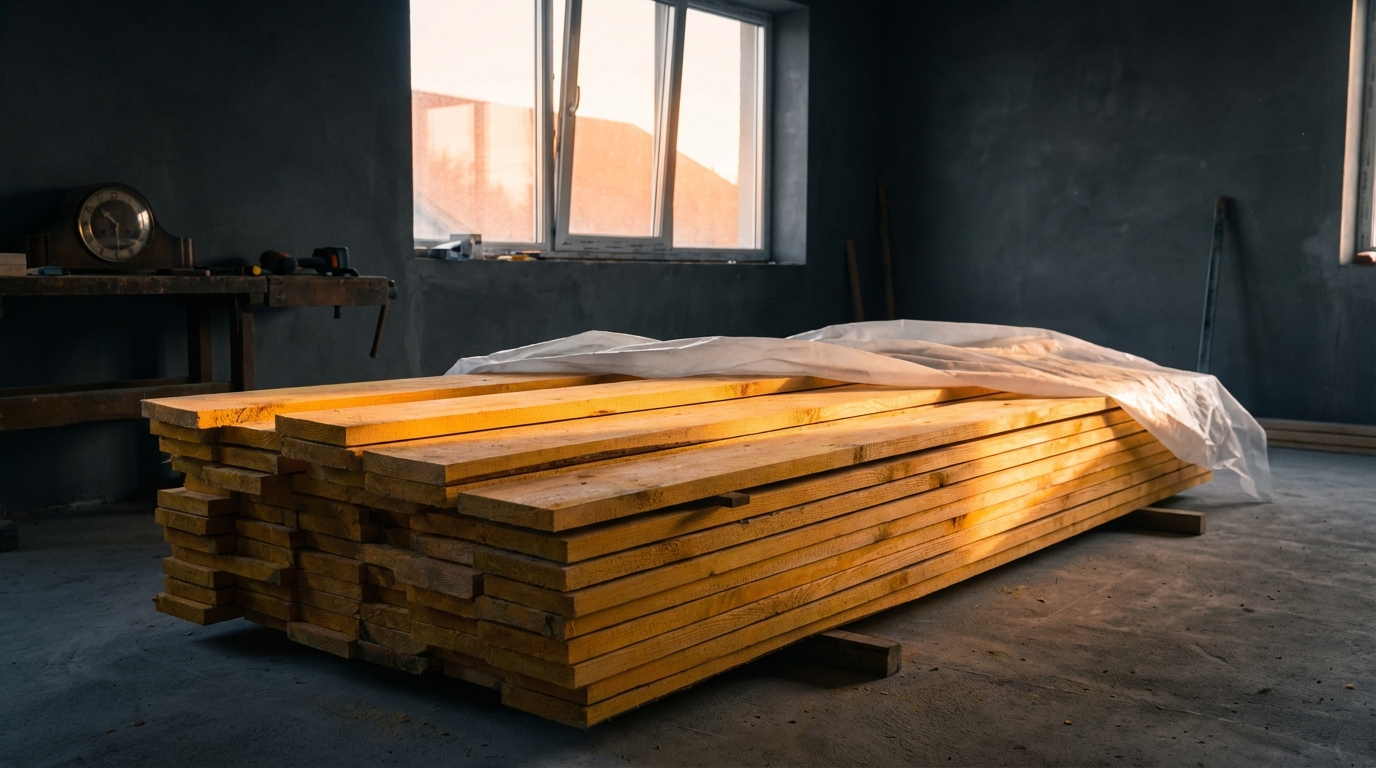
So, you are trying to figure out why your wood flooring or wood panels need to sit in the room before installation and whether acclimatization is really necessary or just a sales trick.
Yes, your wood absolutely needs to acclimatize before installation if you want to avoid gaps, cupping, warping, and expensive repairs.
Wood is not static. It reacts to humidity and temperature. If you install wood before it adjusts to your room conditions, it will move after it is nailed, glued, or floated. That movement can ruin a beautiful floor or wall that you just paid good money for.
Here is the short version: wood wants balance. Acclimatization is giving your boards time to reach the same moisture level as your home so they stay stable after they are fixed in place.
- Wood gains and loses moisture based on room humidity and temperature.
- Unacclimated wood can gap, cup, crown, or even buckle after installation.
- Acclimatization is about moisture content, not just “letting it sit.”
- You need a moisture meter, not guesswork, for serious projects.
- Different products (solid, engineered, laminate, vinyl) have different needs.
- Most solid wood needs 3 to 7 days; some jobs need longer.
- The subfloor and the wood both need to be within a tight moisture range.
- Skipping acclimatization often voids the product warranty.
- Good HVAC control before, during, and after the install is critical.
- A simple hygrometer and thermometer can save thousands of dollars.
What acclimatization actually means for wood
When a contractor or manufacturer says “let the wood acclimatize,” they are not just telling you to dump boxes in a room for a couple of days.
They are really talking about moisture content and equilibrium.
Wood cells take in water when the air is humid and give off water when the air is dry. This keeps happening until the wood reaches what is called “equilibrium moisture content” (EMC) with the surrounding air. At that point, the wood is stable for that room.
> Think of wood like a slow sponge. It does not react in minutes. It reacts over days.
If you install wood that is too wet for your space, it will shrink later and cause gaps or cracks.
If you install wood that is too dry for your space, it will swell later and cause cupping or buckling.
So acclimatization is not a ritual. It is a moisture adjustment process.
Moisture content basics (without getting too technical)
Wood moisture content (MC) is the amount of water in the wood compared to the dry weight of the wood, expressed as a percentage.
For most indoor residential spaces:
- Ideal relative humidity: about 30% to 50%
- Ideal wood moisture content: about 6% to 9% for many heated homes, 8% to 12% for more humid regions
Those are not fixed for every region, but they work as a reference.
You run into trouble when the wood you ordered sits at, say, 13% MC in a warehouse, and your home is at 7% to 8%. That difference will translate directly into movement inside your home if you rush the install.
> Acclimatization is not a time number. It is a moisture number. Time is just the tool to reach that number.
Why your wood needs to sit before installation
You are not paying for wood just to watch it sit in boxes. You want it installed. That is normal.
The problem is that most wood products travel through different environments on the way to your project:
- Factory or mill storage
- Transport trucks
- Regional or local warehouses
- Retail stores or distributors
- Your garage, basement, or jobsite
Each step has different humidity. Sometimes very different.
If the last environment the wood saw was a cold, damp truck, the boards will not be ready for your heated, relatively dry living room.
> If the room and the wood do not “agree” before installation, they will fight after installation. The wood will always win.
This is why pros often bring the wood inside, open the boxes, and let the boards sit stacked properly in the exact rooms where they will be installed.
What happens if you skip acclimatization
Let us get specific. Here is what you risk if you just install straight out of the truck.
| Problem | What you see | Typical cause | How bad it can get |
|---|---|---|---|
| Gapping | Spaces between boards after a few weeks or months | Wood shrank because it was installed too wet | Visible gaps, drafts, dirt collecting between boards |
| Cupping | Board edges higher than the center | Top and bottom of boards at different moisture levels | Trip hazard, finishing issues, hard to refinish |
| Crowning | Board center higher than the edges | Opposite moisture pattern to cupping, or over-sanding cupped boards | Uneven surface, poor appearance |
| Buckling | Boards lifted off the subfloor, sometimes dramatically | Wood swelled after install, no room to expand | Whole sections of floor ruined, often needs replacement |
| Checking / cracking | Cracks along the grain | Rapid drying or big swings in humidity | Permanent damage to boards |
These issues are not just cosmetic. They can void warranties, devalue a property, and force you to tear out and reinstall flooring.
How long should wood acclimatize?
This is the part everyone wants a simple number for.
The honest answer: you need to check moisture, not the clock.
That said, you can use general ranges:
- Solid hardwood flooring: 3 to 7 days in the jobsite conditions, sometimes longer in humid or very dry regions.
- Engineered wood flooring: often 2 to 3 days, some products come “stabilized” but still need time.
- Laminates: some manufacturers call for 48 to 72 hours.
- Luxury vinyl plank (LVP/LVT): 24 to 48 hours so the boards reach room temperature, even though they are not wood.
- Wall panels, trim, and millwork: often 2 to 5 days in the actual room where they will be installed.
> Do not just trust the typical schedule. Check the box, the data sheet, and the warranty.
Every manufacturer has its own instructions based on how the product is built, the core material, and the finish.
What manufacturers usually require
Most product guides will say something like:
> “Acclimatize flooring in the installation area for a minimum of 72 hours, with HVAC operating at normal living conditions (65 to 75°F, 30 to 50% relative humidity). Wood and subfloor moisture must be within 2 to 4 percentage points of each other.”
That last part is what many people skip. They follow the time but ignore the moisture difference between the subfloor and the wood.
You need both:
- Correct temperature and humidity
- Moisture content of wood within the manufacturer range
- Moisture difference between subfloor and wood within a narrow band (often 2% to 4%)
How to acclimatize wood correctly (step by step)
Let us go through a practical process that works for most projects.
1. Prepare the room first
This part gets skipped often. The room must be at “living conditions” before the wood arrives.
- HVAC system running for at least 5 to 7 days before wood delivery.
- Windows and doors installed, building closed to the outside.
- Wet work finished: drywall mud, paint, plaster, concrete curing stage done.
- Relative humidity stable in the target range (often 30% to 50%) for several days.
> If you bring wood into a construction site that still has wet concrete and wet drywall, acclimatization will fail. The wood will soak up that moisture.
2. Check subfloor moisture
Before the wood ever comes inside, you want to know what the subfloor is doing.
Use a moisture meter that is suitable for your subfloor material:
- Plywood or OSB: use a wood moisture meter set to the correct species or an equivalent scale.
- Concrete: use a concrete moisture meter or do proper tests like in-slab probes or calcium chloride, based on standards such as ASTM F2170 or F1869.
Typical targets (these can vary by product, so confirm):
- Wood subfloor: often 10% to 12% MC or closer to the target wood MC.
- Concrete: often 75% to 85% RH or lower, or a specific pounds/1000 sq ft/24 hours emission rate.
If the subfloor is out of range, you fix that first. Dehumidifiers, fans, or more cure time, depending on the situation.
3. Bring wood into the actual installation space
Bring the boxes into the room or rooms where the floor or woodwork will be installed. Avoid leaving them in:
- Garages
- Basements that are not controlled
- Unheated porches
Cut the plastic or shrink wrap open so air can reach the boards. Do not leave the packs completely sealed.
> You want the boards to see the same air that they will live in later.
4. Stack the wood correctly for airflow
How you stack the wood affects how fast it acclimatizes.
- Lay boxes flat on the floor, not standing on end.
- Use spacers or strips (“stickers”) between layers if boards are out of boxes, to allow air circulation.
- Keep stacks away from exterior walls or vents where conditions might be uneven.
- Do not place heavy objects on top that could bow boards.
A common pattern is nested or cross-stacked boxes with slight gaps, so air moves around the stack.
5. Monitor temperature and humidity
Use a basic digital hygrometer and thermometer combo. They are inexpensive and very useful.
Record:
- Room temperature
- Relative humidity
You want these to hold steady over several days, not swing up and down each day.
> Stable room conditions matter more than a specific hour count. Wood reacts to stability.
6. Measure wood moisture content regularly
Do not guess. Use a wood moisture meter.
Pick several boards from different boxes and locations in the room and measure each day or every other day.
Keep notes of:
- Day 1, 2, 3, etc.
- Moisture content readings
- Room humidity and temperature
You are looking for two things:
- The wood MC readings are moving toward the expected range for your region.
- The readings are stabilizing, meaning they do not change much day to day.
7. Compare wood MC to subfloor MC
Before you start installation, measure both again:
- Wood flooring MC
- Subfloor MC
Many guidelines say:
- Wood flooring should be within 2% to 4% of the wood subfloor.
- Never install if there is a big gap such as 6% to 8% difference.
Always confirm the limits for your product.
> A good habit is to write these numbers on a notepad and take a photo. If anything goes wrong, you can prove you followed the process.
How climate and region affect acclimatization
Your local climate has a big role in how long this takes and where the moisture will settle.
Dry, heated climates
In colder regions with heated homes in winter:
- Indoor relative humidity often drops low, sometimes under 30%.
- Wood will tend to dry out and shrink over the heating season.
- Narrow seasonal gaps between boards are common and not always a failure.
For these regions, you want your wood closer to the lower end of the moisture range, such as 6% to 8%.
Humid or coastal climates
In more humid regions:
- Indoor relative humidity can sit around 50% to 60% or more.
- Wood tends to swell in the most humid times of year.
- Larger seasonal movement is common.
For these regions, keeping the home humidity under control with dehumidifiers or air conditioning helps a lot. Wood might settle in the 8% to 12% MC range.
Seasonal swing and timing
If you install during:
- Dry season: the wood may swell later in the year.
- Humid season: the wood may shrink later when air dries.
Pros often aim for a middle ground installation time when possible, or they manage humidity more aggressively to keep conditions in that 30% to 50% band all year.
> Think about how your home lives through the whole year, not just on installation day.
Solid vs engineered: do both need acclimatization?
This is a frequent misunderstanding. Many people think engineered flooring does not need acclimatization. That is not accurate.
Solid hardwood
Solid hardwood is one piece of wood from top to bottom. It reacts strongly to moisture changes. It:
- Expands and contracts more across its width than along its length.
- Needs more careful acclimatization.
- Can show more cupping and gapping if conditions are not stable.
Engineered hardwood
Engineered flooring has a hardwood wear layer and a plywood or multi-layer core. It is built so the layers cross each other to reduce movement.
It still moves, but less than solid.
Pros:
- Handles humidity swings a bit better.
- Often suitable for concrete slabs or radiant heat, if the manufacturer allows it.
Cons:
- You still need acclimatization. The core layers and top veneer still react to humidity.
- Too much moisture at install can still cause delamination, cupping, or glue failure.
> Read the box. Many engineered floors still require 48 to 72 hours of acclimatization at jobsite conditions.
What about laminate and vinyl? Do they need to “sit”?
Many homeowners get confused because laminate and vinyl are not real wood, but the boxes still say “acclimate before installation.”
Laminate flooring
Laminate has a high-density fiberboard (HDF) core made from wood fibers. That means:
- The core still reacts to moisture.
- Swelling of the core can ruin the locking system.
- Humidity and temperature swings can affect fit and flatness.
So most laminate makers ask for at least 48 hours at room conditions.
Luxury vinyl plank or tile (LVP/LVT)
Vinyl does not have the same moisture movement that wood does. The main reason to let it sit is temperature.
- Boards can expand or contract slightly with temperature.
- They install better when at room temperature.
Many instructions call for 24 to 48 hours inside the space, laid flat in the boxes.
> Even when the product is waterproof, the room still is not. Prep and acclimatization still matter.
Common acclimatization myths (and what is actually true)
You will hear a lot of advice on forums and from friends. Some of it is helpful. Some is risky.
“Just leave the boxes in the room for 3 days and you are fine.”
Sometimes that works. But it ignores:
- Huge differences between climates.
- Moisture conditions of the subfloor.
- The fact that different products need different ranges.
Better: follow manufacturer time guidance and verify with a moisture meter.
“You need to spread all the boards out over the floor on day one.”
Spreading boards randomly across the entire floor might:
- Expose them to foot traffic before installation.
- Increase risk of damage or warping if the room is not ready.
You can lay out boards for color and grain matching later. During acclimatization, careful stacked storage with airflow usually works better.
“Engineered floors do not need acclimatization at all.”
Engineered floors are more stable but not immune to moisture. Most manufacturers still specify acclimatization time.
Ignore that and you risk:
- Edges peaking at joints.
- Gaps forming as the floor settles.
- Warranty problems if something goes wrong.
“If the house is new, you can skip acclimatization.”
New construction often has extra moisture from:
- Fresh concrete slabs
- New drywall and paint
- Plaster and other wet trades
That actually means you need to be more careful, not less. New houses often have higher indoor relative humidity until they dry out.
> In new builds, many flooring failures trace back to skipping acclimatization while the building was still drying.
How acclimatization ties into warranties and inspections
When something goes wrong with a floor, there is a pattern many inspectors look for.
What inspectors check after a problem
If you file a claim or call a manufacturer, an inspector may:
- Measure current wood moisture content.
- Measure subfloor moisture content.
- Check the home relative humidity and temperature.
- Look for signs of moisture or leaks.
- Ask about pre-install moisture readings and documentation.
If you have no records, you are at a disadvantage. If your numbers are far outside the specified range, they may deny coverage.
Why documentation matters
Keeping simple notes helps:
- Date the wood was delivered.
- Room conditions (temperature and RH) over several days.
- Subfloor moisture readings by area.
- Wood MC readings by date.
> A single sheet of paper with a few readings can be the difference between an expensive denial and a covered claim.
Practical tools that make acclimatization easier
You do not need lab gear. Simple tools help check the basics.
1. Wood moisture meter
Look for:
- Pin or pinless meter suitable for your wood type.
- Species settings or correction charts.
- Reasonable accuracy, not the cheapest toy on the market.
Use it on multiple boards, not just one.
2. Concrete moisture testing tools
For concrete slabs, you can:
- Use an in-slab RH test kit that follows standards.
- Or use a surface meter as a screening tool, then do proper tests if readings look high.
Concrete can hold moisture for a long time, so this part is critical if your floor crosses a slab.
3. Hygrometer / thermometer
These small devices give you:
- Room temperature
- Relative humidity
Some models log readings over days. That can give a clear picture of how stable your environment is.
4. Dehumidifiers and fans
If humidity is high:
- Dehumidifiers can bring RH into a safer range.
- Fans help move air but do not remove moisture on their own.
Remember, you are not trying to bake the wood. You are trying to get the room and the wood to match realistic living conditions.
Special cases: radiant heat, basements, and wide planks
Some installation conditions are more sensitive. Acclimatization becomes even more critical in these setups.
Radiant heat systems
With radiant heat:
- Heat comes from below the floor.
- Drying forces act directly on the boards and subfloor.
Things to watch:
- Bring the slab or subfloor to operating temperature gradually before wood arrives.
- Turn the system off or down during installation, based on product instructions.
- Keep long-term floor surface temperatures within product limits.
Products that are approved for radiant heat will have very specific acclimatization and temperature guidelines. Follow them closely.
Basements and below-grade spaces
Below-grade spaces are often more humid. Moisture can come through walls and floors.
You need:
- Careful moisture testing of concrete.
- Vapor barriers or underlayments that are compatible with your floor.
- Extra attention to dehumidification and ongoing humidity control.
> Many solid woods are not approved for below-grade. Engineered or vinyl products are more common here, but they still need acclimatization.
Wide plank flooring
Boards wider than 5 inches can show movement more clearly, because any small width change is more noticeable.
For wide planks:
- Acclimatization time may need to be on the longer side.
- Humidity control year-round is more critical.
- Some installers glue and nail or use specific patterns to control movement.
Real-world example: how acclimatization saves a project
Imagine you are installing 800 square feet of 3/4 inch solid oak in a living room and hallway. The house is in a region that has cold winters and mild summers.
You do this:
- HVAC has been running for a week. The hygrometer reads 45% RH and 70°F consistently.
- Subfloor is plywood. Moisture readings show 11% to 12% MC across the area.
- The flooring arrives. Initial wood MC readings from random boxes show 8% to 9% MC.
So the subfloor is about 3% higher than the flooring. That is a bit on the high side, so you:
- Bring in the wood, cut open the boxes, and stack them for airflow.
- Monitor for 5 days. Over that time, the wood creeps up to 10% to 11% MC.
- Room conditions stay stable in the same humidity and temperature range.
On day 6:
- Subfloor still reads 11% to 12%.
- Wood now reads 10% to 11% across several boards.
Now your difference is around 1% to 2%. That is within many guidelines, so you install.
If you had installed on day 1, you would have had:
- Subfloor: 11% to 12%
- Flooring: 8% to 9%
That could have driven moisture into the flooring from below and triggered cupping or movement later.
> A few days of patience can save years of frustration with a floor that never feels quite right.
Simple checklist for acclimatization before you start installing
You can turn this into a printed checklist for your project.
- Is the building closed, with windows and doors installed?
- Is HVAC running and holding stable living conditions?
- Are wet trades (concrete, drywall mud, paint) finished and dry?
- Have you measured and recorded subfloor moisture?
- Have you brought the flooring into the actual install rooms?
- Have you opened boxes and stacked flooring to allow airflow?
- Have you checked temperature and humidity daily for several days?
- Have you measured flooring moisture over a few days and seen it stabilize?
- Is flooring moisture within the product’s recommended range?
- Is the difference between subfloor MC and flooring MC within the allowed limit?
- Have you documented readings in case of warranty needs?
If you cannot check several items on that list, you are likely rushing the job.
> Last practical tip: buy a decent moisture meter before you buy expensive flooring. The meter will outlive several projects and will cost far less than fixing one failed installation.