
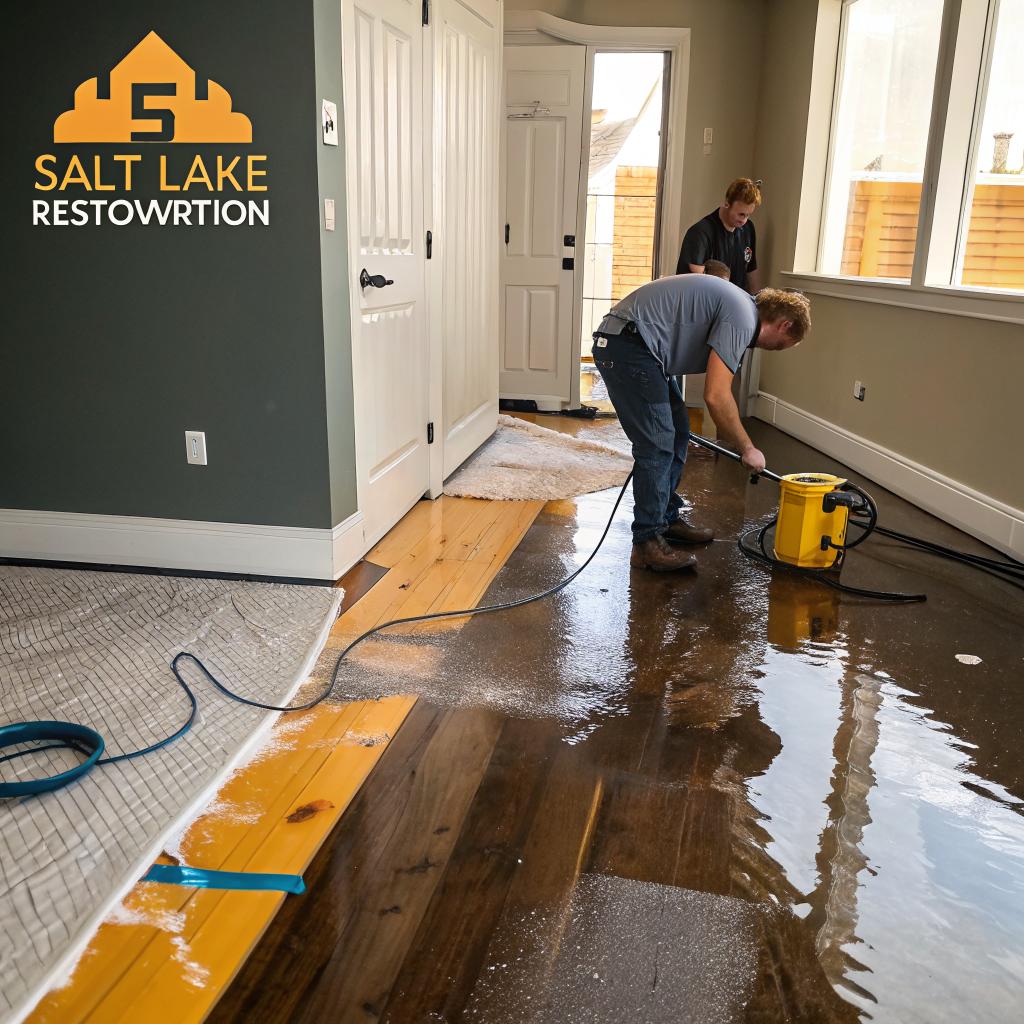
So, you are trying to figure out how water damage restoration in Salt Lake City affects your flooring and what to do about it. The direct answer is that you need to stop the water fast, dry the structure correctly, then decide whether to repair or replace your flooring based on moisture readings, not guesswork.
In Salt Lake City, flooring and water do not mix well because of our dry climate, temperature swings, and a lot of slab-on-grade homes. Water that might look minor on the surface can move into concrete, subfloors, and underlayment and come back later as cupping, warping, or mold. That is why proper drying and a realistic plan for each flooring type matters more than just getting fans and hoping for the best. If you bring in a local pro for water damage restoration Salt Lake City, they will usually start with your flooring, because that is where the damage shows first.
- How fast you remove the water affects whether your floor can be saved.
- Different floors react very differently to water: carpet is not hardwood, and laminate behaves almost like cardboard.
- Salt Lake City slabs, basements, and low humidity change how floors dry and how long it takes.
- You need moisture meters and clear standards, not just “it feels dry” by hand.
- Sometimes partial repairs cost more long term than a clean replacement.
- Insurance coverage often depends on whether you followed reasonable restoration steps.
If you remember nothing else, remember this: do not start reinstalling or refinishing flooring until the subfloor and slab test dry in the normal range for your area.
How water affects flooring in Salt Lake City homes
So, what actually happens to your floors when water hits them? It is not all the same. A kitchen leak, a basement flood from snowmelt, and a slow fridge line drip can all leave different damage patterns.
The typical Salt Lake City setup
Most homes around Salt Lake have some mix of:
- Concrete slab with carpet or luxury vinyl plank
- Basements finished with carpet over pad, sometimes on tack strip
- Engineered or solid hardwood on the main level
- Tile in bathrooms, entries, and sometimes kitchens
Concrete here tends to hold moisture once it is wet. Our air is usually dry, which sounds helpful, but it can pull moisture out of wood surfaces faster than out of the core. That can cause cupping or cracking if drying is rushed.
Salt on winter roads can also get tracked in with meltwater. That dirty water is harder on grout, carpet, and adhesives than clean water.
Clean water vs dirty water on floors
Not all water losses are equal. A broken supply line is very different from a backed up drain.
| Water source | What it means for flooring | Typical response |
|---|---|---|
| Clean supply line (sink, fridge, washer) | Least contamination, damage is mostly structural and cosmetic | Often can dry in place or salvage parts of the floor |
| Rain or snowmelt seepage | Can bring dirt, salts, and microbes into padding and subfloor | More removal under walls, careful drying of framing and slab |
| Toilet overflow, drain backup | Unsanitary, especially if solids present | Usually remove porous materials like carpet, pad, and some wood |
Any time water comes from below grade or from a drain line, assume you will need to remove carpet and pad in that area, even if you think you can clean it.
First steps when water hits your flooring
Let us stay practical for a moment. You walk in and see water on the floor. What should you actually do, in order?
Step 1: Shut off the source
This sounds obvious, but people sometimes skip it because they panic.
- Find and close the main water shutoff or the shutoff to the affected fixture.
- If water is coming from outside, like heavy rain toward a basement door, try to divert it with towels, boards, or even a tarp.
- Turn off power to outlets or circuits in standing water areas if it is safe and you can reach the panel without stepping in water.
Step 2: Get standing water off the flooring
You will not save your flooring if water sits. Even an extra hour can matter with wood or laminate.
Simple steps while you wait for a pro:
- Use a wet vac, not a regular vacuum.
- Push water toward a floor drain if you have one.
- Move furniture and rugs out of the wet area, not through other dry rooms without protection.
- Put aluminum foil or blocks under furniture legs that stay in the room.
I have seen people try to use towels for a full basement. That might help in a small hallway, but on a large floor, it mostly delays real extraction.
Step 3: Call a restoration company early, even if you are not sure
This part people sometimes resist. I get it. You worry about cost and insurance and would rather see how bad it really is.
Here is the reality: early professional extraction and drying often lowers the total cost, even if it feels expensive on day one. It can mean the difference between salvaging a hardwood floor or ripping it out.
Step 4: Protect areas that are still dry
You do not want to spread water or contaminants.
- Lay plastic or old sheets along traffic paths.
- Keep kids and pets out of the affected rooms.
- Do not start cutting flooring or tearing out baseboards on your own unless you are ready to commit to a full repair plan.
Quick extraction and controlled drying are more useful than random demolition. Tearing things out is easy. Putting them back correctly is the hard part.
How different flooring types react to water
Here is where it gets practical for renovation and flooring fans. Different floors handle water in their own way, and knowing that helps you pick the right material during future remodels too.
Carpet and padding
Carpet is often the first victim in a basement or on a slab.
What usually happens:
- Padding acts like a sponge and holds a lot of water.
- Carpet fibers may dry faster than the backing and the pad.
- Tack strip along walls absorbs water and can grow mold or rot.
When can carpet be saved?
| Situation | Carpet | Pad | Notes |
|---|---|---|---|
| Clean water, addressed within 24 hours | Often salvageable | Often replaced | Carpet can be floated and dried, new pad installed |
| Clean water, more than 48 hours | Maybe salvageable | Usually removed | Odors and backing delamination risk go up |
| Dirty or sewer water | Usually removed | Removed | Health concerns outweigh cost savings |
From a renovation view, some homeowners use water damage as a point to upgrade basement carpet to luxury vinyl plank. Just be honest with yourself about comfort, sound, and warmth. Vinyl on a basement slab can feel colder underfoot without an underlayment.
Solid hardwood flooring
This one can be painful. Hardwood is expensive, and people get attached to it.
What water does to hardwood:
- Boards swell, starting at the edges, causing cupping.
- If water stays in or under the boards, they can crown later.
- Fasteners and subfloor take on moisture too.
In Salt Lake, dry air can pull surface moisture out fast while the underside stays wet. That uneven drying can twist boards.
Can hardwood be saved?
Sometimes, if:
- You catch the loss quickly.
- You get aggressive extraction and drying under and around the floor.
- Moisture readings return to normal before refinishing.
But sanding too soon is a classic mistake. People see cupping, want it flat, and sand it. Then as the boards fully dry, they shrink and you get gaps or crowning that cannot be fixed without even more work.
If you have solid hardwood and it floods badly, you may be better off planning a full replacement and picking a product suited to future risk, like an engineered floor.
Engineered wood
Engineered wood has a thin hardwood layer glued to layers of plywood or composite. It usually handles minor spills better than solid hardwood. But once water hits the core and the layers start to separate, there is no real way to repair that.
If the floor is glued directly to a slab and water gets trapped under it, the glue can release. Planks may bubble or sound hollow. In that case, localized repairs can turn into a patchwork that never feels right.
This is where thinking like a renovator matters. If your engineered floor is already older, or you never loved the color, water damage is sometimes the push to redo it properly instead of trying to chase down individual damaged boards.
Laminate flooring
Laminate and water are almost enemies. The core often swells quickly and permanently. Even small spills that get into seams can cause raised edges.
If you have a real flood on a laminate floor, expect to remove it. People try to dry it, but the panels rarely go fully back to normal.
For remodels in areas at risk of water, like near exterior doors or in basements, many flooring pros in our area steer clients toward luxury vinyl plank instead of laminate. It is not perfect, but it handles getting wet far better.
Luxury vinyl plank and tile
LVP and LVT are popular for a reason. Most brands are resistant to direct water on the surface.
That does not mean you can ignore what happens underneath:
- Water can seep into click joints and sit under planks.
- If water comes up from below, from a crack in the slab or a drain, it can support microbial growth under the floor.
- Prolonged wetness can impact adhesive in glue-down installs.
In many clean-water events, LVP can be pulled, the slab dried, and the same planks reinstalled if they have not warped. It is more labor, but less material cost.
Tile and stone
Tile itself often survives, but that does not mean the floor system is fine.
Things that go wrong under tile:
- Subfloor or backer board gets wet and breaks down over time.
- Water runs into wall cavities through gaps at the edges.
- Grout and some adhesives deteriorate when soaking in dirty water.
You cannot judge a wet tile floor just by looking at the surface. A tile floor can look perfect and still be loose or hollow below. That sometimes shows up months later as cracking grout or movement.
On a renovation project, if you are already seeing cracked grout lines near a past water loss, that is a hint that the subfloor might not be stable any more.
Drying strategy: why “it feels dry” is not enough
People like the hand test. They touch the floor and say, “It seems dry now.” The problem is that most of the moisture is below or behind what you can touch.
Tools that pros use
Restoration techs do not guess. They check:
- Non-penetrating moisture meters for surfaces and quick scans
- Penetrating meters for subfloors and framing
- Relative humidity readings, sometimes inside hardwood or walls
- Infrared cameras to see temperature patterns where water might still sit
Without those, you can dry a surface and leave a wet pocket in a wall or under a sill plate.
Salt Lake City climate and drying
You might think our dry air helps and solves the problem. It helps, but not by itself.
Factors around here:
- Big swings between day and night temps can stress wood.
- Furnaces and ACs affect air movement through the house.
- Basements often have poor air exchange with the rest of the home.
A balanced drying plan uses:
- High-volume air movers aimed along floor and wall surfaces
- Dehumidifiers sized for the space volume and moisture load
- Occasional containment zones to focus drying in the wet area
If you only open windows, you might help a little in spring and fall, but you can also bring in damp outside air during storms or humid days. Or you steal conditioned air from your HVAC and make it work harder.
Repair or replace: how to make the flooring call
This is the question everyone comes back to: can the floor be saved or should you replace it?
Key factors in the decision
Ask yourself:
- How long was the floor wet before you found it?
- What type of water was it: clean, gray, or sewer?
- What is the construction under the floor: slab, plywood, OSB?
- How old is the flooring and did you like it before the loss?
- What do the moisture readings say, not just on the surface but below?
Sometimes the emotional pull of “saving” a floor does not match the math. For example, paying for extra labor, specialized drying mats, and a full refinish on an older hardwood might cost more than a new engineered floor that fits your current style better.
When replacement is usually smarter
Here are some situations where, in practice, replacement makes more sense than heroic drying:
- Laminate that has visibly swelled or lifted.
- Carpet and pad affected by dirty water or sewer backups.
- Engineered wood with clear delamination or bubbling.
- Hardwood that has remained wet at the subfloor for days and is already badly cupped.
- Any floor where odor does not go away after proper cleaning and drying.
On the other hand, tile, LVP, and some carpets in clean water events can often be part of a restore plan, especially if caught quickly.
Flooring choices after water damage: thinking ahead
If your floor must be replaced, you have an opportunity. You can pick something that looks good and handles future risk better.
Match flooring type to room risk
You do not need to flood-proof your entire house. But you can be strategic.
- Basements: Consider LVP or tile with a good underlayment and moisture control, especially along exterior walls.
- Kitchens: Waterproof or water-resistant surfaces with sealed transitions at dishwashers and sinks.
- Entryways: Tile or LVP near exterior doors where snow and meltwater land.
- Upper levels: Engineered wood tends to be more stable than solid over time.
If you love the feel of carpet in a basement, you can still have it. Just factor in that a future flood might mean replacing it again. Some homeowners pick carpet tiles instead of broadloom for easier replacement in small zones.
Underlayment and subfloor upgrades
For renovation-minded readers, this part is often overlooked.
You can:
- Add a moisture barrier under new flooring on concrete slabs, if rated for your product.
- Replace damaged sections of OSB or plywood subfloor rather than patching soft areas with filler.
- Use more water-resistant backer boards under tile in known risk areas.
Those steps are not glamorous, but they affect how the floor survives the next leak.
Salt Lake City details: basements, snow, and sprinklers
Water damage here has a few patterns you do not always see in other places.
Basement flooding patterns
Common basement sources:
- Foundation seepage in spring from snowmelt.
- Backed up window wells in heavy storms.
- Broken sprinkler lines or mis-aimed heads near foundation walls.
- Sump pump failure during storms.
Basement carpet at exterior walls is a frequent casualty. When that happens, you might see:
- Wet tack strip but only slightly damp carpet surface.
- Water wick up into baseboards and drywall a few inches.
- Moisture trapped behind vapor barriers on framed walls.
For renovation projects, some homeowners now stop carpet a few inches off exterior foundation walls and transition to a hard surface border, almost like a perimeter. That can limit how much carpet you need to replace after future seepage.
Snow and ice at entries and garages
Winter brings water in a slower way:
- Snow melts off shoes onto wood entries and stairs.
- Ice melt products and salt sit on grout and natural stone.
- Garage meltwater can seep under door thresholds.
Over years, you might not call a restoration company for these small events, but they still weaken flooring.
For new floors near doors:
- Use proper transition strips and sealant where wood meets tile or vinyl.
- Plan for washable rugs, not thick mats that trap water.
- Choose grout and sealers that hold up against salt and regular cleaning.
Working with insurance on flooring claims
Water damage and insurance can get messy, especially when it comes to flooring costs.
Documenting floor damage
Before anyone pulls your flooring out, get proof:
- Photos of standing water, wet flooring, and where it came from.
- Close-ups of cupping, staining, delamination, or swelling.
- Measurements of affected rooms and hallways.
Ask your restoration company for:
- Moisture readings by area, with dates.
- A clear scope of what needs removal and why.
- Notes on whether flooring can be cleaned and saved or must be replaced.
Many carriers want to see that removal was necessary, not just a choice. Having clear technical reasons on paper helps.
Matching flooring across rooms
One tricky part with claims is where the damaged flooring stops and the same product continues into other rooms.
For example:
- Your kitchen hardwood floods, but the same hardwood runs into your dining and living room.
- A basement family room carpet gets ruined, but it matches the hall and guest room.
Insurers often pay to make the damaged area match, but may not want to cover redoing perfectly dry rooms. This is where you may need to negotiate or accept some transitions.
From a design view, sometimes a planned change in material at a logical break, like a doorway or stair, looks better than an awkward partial patch that never matches perfectly.
Do-it-yourself vs professional restoration for flooring
You can do some parts yourself. But you should be honest about where DIY stops making sense.
What homeowners can usually handle
- Shutting off water and power safely.
- Moving furniture, rugs, and belongings out of harm’s way.
- Shop-vac extraction of shallow puddles, especially if the area is small.
- Removing and tossing obviously ruined area rugs, cardboard boxes, and basic trim.
Small spills on tile or vinyl that did not run into walls or subfloor can often be handled without a pro, as long as you fully dry and clean.
Where professional help makes a real difference
Call in pros when:
- Water has been present for more than a few hours on wood or carpet.
- You see water at baseboards, inside closets, or in multiple rooms.
- There is standing water you cannot remove quickly with your own tools.
- The source is uncertain or may involve dirty water.
The value is not just equipment. It is also:
- Moisture mapping, so you know where water actually went.
- Targeted removal that preserves what can safely stay.
- Drying logs that support insurance claims and future resale disclosures.
Preventing future water damage to your floors
You cannot control everything, but you can lower your odds of flooring damage.
Simple checks around the house
A quick home routine a few times a year can catch issues early:
- Look under sinks for slow leaks and warped cabinet bottoms.
- Pull out your fridge slightly and check the water line and floor.
- Inspect around toilets for soft flooring or staining.
- Watch your sprinkler overspray and adjust heads away from the foundation.
- Test your sump pump if you have one.
Small drips over months can be worse for wood than one quick spill, because they encourage slow rot and mold.
Flooring-focused upgrades
For those already planning remodels:
- Add water alarms near water heaters, under sinks, and in basements near sumps.
- Use shutoff valves with leak detection on critical lines if your budget allows.
- Pick flooring materials with water resistance in rooms with multiple plumbing fixtures.
These steps are not magic, but they tend to show up in homes that survive surprise leaks with less drama.
Common questions about flooring and water damage
Q: My hardwood cupped after a leak. Will it flatten again if I just wait?
Sometimes, but not always. Mild cupping can relax once the wood and subfloor dry fully and evenly, which can take weeks. Severe cupping often leaves permanent shape change or gaps. You need moisture readings, not just patience, before deciding to refinish or replace.
Q: Is luxury vinyl really waterproof, or is that just marketing?
The vinyl itself usually handles water on the surface well, but the system is not magic. Water can still sit under planks, damage adhesives, or support microbial growth on dust and debris. If you flood an LVP floor, you still need extraction and drying, and sometimes temporary removal.
Q: Can I just replace the wet section of carpet and leave the rest?
Technically, yes, but color and wear differences often show. Men, women, kids, pets, sunlight, and cleaning all age carpet. A patch in the middle of a room usually looks off. Replacing wall to wall in a logical section, like the full room or level, often looks better and can be simpler for installers.
Q: How do I know when the concrete slab under my flooring is dry enough?
You cannot know by touch. Professionals use moisture meters suited for slab readings and sometimes perform more formal tests. The idea is to compare readings in the wet area to known dry reference zones or published limits for the flooring product you plan to install. If the slab is still holding excess moisture, adhesives can fail and wood products can move.
Q: If my basement has flooded once, is it crazy to put carpet back in?
Not crazy, but you should be realistic. If the cause was a one-time event that you fixed, like a broken pipe, carpet can be fine. If the cause is ongoing, like regular seepage in spring that you choose not to address, then carpet will likely be an ongoing maintenance item. The choice depends on your comfort, budget, and how you use the space.
What part of your flooring situation worries you most right now: saving what you have, picking new materials, or getting through the insurance part without making a mistake?