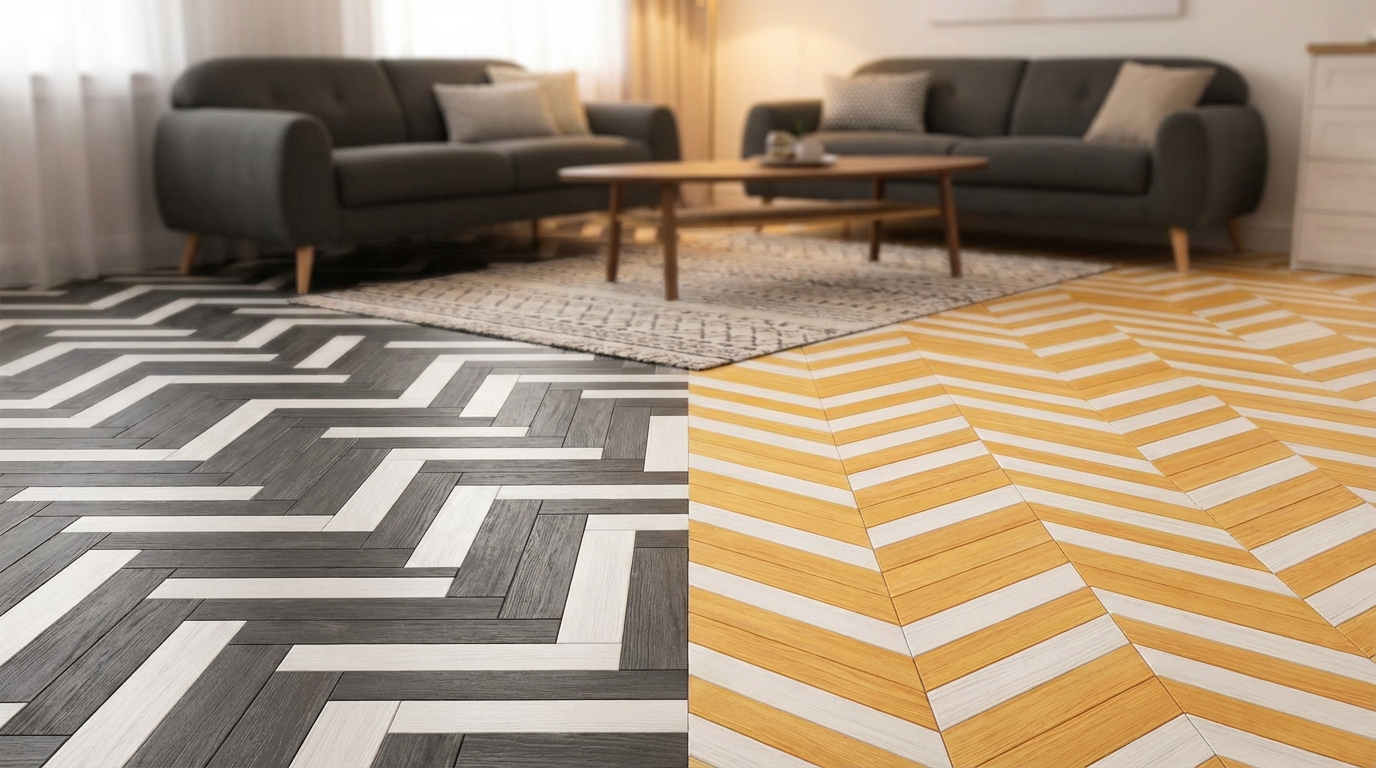
So, you are trying to figure out the real difference between herringbone and chevron, and which one you should pick. The short answer is: herringbone uses rectangular pieces with square ends that create a broken zigzag, while chevron uses boards cut at an angle so the ends form a sharp, continuous V shape.
Both patterns look similar at a glance, which is why so many people mix them up. The way the boards are cut, joined, and laid out changes how your floor or wall looks, how hard it is to install, how much waste you have, and even how modern or classic the space feels.
Here are the things you need to know before you choose one pattern over the other:
- Herringbone uses straight-cut boards; chevron uses boards cut at angles.
- Herringbone looks like a broken zigzag; chevron looks like clean V-shaped arrows.
- Chevron usually costs more in both material and labor.
- Herringbone is more forgiving with imperfections and small layout mistakes.
- Chevron looks sharper and more modern; herringbone leans classic and textured.
- Both patterns impact room size perception and how your eye moves through the space.
- Chevron needs precise planning; herringbone gives your installer more room to adjust.
- The wrong subfloor or prep can ruin either pattern, so installation quality matters.
> If you remember only one thing: herringbone is staggered rectangles; chevron is angled V-shapes.
What are herringbone and chevron, in plain language?
Forget design jargon for a second. Think about arrows on a road and fish bones.
Herringbone pattern
Herringbone looks like the skeleton of a fish lying on its side. Short boards meet each other at a right angle, but their ends do not line up in a straight line across the room.
Each piece is a simple rectangle. The short end of one board hits the long side of the next board, and they keep stacking like that.
If you looked closely at the joints, you would see this:
– One board runs up
– Another board runs across it at 90 degrees
– The ends create a “stepped” or broken zigzag line
So the “spine” of the pattern looks jagged, not like a clean arrow.
Chevron pattern
Chevron looks like a clean row of arrows or V shapes pointing in one direction.
Here, the boards are not simple rectangles anymore. Each piece is cut at an angle (often 45° or 60°) at the ends. When two boards meet, they touch end to end and form a perfect point.
Picture this:
– Board A has an angled end.
– Board B has the mirror of that angle.
– When they meet, they create one sharp V.
– The V repeats across the floor or wall in a clean zigzag line.
There is no broken spine here. The joints line up in a straight, continuous zigzag.
> Herringbone is about overlapping rectangles, chevron is about angled points.
Key visual differences: how they actually look
If you walk into a room, how can you tell which pattern you are looking at without kneeling down?
How to spot herringbone
You are probably seeing herringbone if:
- The zigzag line looks “stepped” or staggered.
- The ends of the boards do not meet in a single sharp point.
- The pattern feels textured, almost like woven fabric.
- You notice small offset joints where pieces overlap.
Herringbone often gives the space a subtle sense of movement. Your eye flows across the floor, but it does not follow a single perfect line. It feels more broken up, in a good way.
How to spot chevron
You are probably looking at chevron if:
- You can trace a clean, continuous V or zigzag from one side of the room to the other.
- The points look sharp, almost like arrows.
- The pattern feels very orderly and aligned.
- The seams line up in straight diagonals across the room.
Chevron has a stronger directional pull. It tends to lead your eye toward a wall, a window, or a focal point like a fireplace.
> Quick memory trick: herringbone “breaks” the line, chevron “completes” the line.
The technical difference: how the boards are cut and joined
From a design angle, these patterns feel like cousins. From an installer’s angle, they are not the same thing at all.
Board shape and cut
Here is where everything starts:
| Pattern | Board shape | End cut | Typical angle |
|---|---|---|---|
| Herringbone | Perfect rectangles | Square (90°) | Boards meet at 90° |
| Chevron | Rectangles cut into parallelograms | Angled (not 90°) | Commonly 45° or 60° |
For herringbone, the manufacturer can start with normal planks and just cut them to a certain length. The edges stay straight.
For chevron, the factory has to cut each short end precisely at an angle. That means:
– More time on the cutting line
– More waste from offcuts
– Tighter quality control
So even before the product reaches your door, chevron has done more “work.”
How the pattern is assembled
Here is how this plays out on site.
Herringbone:
- Installer snaps a reference line (often down the center of the room).
- Two boards are laid at a 90° angle to form the first “L” shape.
- The pattern grows from that center, with each new board locking into the previous ones.
- Small layout issues can be adjusted as you go.
Chevron:
- Installer needs a very accurate center line and angle reference.
- Each joint must meet perfectly tip to tip.
- One tiny error in angle can ripple across the entire floor.
- Trim pieces around the perimeter are more complex.
> With herringbone, the pattern hides tiny shifts. With chevron, the pattern exposes them.
Cost comparison: herringbone vs chevron
Cost is not only about material. You also have to think about labor, waste, and prep time.
Material cost
In many markets, you will see something like this trend:
| Pattern | Typical material price vs straight lay |
|---|---|
| Straight plank | Baseline (100%) |
| Herringbone | About 120% to 150% of straight plank |
| Chevron | About 130% to 170% of straight plank |
Numbers vary by brand and country, but chevron almost always carries a premium over herringbone.
Why:
- Angled cutting is slower and more complex.
- Quality control needs to be stricter.
- Some factories treat chevron as a special product line.
Labor cost and time
Labor is where many people are surprised.
Installers often charge:
– More per square foot (or per square meter) for herringbone than straight planks
– Even more for chevron than for herringbone
A flooring pro might, for example, charge:
| Pattern | Relative labor cost |
|---|---|
| Straight plank | Baseline |
| Herringbone | About 1.5x to 2x baseline |
| Chevron | About 2x to 3x baseline |
Again, this varies, but the direction is consistent. Chevron is:
– Slower to install
– Less forgiving of mistakes
– More demanding on layout and cutting
Even small misalignments show up fast in a chevron pattern, so an installer might move slower to get it right.
> If you are tight on budget, you often get more “pattern impact per dollar” with herringbone.
Waste, layout, and room constraints
Patterns are not only about looks. They also affect how much material ends up in the trash.
Material waste
With straight planks:
– You lose offcuts only at walls and around obstacles.
With herringbone:
– The pattern itself is based on standard rectangles.
– Offcuts are mainly from trimming along edges.
– Many offcuts can be used somewhere else in the pattern.
With chevron:
– Every board already has angled cuts.
– Perimeter cuts often create triangle or wedge-shaped pieces.
– You get more waste that cannot be reused.
Installers might recommend ordering:
- About 5% to 10% overage for straight layouts
- About 10% to 15% for herringbone
- About 15% to 20% for chevron
The exact numbers depend on room shape and product type, but chevron usually sits at the top.
Room shape and where the pattern points
Patterns change how your room feels.
With both herringbone and chevron, you need to decide:
– Which way should the arrows run?
– What do you want the eye to move toward?
Some rules of thumb:
- Point the “V” toward the main window to pull your gaze to the natural light.
- Run the pattern along the longest wall to stretch the room visually.
- In a hallway, run the pattern in the direction you walk to avoid a choppy feel.
Chevron exaggerates this directional pull more than herringbone. If you get the layout wrong with chevron, the room can feel off.
> Before you commit, sketch the pattern on paper over your floor plan and decide where the “arrows” should lead.
Style and mood: what each pattern does to your space
You are not picking just a pattern. You are picking how your room feels every time you walk into it.
Herringbone mood and design use cases
Herringbone often fits when you want:
- A classic look that still feels current.
- Texture that adds interest without shouting.
- Flexibility to work with both traditional and simple modern furniture.
Think of:
– Old European apartments
– Historic townhouses
– Modern homes that still want some warmth
Herringbone has been around for centuries in wood, stone, and even in fabrics. That history makes it feel grounded.
It also plays well with variation in color and grain. If your wood planks have knots or shade differences, herringbone spreads them out in a pleasant way, almost like a woven rug.
Chevron mood and design use cases
Chevron often fits when you want:
- A sharper, more graphic pattern.
- A floor or wall that acts as a key visual feature.
- A strong directional flow in the space.
Chevron tends to:
– Look more tailored and “crisp”
– Suit modern, minimal, or high-contrast interiors
– Stand out more in photos and marketing images
You often see chevron in:
– Boutique hotels
– Feature walls behind beds or sofas
– Showrooms that want a clear style statement
> If you want subtle texture, lean herringbone. If you want a bold statement, lean chevron.
Comfort, wear, and long-term performance
At first glance, a pattern does not change how a floor feels under foot. But installation choices tied to these patterns can influence comfort and longevity.
Subfloor and stability
Both patterns:
– Put more stress on joints than straight planks.
– Need a stable, flat subfloor.
– Benefit strongly from proper adhesive and underlayment in many cases.
Many installers will:
- Spend more time leveling the subfloor for patterned installs.
- Prefer glue-down installations for engineered wood in these patterns.
- Be strict about acclimating the wood to the room humidity.
Any movement in the subfloor shows up more clearly with these repeating diagonal lines.
Wear patterns and scratch visibility
Interestingly, both patterns can hide wear better than straight planks in some scenarios.
Why:
– Diagonal boards break up straight traffic lines.
– Scratches and dents often blend into the directional grain of the pattern.
Between the two:
– Herringbone hides small damage slightly better, because its “broken” movement confuses the eye.
– Chevron, with those longer, continuous lines, can make certain marks more noticeable if they cut across multiple V shapes.
> If you expect heavy wear and tear, pair the pattern with a matte or low-sheen finish. Shiny finish plus chevron can highlight scratches more.
Installation difficulty: DIY or hire a pro?
Many readers ask if they can install these patterns themselves. Technically, yes. Practically, it is tricky.
Herringbone difficulty
Herringbone is difficult, but not impossible for a skilled DIYer with patience.
You need:
- Accurate layout lines.
- Good tools for cutting and measuring.
- Willingness to correct course if the pattern drifts.
If you are installing click-lock herringbone flooring meant for floating installation, some brands design the locking system to guide you into the correct pattern. That helps a lot.
Still, one small angle mistake at the start can cause ugly gaps near walls. So you have to:
– Dry lay a section first.
– Double-check your center line.
– Respect expansion gaps if it is a floating floor.
Chevron difficulty
Chevron is almost always best left to a pro who has done it many times.
Why:
- Each V needs perfect alignment, or the whole row looks off.
- The angle cuts must match, or gaps show immediately.
- Layout lines need to be accurate in both directions.
Patterns can also drift across the room. With chevron, drift is obvious because the zigzag lines should stay straight and consistent. If they wander, you can see it from the doorway.
> If you want chevron and you are not highly experienced, budget for professional installation. It saves headache and rework.
Where to use herringbone vs chevron: floors, walls, backsplashes
Both patterns are not just for floors. You will see them on walls, backsplashes, and even outdoor paths.
Flooring choices
Common materials for these patterns:
- Solid hardwood
- Engineered hardwood
- Luxury vinyl plank (LVP / LVT) in special patterns
- Porcelain tiles shaped for herringbone or chevron
Herringbone floor:
– Works well in living rooms, hallways, dining rooms.
– Can stretch across multiple rooms for a unified look.
– Adds interest without demanding that every wall and piece of furniture revolve around it.
Chevron floor:
– Best as a feature in key areas.
– Can look great in a long hallway or entry, pointing toward a focal point.
– In a very busy open-plan space, it can be overwhelming if not balanced with simple furniture and walls.
Walls, backsplashes, and feature areas
On vertical surfaces, the patterns feel a bit different.
Herringbone on walls:
- Looks like woven texture.
- Contains more visual “noise,” which can be nice behind open shelving.
- Works well with smaller tiles, for example in a kitchen backsplash.
Chevron on walls:
- Looks more like a graphic print.
- Pulls your eye up or sideways, depending on direction.
- Can frame a bed, a TV, or a fireplace strongly.
> For backsplashes, herringbone often feels calmer over time. Chevron can look very pattern-heavy in small kitchens unless color and grout are kept simple.
Common mistakes people make (and how to avoid them)
There are a few traps that come up again and again.
Mistake 1: Calling herringbone “chevron” when ordering
This happens a lot. Some product listings are mislabeled or oversimplified.
You might:
– Show a photo of chevron to your contractor.
– Say “herringbone” by accident.
– End up with the wrong product in the truck.
To avoid this:
- Bring or send a clear reference photo.
- Ask for the word “chevron” or “herringbone” on the written quote.
- Look at a sample box before full delivery.
> If the boards have straight, square ends, you are not getting chevron, no matter what the label says.
Mistake 2: Picking the wrong pattern for the room size
Pattern scale matters.
– Tiny boards in a tiny powder room can look overcomplicated.
– Huge chevron in a small entry can feel cramped.
As a simple check:
- Mock up the pattern on the floor with painter’s tape to see the scale.
- Or lay a few sample boards on the floor and take a photo from the doorway.
If the pattern dominates the photo completely, you might want larger boards or a simpler layout.
Mistake 3: Starting the pattern in the wrong place
Both patterns need a starting line. If you start from a random wall that is not straight, you can:
– End up with angled cuts on both sides that look odd.
– Highlight crooked walls instead of hiding them.
A better approach:
- Find the visual center of the room or the main line of sight.
- Snap a straight reference line there.
- Start your pattern along that line and work outward.
Herringbone is a bit more forgiving here than chevron, but both benefit from thoughtful layout.
Maintenance and cleaning: any real difference?
From a cleaning perspective, pattern does not change your routine that much. But a few small details matter.
Dust and dirt visibility
With both patterns, you have more edges and short joints compared to long straight planks.
Real-world effects:
– Light dust can catch light differently on diagonal boards.
– Herringbone can camouflage small crumbs better because the pattern breaks the background.
– Chevron’s long lines might show streaks more when light hits at an angle.
Daily cleaning strategy:
- Vacuum with a soft-brush head in the direction of the pattern.
- Use a damp microfiber mop with a gentle cleaner suitable for the material.
Maintenance for wood versions
For wood herringbone or chevron floors:
– Moisture control becomes critical, since many short boards means more joints.
– Use mats at entries and keep humidity reasonably steady.
– Follow manufacturer guidance on refinishing. Patterned floors refinish like normal wood, but pros must keep sanding movement even so you do not create waves that break the pattern visually.
> Pattern does not make maintenance harder, but it makes sloppy maintenance more obvious over time.
Comparing herringbone vs chevron at a glance
Sometimes a compact comparison helps you decide quicker.
| Aspect | Herringbone | Chevron |
|---|---|---|
| Board shape | Rectangles with square ends | Parallelograms with angled ends |
| Pattern look | Broken zigzag, woven feel | Sharp V-shaped arrows, continuous zigzag |
| Visual style | Classic, textured, flexible | Bold, graphic, tailored |
| Material cost vs straight planks | Moderately higher | Higher |
| Labor difficulty | High | Very high |
| Waste percentage | Medium | Higher |
| DIY-friendly | For experienced DIYers | Usually pro-only |
| Best use | Floors across larger areas, backsplashes | Feature floors, focal walls, hallways |
> If you want a “safe” patterned choice that fits many styles, herringbone tends to be the easier bet.
So which one should you choose?
Let us break the choice into a few clear questions you can answer in a minute.
Question 1: What describes your design goal better?
- “I want interest and texture, but I do not want the floor to shout.”
→ Lean herringbone. - “I want the floor or wall to be a strong visual feature.”
→ Lean chevron.
Question 2: How sensitive are you to budget?
- Budget is tight, but you still want pattern
→ Herringbone with a cost-friendly material like engineered wood or LVP. - Budget has room, and this is a key design moment
→ Chevron with quality material and pro installation.
Question 3: Do you have a trusted installer with pattern experience?
- Yes, and you have seen their work
→ Both are workable; choose based on design. - No, and flooring in your area is hit-or-miss
→ Herringbone gives more margin for error. Chevron can punish inexperience.
Question 4: How long do you plan to live with this choice?
If you think you will be in the space for many years:
– Herringbone’s timeless feel can age very well and survive trend cycles.
– Chevron will likely stay attractive too, but it can feel more tied to certain style waves, especially in bold colors or very sharp contrasts.
> When in doubt over long horizons, go a little more subtle. You can add bolder elements in rugs, art, and furniture later.
A simple practical tip before you commit
Before you place a full order, print two photos at the same size: one of a herringbone floor and one of a chevron floor, in colors close to what you want. Tape them to the actual wall of the room, or place them on the existing floor.
Look at them:
– In daylight
– In the evening with your real lights on
– From the doorway and from where you usually sit
Then ask yourself, very plainly: “Which one would I still want to look at every day in five years?”
That quick, honest reaction beats any trend chart.