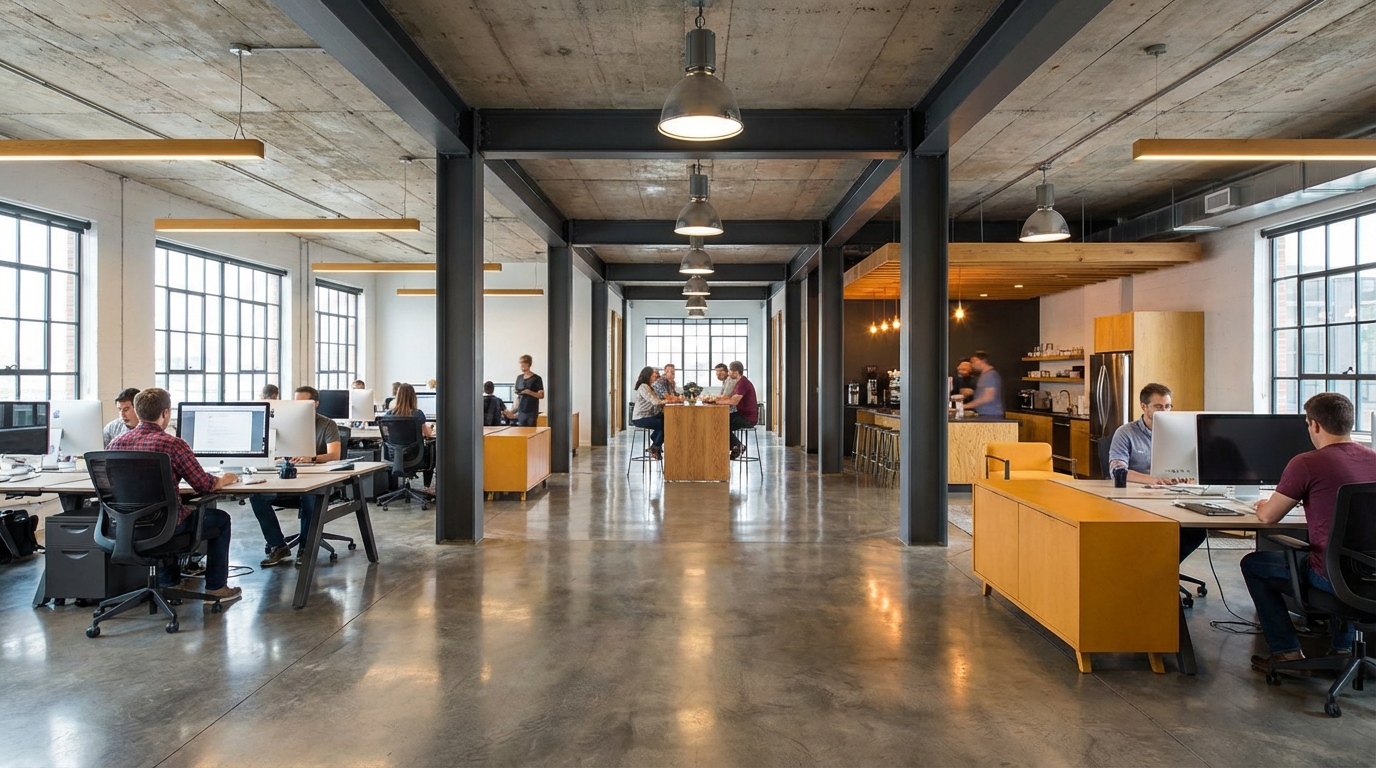
So, you are trying to figure out if polished concrete is the right modern industrial look for your tech startup space. Yes, polished concrete can be one of the smartest flooring choices for a startup office if you care about budget, maintenance, branding, and long-term flexibility.
You see this look everywhere in tech: exposed ceilings, open plans, glass, and that clean concrete floor that looks simple but actually does a lot of work for the space. It is not just a style choice. It affects noise, comfort, cleaning, how investors perceive your brand, and even how your team feels during long workdays.
Things you need to know:
- Polished concrete is not just “raw” concrete; it is a mechanical process that changes the surface.
- It pairs well with the industrial tech aesthetic: open ceilings, steel, glass, and minimalist furniture.
- Upfront cost can be lower than many alternatives, especially if the slab already exists.
- Maintenance is straightforward, but you need the right cleaning routine and team habits.
- It can be noisy and hard underfoot, so you often balance it with rugs, soft seating, and acoustic treatments.
- Finish level, sheen, and sealer choice matter for both looks and durability.
- What looks great in photos can be slippery or dusty if done badly, so contractor choice is critical.
Polished concrete is the tech-office version of a good backend: invisible when done right, painful when done wrong.
What polished concrete actually is (and what it is not)
So, what are you really getting when you ask for polished concrete in your startup office?
Polished concrete is not just “leaving the slab unfinished.” That is a common misconception. There is a real process behind it.
The basic process in plain language
Most commercial polished concrete projects follow a sequence like this:
- Surface prep: Grind the surface to remove glue, paint, high spots, or old coatings.
- Repairs: Fill cracks, joints, and holes with patch or epoxy.
- Initial grinding: Cut the slab with metal-bond diamonds to flatten and expose the desired level of aggregate (stone, sand).
- Densifier application: Apply a liquid densifier that reacts with the concrete to make it harder and less dusty.
- Progressive polishing: Move through finer “grit” levels (resin-bond diamonds) to refine the surface.
- Guard/sealer: Apply a penetrating sealer or guard to add stain resistance and deepen color.
- Burnish (optional): High-speed buffing to boost shine and tighten the surface.
The result is a surface that can go from a soft matte look to a mirror-like gloss, depending on your choice.
Different looks you can pick from
Think of polished concrete like you think of typography. Same base material, very different feels depending on how you “set” it.
Here are the main variables:
- Aggregate exposure
- Cream finish: Little to no aggregate visible. Smoother, more subtle. Needs a decent slab to begin with.
- Salt-and-pepper: Light exposure of sand and small stone. Common for offices; hides marks better.
- Full aggregate: Lots of stone exposed. Very “industrial” and character-heavy.
- Sheen level
- Matte / low sheen: Softer reflections, hides scuffs, good for heads-down work zones.
- Satin: Gentle shine, a balanced office look.
- High gloss: Strong reflections, very “showroom.” Great for reception, not always ideal for every space.
- Color
- Natural grey (most common)
- Integral colored slab (chosen when pouring)
- Dyes or stains (added during polishing to introduce tone)
You can think of polished concrete like UI theming for your floor. Same engine, different skin.
Why tech startups gravitate toward the polished concrete look
There is a reason you see polished concrete in WeWork-style offices, co-working spaces, and modern startup hubs. It fits a specific story that founders want their space to tell.
Brand and investor perception
When an investor walks in, your space sends a signal before you say a word.
Polished concrete says:
- “We are lean but not cheap.”
- “We focus on function first, with a clean modern edge.”
- “We use the base structure of the building and give it a refined, intentional finish.”
Compare that to thick carpet and heavily decorated walls. That can suggest a very different set of priorities.
Here is a simple comparison:
| Flooring type | Perception in a startup context |
|---|---|
| Polished concrete | Lean, modern, industrial, focused on growth and product. |
| High-end hardwood | More corporate or boutique; can feel “finished” early in the company timeline. |
| Wall-to-wall carpet | Traditional office feel; cozy, but not very “tech.” |
| Luxury vinyl planks | Practical; often seen as a budget way to mimic wood. |
None of these are right or wrong by default. They just tell different stories.
The “industrial” layer in the tech aesthetic stack
A typical VC-backed startup office aesthetic usually stacks like this:
- Polished concrete or exposed wood floors
- Exposed ductwork and open ceilings
- Glass partitions and whiteboards
- Minimalist desks, shared tables, soft seating zones
- Brand color accents, maybe a mural or logo wall
Polished concrete is the “base layer” that ties those elements together. It is neutral and consistent. It does not fight your brand colors. It just sets a calm, modern background.
If your product UI is clean and minimal, polished concrete is the physical echo of that design language in your office.
Cost: how polished concrete stacks up against other flooring
Founders care about runway. Office design choices often have bigger budget impact than people expect.
Here is a rough comparison of cost ranges you might see for a commercial project in a major city. Real numbers depend on region, contractor demand, and slab condition, but this gives an order of magnitude.
| Floor type | Approximate installed cost (USD / sq ft) | Typical replacement cycle |
|---|---|---|
| Polished concrete (on existing slab) | $3 – $10 | 10+ years with maintenance |
| Luxury vinyl plank (LVP) | $4 – $8 | 8 – 15 years |
| Commercial carpet tile | $4 – $7 | 5 – 10 years (often sooner in high traffic) |
| Engineered wood | $8 – $15 | 10 – 20 years (often higher maintenance) |
Two key budget angles for startups:
- If your building already has a suitable concrete slab, polished concrete removes the need for extra materials.
- It is less about the material and more about the labor and skill, especially on the high-end gloss finishes.
If you are doing a short lease with a smaller space, you might not care about 15-year lifespan. If you are building a HQ you want to keep for a while, the long life of polished concrete becomes more interesting.
Maintenance: what your team actually needs to do
Polished concrete gets marketed as “low maintenance.” That can be true, but only if you respect a few rules.
Daily and weekly habits
Here is a simple routine you can hand to your office manager:
- Daily: Dust mop or vacuum hard surfaces to remove grit. Tiny dirt particles act like sandpaper.
- 2-3x per week (high traffic): Damp mop with a pH-neutral cleaner. No harsh acids or strong degreasers.
- Weekly check: Look for spills that might have stained or etched, especially near kitchens and coffee stations.
What to avoid:
- Acidic cleaners (like strong vinegar mixes) that can dull or etch the surface.
- Very strong degreasers that break down the sealer/guard.
- Letting gritty dirt pile up, which leads to micro-scratches over time.
Most worn-looking polished concrete floors do not “age badly.” They just got cleaned wrong for years.
Longer-term maintenance
You will probably need:
- Periodic burnishing: A high-speed buff with a diamond-impregnated pad to refresh gloss.
- Re-applying guard/sealer: Every few years, depending on foot traffic and cleaning habits.
- Spot repair: For chipped edges, stains, or deep scratches in heavy traffic paths.
In a growing startup, heavy wear zones often show up:
- Right at the main entrance.
- Between the kitchen and open desks.
- Around conference room entries.
If you plan for that, you can add walk-off mats, extra rugs, or slightly deeper grind and higher sheen in those areas from the start.
Comfort, acoustics, and real-world work conditions
Here is where polished concrete can both shine and cause friction with your team if you do not manage it.
Hardness and standing comfort
Concrete is hard. That is not a surprise. For a software team mostly sitting, that is usually fine. For teams with:
- Standing desks.
- Support staff always on the move.
- People who like to stand while talking or pair programming.
You will want to soften the experience.
Practical ways to deal with it:
- Anti-fatigue mats under standing desks.
- Rugs in collaboration zones.
- Softer seating areas scattered through the space.
This is similar to how you balance the intensity of a high-brightness monitor with calibrated color profiles. You do not get rid of the monitor. You tweak the conditions.
Noise and echo in open-plan offices
Polished concrete reflects sound. Pair that with glass and an open plan, and you can get a harsh echo that makes calls tiring.
If you are not careful, your floor can amplify:
- Keyboard noise.
- Rolling chairs.
- Kitchen sounds.
- Group conversations.
To manage this, you combine polished concrete with:
- Acoustic ceiling treatments or baffles.
- Soft furniture, fabric panels, and curtains where it fits.
- Strategically placed large rugs in high-traffic and collaboration zones.
Think of polished concrete as a “bright” audio track. You mix it with softer backing elements to get a balanced environment.
Safety: slip, stain, and impact concerns
Founders often ask two questions:
- “Will people slip on polished concrete?”
- “Will coffee wreck the floor?”
Slip resistance
Polished does not automatically mean slippery. The coefficient of friction can still be within safe ranges.
Risk increases when:
- There is water or grease on the floor (kitchens, restrooms, entry on rainy days).
- The contractor used a high-gloss system intended for showrooms but did not tune it for commercial traffic.
What you can do:
- Ask for a specified slip rating and written test results from the contractor.
- Use walk-off mats at entries.
- Add texture or a different finish in wet-prone areas.
Stains and surface damage
Polished concrete is more resistant than raw concrete, but it is not bulletproof.
Common startup “hazards”:
- Coffee, tea, wine at events.
- Food spills in kitchen and snack areas.
- Office chairs with worn wheels scraping grit across the floor.
- Heavy equipment (server racks, large printers) being dragged instead of lifted.
Mitigation tips:
- Use chair mats or make sure your casters are rated for hard surfaces.
- Train staff and cleaning crew to wipe spills quickly.
- Put protective sliders or pads under anything heavy that may be moved later.
If you would protect your MacBook from scratches, treat your floor the same way. It is part of your brand hardware.
How polished concrete fits different startup spaces
Not all tech offices are the same. Your floor needs to match your layout, culture, and plans for growth.
Scrappy seed-stage office
You might be in:
- A small warehouse unit.
- An old retail space.
- A budget sublease in a bigger building.
In this case:
- There might already be a concrete slab under old carpet or tile.
- Your budget is tight, but you want your space to look intentional for investor visits.
Options:
- Minimal grind and polish to clean up the slab and remove glue.
- Lower sheen finish that hides imperfections.
- Focus your spend on public-facing areas like entry and meeting rooms.
You can leave secondary spaces (storage, back hallways) at a more basic level.
Series A-B growth office
Now you have:
- More staff.
- Frequent investor visits and candidate interviews.
- Maybe a multi-year lease in a better building.
Your goals expand:
- Support a strong employer brand.
- Keep maintenance simple as the team grows.
- Make the office flexible for layout changes.
Polished concrete supports that by:
- Allowing you to move desks and partitions without redoing the floor.
- Serving as a neutral base for branding and furniture changes.
- Reducing long-term replacement cycles vs carpet.
Later-stage HQ or flagship office
Now your office is part of your public image. You get press visits, enterprise clients, and partner meetings.
In this scenario, polished concrete can be paired with more refined details:
- Higher aggregate exposure in key areas for visual interest.
- Subtle concrete dyes that mirror your brand color palette.
- Contrasting floor “zones” to organize open space without physical walls.
Example floor zoning:
| Zone | Polished concrete approach |
|---|---|
| Reception | Higher gloss, salt-and-pepper aggregate, maybe a soft tint or pattern. |
| Open work area | Lower sheen, neutral tone, rugs under collaboration islands. |
| Kitchen / cafe | Matte finish, strong sealer, maybe a darker tone to hide spills. |
| Focus rooms | Mixed approach: polished concrete at entry, softer flooring inside. |
Common mistakes startups make with polished concrete
You can avoid a lot of headaches if you watch for a few traps.
1. Treating polished concrete as an afterthought
If you leave the decision to the last minute:
- The slab might not be ready (cracks, patchwork, moisture problems).
- Your contractor may rush the schedule.
- You may not have time to test finish options.
Better path: treat the floor like a core part of the design early. Like you would treat your brand typography.
2. Over-polishing for the wrong areas
High gloss in:
- All open office zones with heavy foot traffic.
- Kitchen or coffee bar zones.
can make every streak and footprint visible. Maintenance then becomes a constant battle, and your team might complain.
Often, a satin or low sheen finish gives you the modern look without the daily frustration.
3. Ignoring the acoustics
If you install polished concrete, glass walls, and hard ceilings without an acoustic plan, people will feel the difference on day one.
Plan the floor along with:
- Ceiling absorption.
- Soft furnishings.
- Wall panels in key areas.
4. Hiring the wrong contractor
Polished concrete is not a simple trade. A cheap bid can lead to:
- Uneven gloss across rooms.
- Swirl marks and “ghost” lines from poor grinding.
- Weak densifier use, leading to dusting.
- Sealer peeling or hazing.
When you are evaluating contractors, ask questions like:
- “Can you show me three commercial offices you have done in the last two years?”
- “What system do you use for polishing, and what grit levels do you go up to for a satin finish?”
- “What is your recommended maintenance schedule for a team of 50-100 people?”
A good polished concrete contractor is like a good backend engineer: you barely notice the work, but everything feels solid.
How to brief your designer and contractor
If you are working with an interior designer or architect, they will usually handle the tech specs. Still, you should be clear about your priorities as a founder.
Questions to answer internally
Before you meet your designer, answer these with your leadership team:
- “Do we see this office as 2-3 years or 7-10 years?”
- “How often do we expect clients, investors, and candidates to visit?”
- “What level of gloss feels right for our brand: more subtle or more showy?”
- “How sensitive is our team to noise in the current office?”
Your responses shape choices like:
- Sheen level and aggregate exposure.
- Where to pair concrete with carpet or other materials.
- Investment in acoustic treatments.
Key specs to nail down
Ask your designer or contractor to define and document:
- Target aggregate exposure level.
- Polishing grit sequence and final gloss level.
- Densifier type and application rate.
- Sealer/guard product and expected performance (stain resistance, slip resistance).
- Mockup area: a test patch in the actual space to approve before doing the whole floor.
Insist on a mockup. This is like seeing a prototype of your app UI before full build. Floors are expensive to redo.
Polished concrete vs other tech-office favorites
To make a clear decision, it helps to weigh polished concrete against a few common alternatives in tech offices.
| Feature | Polished concrete | Carpet tile | Luxury vinyl plank |
|---|---|---|---|
| Visual style | Modern, industrial, minimalist. | Softer, more traditional office look. | Wood or stone look without the cost. |
| Acoustics | Reflective; needs added acoustic design. | Absorbs sound well. | Moderate; better than concrete, worse than carpet. |
| Comfort underfoot | Hard; needs mats/rugs in key areas. | Softer and warmer. | Slight cushioning; more forgiving. |
| Maintenance | Easy daily cleaning; periodic burnishing or reseal. | Vacuuming and periodic deep cleaning; stains can linger. | Regular cleaning; can scratch or dent. |
| Lifespan | 10+ years with care. | Shorter; tiles often replaced in phases. | Medium; can require replacement where heavily worn. |
| Brand fit for tech | Common in modern tech offices and co-working spaces. | More classic corporate or call center vibe. | Common in budget-conscious offices and mixed-use spaces. |
You do not have to pick only one surface. Many strong tech offices use a mix:
- Polished concrete in open zones and circulation paths.
- Carpet tile in focus rooms and some meeting spaces.
- Different material, like LVP or tile, in kitchens.
Using polished concrete to express your brand
Flooring is not just background. It can reinforce what you stand for as a company.
Color and pattern choices
You can keep it simple, or you can get creative:
- Neutral grey throughout with colored furniture and walls.
- Subtle concrete dye that echoes your primary brand color.
- Simple scoring (saw-cut lines) to create patterns or “paths.”
For example:
- A startup focused on security might choose a darker, grounded tone with a matte finish.
- A product-led startup with a bold, bright brand might keep the floor neutral and let furniture carry the color.
Zone-based experience design
Think about how people should feel in different areas:
- Reception: Slightly higher gloss, strong visual first impression, maybe some aggregate exposure.
- Engineering floor: Lower sheen, fewer reflections, more acoustic treatments, practical rugs.
- Event space: Durable, easier to clean after gatherings, more tolerant of spills.
Polished concrete gives you a flexible base to adapt these experiences over time. You can swap furniture and layout without redoing the floor.
Environmental and sustainability angles
Many startups care about their environmental impact, at least to some degree. Concrete itself has a large carbon footprint at the production stage, but polished concrete often involves working with what you already have.
Positive aspects when compared to some alternatives:
- You are using the existing slab instead of adding more material on top.
- No large amount of synthetic backing or adhesives like in some carpets.
- Long lifespan reduces replacement cycles and associated waste.
On the other side:
- Concrete production is energy-intensive; the slab is already there, but it is part of the building’s footprint.
- Some sealers and guards are chemical products, though many have improved low-VOC options.
If this matters for your brand or investor discussions, ask your contractor about:
- Low-VOC sealers.
- Dust control measures during grinding.
- How they handle slurry and waste from the process.
Step-by-step plan to decide if polished concrete is right for your startup
If you want a simple approach to make this decision, use this checklist.
Step 1: Audit your current or future space
Walk the site and look for:
- Existing slab quality: cracks, uneven spots, old glue.
- Moisture issues: signs of past water problems.
- Where you expect the most traffic.
Document with photos and basic measurements.
Step 2: Clarify your priorities
Ask yourself and your leadership team:
- How long will we stay here?
- Do we want a strong industrial vibe, or a softer one?
- What is our top concern: budget, brand impression, acoustics, or maintenance?
Rank those from 1 to 3. It helps cut through some of the noise.
Step 3: Get at least two quotes
Talk to:
- A polished concrete specialist.
- Another flooring contractor offering alternative options (carpet, LVP, etc.).
Ask both:
- For references from similar tech or creative spaces.
- For a small on-site mockup if polished concrete is on the table.
Step 4: Test the experience
If you can, visit another startup or co-working space with polished concrete and sit there for a couple of hours.
Pay attention to:
- Noise levels during calls.
- How it feels to walk and stand for 30+ minutes.
- How the floor looks near entrances and kitchens.
This is like user testing your office environment.
Step 5: Lock in the spec and maintenance plan
Once you decide to go ahead:
- Document sheen, aggregate exposure, and sealer in writing.
- Ask for a maintenance guide in plain language for your operations team.
- Set expectations with the team about rugs, mats, and cleaning.
Think of this as your “flooring playbook” that survives team changes and office managers.
One practical tip you can act on this week
If you are seriously considering polished concrete for your startup office, pick one area (even a hallway or a corner room) and ask a contractor to do a small, full-process mockup there. Live with that patch for two weeks, walk on it, spill a bit of water, see how it cleans, and look at it at different times of day. That tiny experiment will tell you more than 50 Pinterest boards or mood decks.