
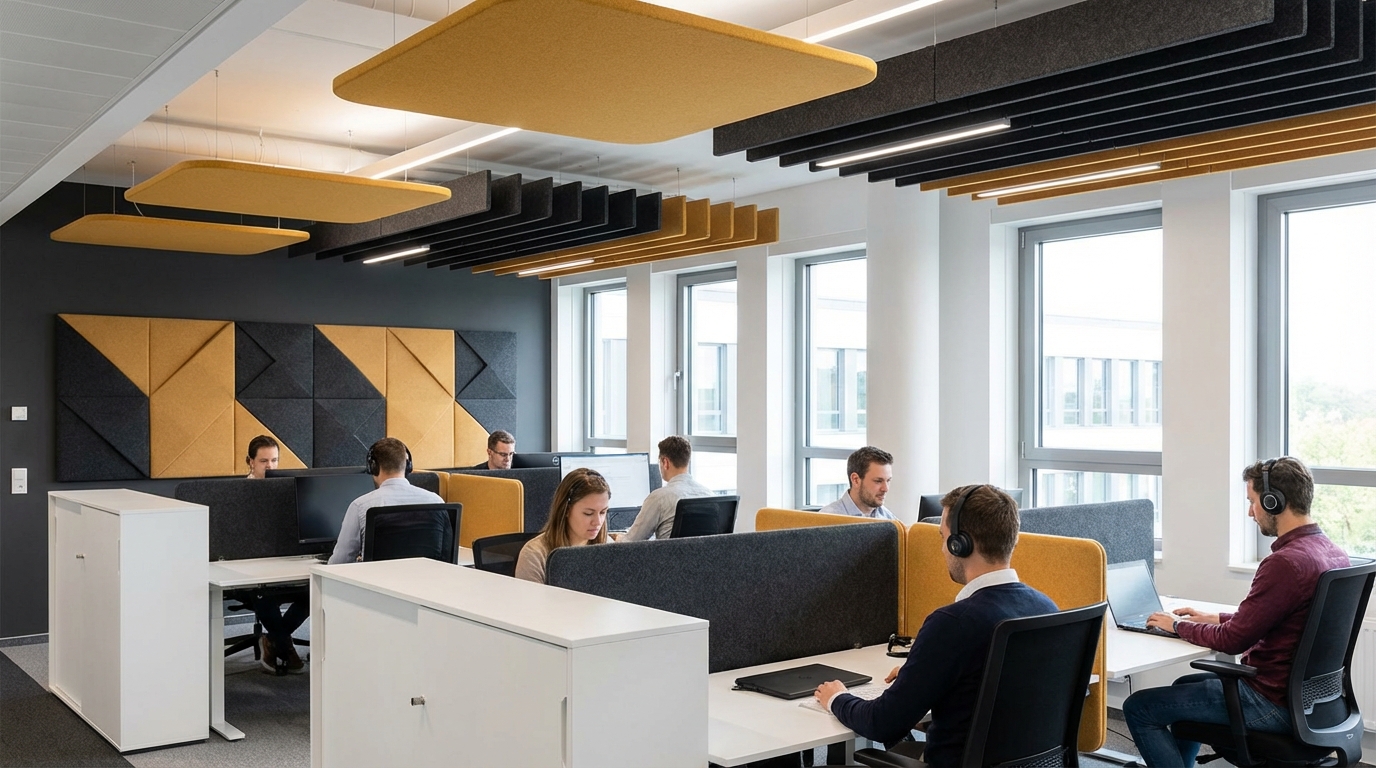
So, you are trying to reduce noise in your open‑plan office and turn that into a real business advantage.
You can cut noise in an open office with the right acoustic layout, materials, and behavior rules, and that can directly improve focus, sales, and staff retention.
Open offices are cheap to build and look modern, but speech noise, ringing phones, and video calls crush concentration. That hits productivity, increases mistakes, and pushes people to leave. When you fix the sound, you are not just making people “more comfortable.” You are protecting revenue and making your company a place where people actually do their best work.
Things you need to know:
- Noise in open offices is mostly about speech, not machines.
- People start losing focus when background noise passes roughly 55 dB.
- Sound masking, ceiling tiles, and desk screens work best as a system, not in isolation.
- Good acoustics lower error rates and increase task completion speed.
- Quieter offices help keep employees longer and lower burnout.
- Acoustic choices should align with your business goals, not just interior design trends.
- Small, low‑cost tweaks can deliver measurable performance gains.
“Noise is not just an annoyance. It is a hidden tax on every hour your team spends in the office.”
Why open‑plan offices get so noisy so fast
So, you are trying to figure out why your open‑plan office sounds like a cafeteria at 10 a.m. on a Monday.
The direct answer: open offices mix hard surfaces, many talkers, and no barriers, which lets speech travel far and stay loud.
A short version of the story: open layouts remove walls, which cuts construction costs and helps collaboration, but they also remove the main thing that blocks and absorbs sound. Add glass, concrete, and exposed ceilings, and you create a space where every conversation bounces around and distracts the whole floor.
The three main drivers of office noise
There are many sound sources, but three dominate in most open offices:
- Speech (meetings, collaboration, calls)
- Phones and alerts (desk phones, mobiles, notifications)
- Office equipment (printers, HVAC, coffee machines)
Among these, speech is the biggest problem for knowledge work. Your brain is wired to pay attention when you hear someone talking words you understand. That means “intelligible speech” is your true enemy, not just “noise level.”
Researchers often look at two ideas:
- Signal‑to‑noise ratio (SNR): How loud a voice is compared to the background noise around it.
- Speech Transmission Index (STI): How clear speech remains as it travels across the room.
If STI stays high across your floor, people can clearly hear conversations 10 meters away. That might seem good for team spirit, but it ruins concentration for anyone not in that conversation.
The 55 dB tipping point
Most open offices sit somewhere between 45 and 65 dB during the day. It does not sound extreme. There is no rock music playing. But the research is pretty stable:
- At around 45 dB, people can focus well for long stretches.
- At 50 to 55 dB, concentration starts to drop on complex tasks.
- Above 55 to 60 dB, error rates and stress go up.
Now add the “speech” factor. A single phone call can spike the local level and, more importantly, introduce words that someone 2 desks away can understand. That pulls their attention, even if they do not want it to.
“The worst noise in an office is not loud. It is distracting. One loud call can break the focus of ten quiet workers.”
The business case: why acoustics matter to revenue
So, you want to know whether acoustic solutions are just a “nice to have” or if they connect to real business outcomes.
They connect directly. Better acoustics:
- Improve focus and deep work time.
- Lower error rates in detailed tasks.
- Shorten call handling time in sales and support.
- Reduce sick days linked to stress and fatigue.
- Support hiring and retention in a tight talent market.
Noise, productivity, and real numbers
Let us be concrete.
Several studies on office noise show results along these lines:
| Effect of noise | Finding (typical range from studies) |
|---|---|
| Complex task performance | Up to 10-15% slower in noisy, speech‑rich spaces |
| Error rates (data entry, coding, etc.) | 3-7% more errors with distracting speech |
| Reported stress / fatigue | Higher in open noisy offices vs quiet or well‑treated spaces |
Now connect that to cost.
Imagine you have 50 knowledge workers:
- Average fully loaded cost per person: 80,000 dollars per year.
- Work days per year: about 220.
- Daily cost per person: about 360 dollars.
If poor acoustics knock productivity by even 5 percent, that is 4,000 dollars per person per year. For 50 people, that is 200,000 dollars a year.
“When you think of acoustic panels as ‘expensive decoration,’ you miss the point. They are often cheaper than the productivity you lose in a single quarter.”
Retention, hiring, and culture
Noise is one of the most common complaints in open offices. If your best people spend all day with headphones on, that is a signal. They are protecting themselves from an environment that fights their work.
This matters because:
- Quiet, focused spaces help senior staff stay longer.
- Good acoustic design is a selling point for candidates who expect hybrid or flexible work.
- Lower stress means fewer sick days and burnout cases over time.
None of this sits on a neat line in your profit and loss statement, but it shows up in turnover rates, recruitment costs, and project delays.
The three levers of acoustic control
So, you are trying to choose what sort of solution to pay for: panels, carpets, white noise, something else.
The direct answer: you manage office sound with three levers that work together:
- Absorption: Soften reflections so sound dies quickly.
- Blocking: Physically interrupt sound paths.
- Masking: Add controlled background noise to hide speech.
Think of them as layers, not options. The best results come when you use all three in the right mix.
1. Absorption: stopping the echo
Absorption reduces the “liveliness” of a room. The goal is to lower reverberation time, often called RT60, which is how long a sound takes to drop by 60 dB.
Open offices with bare ceilings and glass can have RT60 above 1 second. For speech‑focused work, many acoustic consultants aim for something closer to 0.5 seconds or less.
Common absorption tools:
- Acoustic ceiling tiles: High Noise Reduction Coefficient (NRC) tiles absorb sound that hits the ceiling.
- Wall panels: Fabric‑wrapped or PET panels on walls near talkative zones, meeting nooks, and corridors.
- Baffles and clouds: Hanging elements above work areas, especially where ceiling tiles are not possible.
- Soft finishes: Carpets, curtains, and upholstered furniture that add a bit more sound absorption.
If you can only do one thing in an echo‑heavy office, a good acoustic ceiling often gives the biggest improvement per dollar.
2. Blocking: interrupting sound paths
Blocking is about stopping sound from traveling unhindered from A to B. In open offices, you rarely add full walls, but you can interrupt direct lines of sight between mouths and ears.
Options include:
- Desk screens: 18 to 24 inch high screens between desks, at least partially made from sound‑absorbing material.
- High‑back furniture: Sofas, booths, or pods with high sides for ad‑hoc meetings and calls.
- Partial partitions: Low walls or bookcases that break up long open rows of desks.
- Phone booths: Enclosed units for calls and video meetings, placed in convenient locations.
Blocking does not completely isolate sound, but it reduces direct speech transmission and supports privacy.
3. Masking: adding the right sound
Sound masking sometimes confuses people. It is not about playing music. It is about adding a controlled, neutral background sound, usually with more energy in the speech frequency range, so that conversations fade into that background beyond a short distance.
Done right, masking:
- Makes speech less intelligible a few desks away.
- Reduces the distraction impact of conversations.
- Lets you raise the acceptable noise floor slightly without hurting focus.
You can install dedicated sound masking systems in the ceiling, tuned for your space. Background levels often sit around 45 to 48 dB, depending on your existing HVAC and room type.
“People do not need silence. They need a space where only the sounds near them matter.”
How to design acoustic zones that match your business
So, you are trying to connect acoustic planning to how your business actually works, not just what looks nice on a floor plan.
The direct answer: create distinct zones for focus, collaboration, and communication, and give each zone the acoustic treatment that fits its main activity.
Step 1: Map your work types
Start with a simple map of what people actually do, not just their job titles.
Ask:
- Which roles need long stretches of focus? (Developers, designers, analysts)
- Which roles talk a lot during the day? (Sales, support, customer success)
- Which teams need to collaborate in person often? (Product, marketing, project teams)
Then tag your floor area:
- Focus zones: Deep work, reading, writing, coding.
- Mixed zones: Some calls, some focus, moderate conversation.
- High‑talk zones: Sales, support, collaboration tables.
Step 2: Set acoustic targets for each zone
You do not need lab‑level numbers, but rough targets help guide choices.
| Zone type | Goal background level | Speech privacy target |
|---|---|---|
| Focus zone | Around 40-45 dB | Low intelligibility beyond 2-3 desks |
| Mixed zone | Around 45-50 dB | Conversations fade beyond short radius |
| High‑talk zone | 50-55 dB acceptable | Limit spill into focus areas and meeting rooms |
These numbers are general guidelines. The key is relative quiet in focus zones and controlled spread from high‑talk zones.
Step 3: Match treatments to zones
For each zone, think in terms of the three levers again.
Focus zones should get:
- High absorption (good ceiling tiles, wall panels, carpet).
- Some blocking (desk screens, partial partitions).
- Careful masking, if used, tuned to be gentle and stable.
Mixed zones should get:
- Balanced absorption and blocking, with a bit more tolerance for speech.
- Nearby enclosed rooms for calls that might get intense or long.
High‑talk zones need:
- Strong absorption around and above the talking areas.
- Physical separation from focus zones, not just a change in carpet color.
- Possibly stronger masking between them and quiet areas.
“Treat the floor like a small city. You would not put a library next to a nightclub. Your focus team should not sit next to your outbound sales team either.”
Practical acoustic solutions you can deploy
So, you want specific tools you can buy or install that make a measurable difference.
Let us break this down by intervention level: low, medium, and higher investment.
Low‑cost, quick changes
These do not turn a bad office into a great one, but they often deliver clear improvements fast.
- Desk placement: Avoid facing two rows of people directly toward each other across a wide open corridor. Rotate desks slightly or create clusters.
- Soft surfaces: Add area rugs under collaboration tables and in circulation paths. Use fabric‑upholstered chairs instead of hard plastic.
- Door policies: Keep doors on meeting rooms and phone booths closed, with clear signs.
- Quiet rules for nearby areas: Keep printers, shredders, and loud coffee machines away from focus zones.
- Behavioral norms: Simple guidelines like “Video calls belong in booths or rooms, not at desks” make a big difference.
Medium‑level interventions
These require some planning and budget but are still realistic in most offices.
- Suspended acoustic baffles or clouds in exposed ceiling areas, especially above busy circulation paths and collaboration spaces.
- Acoustic wall panels behind desks, near huddle areas, and along long reflective walls.
- Desk screens that are at least partly absorptive, not just glass.
- Phone booths or pods for calls and video conferences, spread across the floor so people actually use them.
- Dedicated quiet zones with higher acoustic standards and visible signage.
Higher investment, high return
These are usually part of a renovation or major redesign, but they often bring the best long‑term performance and business value.
- High‑NRC acoustic ceiling systems across key areas, paired with smart lighting layouts.
- Systematic sound masking installed and tuned by specialists.
- Re‑zoning of departments based on actual activity, moving loud teams further from quiet teams.
- Purpose‑built rooms for stand‑ups, Scrum meetings, and “war rooms” so those events do not flood the entire floor with noise.
Linking noise control to your metrics and business goals
So, you want to link acoustic decisions to actual business metrics instead of treating them like a design project.
The direct answer: tie sound improvements to productivity, sales, support performance, and HR outcomes, then track before and after.
Pick metrics that noise can influence
Here are some simple ones that tend to move with acoustic quality:
- Focus time per day: Measured with time‑tracking tools or surveys.
- Error rates: In data entry, order processing, or coding defects per release.
- Call center stats: Average handling time, first‑call resolution, call quality scores.
- Sales conversion: For roles that spend their day on the phone.
- Absence rates: Sick days per person per year.
- Turnover: Exit interviews that mention noise or office conditions.
Estimate ROI with a simple model
Create a basic before/after scenario.
Example:
- 100 employees in the office.
- Average total cost per person: 70,000 dollars per year.
- You implement a 60,000 dollar acoustic package (ceiling improvements, panels, phone booths, and masking).
- Staff surveys and productivity measures suggest a conservative 4 percent performance gain in noise‑sensitive tasks.
Value of that gain:
- 4 percent of 70,000 = 2,800 dollars per person per year.
- For 100 people, that is 280,000 dollars per year.
So, a one‑time 60,000 dollar spend returns its cost in well under a year if your assumptions are even roughly correct. And you keep the gains in later years.
“If you treated noise like a software bug that costs you 200,000 dollars a year, you would fix it fast. That is what acoustic work often looks like when you run the numbers.”
Tech, tools, and data for better acoustic decisions
So, you are trying to understand what technology can help you measure and manage office noise.
The direct answer: use simple measurement tools, sensor data, and sometimes building tech to track noise levels and feedback over time.
Simple measurement tools
You do not always need a full acoustic consultant to get a basic picture.
Options:
- Sound level meter apps on smartphones give rough dB readings. They are not perfect, but good enough for initial mapping.
- Consumer sound level meters are cheap and often accurate within a couple of dB.
- Spot checks throughout the day in different zones to build a noise map.
You can record readings like:
- Morning (9-10 a.m.).
- Midday (12-1 p.m.).
- Afternoon (3-4 p.m.).
Then log them by zone type.
Sensor‑based monitoring
For a more structured approach, some companies install small sensors that log sound levels over time. This gives:
- Heatmaps of noisy spots.
- Trends by day and week.
- Data to test before and after changes.
You can integrate sound data with usage data from meeting room booking systems, badge systems, or Wi‑Fi, to see when rooms are packed and how that affects noise.
Digital twins and smart buildings
Larger offices sometimes build a “digital twin” of their workspace: a model that tracks real‑time data from sensors, occupancy, temperature, and sound.
From a noise angle, this lets you:
- See how occupancy affects acoustic conditions.
- Adjust sound masking levels dynamically.
- Plan re‑stacking of teams based on actual behavior, not assumptions.
If that sounds complex, you do not have to start there. The key idea is simple: treat sound as a measurable variable, not a vague complaint.
Human behavior: ground rules that support the tech
So, you want your acoustic investments to work over time, not just in the first month.
The direct answer: pair physical solutions with clear etiquette that your leaders follow and model.
Set simple, clear norms
Keep them short and visible. For example:
- “Use phone booths or meeting rooms for calls longer than 2 minutes.”
- “No speakerphones in open areas.”
- “Treat focus zones like libraries: quiet voices, short conversations only.”
- “Take stand‑ups to collaboration zones, not between desk rows.”
Reinforce these norms in onboarding and team meetings. The rules only work if managers follow them too.
Support with design cues
People read the room. If you want quiet, design for it.
Ideas:
- Use softer colors and lower lighting in focus zones.
- Use more playful colors and lighting in collaboration zones.
- Place whiteboards and project tables in high‑talk zones, not in the middle of quiet desk areas.
This way, behavior and acoustics align.
Common mistakes when tackling office noise
So, you want to avoid spending money on acoustic work that fails.
The direct answer: do not over‑rely on a single solution, ignore behavior, or treat aesthetics as the main driver.
Here are patterns I see a lot:
- Only adding wall art: Nice to have, but a few panels on a wall rarely solve a serious noise problem.
- Glass everywhere: Glass looks clean, but it reflects sound. If you use much of it, pair it with more absorption elsewhere.
- Phone booths as decoration: If booths are too few, badly placed, or not well ventilated, people will not use them.
- No maintenance: Over time, seals break, doors stop closing softly, and masking levels drift. Check your setup once or twice a year.
- No measurement: Making changes without any before/after data means you cannot prove value to leadership.
A phased plan you can start next week
So, you are trying to figure out how to start without redesigning your entire office.
Here is a simple phased approach you can use in almost any space.
Phase 1: Listen, measure, and adjust behavior
- Run a short survey asking staff where and when noise bothers them most.
- Do simple sound level checks in your key zones at three times of day.
- Put in place two or three clear etiquette rules (for calls, speakerphones, and video meetings).
- Relocate especially noisy devices away from focus areas.
This phase costs very little and already cuts some of the worst issues.
Phase 2: Treat the worst zones
- Identify one or two “red” zones with the highest noise and highest business impact (for example, a sales pod near developers).
- Add absorption (panels, baffles, rugs) and some blocking (screens, partitions).
- Introduce or improve access to phone booths or small rooms near those zones.
- Measure again, and track any changes in performance metrics that are easy to access.
Phase 3: System‑level fixes
- Plan for an acoustic ceiling upgrade in your next renovation cycle.
- Implement a sound masking system across open areas.
- Re‑zone departments based on the activity map you built.
- Set targets and track them: focus time, call metrics, survey scores, and turnover.
At this point, noise management becomes part of how you run the office, not a one‑off project.
“Treat acoustics like you treat your tech stack. You do not fix it once and forget it. You keep adjusting it as the way you work changes.”
A simple practical tip you can act on this week: walk your floor twice in one day with a basic sound level app, write down readings in each zone, and ask three people in each zone, “What is the most distracting sound for you here?” Then pick one of those sounds and solve just that one.