
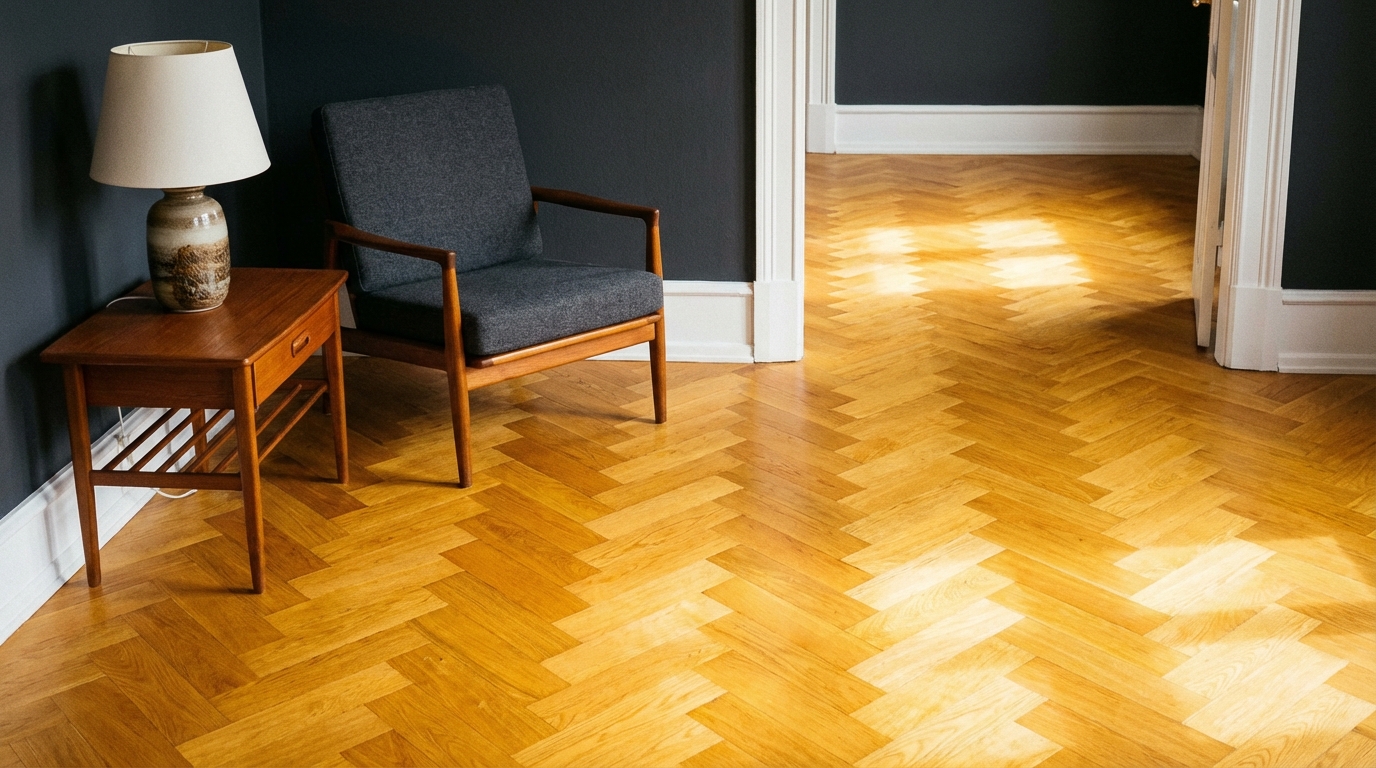
So, you are trying to restore a mid-century parquet floor and bring back those vintage vibes without ruining the wood or your sanity. The short answer is: yes, you can restore it, but you need patience, the right tools, and a plan that respects how parquet is built.
Parquet is less forgiving than straight floorboards. You are dealing with small blocks, thin wear layers, and old adhesives. If you treat it like modern plank flooring, you can sand right through the top and destroy the pattern. If you slow down, test in small areas, and follow a clear sequence, you can get a floor that looks close to what it was in the 50s or 60s.
Things get easier when you break the project into stages: inspection, repairs, cleaning, sanding (or alternatives), staining, finishing, and ongoing care. Each stage has traps you want to avoid.
Here are the key points before we go step by step.
- Old parquet often has a thin wear layer; aggressive sanding can ruin it.
- Check for loose, cupped, or missing blocks before any heavy work.
- Moisture, subfloor movement, and old adhesive remain the main enemies.
- You can refresh parquet with light sanding or chemical stripping instead of full sanding.
- Finish choice (oil vs polyurethane vs hardwax oil) affects look, maintenance, and repair later.
- Test everything in an inconspicuous corner first: cleaners, stain, and finish sheen.
- Good dust control and vacuuming matter more than people think for a clean, smooth finish.
- Repairs should match pattern, species, and grain direction; mismatches stick out forever.
- Do not skip cure time on finishes before moving furniture back.
- Protect the floor with pads, rugs, and regular cleaning to keep that mid-century look longer.
What makes mid-century parquet different
So, you are trying to understand what you are actually working on before you touch a sander. That is smart. The direct answer is: mid-century parquet is usually thin, block-based hardwood glued to a subfloor, often with tar-like adhesive, and it reacts badly to heavy sanding and moisture.
Parquet from the 40s, 50s, and 60s was installed for looks and status. It gave a geometric, modern feel. It often used:
- Small oak or maple blocks, sometimes walnut accents.
- Patterns: herringbone, basket weave, finger block, brick, or mosaic.
- Old glue: bitumen, cutback adhesive, or early urethane glues.
- Concrete or plywood underneath, sometimes with old felt layers.
Here is a simple comparison many homeowners find helpful:
| Feature | Mid-century parquet | Standard plank floor |
|---|---|---|
| Board size | Small blocks/strips in patterns | Long boards, parallel |
| Wear layer thickness | Often 3-5 mm | Usually 5-8 mm (solid) |
| Sanding risk | High risk of sanding through | Lower, more margin for error |
| Movement | More joints, more places to loosen | Fewer, longer pieces |
| Repair difficulty | High, pattern matching needed | Moderate, swap boards |
The main takeaway: treat it gently. Once you sand through the thin top of those blocks, the pattern is gone and you cannot bring it back without replacing sections.
Step 1: Inspect before you touch anything
So, you are trying to figure out where to start. The direct answer: start by inspecting every square foot, looking for loose blocks, water damage, and hollow spots.
Think like a detective for 30 to 60 minutes. It saves days later.
Check for loose or hollow blocks
Walk the floor slowly. Listen.
You can tap with a coin or the back of a screwdriver. Mark suspicious spots lightly with masking tape.
Look for water and cupping
Water ruins parquet in a specific way:
- Cupping: edges of blocks higher than the center.
- Crowning: centers higher than edges.
- Black stains: often from long-term moisture and iron in nails or old furniture.
- Powdery or crumbling wood: possible rot.
Areas near radiators, exterior doors, and under old rugs usually tell you the real story of the house.
Check if it is solid parquet or engineered
This part matters for how much sanding you can do.
If you can see the side of a block at a threshold, you might see layers. If you are unsure, err on the safe side and assume the wear layer is thin.
Check the finish that is already on it
You have three main suspects:
- Old oil or wax: usually dull, can feel slightly greasy, responds to mineral spirits.
- Polyurethane: glossier, forms a clear film on top, does not soften with mineral spirits.
- Old shellac or varnish: can flake or alligator, often amber in color.
A small test spot helps:
Put a few drops of denatured alcohol on a hidden patch. If the finish softens quickly, it is likely shellac. If lacquer thinner softens it, you might have lacquer. No reaction means likely poly or similar film finish.
Knowing what is on there helps when you pick new finishes and cleaning methods.
Step 2: Decide your restoration level
So, you are trying to decide how far to go: deep restoration or light refresh. The direct answer: choose between three levels based on damage and your budget.
The three levels:
- Clean and refresh only.
- Screen and recoat.
- Full sand and refinish (most aggressive).
Option 1: Clean and refresh only
This works if:
- The finish is intact, only dull and dirty.
- Scratches are light, mostly surface level.
- No gray raw wood showing through.
You would:
- Deep clean with a wood floor cleaner.
- Degrease with a mild solvent if there is old wax buildup.
- Apply a compatible refresher or maintenance oil, depending on the current finish.
This keeps more of the original patina, which many mid-century fans prefer.
Option 2: Screen and recoat
Screening means lightly abrading the existing finish, not the wood.
You might pick this if:
- Finish is scratched but not worn through.
- You like the current stain color.
- No deep gouges or serious water damage.
The process:
Scuff the surface with a buffer and a fine screen (such as 120 grit), vacuum thoroughly, tack cloth, then apply new coats of compatible finish.
This adds protection and evens out sheen but does not fix deep defects.
Option 3: Full sand and refinish
You go this route when:
- Finish is worn through to bare wood in many areas.
- Color is uneven or too orange and you want to change it.
- There are stains, old pet damage, or roughness you cannot live with.
This is also the riskiest for parquet because of how thin the wear layer can be.
Step 3: Repairs before sanding
So, you are trying to address loose or damaged blocks before any sanding or finishing. The direct answer: fix structure first, finish later.
Sanding a loose floor just shaves moving pieces and can break edges. That is like painting over peeling paint.
Re-gluing loose blocks
If blocks move under light pressure:
- Carefully pry them up with a thin chisel or putty knife.
- Scrape old adhesive from both the back of the block and the subfloor.
- Check moisture levels in the subfloor if you suspect water problems.
- Use a modern adhesive rated for wood parquet over your specific subfloor (concrete vs wood).
- Press blocks back in place, align pattern, and weight them until cured.
If you see old black tar-like adhesive, avoid sanding it heavily. Some old mastics may contain asbestos. If you suspect that, consult a pro for testing before disturbing it.
Replacing missing or ruined blocks
When blocks are cracked deeply, rotten, or burned, replacement is better than trying to fill them.
You need to match:
- Wood species (often oak, sometimes maple, rarely walnut or mixed).
- Dimensions (length, width, and thickness).
- Grain orientation and pattern direction.
You can:
- Salvage from a closet or under a built-in cabinet.
- Buy reclaimed mid-century parquet off auction sites or salvage yards.
- Use new milled blocks that match, though color and grain will differ at first.
Do not rely on stains to fix a poor species match. The difference in grain will still reveal the patch, even if the color is close.
Fixing gaps and hairline spaces
Small seasonal gaps are normal. Parquet in old houses breathes.
For hairline gaps:
- Save fine sanding dust from your own floor (same wood, same color).
- Mix it with a compatible wood filler or clear binder to form a paste.
- Press into gaps after the first coarse sanding pass.
- Sand flush once dry.
Avoid filling wide gaps that move a lot. Those can crack out again as seasons change.
Step 4: Cleaning and prep before finish work
So, you are trying to get the surface ready without embedding dirt into the new finish. The direct answer: thorough dry cleaning first, then careful wet cleaning with the right products.
Dry cleaning: vacuum and dust
Do not start with water.
- Vacuum with a soft brush head. Get into corners and between blocks.
- Use a microfiber dust mop to lift fine particles.
- Check for nails, staples, or grit that can scratch during sanding.
A single forgotten nail can tear a sanding pad or leave deep marks.
Wet cleaning: gentle and targeted
Use a cleaner made for wood floors, not a generic soap.
- Lightly dampen, not soak, your mop.
- Work in small sections.
- Dry immediately with a clean cloth if you see standing water.
For greasy buildup or old wax:
Test a small patch with mineral spirits and a white cloth. If you pick up brown residue, you probably have old wax and grime. Work slowly and ventilate well.
Never use steam mops on parquet. They can soften glue and warp blocks.
Step 5: Sanding parquet without destroying it
So, you are trying to sand a mid-century parquet floor safely. The direct answer: use a lighter touch, finer grits, and multi-directional techniques instead of aggressive belt sanding along the grain.
Choosing sanding tools
For mid-century parquet, the safer setup often looks like this:
- Drum or belt sander with fine grits, used very carefully, or
- Better yet, a three-disc orbital floor sander (sometimes called a planetary sander).
- Edge sander for corners and walls.
- Detail sander or scraper for tight spots.
The multi-disc machines are more forgiving because they sand in overlapping circles rather than in a straight line.
Grit sequence that respects thin parquet
A common mistake is starting with 24 or 36 grit. That is often too aggressive.
A safer starting sequence for many parquet floors:
| Stage | Typical grit | Purpose |
|---|---|---|
| Initial pass | 60 or 80 | Remove old finish gently |
| Mid pass | 80 or 100 | Refine scratches, flatten lightly |
| Final pass | 100 or 120 | Smooth surface for finish |
If you are hitting bare wood quickly with 80 grit on your first pass, stop and reassess. That means your wear layer is very thin and full sanding may not be safe.
Always sand with the pattern in mind. With herringbone, for example, a diagonal approach can help keep scratch patterns less obvious, but do not fight the machine across tight corners.
Hand sanding and scraping edges
Edges and borders around vents and doorways show the most. Take your time.
- Use an edge sander with matching grit to your main passes.
- Feather the edge sanded areas into the field so there is no step or halo.
- Use a hand scraper in tight corners, then follow with sanding sponges.
Check with raking light (light at a low angle across the floor) to spot swirl marks or ridges before you move to finer grits.
Dust control
Good machines have dust collection bags or ports.
- Vacuum between each grit change.
- Use a tack cloth or slightly damp microfiber after the final sanding.
- Seal vents or cover doorways to reduce dust spread to the rest of the home.
The cleaner your surface, the smoother your finish.
Step 6: Choosing the right finish for vintage parquet
So, you are trying to pick a finish that keeps the mid-century character and survives modern life. The direct answer: pick between oil, polyurethane, or hardwax oil, based on your tolerance for maintenance and your taste for sheen and depth.
Finish options overview
Here is a simple comparison:
| Finish type | Look | Durability | Maintenance | Repair style |
|---|---|---|---|---|
| Penetrating oil | Warm, low sheen, natural | Moderate | Needs periodic re-oiling | Spot repair friendly |
| Polyurethane (oil-based) | Richer color, can amber | High | Low, but full recoats when worn | Spot repairs visible |
| Polyurethane (water-based) | Clear, less yellowing | High | Low, strong film | Spot repairs visible |
| Hardwax oil | Matte/satin, natural | Good, if maintained | Regular care with soaps/oils | Localized repairs easier |
Penetrating oil: more “vintage” feel
Oil brings out grain and gives a soft, low-sheen look people often associate with older parquet.
Pros:
- Very warm look, keeps the wood look, not a plastic-like film.
- Easy to touch up small areas.
- Feels pleasant underfoot.
Cons:
- Needs periodic re-oiling, especially in traffic zones.
- Less surface protection against standing water.
- Drying and curing can be slower.
Polyurethane: tougher film protection
Poly creates a hard protective film on top.
Oil-based poly:
- Warmer color, slight ambering, can match older tones.
- Longer open time, easier to flow out.
- Stronger smell and longer cure time.
Water-based poly:
- Clearer color, keeps oak lighter, less yellow shift with time.
- Faster drying, less odor.
- Sometimes needs a sealer coat to avoid grain raise.
For mid-century parquet, many people like a satin or matte sheen rather than high gloss. Gloss shows every scratch and particle.
Hardwax oil: hybrid approach
Hardwax oils penetrate and also leave a thin flexible layer.
Pros:
- Natural look, lower sheen, pleasant feel.
- Repairs and localized maintenance easier than full poly.
- Generally more forgiving to spot wear.
Cons:
- Needs care with special soaps and refreshers.
- Initial application can be finicky if you are new to it.
If your goal is to keep a “museum perfect” finish for decades without touch-ups, choose a strong poly. If you want something closer to old European parquet with character and repairability, look at oils or hardwax oils.
Step 7: Stain or keep natural
So, you are trying to decide whether to stain your mid-century parquet or leave the natural tone. The direct answer: stain only if you are sure you dislike the natural color, because stain on parquet is harder to apply evenly.
Parquet has many grain directions. Stain can absorb unevenly, making blotches.
When stain makes sense
Stain can help if:
- The floor has mismatched replacement blocks and you want to unify tone.
- You are dealing with heavy ambering from old finishes and want a deeper, more even color.
- You want to shift a very light or very red floor toward a more neutral brown.
Always test multiple stains:
- On scraps, if you have them.
- In a closet or behind where a piece of furniture will live.
Apply, let it sit, wipe, then wait for it to dry fully. Stains change a bit as they cure.
Staining tips for parquet
- Work in small, manageable zones so stain does not sit too long.
- Apply with a pad or cloth, then wipe off in the direction of the dominant pattern.
- Keep a wet edge to avoid lap marks.
- Avoid flooding joints with stain; it can bleed and create dark lines.
Do not use stain as a way to “hide” deep pet stains or water marks. Those often telegraph through, just darker. Sanding or board replacement is the real fix.
Step 8: Applying the finish
So, you are trying to get a smooth, professional-looking finish. The direct answer: use thin coats, consistent technique, and respect drying and cure times.
General prep before the first coat
- Vacuum very carefully, including walls and baseboards.
- Tack cloth or wipe with a slightly damp microfiber to pick up fine dust.
- Check for any missed scratches with a raking light.
Once you start finishing, dust is your enemy. Close windows if there is wind, keep pets and people out.
Applying oil or hardwax oil
The general rhythm:
- Apply thinly with a roller, trowel, or pad, depending on product instructions.
- Work along the pattern, keeping coverage even.
- After the recommended time, buff or wipe off excess to avoid sticky spots.
- Let it dry fully, then sometimes repeat for a second coat.
If the product calls for buffing:
Use a floor buffer with white or beige pads to work the oil into the wood, then buff off excess. The floor should not look wet and thick; it should look lightly moistened and even.
Applying polyurethane
Film finishes need a methodical approach.
- Start with a sealer if your system calls for it.
- Apply poly with a T-bar applicator or high-quality brush/roller.
- Work with the light and pattern so you can see where you have been.
- Avoid overworking; let the finish level on its own.
Between coats:
- Indoor temperature and humidity affect drying. Follow the product’s wait time.
- Lightly abrade (screen) with very fine grit or a sanding pad to remove nibs.
- Vacuum and tack before the next coat.
Most homes do well with:
- 2 to 3 coats of poly on top of the bare wood or sealer.
Too many coats can start to look like plastic, which fights that vintage vibe.
Step 9: Cure time and first weeks of care
So, you are trying to know when you can live on your “new” vintage floor. The direct answer: light foot traffic after drying, rugs and heavy furniture only after full cure.
Dry time and cure time are not the same.
- Dry: when you can walk gently in socks without leaving marks.
- Cure: when the finish reaches full hardness and chemical cross-linking is done.
Typical ranges:
- Water-based poly: light traffic in 24 hours, rugs in 7 to 14 days.
- Oil-based poly: light traffic in 24 to 48 hours, rugs in 14 to 30 days.
- Oils and hardwax oils: walkable within 24 hours, careful with heavy items for several days.
Avoid plastic or rubber-backed rugs for the first weeks. They can trap solvents or moisture and imprint on the fresh finish.
Put felt pads under every chair and table leg. If you have rolling chairs, consider a mat designed for hardwood or change to softer casters.
Long-term care for restored parquet
So, you are trying to keep the floor looking good once the hard work is done. The direct answer: gentle regular cleaning, moisture control, and quick reaction to scratches.
Daily and weekly habits
- Dry dust mop or vacuum with a hardwood floor setting.
- Wipe spills quickly, do not let water sit.
- Use walk-off mats at entries to reduce grit.
Avoid:
- Abrasive cleaners or pads.
- “All-purpose” floor cleaners that leave residues.
- Waxing a poly finish unless you plan never to recoat it properly.
Seasonal checks
Twice a year:
- Inspect for new gaps or movement, especially near radiators and exterior doors.
- Check humidity levels. Aim for a moderate indoor range to reduce seasonal movement.
- Refresh maintenance oils or soaps if you used oil or hardwax oil finishes.
Dealing with scratches and dents
Small surface scratches:
- With poly: a light buff and recoat over a full area, not just a single scratch, helps blend.
- With oil/hardwax: light sanding of the damaged spot and reapplication often works.
Deeper dents:
Sometimes you can raise small dents in solid wood with a damp cloth and a warm iron, but be cautious on finished floors. Always test in a hidden spot; some finishes might turn white or haze with direct heat and moisture.
Deep gouges that hit bare wood usually need localized sanding and touch-up, or even block replacement if they cut through pattern edges.
Tech perspective: tools, data, and smart planning
So, you are trying to bring a bit of structure and tech thinking into a very physical project. The direct answer: use basic measuring tools, moisture meters, and planning apps to lower risks and track progress.
Moisture meters and why they matter
A simple wood moisture meter is cheap compared to floor repairs.
Use it to:
- Check that the wood is at a stable moisture level before sanding and finishing.
- Compare readings in problem areas vs healthy areas.
- Validate if a suspected water leak is still active.
If subfloor moisture is high, fixing the source (leak, poor ventilation, missing vapor barrier) comes before any cosmetic work.
Documenting the floor condition
Before you start:
- Take clear photos of all damaged zones.
- Sketch simple floor plans and mark problem spots.
- Keep notes on the products and grits you used.
It might feel like overkill, but if you need to troubleshoot later, those notes help you or any professional you bring in.
Budgeting time and cost
You can roughly estimate:
| Task | DIY time (per 200 sq ft) | Main costs |
|---|---|---|
| Inspection & repairs | 4-10 hours | Adhesive, replacement blocks, tools |
| Cleaning & prep | 2-4 hours | Cleaners, pads, vac filters |
| Sanding | 6-12 hours | Machine rental, abrasives, dust bags |
| Stain & finish | 4-8 hours (plus drying) | Stain, finish, applicators |
Knowing this up front helps you plan weekends and avoid rushing finish coats late at night when you are tired.
When to call a professional
So, you are trying to decide if you should go all DIY or bring in help. The direct answer: bring a pro in if you suspect asbestos in adhesive, have severe cupping or loose sections, or if the wear layer looks paper thin.
Signs you should at least get a consultation:
- Extensive hollow sounds across large areas.
- Blocks lifting in clusters, not just individual pieces.
- Black, tar-like adhesive under blocks, especially in older buildings.
- Major unevenness that would need heavy sanding to flatten.
One practical approach many homeowners take:
Handle cleaning, small repairs, and planning yourself, then hire a pro for the actual sanding and finishing of the parquet, which is the highest risk part.
You still save money doing prep while reducing the chance of irreversible sanding mistakes.
Bringing back the “vintage vibes” in practice
So, you are trying to keep the floor looking mid-century, not brand new and generic. The direct answer: keep the pattern visible, avoid overly dark stains, aim for satin or matte sheen, and do not erase every sign of age.
Some practical ideas:
- Choose a finish that highlights grain rather than masking it.
- Accept tiny imperfections that show history, while fixing structural problems.
- Aim for a color that fits your furniture and walls, but also respects the wood’s natural tone.
- Use rugs in places where wear will be highest, while leaving feature areas bare so the pattern can be seen.
One last practical tip: before you commit to a full-floor approach, create a “sample zone” about 2×2 feet in a low-visibility corner. Run through your exact cleaning, sanding, stain, and finish steps there. Live with it for a few days. If you still love the look in different light and at different times of day, then repeat that process across the rest of your parquet.