
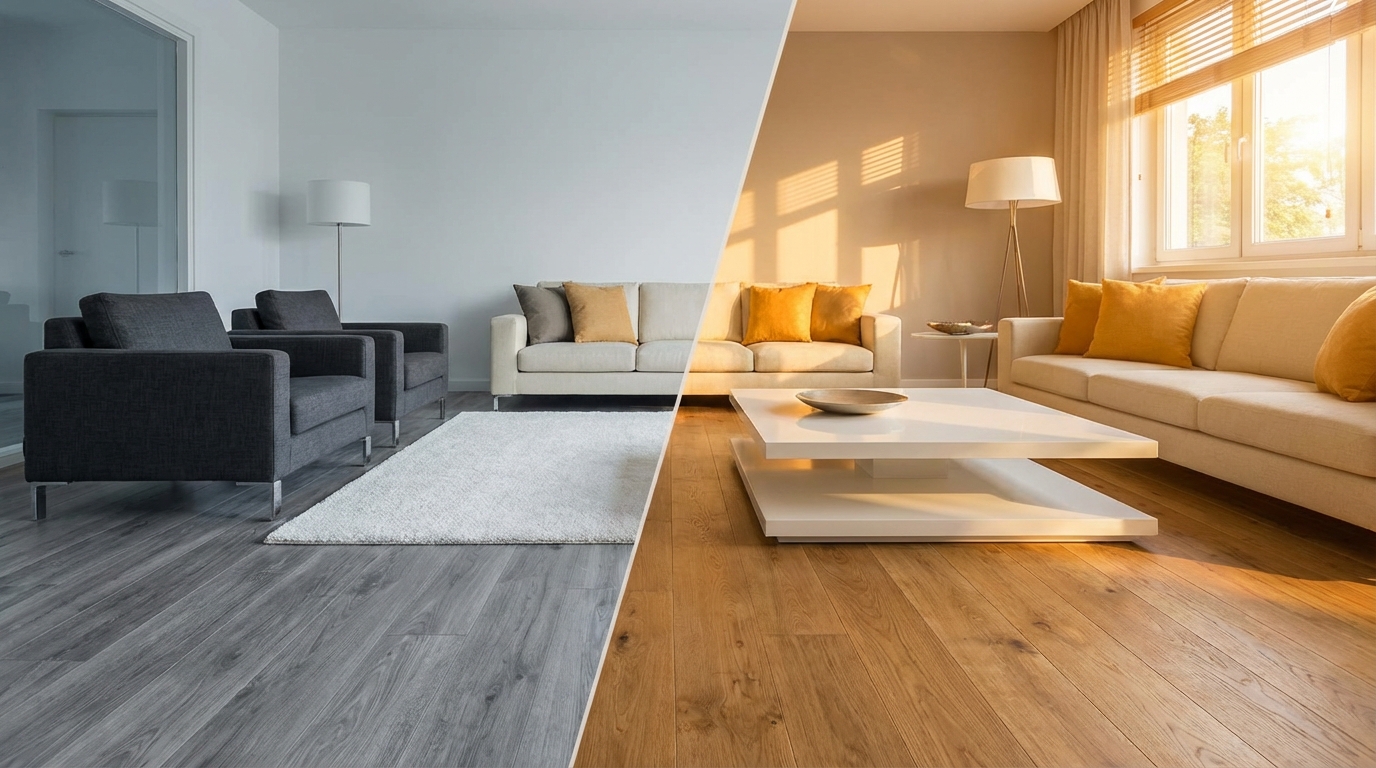
So, you are trying to figure out if gray flooring is finally over. Short answer: the gray flooring trend is fading, but it is not dead, and in some cases it still makes a lot of sense.
The real story is more nuanced. Design trends move in cycles. For years, gray wood and gray vinyl dominated home photos on Pinterest and Instagram. Now buyers, designers, and even big-box retailers are moving toward warmer tones, natural wood looks, and softer, more organic palettes. Gray is shifting from “default choice” to “very specific design choice.”
Things you need to know:
- Pure cool gray floors are less popular with buyers than they were 5 to 7 years ago.
- Warmer neutrals (greige, natural oak, honey, light brown) are trending up.
- Gray is polarizing in resale; some buyers love it, others see it as “dated 2018.”
- Real estate listings with very cold gray flooring can sit longer in some markets.
- If your home style is modern, coastal, or industrial, gray can still work well.
- Lighting, wall color, and furniture matter more now to “update” existing gray floors.
- You do not always have to rip out gray floors; there are design tricks to balance them.
- If you are installing new floors, soft warm tones are a safer long-term bet than cool gray.
How gray flooring became such a big thing
Gray flooring did not just appear out of nowhere. It grew out of a few overlapping design shifts:
- People moved away from red and orange oak that screamed “1990s suburban.”
- Open concept layouts needed a calm base that worked with white kitchens and stainless appliances.
- Social media photos loved anything that looked “crisp” and “clean” on camera.
- Manufacturers pushed gray vinyl plank and laminate because it sold well.
For a long run, gray felt fresh. It made spaces feel more modern, it hid some dirt, and it matched black, white, and chrome pretty easily.
> When a color suddenly seems to be in every listing photo, every builder model, and every influencer post, you are not just seeing taste; you are seeing mass production and marketing at work.
A big piece of the gray flooring wave was luxury vinyl plank (LVP) and laminate. These products were:
- Cheaper than solid hardwood.
- Water resistant for kitchens and basements.
- Easy for builders to install at scale.
Manufacturers leaned into gray because it was a simple, repeatable design. One “weathered gray oak” pattern could fit an entire subdivision.
What has changed: why gray floors are losing steam
So what shifted? Several trends are pushing gray out of the spotlight.
1. People are tired of cold, flat spaces
For years, home photos were full of gray floors, gray walls, white kitchens, and cool lighting. The rooms looked clean, but not always comfortable.
Designers started hearing the same feedback from clients:
- “My house feels cold.”
- “It looks like a rental.”
- “It is pretty, but it does not feel like home.”
> When people spend more time at home, they start to care less about a room that photographs well and more about a room that feels good at 9 p.m. on a Tuesday.
Warmer wood tones help with that. Honey oak, natural white oak, and light brown floors reflect warmer light, which softens the whole room.
2. Wall colors and cabinets are warming up
Gray flooring rode on the back of gray walls like “Agreeable Gray” and “Repose Gray.” Now, paint trends are moving to:
- Warm whites (cream, ivory, off-white).
- Greige tones (a mix of gray and beige).
- Muted earthy colors (sage, clay, taupe).
At the same time, cabinet trends shifted too:
- White shaker cabinets are still common, but natural wood and light stained cabinets are growing.
- Black or charcoal cabinets with warm wood floors are popular on social media.
Pure cool gray floors fight with these warmer elements. The room starts to feel split in half: warm walls, warm furniture, cold floor.
3. Resale data and agent feedback
Real estate agents and stagers have been signaling this shift for a while.
Many agents report that:
- Buyers link very cool gray floors with the late-2010s trend cycle.
- Homes with softer wood tones tend to photograph more inviting.
- Overly gray interiors sometimes lead buyers to budget for “future updates.”
No, there is not one magic data set that can say “gray floors reduce your selling price by X percent.” Design does not work that cleanly.
But you can look at patterns: national new-build communities that used to install mostly cool gray LVP now promote:
- Natural oak looks.
- Light warm beige or greige planks.
- Subtle, neutral grain instead of high-contrast gray streaks.
Builders change what they install when buyers change what they want.
4. The pendulum effect in design
Design often swings like a pendulum.
- Heavy reds and golds in the 90s.
- Dark espresso floors in the mid 2000s.
- Cool gray everywhere in the 2010s.
Now the pendulum is swinging back toward the middle: more natural, human, in-between tones.
> If a color trend dominates for almost a decade, the next big shift is rarely another extreme. People go back toward neutral middle ground.
Gray is not vanishing, but the extremes (very blue-gray, very cool-toned, high-contrast “weathered barn” looks) are dropping in demand.
Gray flooring today: what is actually happening
Instead of thinking “gray is over,” it is more accurate to say “the role of gray is changing.”
Gray is moving from default to niche
Five years ago, a lot of homeowners walked into a flooring store and said:
> “Show me your gray planks.”
Now, they are more likely to say:
> “Show me light neutrals that will still look good in 10 years.”
That shift matters.
Cool gray planks with heavy blue undertones are losing shelf space. In their place you will see:
- Greige planks (gray + beige).
- Natural oak looks with subtle gray undertones.
- Warm, desaturated browns that are not too yellow or orange.
So yes, the old “builder gray” look is fading.
Gray flooring is still strong in modern and industrial styles
Gray is not gone in:
- Urban lofts.
- Modern minimalist apartments.
- Industrial-style spaces with concrete, brick, and black metal.
In those cases, gray floors can still be the right call. They echo concrete. They keep the palette controlled and simple.
If you love:
- Black window frames.
- Matte black hardware.
- Exposed brick or concrete walls.
Then a gray floor with the right undertone can still look sharp.
Warmer gray and greige are replacing cold gray
This is the subtle, but key, shift.
Instead of icy, blue-leaning grays, buyers lean toward:
- Greige (a soft mix of gray and beige).
- Light taupe wood looks.
- Warm gray with brown or cream undertones.
These floors still feel neutral, but they play nicer with:
- Warm white walls.
- Natural wood furniture.
- Leather, linen, and woven textures.
> Most homeowners do not actually want “gray” or “brown”; they want a floor that stays quiet while their furniture and art change over time.
Greige does that job better than cold gray for many spaces.
If you already have gray flooring: what now?
Here is the big practical question: if your floors are gray, are you stuck?
No.
You do not have to rip everything out. You just need to design around it more intentionally.
1. Identify your gray undertone
Not all gray floors are the same. Some lean:
- Blue (cooler, almost silver).
- Green (cool, but a bit softer).
- Purple (can read “stormy”).
- Brown (greige, warmer).
Test this by holding a pure white sheet of paper next to your floor in natural light, then trying small samples of:
- Soft beige.
- Warm white.
- Cream.
- Taupe.
You will quickly see which way your floor shifts.
> Once you know your undertone, you can stop guessing at paint colors and fabrics that clash and start choosing ones that support the floor.
2. Warm up the space with textiles and furniture
The easiest way to pull gray floors forward into the current cycle is to add warmth elsewhere:
- Use warm area rugs: oatmeal, camel, cream, muted patterns.
- Add wood furniture in light to medium tones (oak, ash, walnut).
- Bring in fabrics like linen, boucle, wool blends.
- Use warm metals like brass, bronze, or aged gold for hardware and lamps.
If the floor reads very cool, think about adding at least one clearly warm element in each zone:
- A caramel leather sofa in the living room.
- Wood counter stools in the kitchen.
- A warm-toned headboard in the bedroom.
3. Adjust wall color to balance the floor
This one move can completely change how modern or dated gray flooring feels.
If your walls are:
- Cold blue-gray.
- Very stark white with a cool undertone.
Try shifting to:
- Soft white with a warm base.
- Light greige if you like a bit of color.
- Pale beige or taupe for a cozier look.
> When you warm up the vertical surfaces, the cool floor stops feeling like the boss of the room and becomes just one element among many.
Paint is cheaper than new flooring and has huge visual impact.
4. Use contrast on purpose
If you lean into contrast, gray floors can still look current.
For example:
- Cool gray floor + warm white walls + black accents + natural wood furniture.
- Light gray floor + deep green walls + warm brass lighting.
The key is not to let everything sit in a flat gray scale. Add clear, intentional hits of:
- Warm wood.
- Deep color.
- Soft texture.
5. When to consider refinishing or replacing
If you have:
- Solid hardwood that has been stained gray.
- Engineered hardwood with a thick enough wear layer.
You can often sand and restain to a warmer tone.
This can make sense if:
- You are planning a full remodel anyway.
- You are preparing to sell in a market where buyers clearly prefer natural wood tones.
- Your gray floor is very dark or very cool and clashes with everything else you want.
If you have LVP or laminate in a strong gray pattern, replacement is the only way to change the tone of the floor itself, but do the math first:
- What is your timeline in the house?
- Will the budget be better used on kitchens, baths, or lighting?
- Can you get 3 to 5 more years by updating paint, furniture, and decor instead?
Sometimes improving lighting and walls gets you 80 percent of the way there at a fraction of the cost.
If you are choosing new flooring: should you still pick gray?
Now, if you are still in the shopping phase and asking, “Should I install gray flooring in 2026?” here is how to think about it.
Questions to ask before committing
- What style do you actually like long term? Modern, traditional, coastal, something else?
- How long do you plan to stay in this home?
- Is resale a top priority, or is this more about your daily happiness?
- What colors do you naturally buy in furniture and textiles?
> When your floor matches the kind of items you are always drawn to, it will feel current to you longer than any trend article predicts.
If your answers lean toward minimal, cool-toned, black-and-white, industrial, then a well-chosen gray or greige can still work.
If your answers lean toward cozy, layered, natural, earthy, then a warm neutral floor is usually a better base.
What is trending now instead of pure gray
You will see a few strong directions in new collections:
| Floor Tone | How it looks | Why people pick it |
|---|---|---|
| Light natural oak | Pale beige, soft grain, not too yellow | Feels bright, works with many styles, ages well |
| Greige wood | Mix of gray and beige, very neutral | Bridges warm and cool decor, softer than cold gray |
| Warm light brown | Honey to light caramel, natural wood look | Adds warmth, still feels clean and modern |
| Medium brown | Richer tone, visible grain | Classic, hides dirt well, works in larger spaces |
| Concrete-look gray | Flat, modern, often large format tile | Suited to modern / industrial kitchens and lofts |
You can see gray is still there, just in more targeted uses.
When gray flooring still makes sense
Gray can still be the right choice when:
- Your home has modern or industrial architecture.
- Your windows bring in very warm sunlight and you want to balance it.
- You are pairing it with strong, warm elements (wood, leather, brass).
- You genuinely like the look and are not just following trend boards.
If you go gray now, aim for:
- Soft gray or greige, not icy blue-gray.
- Subtle, natural wood pattern, not high-contrast streaks.
- A mid-range tone that hides dirt but does not feel heavy.
> The more “real wood” your gray floor looks, and the less “pattern printed on vinyl,” the longer it tends to feel relevant.
When to skip gray for something warmer
You might want to skip gray if:
- Your walls and furniture already lean cool and the house feels flat.
- Your market strongly favors warm floors for resale.
- You love vintage, cottage, or traditional styles.
- You plan to use a lot of earthy tones, terracotta, or warm textiles.
In those cases, a warm neutral floor supports your taste better long term.
How gray flooring affects resale value
People often ask if gray floors will “hurt” resale. The answer is less dramatic.
Buyers care more about condition and cohesion
Most buyers look at:
- Is the floor in good shape?
- Does the color fight with the walls and kitchen cabinets?
- Does the whole space feel move-in ready?
If your gray floors are:
- Scratched or warped.
- Very dark and make rooms feel small.
- Clashing with bright cool gray walls and heavy dark furniture.
Then yes, buyers may mentally budget for a flooring change.
But if your gray floors are:
- Clean and well maintained.
- Balanced with warm paint and decor.
- Consistent through the main level.
Most buyers will see them as fine, even if they might choose something slightly warmer if they were starting from scratch.
Market segments respond differently
In some urban condo markets, gray floors still read modern and “expected.” In many suburban family home markets, warm oak tones are now more popular.
This varies by:
- Region.
- Price point.
- Type of buyer (first-time, move-up, downsizing).
> If you are planning to sell soon, talk to a local agent and ask what buyers in your area respond well to this year, not what national trend lists say.
Often they will say something like: “Buyers like light, natural wood looks” or “People are moving away from blue-gray.” That signal is more valuable than any generic rule.
Gray flooring in different rooms
Gray can behave differently in various spaces.
Living rooms and bedrooms
Here, comfort matters most.
Pros of gray flooring:
- Neutral base for many rug styles.
- Looks tidy in listing photos.
Cons:
- Can feel cold in low natural light.
- Requires more effort with textiles to feel cozy.
Tip: Layer large rugs in warm tones over gray floors in seating and sleeping areas. Let the rug become the visual “floor” where you spend most time.
Kitchens
Kitchens are where trends show hardest.
Gray floors with white shaker cabinets and gray subway tile can now feel like a very specific past era, unless you update:
- Hardware (warmer metals).
- Lighting (more character, less “builder basic”).
- Backsplash (warmer or more textured tile).
Warm natural wood or greige floors pair well with newer cabinet finishes like:
- Natural oak.
- Soft green or blue-gray painted cabinets.
If you are keeping a gray floor in the kitchen, try a warm runner and warmer metal finishes to keep it current.
Bathrooms
Gray looks at home in bathrooms, partly because of its link to stone and concrete.
Gray tile floors still work well with:
- White or oak vanities.
- Warm white walls.
- Black or brass fixtures.
Here, the “gray is over” talk is less intense. Bathrooms can lean a bit cooler and still feel fresh.
Basements
Basements often get little natural light. Cool gray floors can make them feel like offices or storage, not living spaces.
If you already have gray LVP in a basement, invest in:
- Warm, layered lighting (lamps, sconces, not just overhead cans).
- Soft, thick rugs.
- Warmer wall paint.
If you are starting from scratch, a warm neutral floor tone can make the space feel more like an extension of your main living area.
How to pick a “future friendly” floor color
Trends come and go, so how do you pick something that does not feel locked to a single decade?
Look at nature for cues
Natural materials age better than artificial-feeling patterns. In floors, that usually means:
- Wood tones that you could imagine from a real tree.
- Stone tones that you might see in actual stone, not just prints.
Very blue-gray wood or strange high-contrast streaks do not show up in nature often.
> When a floor color looks like it could exist in nature, your eye accepts it more easily over time.
Stay within 1 to 2 steps of “center”
Think of color temperature as a line from very cool to very warm. The safest long-term options:
- Are near the center, slightly warm or slightly cool.
- Do not push all the way into icy gray or orange oak.
So, instead of:
- Ice gray, go for soft greige.
- Red cherry, go for mid-brown walnut-like tones.
Test with your actual furniture choices
Bring home large plank samples and lay them next to:
- Your current sofa or dining table.
- Paint chips you are considering.
- Fabric swatches or rugs you love.
Look in morning, afternoon, and evening light. Take photos and compare.
You will see quickly if a floor leans too cool or too warm for your taste.
Where gray flooring is clearly fading
There are a few specific styles of gray floor that are struggling more than others.
High-contrast “barnwood” gray planks
These often show:
- Very dark and very light streaks in one plank.
- Artificial, weathered patterns repeated across the floor.
They were popular in early LVP launches but now tend to read as busy and fake.
If you are shopping, look for:
- More subtle variation.
- Patterns that do not repeat too obviously.
Very blue or purple-leaning grays
Floors that read almost silver, with a strong blue or purple cast, are hard to match with warm decor.
These show their age fastest as tastes move toward warmer and more natural palettes.
Gray floors with matching gray walls
The all-gray box look is fading fast.
> Gray floor + gray wall + gray sofa feels less like a design decision now and more like a time stamp: “this was done in the mid-2010s.”
Breaking that up with warm walls or furniture does a lot to refresh the space.
Where gray still has a future
Not all gray is on the same timeline.
Concrete-inspired and stone-inspired grays
In modern kitchens, entryways, and bathrooms, large format gray tiles inspired by concrete or natural stone still feel current.
They work because:
- They reference real materials.
- They pair well with warm woods and metals.
- They give a calm, minimal backdrop.
Soft, natural-looking gray oaks
Wood floors that:
- Have a subtle gray wash.
- Let the natural grain show.
- Lean toward greige rather than hard gray.
are more forgiving. They can flex with both cool and warm decor choices.
Accent spaces
Gray can be effective in:
- Home offices.
- Gym areas.
- Small powder rooms.
These spaces can handle cooler, more defined looks without feeling like the entire home is stuck in one trend.
Practical tips if you are “over” your gray floors
If you turn on the lights each morning and think, “I am tired of this gray,” but full replacement is not in the cards, try this sequence:
- Repaint one main room
Choose a warm white or soft greige that works with the floor undertone. Start with the living room or kitchen, where you spend the most time. - Add one big warm rug
Think large enough that the front legs of sofas and chairs sit on it. Go for cream, beige, or a muted traditional pattern. - Swap a few key textiles
Replace cold gray pillows and throws with camel, rust, ivory, or soft greens. - Change lamp shades and bulbs
Use warmer LED bulbs and fabric shades that soften light. - Introduce real wood
Even one or two real wood pieces (a side table, console, or coffee table) can shift the tone of the entire room.
> Make these changes, then live with them for a few weeks before deciding if the floor itself is the real problem or if it just needed support.
If you are still unhappy after that, then it might be time to plan for refinishing or replacement.
A quick way to decide your next step
When you stand in your space and look at your gray floor, ask three simple questions:
- Does the color actively bother you, or are you just worried it might be “out of style”?
- Could paint, rugs, and lighting fix 70 to 80 percent of what you dislike?
- Is the money you would spend on new floors better used on kitchen, baths, or storage right now?
If the floor does not bother you day to day, do not let a trend post push you into a big project.
If it truly does bug you every time you walk through the door, start budgeting and planning for a warmer, more natural tone that will support how you actually live, not just what you see online.
A practical tip to wrap this up: before you commit to any new floor, borrow or buy at least three large plank samples (not tiny chips), live with them on your current floor for a week, and take photos morning, noon, and night; whichever sample still looks good in all three lights is usually the one that will age best in your home.