So, you are trying to decide between carpet tiles and LVT for a high-traffic office and want to know which one is best.
The direct answer: LVT is usually better for very high-traffic, spill-prone office spaces, but carpet tiles are better when noise control and comfort matter more.
In other words, both can work well in a busy office, but they shine in different situations. LVT (luxury vinyl tile) wins on durability, cleaning, and longevity. Carpet tiles win on acoustics, comfort underfoot, and design flexibility. The right choice depends on what your space deals with every day: foot traffic, coffee, rolling chairs, noise, and your brand.
Things you need to know:
- LVT usually lasts longer in heavy foot traffic and rolling-chair zones.
- Carpet tiles absorb sound much better than LVT.
- LVT is easier and faster to clean, especially for spills and stains.
- Carpet tiles are easier to spot-replace when individual tiles are damaged.
- LVT often has lower lifetime cost in the busiest areas.
- Carpet tiles are better for comfort and warmth, especially in open offices.
- Many offices now mix both: LVT in corridors / kitchens and carpet tiles at desks.
What “high-traffic” really means for an office floor
When you say “high-traffic office,” you might be thinking of:
- Busy corridors with constant movement.
- Reception areas with visitors all day.
- Open-plan workstations with rolling chairs.
- Meeting rooms used back-to-back.
- Breakout areas near the kitchen with food and drinks.
Every one of these spaces attacks the floor in a slightly different way. That is where the choice between carpet tiles and LVT gets real.
Floors are not a design detail for high-traffic offices. They are infrastructure. They affect noise, cleaning, and how the space feels every day.
You are not just picking a “look.” You are picking how often the facilities team needs to clean, how fast people can move around, and how visitors experience your brand the moment they step into reception.
Quick comparison: Carpet tiles vs. LVT for busy offices
Before going into the details, here is a comparison table you can skim.
| Factor | Carpet Tiles | LVT (Luxury Vinyl Tile) |
|---|---|---|
| Durability in heavy foot traffic | Good, but can show wear patterns faster | Very good, resists wear and scuffs |
| Rolling chairs & trolleys | Can flatten or fuzz; needs chair mats in some cases | Handles rolling loads well |
| Acoustic performance (noise control) | Strong sound absorption, quieter space | Hard surface, reflects sound, needs extra acoustic treatment |
| Cleaning & maintenance | Vacuum often; spots need quick treatment | Simple sweep/mop; handles spills better |
| Resistance to spills / stains | Improved with stain-resistant fibers, but still risk | Very strong; liquids sit on top and wipe off |
| Comfort underfoot | Softer, warmer, more comfortable for standing | Firmer, can feel harder on legs and joints |
| Acoustic privacy for calls / meetings | Helps reduce noise between zones | Needs more acoustic panels / ceiling treatment |
| Installation speed | Fast, especially in open areas; easy to phase | Fast; click or glue-down; good for tight timelines |
| Design flexibility | Mix patterns, colors, create zones with layout | Wide range of wood/stone/concrete looks, less texture variation |
| Spot replacement of damaged tiles | Very simple; swap single tiles | Possible, but color batch differences can show more |
| Upfront cost (material + install) | Mid to higher range depending on spec | Mid range; often similar to or below commercial carpet tiles |
| Lifetime cost in very high traffic zones | Higher if you replace often | Often lower due to longer wear life |
| Sustainability options | Strong, with many recycled-content lines | Improving, with low-VOC and recycled backing options |
How your office actually uses the floor
Before you pick a material, you need to map how your office really works.
Ask yourself:
- Where do people walk the most each day?
- Where do spills and food show up?
- Where do you need quiet calls and focus?
- How often do you rearrange desks or add teams?
- How long do you plan to stay in this office?
For example:
- A call center with rows of desks and constant conversations will value noise control and comfort strongly.
- A tech startup with a large kitchen, coffee bar, and casual meeting zones will hit floors with coffee, food, and dragging chairs.
- A corporate HQ with many visitors and a big reception will worry about first impressions and long-term wear on visible areas.
The best floor choice comes from your floor plan, not from a showroom photo.
So, lets look at carpet tiles and LVT one by one through a “high-traffic office” lens.
Carpet tiles in high-traffic offices
Why offices like carpet tiles
Carpet tiles have been the default in many offices for years. That is not an accident. They solve some very real office problems.
- They reduce noise.
- They feel softer underfoot.
- They hide minor dust and day-to-day dirt better than a glossy hard floor.
If you have ever walked into an all-hard-surface office during peak hours, you can feel the difference. Sound bounces, phones echo, and general noise climbs quickly.
With carpet tiles, footsteps are muted, rolling chairs are quieter, and voices feel less sharp. That matters when you have 50, 100, or 500 people on calls or meetings.
Acoustic performance
This is one of the strongest reasons to pick carpet tiles.
Sound in an office comes from:
- Footsteps and rolling chairs.
- Voices in open plan and meeting rooms.
- Printers, coffee machines, sliding chairs.
Carpet tiles absorb and dampen part of that noise. The surface and backing both contribute. Higher-quality commercial tiles come with backings designed to improve sound absorption and sound transmission performance.
If you are fighting echo and noise complaints today, LVT alone will not fix that. Carpet tiles can take a big bite out of the problem without adding extra acoustic panels everywhere.
For teams that spend all day on calls or video meetings, this can change how the office feels and how people perform.
Comfort and ergonomics
Standing on a hard surface for long periods can be tough on knees, hips, and lower back, especially for people who do a lot of walking around the office.
Carpet tiles help with:
- Perceived warmth underfoot.
- Slight cushioning that reduces impact while walking.
- A more “soft” feel if people work in socks sometimes or sit on the floor in casual spaces.
In open-plan workstations, the combination of acoustic comfort and foot comfort is one reason carpet tiles remain popular.
Maintenance for carpet tiles in busy areas
Here is where the story gets mixed.
Daily cleaning:
- Routine vacuuming keeps dust and dry dirt under control.
- High-traffic lanes should be vacuumed daily in busy offices.
Spills and stains:
- Spills should be treated quickly to prevent permanent staining.
- Commercial carpet tiles often have stain-resistant treatments, which give you a time window, but not unlimited protection.
Deep cleaning:
- Periodic hot-water extraction or low-moisture cleaning is needed.
- High-traffic zones might need this several times per year.
The big advantage is spot replacement. When a tile is badly stained or damaged, you can lift it and drop in a new one. That can be faster and cheaper than dealing with a large patch of broadloom carpet.
But there are a few real-world issues:
- Color batch differences can show if the tile pattern or color is plain.
- If you do not keep attic stock (extra tiles from the same batch), matches can be hard later.
- Very heavy traffic paths can wear down faster than the rest of the room, causing visible “lanes.”
Durability in heavy-traffic offices
Modern commercial carpet tiles are much stronger than many people think. They often use solution-dyed nylon or similar fibers that stand up to serious wear.
Still, compared to LVT, there are weak spots:
- Rolling chairs can crush fibers and create flat, shiny tracks.
- Frequent dragging of furniture can cause snags or fuzzing.
- Heavy dirt (from street shoes) acts like sandpaper in entry corridors.
High-traffic areas near entries and elevators often show wear first. That is where many offices now switch to LVT, even when they keep carpet tiles at the desks.
Cost profile of carpet tiles
For commercial carpet tiles, costs vary by:
- Fiber type (nylon vs lower-cost fibers).
- Backing style.
- Design complexity and brand.
You will see:
- Low to mid-priced ranges suited for standard offices.
- Higher-priced designer lines that deliver more unique looks or acoustic benefits.
The catch is lifetime cost. In the busiest corridors and open areas, you might need partial replacement earlier than with LVT. Over a 7 to 10 year period, that matters.
LVT in high-traffic offices
Why LVT is winning more office projects
Luxury vinyl tile has grown very fast in commercial interiors. You see it in corporate offices, coworking spaces, and even large campuses.
The reasons are pretty practical:
- It handles heavy foot traffic and rolling loads well.
- It is simple to clean every day.
- It mimics wood, stone, or concrete visually, which feels modern and clean.
For many high-traffic areas, this is exactly what facility managers want: a durable, predictable, low-headache surface.
Durability and wear resistance
High-traffic offices punish surfaces in a few ways:
- Constant footsteps with dirt and grit.
- Rolling chairs, filing cabinets, carts, and trolleys.
- Occasional impact from dropped items.
Commercial-grade LVT is built with:
- A wear layer (often 20 mil or higher in commercial products).
- A protective coating that resists scratches and stains.
- A stable core that keeps tiles flat and locks together or adheres well.
With the right spec, LVT can run for many years in busy corridors and reception areas with far less visible wear than most carpet tiles.
If your office has people moving nonstop and rolling chairs crossing the same path every day, LVT will usually outlast carpet tiles in that lane.
Cleaning and maintenance
This is LVT’s strongest point.
For day-to-day use:
- Dust mop or vacuum with a hard-floor setting to remove debris.
- Damp mop with a neutral cleaner as needed.
For spills:
- Liquids sit on the surface and can be wiped up quickly.
- Food, coffee, and ink are far easier to handle than on textile surfaces.
There is no need for hot-water extraction. There is no absorption into fibers. That means a lower maintenance load and usually fewer complaints about “dirty carpets” over time.
For high-traffic offices with frequent food and drink near desks, this is not a small benefit. It directly affects how clean the office feels.
Acoustic tradeoffs with LVT
LVT has a weakness: acoustics.
Hard surfaces reflect sound. That leads to:
- More footstep noise.
- Chair scraping sounds.
- Longer reverberation times, so voices carry further.
To control this, you often need extra acoustic treatments:
- Acoustic ceiling tiles or baffles.
- Wall panels or soft furnishings.
- Area rugs or acoustic carpet in certain zones.
Many modern offices handle this by:
- Using LVT in corridors, reception, and kitchens.
- Using carpet tiles in open work areas and meeting rooms.
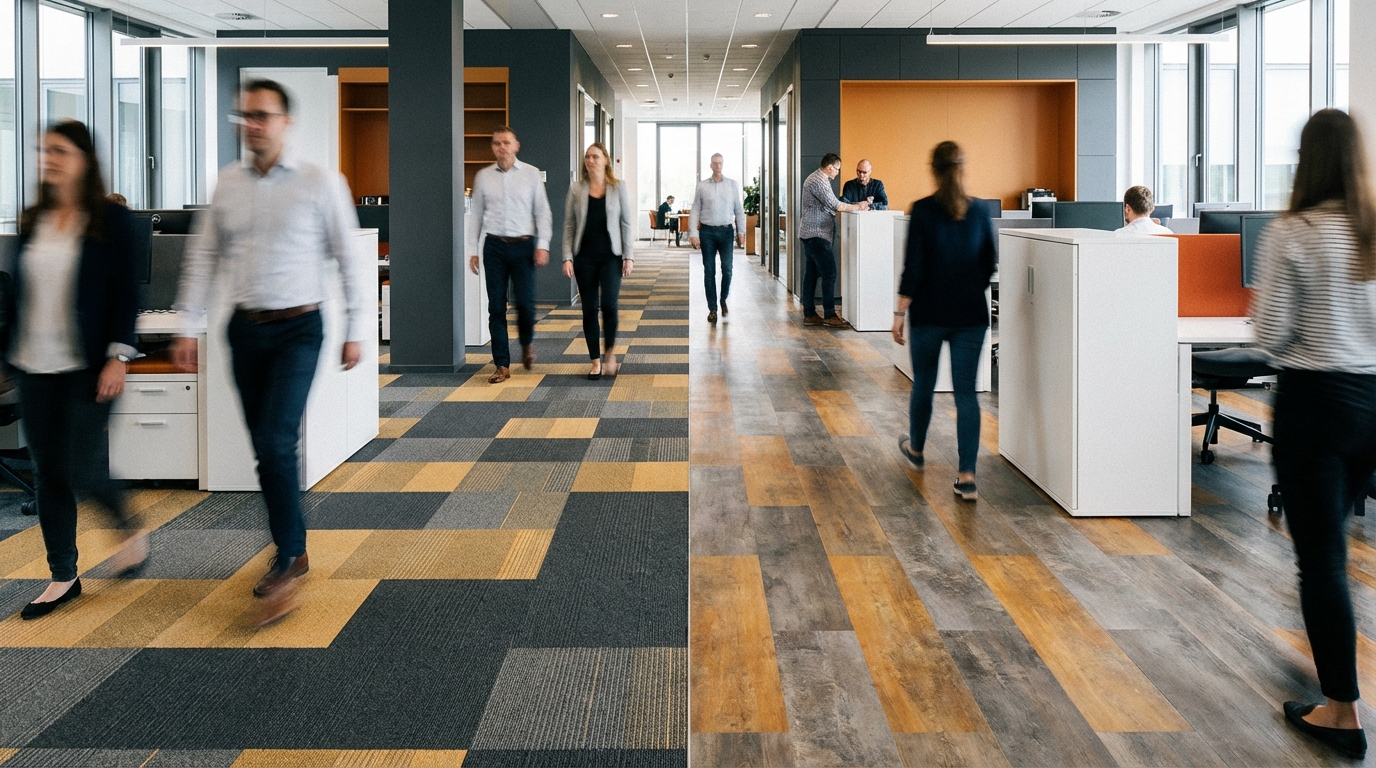
This mixed-flooring approach gives you the cleaning benefits of LVT where spills and shoes are worst, and the acoustic comfort of carpet where people work.
Comfort and ergonomics with LVT
LVT feels firmer than carpet. Even with an acoustic underlay, it will not feel as soft as a good carpet tile.
Impacts:
- Standing desks over LVT might need anti-fatigue mats for comfort.
- People who walk a lot through the office feel slightly more impact than on carpet.
- In winter climates, LVT can feel cooler underfoot, though this depends on the subfloor and HVAC.
If your staff spends most of their time sitting, this may not matter much. If you have people on their feet for long periods each day, it becomes more relevant.
Installation and flexibility
Commercial LVT comes in two main install types:
- Glue-down tiles or planks.
- Click or loose-lay systems (less common in very heavy commercial traffic but used in some projects).
Glue-down LVT is stable under rolling loads and frequent traffic. Installers can:
- Rapidly cover large, open floors.
- Cut around columns, built-ins, and floor boxes.
Spot replacement is possible with LVT, but it is trickier than carpet tiles. You have to:
- Heat and lift the damaged tile carefully.
- Remove adhesive residues.
- Install a replacement tile from the same batch if possible.
Color and pattern differences can be more visible on uniform LVT designs than on patterned carpet tiles. That is why some offices keep extra stock and choose designs that hide small differences.
Design and branding: how each material looks in real offices
You are not just choosing performance. You are also deciding how your office feels to staff and visitors.
How carpet tiles support design
Carpet tiles shine when you want:
- Subtle patterns that hide wear.
- Color blocking to define zones (teams, paths, breakout areas).
- Gradients or pattern mixes to guide movement.
For example:
- Use darker tiles in main routes and lighter tiles under desks.
- Use accent colors near collaboration areas to signal energy.
- Mix patterns to break up large floor plates visually.
Because tiles are modular, you can swap layouts or add new pattern “bands” in future phases.
If you like using the floor as a wayfinding and zoning tool, carpet tiles give you a lot of latitude without complex installation tricks.
How LVT supports design
LVT focuses more on:
- Wood plank looks (oak, walnut, ash, etc.).
- Stone or concrete styles for a clean, modern feel.
- Occasional geometric or patterned tiles.
LVT works well when you want:
- A “hospitality-style” feel in reception and lounge zones.
- A minimal, clean look with straight lines.
- A consistent material that runs through corridors, kitchens, and breakout spaces.
If your brand leans toward modern, simple design, LVT can deliver a very controlled, repeatable look. Many offices add area rugs on top of LVT in certain places for extra comfort and brand accents.
Health, safety, and sustainability questions
Slip resistance and safety
In high-traffic offices, safety is not negotiable.
Carpet tiles:
- Have high slip resistance thanks to the textile surface.
- Can reduce the risk of slips in dry conditions.
LVT:
- Commercial LVT often includes slip-resistant surface textures.
- Can be more slippery when wet if not specified correctly.
If you know you have wet shoe traffic (near entrances, kitchens), you want LVT with tested slip ratings and good cleaning practices. Entry matting systems are still your first line of defense.
Indoor air quality and VOCs
Both carpet tiles and LVT have made progress here.
Carpet tiles:
- Many products are certified for low VOC emissions.
- Backing and adhesive choices matter for air quality.
LVT:
- Quality commercial LVT is often tested for low VOCs.
- Cheaper products can have higher emissions or content issues, so spec matters.
For either option, ask suppliers for:
- Third-party indoor air quality certifications.
- Low-VOC adhesive or installation systems.
Sustainability and end-of-life
Carpet tiles:
- Some manufacturers offer take-back and recycling programs.
- Many tiles have recycled content in backing or fibers.
LVT:
- Some lines now include recycled content and are moving toward better recyclability.
- The market is still maturing on this front.
If sustainability is a key part of your brief, check manufacturer data carefully. Do not assume all products are equal.
Where each product fits best in a high-traffic office
Instead of asking “Which is best overall?”, a more useful question is “Where is each material best in my office?”
Spaces where LVT usually wins
LVT often makes the most sense in:
- Main corridors and circulation paths with constant foot traffic.
- Reception and lobbies where first impression and heavy footfall meet.
- Kitchens, break rooms, and cafe areas with food, drinks, and frequent spills.
- Printer rooms, copy areas, and storage rooms where rolling equipment is common.
- Restroom anterooms where moisture and cleaning are more intense.
Here, the durability and cleaning advantages of LVT usually beat the acoustic benefits of carpet.
Spaces where carpet tiles usually win
Carpet tiles often perform better in:
- Open-plan work areas where noise control and comfort matter.
- Meeting rooms and boardrooms where speech clarity and privacy are priorities.
- Focus spaces and quiet zones that need a calm, soft feel.
- Executive offices where comfort and a more refined atmosphere are important.
These rooms benefit from the sound absorption and underfoot feel of carpet tiles.
Mixed strategy: often the best for high-traffic offices
Many high-traffic offices end up with a mixed solution:
- LVT in circulation, reception, and food zones.
- Carpet tiles in workstations, meeting rooms, and focus rooms.
This gives you:
- Better acoustics where people work.
- Lower maintenance in the messiest, busiest paths.
- A way to visually zone the office without extra construction.
If your office traffic pattern is varied, “both” is often the right answer. Use each material where it is strongest instead of forcing one to do everything.
Cost and lifecycle: where your budget actually goes
Upfront vs long-term cost
When comparing carpet tiles and LVT, many teams only look at material price per square meter or per square foot. That can be misleading.
You want to think about:
- Material cost.
- Installation cost.
- Cleaning over 5 to 10 years.
- Repair and replacement cost over that same period.
For high-traffic zones:
- LVT might cost slightly more upfront than a budget carpet tile, but it can last longer with lower replacement.
- Carpet tiles can need partial replacement in lanes after some years, especially with heavy rolling traffic.
For quieter, low-spill zones:
- Carpet tiles can last very well, and the acoustic benefit justifies both cost and maintenance.
Maintenance budget reality
Many offices underestimate cleaning costs.
With carpet tiles:
- You need consistent vacuuming and periodic deep cleans.
- Stain management products and contractor time add up.
With LVT:
- Cleaning is more predictable and often takes less time.
- There is no need for extraction machines or carpet specialists for routine work.
Over years, those differences translate into real dollars, not just in cleaning budgets, but also in disruptions to office use during deep-clean cycles.
Key questions to decide between carpet tiles and LVT
If you are still stuck, walk through these questions:
- How loud is your office today? Are noise complaints common?
- Do you eat and drink near desks, or only in kitchen areas?
- How many people move through your corridors in a day?
- Do you plan to rearrange teams or furniture layouts often?
- Are you trying to create a warmer, softer feel, or a more minimal, clean look?
- Is cleaning staff in-house or outsourced, and what equipment do they already use?
- What lease length are you planning for? 3, 5, or 10 years?
Once you have those answers, you can line them up against what each product is best at.
So which is best for high-traffic offices: carpet tiles or LVT?
Putting all of this together:
- LVT is generally better for very high-traffic, spill-prone circulation and shared areas.
- Carpet tiles are generally better for work zones where acoustics and comfort matter more than mop-and-go cleaning.
If you forced a single-material choice across the whole office:
- Pick LVT if your top concerns are durability, simple cleaning, and long-term wear in a very busy office where food and drinks move everywhere.
- Pick carpet tiles if your top concerns are noise control, staff comfort, and a softer environment, and you can enforce “food stays in the kitchen” rules more strictly.
In many real high-traffic offices, the best answer is not carpet tiles vs LVT. It is carpet tiles and LVT, each where they perform best.
Practical tip: run a small real-world test before you commit
Before signing a large flooring contract, do one small thing that most companies skip:
- Order several carpet tile and LVT samples from the short list.
- Lay them in an actual high-traffic zone of your office for 2 to 4 weeks.
- Let your team walk, roll chairs, and live on them.
- Ask your cleaning crew to treat them as if they were installed everywhere.
At the end of that period, look for:
- Visible wear or flattening.
- How easy spills wiped up.
- Noise and comfort feedback from the people walking over them all day.
That mini pilot will tell you more than any brochure or showroom visit.