
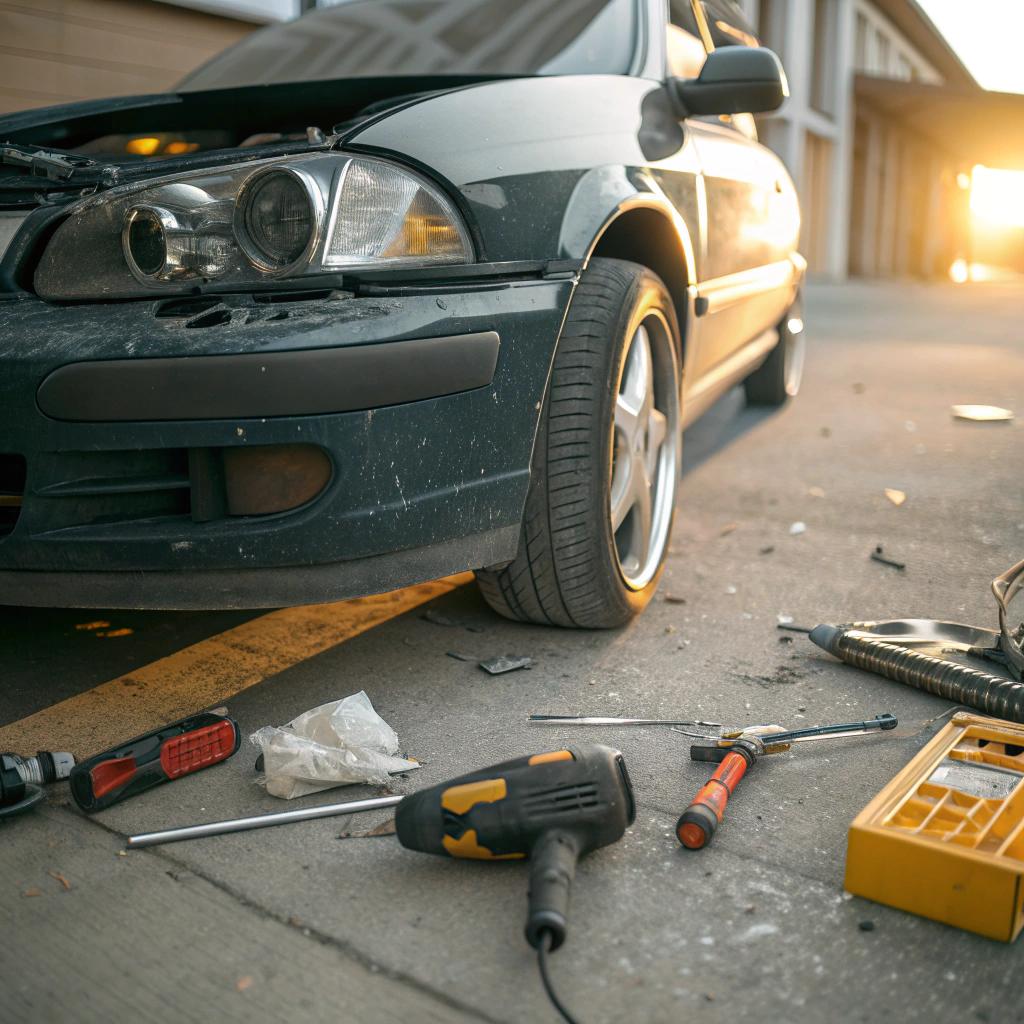
So, you are trying to fix bumper damage and you are wondering what smart bumper repair tricks a home renovator can actually pull off without making things worse. The short answer is that you can handle light scuffs, small dents, and some cracked plastic yourself, but deeper damage, misalignment, or safety parts should go to a pro body shop bumper repair shop instead.
That mix of do-it-yourself and know-when-to-stop is very similar to how you approach home renovation or flooring. You might install your own vinyl plank, but you probably call a flooring installer if the subfloor is rotten or the slab is cracked. Bumpers work the same way. There are projects that fit into a weekend and others that can quietly affect safety, resale value, or even how your paint ages next to your freshly painted garage walls.
Things you need to know
- Not all bumper damage is cosmetic; some affects safety and alignment.
- Plastic bumpers can often be heated and reshaped instead of replaced.
- Prep and sanding matter more than the brand of paint you buy.
- Work clean, like you would before laying new flooring or tile.
- Use guides, blocks, and tape to keep lines straight, just like trim work.
- Know when to stop and call a repair shop so you do not chase hidden issues.
Why home renovators usually do well with bumper repairs
If you are handy with flooring, trim, paint, and general fix-it work, you already have most of the mindset you need. You know that:
- Prep takes longer than the visible work.
- Flat, clean surfaces give better results.
- Shortcuts almost always show later.
The difference is that a bumper is curved plastic instead of drywall or subfloor. Still, you deal with similar ideas: leveling, patching, sanding, priming, painting, and finishing edges so they do not stand out next to the original surface.
Think of bumper repair as a small, curved “wall and trim” project, with slightly fussier prep and much thinner paint layers.
Once you see it that way, it feels less mysterious and more like just another project in the garage next to your stack of baseboards and tile spacers.
First step: decide if the damage is DIY or pro-level
Before you grab sandpaper, you need to judge what sort of problem you have. People skip this and waste time, or worse, they hide a safety problem under fresh paint.
Basic types of bumper damage
| Damage type | Typical cause | DIY friendly? | Notes |
|---|---|---|---|
| Light scuffs / paint transfer | Grazing a pole, wall, or another car at low speed | Yes | Often comes off with compound and polish. |
| Clearcoat scratches | Car wash, branches, bags sliding | Yes | Can usually be sanded and buffed. |
| Deep scratches into plastic | Parking mishaps, small impacts | Sometimes | Needs filler and paint; more like patching a wall. |
| Small dents in plastic | Light bump, parking tap | Yes, often | Heat and pressure can bring the shape back. |
| Cracks, splits, torn plastic | Backed into something harder than expected | Maybe | Plastic welding or stapling is more advanced. |
| Broken mounts or tabs | Hard hit, tow hook, or impact from below | Sometimes, but tricky | Alignment issues if done poorly. |
| Crushed foam / inner support damage | Any real collision | No | Safety item; needs a repair shop. |
| Sensors, cameras, parking aids not working | Impact or removal problems | Better left to pros | Electronics and calibration can be fussy. |
Here is a simple rule of thumb: if the bumper shape, gaps, and sensors still look and work like before, you can probably handle the cosmetic work. If panel gaps changed, the hatch or trunk does not close right, or the lines between bumper and quarter panel look uneven, then you might be dealing with structure and not just skin.
If you would not ignore a sagging subfloor under new luxury vinyl, do not ignore a warped bumper sitting crooked under your liftgate.
How clean, careful prep makes or breaks your repair
Home renovators usually understand prep. You would not paint over greasy kitchen walls or lay laminate over loose tiles. Same idea for a bumper.
1. Clean the bumper like you are about to paint a cabinet
Start by washing the area with car shampoo or mild soap. Dry it, then clean again with a wax and grease remover. Do not rush this step. Old wax and road film will fight you later when you sand or paint.
You want all of this gone:
- Wax
- Silicone products
- Tar or sap
- Old polishing compounds
Wipe with clean microfiber towels and flip them often. If you can see smears or shiny spots where the cloth glides too easily, you probably still have some residue left.
2. Mark and inspect the damage under good light
Dry the bumper fully. Use bright but soft light, not just a tiny phone light. Circle the damaged spots with a washable marker or masking tape. Move your head around and look at reflections. You will often see extra scratches or waviness that you did not notice at first glance.
This small step saves time later, the same way marking low points on a concrete floor with a pencil helps you know where to skim coat.
Fixing light scuffs and paint transfer
Light damage is where you get the fastest results, and it is a good place to start if you are new to car work. Many “bumper hits” are just paint exchanged between surfaces, not actual gouges.
Simple routine for minor marks
- Clean the area well, as described earlier.
- Rub a finger over the mark. If you feel a ridge of foreign paint, that is transfer.
- Start with a mild rubbing compound on a foam pad or microfiber cloth.
- Work in small circles with light to medium pressure.
- Wipe, inspect, and repeat until the mark fades.
- Finish with a finer polish to bring back the gloss.
If your nail does not catch when you gently drag it over the scratch, it is usually only in the clearcoat. Those often polish out. If the nail catches strongly or you see the black or gray plastic underneath, then it is deeper and will need a different approach.
Handling deeper scratches and gouges
Deeper scratches are closer to patching damaged drywall. You fill, sand, prime, then paint. The difference is just the tools and materials.
Step by step for deeper scratches
1. Sand the damaged area
- Start around 320 or 400 grit sandpaper on a small sanding block.
- Feather the edges of the scratch so there is no hard ridge.
- Widen your sanding area a bit past the damage to blend better.
Do not sand only the groove itself. Think like feathering joint compound past a drywall seam so you do not see a sharp line in the finish.
2. Use a plastic-friendly filler
- Pick a filler made for flexible plastic parts, not just any body filler.
- Mix small batches so they do not harden before you spread them.
- Apply thin layers with a plastic spreader, pressing into the damage.
Let each layer cure fully. Many people pile it on thick to “save time” and then spend more time sanding ridges and pinholes. Thin layers are boring but they work better.
3. Sand the filler smooth
- Start with about 320 grit, then move to 400 and 600.
- Use a sanding block where you can so you keep the curve honest.
- Run your fingers over the area with your eyes closed. You will feel bumps your eyes do not catch.
4. Prime the repair
- Use a primer designed for plastics, often labeled as adhesion promoter plus primer.
- Spray light coats, moving side to side, overlapping a bit.
- Let it dry fully, then lightly scuff with 600 to 800 grit before color.
Think of primer on a bumper the way you think of primer on glossy trim: it is not for looks, it is the grip layer that decides if everything else sticks or peels.
Reshaping small bumper dents with heat
This is where it starts to feel like magic the first time you do it. Many plastic bumper dents pop out with controlled heat and patience. But there is a line. If the plastic is creased sharply or has white stress marks all over, you might not get it perfect.
Assess the dent
Ask yourself:
- Is the paint mostly intact, without big cracks?
- Is the dent a smooth depression with no sharp fold?
- Is the plastic thick and still flexible?
If you say yes to those, you have a pretty good shot. If not, you can try, but set your expectations lower.
Heating and pushing method
- Gain access behind the bumper if possible by removing a trim panel or opening the hatch.
- Use a heat gun on a low setting, moving it around constantly. Do not sit in one spot.
- Warm the area until it feels hot to the touch but not smoking or melting. Stay patient.
- Use a gloved hand or a padded tool to push from behind while you support the front.
- Work slowly, easing the shape out a bit at a time.
- Let the area cool while held as close to the correct shape as you can manage.
Think of this sort of like heating vinyl flooring to get it to lay flat, except here you are also trying to reverse a dent. Too much heat and you stretch the plastic. Too little and it springs back to the dented position.
Dealing with cracks and splits in the bumper
Cracks are where some home renovators get a bit too confident. There are DIY ways to join them, but this is closer to structural work. If the crack is short and away from mounts or sensors, you can experiment. If it is long or near a mounting edge, I would be more cautious.
Common repair approaches for cracks
| Method | Skill level | Pros | Cons |
|---|---|---|---|
| Plastic welding (with a plastic welder) | Intermediate | Strong, more permanent | Needs tool, practice, and correct filler material |
| Metal staple “stitching” plus filler | Intermediate | Good strength across the crack | Staples must be buried and finished well |
| Epoxy reinforcement with mesh | Beginner to intermediate | Works with simple tools | Can be bulky on the back side, needs careful sanding on front |
If you already work with structural epoxy for wood or concrete repair, the epoxy and mesh route will feel more familiar. Clean, scuff, apply epoxy and mesh on the back side, let it cure, then fill and finish the front for looks.
Color matching: close enough vs “you cannot see it”
This is where home renovators sometimes get frustrated. Wall paint can be tinted in the store to near perfection. Car paint is fussier, and bumpers sometimes look a tiny bit different from metal panels even from the factory because of how plastic and metal hold color.
Three ways to get color
- Pre-mixed spray cans for your paint code
- Custom mix in a can from an auto paint store
- Professional shop mixed and sprayed
The code on your car (often on a door jamb label) gives you the base color. For small spots on a bumper, pre-mixed cans can be “good enough”. If you are repainting a larger section, a local auto paint store can often mix a better match into a spray can or small gun-ready batch.
How to spray without obvious “patch” lines
- Mask edges carefully, but avoid hard tape lines right in the middle of big, flat areas.
- Overlap your new color into the old paint, fading out softly.
- Keep the can or gun moving, not stopping at the same spot each time.
- Use multiple thin coats instead of one heavy coat to avoid runs.
- After color, apply clearcoat slightly wider to blend the gloss.
This is very similar to feathering touch-up paint on a wall so you do not see a “square.” The better your feather, the less the eye sees a boundary.
Blending repairs with the rest of the car and your space
Since this is on a site for home renovators and flooring people, it is fair to connect the car to the space. People forget how much the garage or driveway lighting affects how a repair looks. You may think your blend is perfect in a dim garage, then hate it in direct sun.
A few tips that cross over from interior work:
- Check color and gloss from different angles, like you do with wall paint next to a window.
- Look at the repair in natural daylight as well as garage light.
- If you have LEDs in your garage, stand back and walk around the car the way you would inspect new flooring for pattern repeats or sheen differences.
If you are updating your garage flooring or adding better lighting, this is actually a good time to do paint work on the car too. You can see what you are doing, and you do not have dust from a current renovation floating around.
Work area: treat it like a small paint booth
Your work space affects how the bumper turns out more than people want to admit. You would not spray a cabinet door right next to someone cutting tile. The same goes for a bumper.
Practical work area tips
- Choose a day with mild temperature and low wind if you are outdoors.
- If inside, keep the area as dust free as possible for at least a few hours before spraying.
- Use plastic sheeting or old drop cloths to shield nearby walls, tools, and your nice new flooring.
- Keep pets and kids away while spraying and drying.
Think of this as the car version of clearing and taping off a room before you paint trim. It is boring, but it keeps other things from getting speckled or scratched.
Comparing DIY bumper repair with other home projects
Sometimes it helps to compare what you are doing with work you already understand.
| Home task | Bumper repair step | Similar skill |
|---|---|---|
| Skim coating a wall | Filling scratches and low spots | Thin layers, wide spread, feather edges |
| Sanding trim for paint | Sanding primer and filler | Using the right grit, not rounding edges too much |
| Installing click-lock flooring | Reassembling bumper and clips | Sequence matters, gentle pressure, correct alignment |
| Cutting and fitting baseboard | Aligning body lines and gaps | Visual alignment, even reveals, steady hand |
| Spraying cabinet doors | Painting the bumper | Thin coats, steady movement, watching for runs |
Once you frame it like that, the bumper is less of a mystery and more like a curved, plastic piece of “trim” on your vehicle.
When to stop and call a professional
I do not think every task should be DIY, even for people who are very handy. Sometimes you save money and time by knowing your limit. With bumpers, I would strongly lean toward a professional shop if you see any of the following.
Signs you should hand it off
- The bumper sits crooked or gaps near the fenders are uneven.
- The hatch, trunk, or tailgate rubs or does not close smoothly.
- Sensors or cameras stopped working after the hit.
- You see crushed foam or metal behind the plastic cover.
- The crack goes near a mount point or corner that holds the bumper on.
Those situations are closer to structure and safety than cosmetics. Like when you pull up old flooring and discover rotten joists, you may be out of the “DIY weekend” zone and into a bigger fix whether you like it or not.
Common mistakes home renovators make on bumpers
Most of the trouble I see from DIY bumper work is not from lack of skill, but from rushing or skipping unglamorous steps. A few real-world errors are very common.
1. Sanding marks visible through the paint
If you jump from coarse grit straight to painting, those scratches stick around. It is the car version of painting over swirl marks from an aggressive drywall sanding job. Take the time to step down your grits, especially in the final passes.
2. Heavy spray coats that run
People aim for full coverage in one shot. That is how you get sagging lines and uneven texture. It is far better to do three or four thin coats that almost look too light at first. They level nicer and dry faster.
3. Hard paint edges and tape lines
This looks bad even from a few feet away. Mask with a soft edge when you can, or place the tape at a natural body line where a change in angle hides it. Then lightly sand the edge of the clearcoat ridge after curing if needed.
4. Ignoring temperature and humidity
Paint behaves badly if it is too cold, too hot, or very humid. You can end up with dull patches, poor adhesion, or a rough feel. You do not need a climate-controlled booth, but you should at least check the can’s recommended range and aim for that window.
How bumper repair links back to your home projects
This might sound like a stretch, but once you get comfortable with small auto repairs, you start looking at your garage and driveway differently. A few side effects that tie right back into home renovation:
- You might plan a cleaner, brighter garage workspace so paint and sanding are easier.
- You might upgrade the garage floor from bare concrete to something that is easier to sweep and mop after sanding and painting.
- You probably get more careful with how you move tools and lumber around cars near the house, because now you know how much work it is to undo a bad scratch.
That mindset keeps both your home and your car in better shape. It is not about making the garage fancy, just practical and easy to clean, like a good workshop or utility room.
Quick reference: choosing your approach
| Scenario | Likely DIY path | Estimated time |
|---|---|---|
| Light paint transfer from brushing a pole | Compound and polish | 1 to 2 hours |
| Several clearcoat scratches from a branch | Wet sand lightly, then compound and polish | 2 to 3 hours |
| One deeper gouge, plastic showing | Fill, sand, prime, color, clear, polish | 1 weekend including drying time |
| Soft dent, paint mostly intact | Heat and push out, then light refinish if needed | 1 afternoon |
| Long crack near corner, bumper still aligned | Reinforce back, fill and refinish front | 1 to 2 weekends, depending on cure times |
| Visible misalignment, sensors affected | Professional repair or replacement | Shop visit |
Be realistic: if you already have three unfinished projects in the house, choose bumper repairs that fit into a single weekend so you actually finish them.
Last thoughts and a few quick questions answered
Do I need special tools to repair a bumper?
You can do light cosmetic work with very basic tools: sandpaper, sanding block, a few spray cans, masking tape, and polishing compound. A heat gun and a small DA sander help, but they are not required for every job. Advanced work like plastic welding needs more gear and practice, which is where a shop starts to make more sense.
Can I get a “perfect” repair at home?
Sometimes, for small areas, yes. But if you are very picky and want it to look like it came out of a paint booth from every angle, then a body shop has better lighting, tools, and experience. For many people, “looks very good from a couple of feet away” is acceptable on a daily driver, especially if it saved a lot of money.
Is it worth learning bumper repair if I mostly focus on home renovation and flooring?
If you own a car, probably yes. You do not need to become an expert, but knowing how to handle light damage, polish out scuffs, and tell when a hit is more serious will save you money over time. It also lines up well with how you already work: careful prep, attention to surfaces, and patience with finishing stages.
So the real question is: if you can handle patching drywall, leveling a floor, and spraying trim, why not add “smart bumper repair” to your set of practical skills too?