
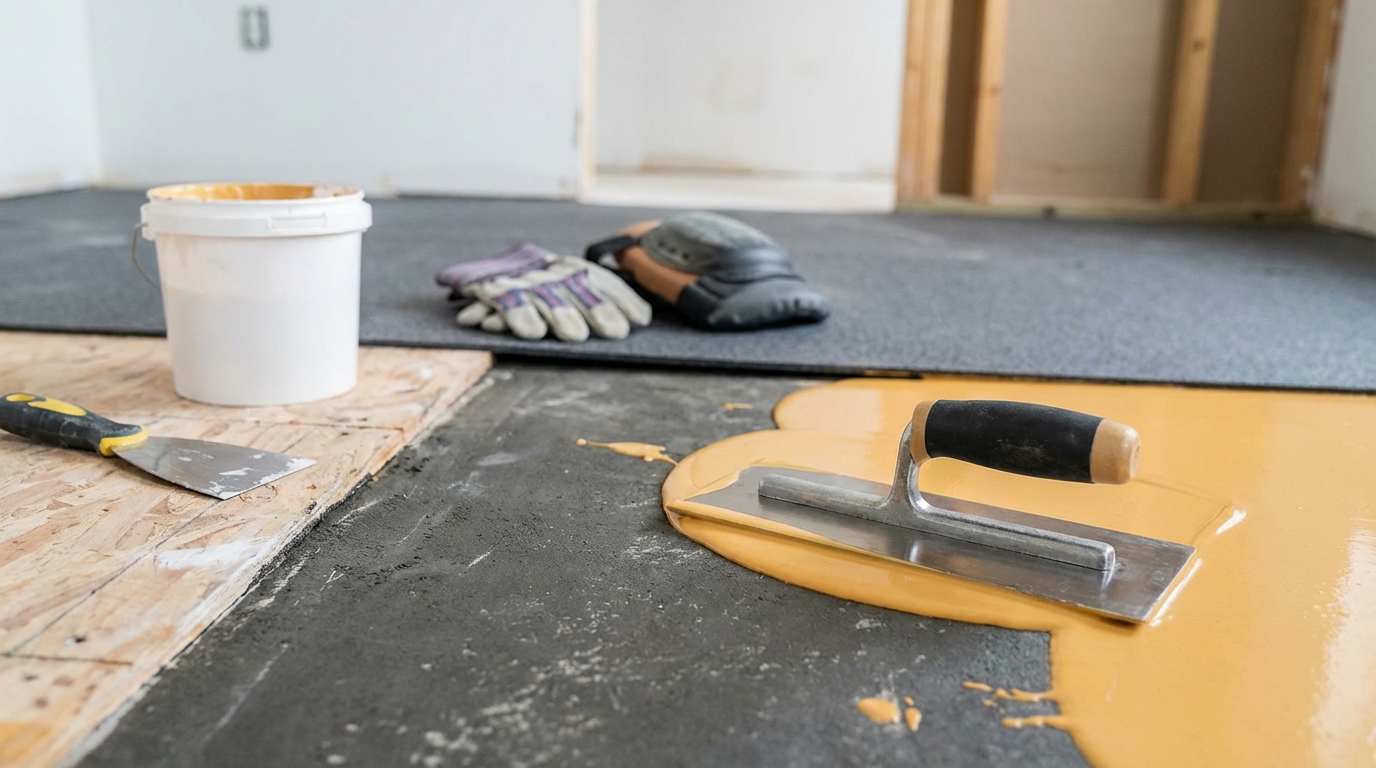
So, you are trying to figure out how to prep a subfloor before you install new flooring, and you keep hearing that this is the step most DIYers skip and regret later. The direct answer is this: you need to clean, repair, flatten, dry, and reinforce your subfloor before any flooring goes down, or you will have squeaks, gaps, cracks, and failures way sooner than you expect.
Most people think flooring is just about laying planks, tiles, or vinyl and making it look good on day one. The real story sits under all of that. The subfloor is the “structure” your finish floor depends on. If it is not flat, solid, and dry, even the best material and the best glue or underlayment will fail early. The good news is you can handle this with basic tools, some patience, and a clear checklist.
Things you need to know:
- Subfloor prep is about four things: structure, flatness, cleanliness, and moisture.
- Every flooring type has its own tolerance for flatness and moisture; you must check yours.
- Skipping screw-and-glue reinforcement is one of the main reasons floors squeak later.
- You fix subfloor problems before you fix cosmetic problems; looks come after structure.
- A cheap moisture meter and a long straightedge often save you thousands in repairs.
- Level and flat are not the same; most floors care more about flat than perfectly level.
- Transitions, doors, and height build-up need planning before you pour or patch anything.
- Every hour you spend on subfloor prep protects every other hour you spend on install.
“Your floor is only as strong as what you cannot see. That is the uncomfortable truth of subfloor prep.”
Why DIYers skip subfloor prep (and why that hurts later)
Before we go step by step, it helps to be honest about why this step gets skipped.
Most DIYers:
- Are excited about the visible part (the flooring) and bored by the hidden part (the subfloor).
- Assume the existing floor “has been fine for years,” so the subfloor must be fine too.
- Underestimate how much flatness matters for click-together products and large tiles.
- Do not want to add days of scraping, sanding, and filling to their timeline.
- Feel nervous about structural stuff like joists and prefer to ignore what they cannot interpret.
The regret shows up later as:
- Squeaks that get louder every month.
- Click floors that separate or “tent” in spots.
- Tiles that crack along the same line the subfloor cracked.
- Soft spots that slowly grow and ruin the feel of the whole room.
“When someone tells me their 3-year-old floor is falling apart, nine times out of ten the real story is a 30-minute subfloor inspection that never happened.”
Subfloor basics: what you are actually working with
Most homes have one of two common subfloor setups:
| Subfloor Type | Common Material | Typical Thickness | Main Problems |
|---|---|---|---|
| Wood framed floor | OSB or plywood over joists | 5/8″, 3/4″, or 1″ | Squeaks, movement, dips over joists, water damage |
| Concrete slab | Poured concrete | 4″ to 6″+ | Cracks, high spots, moisture wicking through slab |
Wood subfloors
Wood subfloors are common on upper floors and in many single-family homes. They sit on top of joists or trusses. What matters for you:
- The sheets (OSB or plywood) must be well fastened to the joists.
- The surface needs to be flat within the tolerance your flooring calls for.
- Any signs of rot or swelling need real repair, not just patching over.
Concrete subfloors
On slabs, basements, and many condos, you are dealing with concrete. Problems change, but the core rules stay the same:
- Concrete can be out of flat by more than you notice with the naked eye.
- Moisture can move up through the slab and damage wood, vinyl, and adhesive.
- Cracks might be stable or might still be moving.
“The mistake is thinking ‘solid’ means ‘ready’. A slab can feel rock hard and still wreck a floor through moisture or minor height variations.”
Step 1: Strip the room and expose the real subfloor
You cannot prep what you cannot see. That sounds basic, but a lot of DIY installs happen over old vinyl, old adhesive, or random underlayments that hide problems.
Remove old flooring and underlayments
Your starting point:
- Take up carpet, pad, tack strips, and staples.
- Pull old laminate, vinyl, or engineered wood.
- Remove loose tiles and thinset if they flake or ring hollow.
- Peel off luan or thin plywood underlayments if they are damaged or flexy.
A few tips while you do this:
- Label boards or trim you want to reuse with painter’s tape.
- Keep a magnet handy to find stray nails or staples you missed.
- Vacuum as you go so you can spot hairline cracks or soft spots.
If something refuses to come up without tearing the subfloor apart, stop and reassess. Glued-down flooring on thin or weak subfloor might mean you need to plan a partial or full resheathing.
Step 2: Structural check before cosmetic fixes
This is where most people rush. They see a dip and want to pour self-leveler, or they see a crack and want to fill it. You first need to decide if the floor is safe and stable.
For wood subfloors
Walk the room slowly and pay attention to what you feel and hear.
- Soft spots: sink under foot pressure, often near sinks, tubs, or exterior doors.
- Squeaks: wood rubbing on wood or fasteners moving in their holes.
- Bounce: entire area flexes too much when you walk or jump.
Use a flashlight and, if you can, check from below (basement or crawlspace).
Look for:
- Water stains around plumbing lines and exterior walls.
- Split joists or cracks near supports.
- Joists not properly bearing on beams or posts.
In many homes, the fix is not dramatic:
- Replace a few sheets of swollen or rotted OSB.
- Screw the subfloor tightly to joists with construction screws.
- Glue and screw a second layer of plywood over a weak area.
For concrete subfloors
Tap around with a hammer or a heavy screwdriver handle. You are listening for hollow spots. Solid concrete has a sharp, dense sound. Hollow or delaminated areas sound dull.
Check for:
- Wide cracks that change width from one end to the other.
- Heaving or lifting at expansion joints.
- Old patch material breaking away.
If the slab is cracked but both sides of the crack feel level and stable over months or years, that is common. Still, it will guide your choice of crack repair and underlayment.
“A subfloor problem that scares you now is cheaper than a floor failure that surprises you later.”
Step 3: Moisture testing (the quiet floor killer)
You can have a perfectly flat subfloor that ruins your flooring because of moisture. This is the one piece people like to ignore, especially in basements, bathrooms, and kitchens.
Moisture testing on wood subfloors
Pick up a basic pin or pinless moisture meter. It does not have to be fancy. You just need repeatable readings.
Guidelines that many manufacturers like:
- Wood subfloor under hardwood: usually 12% moisture content or less.
- Difference between subfloor and hardwood: often within 2% to 4%.
Check:
- Several spots across the room (edges and middle).
- Near exterior doors and under windows.
- Near plumbing fixtures and floor vents.
If readings are high, you are not ready. You might need:
- More drying time.
- Fixing leaks or humidity problems.
- Better ventilation or temporary dehumidifiers.
Moisture testing on concrete slabs
For slabs, you want to know how much moisture is moving up from below, not just what the top surface feels like.
Common approaches:
- Plastic sheet test: Tape clear plastic down on the slab for 24 to 72 hours. If you see condensation or darkening, moisture is high.
- Moisture meter: Some meters read concrete, but take the numbers as a relative guide, not an absolute lab value.
- Professional tests: Calcium chloride or in-slab probes, often used when high-value flooring is going in.
Look at your flooring instructions for max allowable slab moisture. Many glue-down products and some vinyls are strict about this. If you are over the limit, you may need:
- A vapor barrier system rated for your slab.
- Different flooring that tolerates higher moisture.
- More drying time before any prep compounds go down.
Step 4: Flat vs level (and what your floor cares about)
Many people chase a perfectly level floor and get frustrated. In reality, most flooring cares about “flat” more than “level.”
Flat means: no big humps or dips within a certain distance.
Level means: the floor is horizontal relative to gravity.
Most manufacturers say something like:
- Floor must be flat within 3/16″ over 10 feet, or 1/8″ over 6 feet.
You check this with:
- A 6- to 10-foot straightedge or level.
- A laser level combined with a measuring tape.
Walk the room with your straightedge and:
- Mark high spots.
- Mark low spots.
- Write height differences on painter’s tape so you remember.
“Think of your straightedge as an honesty tool. It tells you what your eyes are skipping and what your feet will feel later.”
Step 5: Fixing wood subfloors
Now you know if the floor is structurally sound, dry enough, and where it is high or low. The order matters: structural first, then flatness.
1. Tighten and reinforce
Start by getting rid of movement.
- Drive construction screws every 6″ along joists where you hear squeaks.
- Add screws at panel joints and around plumbing cutouts.
- If panels are loose or edges break, replace or patch those panels.
For very weak areas:
- Add a second layer of plywood (often 1/2″) across the room or in specific zones.
- Stagger seams relative to the original layer to avoid weak lines.
- Glue and screw this layer to minimize future movement.
2. Deal with high spots
High spots in wood subfloor usually come from:
- Joists that crown higher than others.
- Seams that have swelled from moisture.
- Old repairs that sit proud of the surface.
Options:
- Sanding: Use a floor sander or belt sander to knock down minor ridges.
- Planing: For a crowned joist accessible from above, sometimes a power planer is used.
- Replace panels: If swelling is severe, patching often beats sanding for hours.
Be careful not to sand so deep you weaken the panel. If you feel nervous about how thin you are getting in a spot, pause and rethink the repair.
3. Fill low spots
Low spots are where click floors flex and tiles crack.
You can use:
- Floor patch compound: For small dips and feathering edges.
- Self-leveling underlayment (SLU): For larger areas that need a consistent fill.
For patch compounds:
- Vacuum and prime if required.
- Mix only as much as you can place in the working time.
- Use a flat trowel to feather edges to nothing.
For SLU over wood:
- Follow the bag instructions closely; water ratio and mixing time matter.
- Use the primer the manufacturer calls for.
- Honor any need for reinforcing mesh or minimum thickness.
You often need to dam doorways and vents so the pour does not flow out of the room. Simple foam strips and tape work.
4. Sand, scrape, and clean
Before flooring, your wood subfloor should be:
- Free of glue blobs and old thinset ridges.
- Free of loose paint and finish.
- Clean of dust, especially if you will glue or pour anything on top.
A floor scraper, belt sander, and a good vacuum are your friends here.
Step 6: Fixing concrete subfloors
Concrete has its own pattern of problems and fixes. The main ones: high spots, low spots, cracks, and moisture.
1. Grind high spots
High spots in concrete often come from:
- Bad finishing during original pour.
- Settling or lift along cracks.
- Old patch material that stands proud.
Most pros use:
- Angle grinder with a diamond cup wheel.
- Floor grinder for larger areas.
Keep a vacuum handy, and wear proper protection. Concrete dust is not something you want in your lungs.
2. Fill low spots and broad dips
For concrete, you usually reach for:
- Self-leveling underlayment to flatten whole zones.
- Patch products where the area is small.
Steps:
- Prime the slab according to the product instructions.
- Mark depth at low spots so you know how much material you will need.
- Work with a gauge rake and smoothing tool to guide the material.
Pay attention to set time. These compounds go from fluid to unworkable quick. Plan mixing and pouring with that in mind.
3. Repair cracks
You do not always need to “erase” cracks. You need to stabilize and bridge them in a way your new floor can handle.
Common options:
- Epoxy injection or fillers: For stable but open cracks.
- Flexible crack isolation membranes: Rolled or liquid-applied products that create a bridge.
If a crack shows vertical movement (one side higher than the other), you are outside “cosmetic fix” territory. It might be structural, and that is a different conversation.
4. Moisture control
If slab moisture is high for your chosen flooring, you have a few paths:
- Install an approved vapor barrier system and then your prep and flooring.
- Choose flooring that can float over a vapor barrier with a suitable underlayment.
- Work with a pro for moisture remediation if this is a chronic problem.
Again, read the technical sheet for both your prep compound and your flooring. Many self-levelers and adhesives have strict limits on slab moisture.
Step 7: Match subfloor prep to your flooring type
Not every floor needs the same level of subfloor perfection. You want to match the prep effort with what your floor can tolerate.
Here is a simple comparison:
| Flooring Type | Subfloor Sensitivity | Prep Priorities |
|---|---|---|
| Solid hardwood (nail-down) | Very sensitive to moisture and movement | Strong wood subfloor, proper moisture, good flatness |
| Engineered wood (float or glue) | Moderate to high sensitivity | Flatness, moisture, clean surface, sound control underlayment if needed |
| Laminate (floating) | Sensitive to dips and humps | Flatness is key, vapor barrier on slab, seams tight |
| Luxury vinyl plank/tile (LVP/LVT) | Shows subfloor imperfections | Very smooth and flat surface, moisture control on slab |
| Ceramic/porcelain tile | Very sensitive to movement | Stiff subfloor, proper backer board or membrane, flatness for large format |
“The more rigid and large your flooring pieces are, the more they will expose every mistake hiding in the subfloor.”
Special note for tile on wood subfloors
Tile needs stiffness, not just flatness. For wood:
- Joist spacing and span must meet tile standards (often checked against deflection tables).
- Many installs need an extra plywood layer plus cement board or a decoupling membrane.
- Any movement in the subfloor is a future crack in grout or tile.
Step 8: Transition planning and height build-up
Every product you add on top of the subfloor changes the final height:
- Subfloor
- Patch or self-leveler
- Underlayment (foam, cork, cement board, membrane)
- Flooring
If you do not plan this, you get:
- Tripping ridges at doorways.
- Doors that no longer clear the floor.
- Baseboards and trim that look off.
Before you pour or screw down an underlayment, check:
- The current heights at doors that meet other rooms.
- The clearance under door slabs.
- How much space you have under appliances like dishwashers and fridges.
You may decide:
- To use thinner underlayment in one room.
- To feather self-leveler at transitions to avoid big steps.
- To choose a different flooring thickness to keep heights closer.
Step 9: Final inspection before flooring goes down
Before you lay a single plank or tile, walk a final checklist. This is where you catch the last annoying problems.
Ask yourself:
- Do I hear any squeaks at all when I walk the room?
- Does my straightedge rock or reveal gaps bigger than my flooring allows?
- Is the subfloor surface clean of dust, grease, and debris?
- Have all compounds fully cured as per the bag or data sheet?
- Is moisture within the range for both subfloor and flooring?
If any answer is “no,” this is your moment to fix it. Once the flooring is down, every repair gets harder, slower, and more expensive.
Common mistakes in subfloor prep (and how you avoid them)
Here are the repeat offenders I see over and over.
- Relying on your eyes only: Always use a straightedge or long level.
- Assuming old floors mean good subfloors: Age is not proof of quality.
- Patching instead of replacing rot: Rot spreads; cut it out.
- Skipping manufacturer requirements: Every product has limits and they matter.
- Ignoring cure times: Walking or installing too soon ruins good prep work.
- Not vacuuming properly: Dust destroys adhesion and floats under underlayment.
“The boring part of the job is where most value is created. Subfloor prep is the boring part.”
Simple tool and material checklist
You do not need pro-grade everything, but you do need the right categories of tools and materials.
Tools
- 6- to 10-foot straightedge or level
- Tape measure
- Drill/driver and construction screws
- Floor scraper and putty knife
- Belt sander or floor sander (for wood)
- Angle grinder with diamond cup (for concrete)
- Shop vacuum with good filtration
- Moisture meter (wood and/or concrete)
- Mixing paddle and buckets
Materials
- Plywood or OSB for patches or second layers
- Wood glue or construction adhesive
- Floor patch compound
- Self-leveling underlayment and primer
- Crack repair epoxy or filler
- Vapor barrier products if required
- Painters tape, foam dams for pours
How to think about time and cost for subfloor prep
A lot of regret comes from underestimating both time and cost. People plan a weekend project and hit a full week of scraping and repair instead.
Here is a simple way to approach it:
| Room Condition | Typical Extra Time | Common Extra Cost |
|---|---|---|
| Relatively flat, minor squeaks | Half day | Low (screws, patch) |
| Noticeable dips, a few soft spots | 1 to 2 days | Moderate (plywood, SLU, patch) |
| Significant water damage or movement | Several days | High (subfloor replacement, moisture control) |
When you plan, assume subfloor prep will take longer than you think. If it does not, great. If it does, you are not caught off guard.
One practical tip you can apply before you buy anything
Before you purchase flooring or prep products, grab a long straightedge or level and walk every room where you want new flooring. Mark every high and low spot with painter’s tape and a quick note like “+1/8” or “-1/4”. Then count how many marks you made. That number will tell you how serious your subfloor prep needs to be and will guide your shopping list, your budget, and your weekend schedule.