So, you are trying to figure out how FSC certification works and how to ensure your wood is ethical. The short answer is: look for the FSC label, understand what type it is (100%, Mix, Recycled), buy from FSC-certified suppliers, and keep basic traceability so you can prove where your wood came from.
You want wood that does not support illegal logging, forest destruction, or abuse of workers and communities. FSC is one of the clearest systems on the market for that, but you only get the benefits if you understand what the label means, how the supply chain works, and how to avoid common mistakes. Most brands and builders skip those details, and that is where problems start.
Things you need to know:
- FSC is a non-profit system with standards for forests and for supply chains (Chain of Custody).
- There are three main labels: FSC 100%, FSC Mix, and FSC Recycled.
- The label alone is not enough; you should check the license code or certificate code.
- Ethical wood is more than “legal”; it also relates to rights, conservation, and long-term management.
- You can search FSC certificates and products in public databases.
- For businesses, internal tracking and documentation are key if you want to claim you use ethical wood.
- There are limits and criticisms around FSC; knowing them helps you make better choices.
- As a buyer, asking questions and requesting proof has real impact in the supply chain.
What FSC actually is and why it matters for ethical wood
FSC stands for “Forest Stewardship Council”. It is a global non-profit that sets rules for how forests are managed and how wood, paper, and other forest products move through the supply chain.
In simple terms:
- Forest managers get certified for how they manage the forest.
- Sawmills, traders, manufacturers, printers, and retailers get certified for how they track certified material (Chain of Custody).
- Products that meet all the rules can carry the FSC label.
Why does this matter for you, if your goal is “ethical wood”?
Because without a system like FSC, most buyers have no real way to check:
- Was this wood harvested legally?
- Were workers protected?
- Were Indigenous rights respected?
- Was high conservation value forest cleared just to produce this timber?
One way to think about it:
> Legal wood is “not breaking the law.”
> Ethical wood goes further and asks “Is this fair, sustainable, and responsible?”
FSC tries to answer that second question.
The three levels of FSC standards
You do not need to read the full rulebook, but you should know the three building blocks:
- FSC Principles & Criteria: Global rules for responsible forest management (the big picture, like “respect Indigenous rights”).
- National standards: Local versions that adapt the global rules to each country (for example, how to map high conservation value areas in Brazil vs Sweden).
- Chain of Custody (CoC): Rules for tracking wood along the supply chain so certified wood stays separated or controlled.
Think of it like this:
> Forest certification tells you “this wood started in a well-managed forest.”
> Chain of Custody tells you “this wood really came from that forest and was not swapped or mixed carelessly along the way.”
You need both parts if you want to be confident your wood is ethical.
What makes FSC wood “ethical” compared to regular wood?
Let us break the word “ethical” into concrete things you can check.
1. Environmental protection
FSC-certified forests follow rules that cover:
- Protecting high conservation value areas (like rare habitats or key wildlife zones).
- Maintaining or improving forest biodiversity.
- Limiting clear-cut size and planning regeneration.
- Protecting soil and water.
- Managing chemicals, fuel, and waste responsibly.
For example:
> An FSC-certified operation cannot just clear a large area of natural forest to plant a single species plantation if that would destroy high-value habitat.
This is one of the reasons many NGOs still prefer FSC over weaker schemes.
2. Social and workers’ rights
FSC requires that:
- Workers have safe conditions, protective equipment, and training.
- There is respect for national labor laws and core ILO conventions (no forced labor, no child labor, freedom of association).
- Local communities have a say when forest operations affect their resources.
- Indigenous Peoples’ rights and Free, Prior and Informed Consent (FPIC) are respected.
This matters if you want to avoid wood linked to:
- Forced evictions.
- Land conflicts.
- Exploitative labor conditions in remote forest areas.
3. Long-term forest management
Ethical wood is not about one harvest; it is about the future of that forest.
FSC-certified operations must:
- Have a long-term management plan.
- Monitor impacts on growth, regeneration, and biodiversity.
- Keep a balance between harvest and regrowth.
So when you specify FSC wood in a building or product, you are linking your project to that full picture, not just a single shipment of timber.
How FSC labeling works: 100, Mix, Recycled
If you want to be sure your wood is ethical, you have to understand the FSC label types. This is where many brands and builders get confused.
There are three main on-product labels:
- FSC 100%
- FSC Mix
- FSC Recycled
FSC 100%: the strongest signal for fresh wood
“FSC 100%” means:
- All the wood in that product comes from FSC-certified forests.
- No controlled wood or uncertified fresh fiber is mixed in.
If your goal is ethical solid wood from forests, this label is the clearest choice.
Example uses:
- Solid wood furniture.
- Flooring planks.
- Decking boards.
- Construction timber.
> If your project is small and you want the most straightforward ethical option, looking for FSC 100% wood is a simple first filter.
FSC Mix: a mix of certified and controlled sources
“FSC Mix” is where things get a bit more complex.
It means:
- Some percentage comes from FSC-certified forests.
- The rest comes from “controlled wood” or sometimes from FSC Recycled fiber.
“Controlled wood” is not full FSC forest certification. It is a set of rules that prevent the worst problems, such as:
- Illegal logging.
- Wood harvested in violation of traditional or civil rights.
- Wood from areas where high conservation values are threatened by management activities.
- Wood from forests converted to plantations or non-forest use.
- Wood from forests where genetically modified trees are present.
So with FSC Mix, you are not at 100% certified forest, but you are still avoiding some of the most harmful sources.
For products where mills mix inputs (like plywood, MDF, paper, packaging), FSC Mix is very common.
FSC Recycled: focus on recycled fiber
“FSC Recycled” means:
- The wood or fiber is entirely from recycled sources (post-consumer or pre-consumer, within limits).
- No fresh wood fiber from forests is used for that labeled content.
This is especially relevant for:
- Paper products (printer paper, tissue, packaging).
- Panels or boards made from reclaimed wood.
If you want to reduce pressure on natural forests, FSC Recycled is a strong option.
Which FSC label should you aim for?
If your main goal is “ethical wood from well-managed forests”:
- Prioritize FSC 100% for solid wood and key structural elements.
- Accept FSC Mix where fully certified content is harder to get (plywood, MDF, some paper).
- Use FSC Recycled where recycled content is practical and modern (packaging, paper, some boards).
> If you are writing procurement rules, you can set a hierarchy: first preference to FSC 100%, second to FSC Mix, third to FSC Recycled, and keep non-certified as last resort only with a clear justification.
How to verify FSC claims so you do not get greenwashed
Labels on packaging are a starting point, not the final proof.
If you care about ethics, you need to verify claims using a simple but consistent process.
Step 1: Look for the FSC label and license code
On the product or its packaging, you should see:
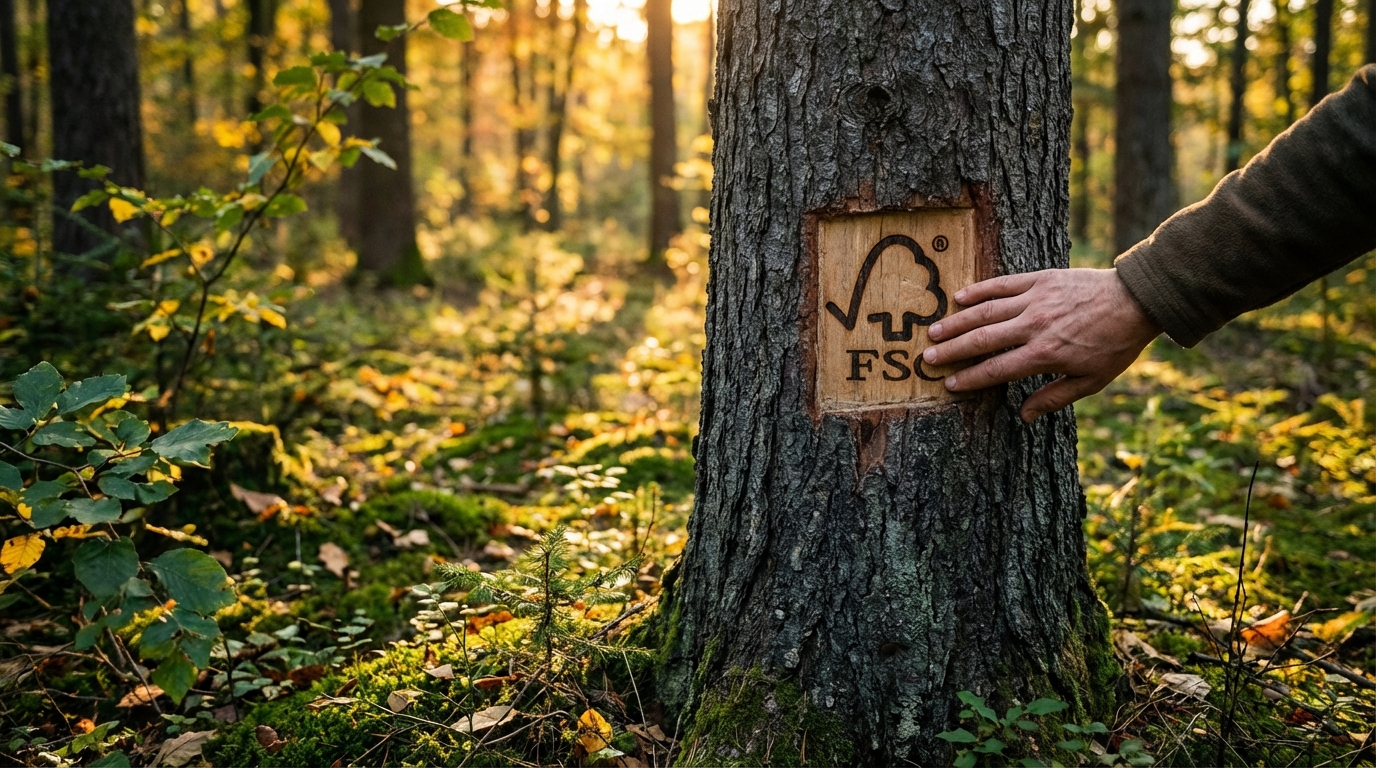
- The FSC logo (the tree with a check mark).
- The label text (FSC 100%, FSC Mix, or FSC Recycled).
- The FSC license code, usually like: FSC-C123456 or an “FSC N” code for brands.
Example of a correct on-product code format:
> “FSC Mix”
> FSC-C012345
If you cannot find any code, that is already a red flag.
Step 2: Check the supplier in the FSC public database
Go to FSC’s public search tools:
- Certificate search (for certified companies).
- Trademark license holder search (for brands using FSC trademarks).
What to do:
- Enter the FSC code (for example, FSC-C123456) or the supplier’s company name.
- Confirm:
- The certificate is valid (not expired, not suspended).
- The certified scope covers the product you are buying (for example, “sawn timber,” “paperboard,” “furniture manufacturing”).
> If the code does not exist, or the certificate is suspended, do not accept the FSC claim until it is clarified.
Step 3: Check the invoice for FSC claims
For any business that wants to make FSC claims, the invoice should show:
- The suppliers FSC CoC code (like FSC-C123456).
- The FSC claim next to each item, for example:
- “Pine sawn timber 50×150 mm FSC 100%”
- “Plywood 18 mm FSC Mix Credit”
- “Corrugated boxes FSC Recycled 100%”
If you only see the logo on a box, but no FSC claim on the invoice, your ability to prove ethical sourcing is weak.
Step 4: For complex projects, trace the chain
If you are working on a large building, a product line, or a brand commitment like “100% FSC by 2028,” you should:
- List each supplier in your chain (forest owner, sawmill, wholesaler, manufacturer, printer, retailer).
- Collect the FSC CoC code for each one.
- Store copies of certificates and invoices in a simple digital folder system.
That way, if a client, auditor, or NGO questions your claims, you have traceable evidence.
> Many brands fail this step. They make nice public claims but cannot show consistent invoices and chain-of-custody links when asked.
How businesses can build an “ethical wood” system around FSC
If you are not just a consumer but a business (builder, furniture maker, architect, retailer), you have more responsibility and more leverage.
Here is a practical structure that works without endless paperwork.
1. Define your ethical wood policy
Keep it to one page. Plain language. For example:
- “We prioritize FSC-certified wood (100%, Mix, or Recycled) for all products and projects.”
- “We will not buy wood that is known or suspected to come from:
- Illegal logging.
- Recent conversion of natural forests to plantations or non-forest use.
- Violations of Indigenous or community rights.
- “When FSC is not available, we will require alternative proof of legal and responsible origin and work toward an FSC solution within a specific timeframe.”
This gives your team and your suppliers a clear target.
2. Identify where wood enters your system
Make a simple list:
- Construction timber from merchant A.
- Plywood from distributor B.
- Veneer and board for furniture from supplier C.
- Packaging and printed materials from printer D.
For each input, ask:
- Do we already have FSC options?
- Are they used by default or only when a client asks?
> Many companies realize that some team members quietly choose cheaper non-certified options unless there is a tender requirement. You want to reverse that: FSC by default, exceptions documented.
3. Talk to suppliers and switch where needed
Send a short, clear message:
- Tell them you are moving to FSC as standard for all wood-based products.
- Ask:
- Are you FSC certified? If yes, what is your CoC code?
- Which of our products can you supply with FSC labels and at what quantity?
- Give them a date by which you prefer all regular products to be FSC.
If a supplier cannot or will not offer FSC, you have a decision:
- Work with them on a transition timeline.
- Or gradually move to a supplier who can support your ethical sourcing goals.
4. Build basic traceability inside your business
You do not need a giant IT project. Start with:
- A shared spreadsheet listing:
- Supplier name.
- FSC code.
- Product types and FSC claims.
- Dates of last certificate check.
- A shared drive or folder where:
- FSC certificates are stored (PDFs).
- Purchase invoices with FSC claims are saved.
- A simple rule in purchasing:
- No “FSC” can be written on tenders, marketing, or labels unless:
- We have valid certificates in the folder.
- We have invoices showing the correct FSC claims.
- No “FSC” can be written on tenders, marketing, or labels unless:
Think of it like keeping receipts for your ethical claims.
5. Train your team on the basics
Most compliance failures happen because staff:
- Do not know the difference between FSC and other labels.
- Confuse “FSC certified supplier” with “all products from them are FSC.”
- Do not check invoices for FSC claims.
Run a short session where you cover:
- The three label types (100, Mix, Recycled).
- How to read an FSC invoice claim.
- How to look up a certificate online.
- Who to ask if there is doubt.
> One hour of targeted training can prevent years of misleading claims and damaged trust.
Common mistakes that undermine “ethical wood” claims
If you want your ethical promise to be real, you should avoid these frequent errors.
1. Assuming any “tree logo” equals FSC
There are many logos on wood and paper:
- FSC (Forest Stewardship Council).
- PEFC (Programme for the Endorsement of Forest Certification).
- Recycling symbols.
- Generic “eco” icons created by brands.
Do not treat them as the same.
If your policy or marketing says “FSC wood,” then the product must actually be FSC, not some other label.
2. Relying only on supplier promises
A line like:
> “We source only sustainable wood”
on a website or price list means very little by itself.
You should always ask:
- “Can you show us your FSC (or other) certificates and example invoices with claims for the products we buy?”
If they cannot, their “sustainable” claim is just marketing.
3. Treating FSC as all-or-nothing perfection
FSC is not perfect. There are:
- Case studies where certified companies were accused of problems.
- Critiques by NGOs about specific regions or companies.
- Ongoing debates about how strong the controlled wood system is.
But that does not mean there is no value.
Think of FSC as a strong floor, not a ceiling. You can layer additional requirements on top, for high-risk regions or sensitive projects.
For example, you might say:
- “We require FSC certification plus:
- Extra due diligence on high-risk countries (risk-based mapping, satellite checks, or third-party risk tools).
- Preference for long-term partners with good transparency on their forest operations.”
4. Forgetting about packaging and print
Many companies focus on wood in products and buildings, but ignore:
- Shipping cartons.
- Retail packaging.
- Brochures and catalogs.
- Labels and hang tags.
These can also carry FSC labels. Shifting them to certified or recycled options is often easier than changing your core raw material supply, and it sends a consistent message.
Comparing FSC with other wood certification systems
You will often see FSC mentioned together with PEFC and national schemes. If your goal is ethical wood, you should know at least the basics of how they compare.
| Aspect | FSC | PEFC (and endorsed schemes) |
|---|---|---|
| Global reach | Large global coverage, strong in both tropical and temperate regions | Very strong in Europe and North America, with many national schemes endorsed |
| Governance | Three chambers: environmental, social, economic, equal voting | Umbrella for national systems; structures vary |
| Perceived strength on environment & rights | Often seen by NGOs as stricter on conservation and Indigenous rights | Varies by country; sometimes seen as closer to industry positions |
| Label clarity | Three main product labels (100%, Mix, Recycled) | Multiple label types; more national variation |
| Main criticism | Cases of weak enforcement, inconsistent audits in some regions | Varied strength; some schemes perceived as weaker or too flexible |
If your brand focuses strongly on ethics and you want a clear standard globally, FSC is often the first choice. Some buyers set a priority order, for example:
- Primary: FSC.
- Secondary: PEFC or other credible schemes if FSC is not available.
- With extra checks in high-risk regions, whatever the label.
What FSC means for different types of buyers
Let us look at how you can act, depending on who you are.
If you are an individual consumer
You might be choosing:
- Furniture for your home.
- DIY timber from a hardware store.
- Flooring or decking.
- Paper products and packaging choices.
Practical steps:
- When comparing products, check:
- Does it have an FSC label on the product or packaging?
- What type (100%, Mix, Recycled)?
- If a store promotes “sustainable wood”, ask:
- “Which items here are FSC certified?”
- “Can you show me where the FSC label or product code is?”
- Tell retailers that FSC matters in your choice. That feedback really does reach their buying teams over time.
> Even if one purchase feels small, a steady pattern of customers asking for FSC pushes large retailers to change suppliers.
If you are an architect or designer
You influence material choices in projects.
You can:
- Specify “FSC-certified wood (FSC 100% or Mix) for all structural timber and visible wood surfaces” in tender documents.
- Require documented FSC claims for key wood elements before approval.
- Coordinate with contractors early so they can source FSC material in time and not treat it as an afterthought.
- Use FSC credentials as part of your story when you present your work to clients.
Clients increasingly ask how their buildings or products affect forests. If you are already careful with FSC, you will be ready.
If you are a manufacturer or brand
You have three main levers:
- Supply chain: Move your suppliers to FSC and phase out non-certified wood.
- Certification: Get your own FSC Chain of Custody so you can label your products and make controlled claims.
- Communication: Be specific in your claims:
- Rather than “We use ethical wood,” say “70% of our wood by volume is FSC certified as of 2025; our target is 100% by 2028.”
Transparent numbers are more credible than vague promises.
Key limits of FSC and how to go further
To keep this grounded, you should be aware of the main limits.
Known challenges
Some recurring concerns from researchers and NGOs include:
- Variation in audit quality between regions and certification bodies.
- Complaints that take time to resolve.
- Cases where certified entities were accused of social or environmental harm.
So while FSC is stronger than most alternatives, it is not a guarantee of perfection.
How to strengthen your ethical sourcing beyond FSC
If your project is high profile, sensitive, or in a high-risk region, you can add extra layers:
- Use satellite-based deforestation monitoring tools for key supply regions.
- Ask suppliers for more detailed forest-of-origin information.
- Engage with local NGOs who track forest issues in your sourcing countries.
- Support suppliers who work with community forests or Indigenous-led projects.
> Think of FSC as your baseline, then adapt based on risk and your own values.
Frequently asked questions about FSC and ethical wood
Is FSC the same as “legal” wood?
No. FSC includes legality, but it goes further.
Legal wood might still come from:
- Natural forests converted to plantations.
- Operations that meet weak national standards for worker safety.
- Areas where Indigenous or community rights are not well protected by law.
FSC applies a stronger, more consistent set of rules across countries.
Does FSC guarantee that no forest was ever cleared?
No. Many FSC-certified forests have a history of past logging and management, and some certified plantations are on land that was converted in the past.
FSC tries to:
- Prevent new conversion of natural forest for plantations under certification.
- Protect remaining high conservation value areas.
- Manage existing forests in a more responsible way.
If your concern is intact primary forest, you might combine FSC with additional screening tools for forest intactness and deforestation risk.
Is FSC wood always more expensive?
Not always.
Patterns that often show up:
- For standard construction timber in regions where FSC is common, price differences can be small or zero in practice.
- For niche products or where FSC supply is limited, there can be a price premium.
- For paper and packaging, large buyers can often get FSC with very small or no price difference when it is part of a long-term contract.
The real cost question is sometimes about planning. If FSC is requested late in a project, supply constraints can push prices up; if it is in the design and tender from the start, suppliers can plan.
How to talk about FSC and ethical wood without overpromising
This part is easy to overlook, but very important.
Be precise with your wording
Avoid broad, absolute claims like:
> “All our products are ethical”
> “We only use sustainable wood”
Instead, say:
- “All our solid wood furniture is made with FSC-certified wood.”
- “As of 2025, 85% of our paper and packaging by volume is FSC certified; the rest meets documented legal origin standards while we work to reach full coverage.”
This approach builds trust and sets you up for real progress.
Share your numbers and your journey
People respond better to transparency than to perfection claims.
For example, as a brand, you might show:
- A simple chart: share of FSC-certified wood by year.
- Targets for the next 3 years.
- Key focus areas, like “converting all packaging to FSC Recycled” or “switching our decking lines to FSC 100% tropical hardwood or FSC-certified alternatives.”
> When you are honest about where you are and where you are heading, customers, staff, and suppliers are more likely to support you.
Simple practical tip to start ensuring your wood is ethical
Pick one regular product or material you buy that contains wood or paper, ask the supplier for FSC-certified options and their CoC code, verify it in the FSC database, and then make that FSC version your new default for all future orders.