
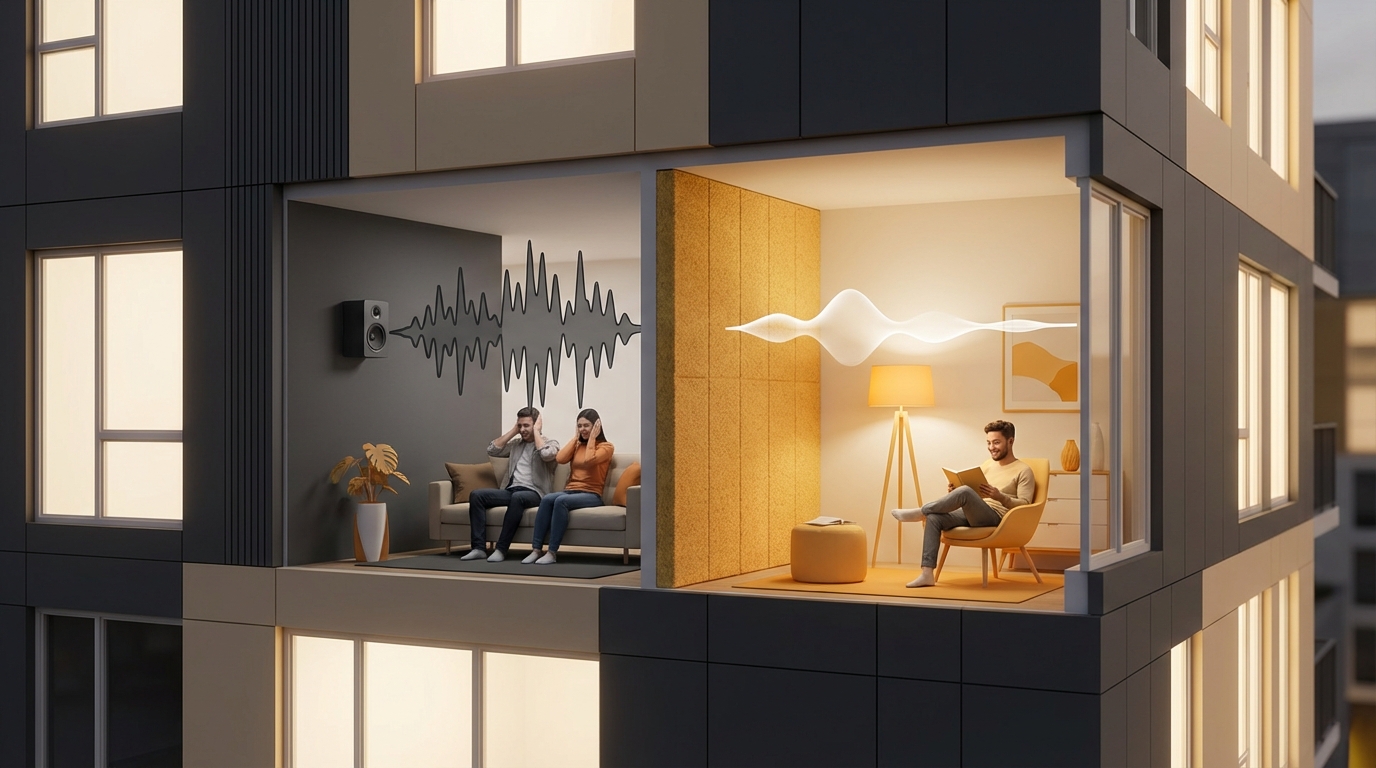
So, you are trying to figure out soundproofing for multi-family units to keep tenants happy and reduce complaints about noise.
You fix that by controlling three things: impact noise, airborne noise, and flanking paths with the right mix of materials, construction details, and clear building policies.
Most tenant complaints about noise are not about “loud neighbors” as much as they are about poor building design. If you manage a multi-family property, or you invest in one, sound is not just a comfort issue. It hits your bottom line: higher churn, more vacancies, more bad reviews, more staff time spent on complaints. The good news is you do not need a recording studio. You just need to hit reasonable acoustic targets and fix the worst weak points.
Things you need to know:
- Sound in apartments comes from two main sources: impact (footsteps, dropping items) and airborne (voices, TV, music).
- Floors and ceilings cause more problems than walls in most multi-family buildings.
- Soundproofing is much easier and cheaper during construction than in occupied units.
- Retrofitting needs a mix of materials: underlayments, resilient channels, acoustic caulk, and sometimes new drywall layers.
- Building codes set minimum STC and IIC ratings, but tenants often expect better than the minimum.
- Noise control is not only about materials; layout, building rules, and tenant education matter just as much.
- Good documentation and photos of assemblies help you lease faster and defend against complaints.
“Most ‘noisy neighbor’ problems in apartments are really design problems, not people problems.”
What “soundproofing” really means in apartments
When people say “soundproof apartment,” they imagine total silence. That is not realistic in multi-family buildings. Your goal is not zero noise. Your goal is to keep noise at a level where people do not feel disturbed or disrespected.
Two key numbers matter here:
- STC (Sound Transmission Class): how well a wall or floor/ceiling blocks airborne sound like speech, TV, or music.
- IIC (Impact Insulation Class): how well a floor/ceiling reduces impact noise like footsteps or chairs dragging.
Here is a simple way to think about them:
| Rating | Perceived performance (real-world feel) |
|---|---|
| STC 35 | You hear normal speech clearly through walls. |
| STC 45 | You hear muffled voices; clear only when someone talks loud. |
| STC 50 | You barely hear speech; loud TV is faint. |
| IIC 40 | Every step from upstairs is noticeable and annoying. |
| IIC 50 | Footsteps are still heard but less sharp; complaints continue. |
| IIC 55+ | Footsteps are much softer; most tenants accept the level. |
Minimum code often hits around STC 50 and IIC 50. In practice, you want to aim a bit higher, especially for mid-range or premium buildings.
Impact vs airborne noise: why tenants complain
If you listen to recorded tenant calls, you will see a pattern:
- “My upstairs neighbor is stomping all night.”
- “I can hear their entire conversation through the wall.”
- “Kids running above my unit every morning.”
- “The bass from next door keeps me awake.”
Those map to:
- Impact noise: footsteps, dropped items, chairs dragging.
- Airborne noise: voices, TV dialogue, music, phone calls.
- Low-frequency noise: subwoofers, bass, big dogs running.
Different construction details help different problems. Hardwood floors with no underlayment are terrible for impact. Shared plumbing walls with no insulation are terrible for airborne sound. You need to know where the weak links are.
“If you only remember one thing: hard surfaces make impact noise worse; light hollow walls make airborne noise worse.”
Where noise really travels in multi-family buildings
Sound does not care about your floor plan. It travels through any stiff connection between units. These are the main paths:
- Floor/ceiling between units.
- Shared walls (party walls, corridor walls).
- Flanking paths: ducts, pipe chases, electrical outlets back-to-back.
- Exterior noise getting in through windows and doors.
Floors and ceilings: the usual trouble spot
For stacked units, the floor/ceiling assembly is the biggest driver of complaints.
Common weak assemblies look like this:
- 2×10 joists, subfloor, hardwood or LVP on top, drywall below, no insulation, no resilient mounting.
- Concrete slab with thin laminate on top, no acoustic underlayment.
These feel “solid” to walk on, but they transmit impact noise well. That is why a light step above someone sounds like a hammer below.
If your reviews mention “stomping,” the floor/ceiling assembly is your main suspect.
Walls: not always the villain, but often part of it
Interior walls between units matter, especially around:
- Bedrooms backed up to living rooms in the next unit.
- Bathrooms and laundry rooms sharing walls.
- Hallways that act like echo chambers.
Common weak wall assemblies:
- Single 2×4 stud wall, drywall each side, no insulation.
- Back-to-back electrical boxes, no acoustic sealant.
- Continuous studs from one unit to the next, creating a direct sound bridge.
Here you get that “I can hear every word” complaint.
Flanking paths: the sneaky problems
You can have a thick wall and still get bad noise transfer because sound goes around it.
Some common flanking issues:
- Shared ductwork with large openings between units.
- Unsealed pipe penetrations between floors and walls.
- Continuous ceiling cavities above demising walls.
- Doors with large undercuts into loud corridors.
“Most retrofit jobs fail not because the wall is weak, but because sound escapes through a gap no one paid attention to.”
Designing sound control in new multi-family construction
If you are early in a project, you are in the best position. You can lock in details that save you thousands per unit later.
Set performance targets early
Do not just say “meet code.” Set clear, measurable targets like:
- Party walls: STC 55 minimum lab rating, aiming for field STC 50 or better.
- Floor/ceiling between units: IIC 55 rated assembly; field IIC 50 or better.
- Corridor to unit walls: STC 45 or better.
- Bedroom adjacency: avoid direct bed-to-TV layouts across party walls.
Put these numbers in your design brief and in your contracts with your architect and GC. Noise is easier to manage when everyone knows the standard.
Better assemblies that do not blow the budget
Here are common upgrade paths that stay relatively cost-effective.
| Element | Basic code approach | Upgraded approach for happier tenants |
|---|---|---|
| Party wall | Single 2×4 stud, R-13 insulation, 1 layer 1/2″ drywall each side | Staggered studs or double studs, mineral wool, 2 layers 5/8″ drywall (one layer possibly damped), acoustic sealant at edges |
| Floor/ceiling wood | Joists, subfloor, carpet or LVP, 1 layer 1/2″ drywall below | Acoustic underlayment under finish, insulation in cavity, resilient channel or clips + double 5/8″ drywall below |
| Floor/ceiling concrete | Thin underlayment or direct glue LVP, simple drywall ceiling | Tested acoustic underlayment with lab IIC > 60, suspended ceiling with insulation |
| Doors to corridors | Hollow core, standard seals | Solid core, perimeter seals, smaller undercut or threshold |
You do not need every upgrade in every building. You focus on where people sleep and where they spend most of their time.
Plan your layout around sound
Material upgrades help, but layout decisions often matter just as much and cost nothing during design:
- Back living rooms to living rooms, bedrooms to bedrooms, not bedrooms to living rooms.
- Put noisy rooms (laundry, elevators, trash, gyms) away from bedrooms.
- Group mechanical rooms and risers together, not behind headboards.
- Keep amenity decks and rooftop terraces away from the quietest stacks.
Think about one real person living in a unit below: would they accept that bedroom wall next to an elevator shaft? If you would not sleep there, your tenants will not either.
Pay attention to details during construction
On site, small shortcuts can kill your performance:
- Unsealed gaps at the edges of drywall around the floor and ceiling.
- Drywall cut tight to pipes and ducts without acoustic caulk.
- Resilient channels installed directly onto studs with screws that are too long and bridge into studs.
- Demising walls stopping short of the structural deck above the ceiling.
You want:
- All demising walls continuous from slab to slab or roof deck, with sealed gaps.
- Acoustic sealant at perimeter joints, not just standard painter’s caulk.
- No “shortcuts” that tie separated assemblies together.
- Photo documentation of key assemblies for your records and marketing.
“A $5 tube of acoustic sealant in the right place can save you thousands in future complaints and retrofit work.”
Retrofitting existing multi-family units
Most owners are not starting from scratch. You inherit a building with thin walls and noisy floors and you need to make it tolerable without gutting everything.
Think in tiers: light fixes, medium fixes, and heavy construction.
Step 1: Diagnose the problem accurately
Before tearing into walls, figure out what type of noise you are dealing with:
- If you hear footsteps, thuds, or chair scrapes: focus on floors and ceilings.
- If you hear clear voices: focus on walls between units.
- If you hear noise through vents: focus on ductwork and flanking.
Walk units above, below, and next door while someone makes controlled noise: talking, walking with shoes, dropping a light ball. Take notes by location and time. Patterns will show you where to focus your budget.
Light retrofit options (low disruption)
These are things you can often do between turns or with short access to units.
- Soft floor coverings: encourage or require area rugs in upper units, especially under living room furniture and hallways.
- Underlayment under new flooring: when turning units, choose tested acoustic underlayments under LVP or laminate.
- Door upgrades: swap hollow corridor doors for solid core when units turn; add better weatherstripping.
- Seal obvious gaps: around electrical boxes, baseboards, and pipe penetrations with acoustic sealant or fire-safe sealants where needed.
These do not solve severe problems but can reduce annoyance and frequency of complaints.
Medium retrofit options (more construction, better results)
For units or stacks with chronic issues, you may need to build new layers.
1. Add a sound-resistant ceiling
From the lower unit, you can:
- Remove the existing drywall ceiling.
- Add mineral wool insulation between joists.
- Install resilient clips and hat channel.
- Add two layers of 5/8″ drywall, staggered seams, with acoustic sealant at edges.
This can improve both impact and airborne performance, especially when combined with better flooring in the unit above during turns.
2. Build a “decoupled” wall over an existing party wall
From the unit with the biggest problem:
- Build a new 2×3 or 2×4 stud wall in front of the existing wall, with a small air gap.
- Add mineral wool in the new studs.
- Use double 5/8″ drywall, possibly with damping compound between layers.
- Seal all edges with acoustic sealant.
You lose a few inches of floor space, but tenants often accept that trade for a quieter bedroom.
3. Treat mechanical and plumbing chases
Common steps:
- Add insulation around drain pipes where accessible.
- Add mass (additional drywall layers) around chase walls.
- Seal gaps where pipes penetrate floors and walls.
This helps with the “I hear every flush and shower” complaint.
Heavy retrofit options (for worst-case buildings)
Some buildings from certain decades or with very light framing just perform poorly. If you have frequent turnover and constant complaints in the same stacks, it might be cost-effective to:
- Strip ceilings and add full acoustic assemblies building-wide.
- Replace or float floors with thicker underlayments and possibly engineered floating systems.
- Rebuild certain party walls as double-stud assemblies when units are vacant for longer periods.
This is closer to a value-add project than a quick fix. It works best when you combine it with other upgrades: new kitchens, baths, and common areas. The acoustic story then becomes part of your marketing.
“For heavy retrofits, sound control should not be a side project. Treat it as part of your repositioning plan and your rent strategy.”
Balancing cost, performance, and tenant expectations
You cannot fix every noise issue in every building. You need a strategy.
Segment by building class and target renter
A realistic profile helps you decide how much to invest.
- Workforce / entry-level units: meet or slightly beat code; focus on the worst stacks; clear house rules about noise.
- Mid-range properties: hit better-than-code targets in bedrooms and between units; show acoustic features in leasing tours.
- Premium / luxury: treat sound control almost like a key amenity; invest more in floors, windows, and layout.
Tenants paying higher rent expect quieter living, even if they do not use the word “STC” in their reviews.
The ROI of noise control
From a management view, sound control affects:
- Turnover: noise is often in the top 3 reasons people move out in multi-family surveys.
- Online reviews: a few “noisy” complaints can drag down your ratings.
- Staff time: repeated “call-and-note” cycles for noise complaints eat into your operating budget.
You can track:
- Number of noise complaints per month per 100 units.
- Average length of stay in “quiet” stacks vs “noisy” stacks.
- Rent premiums or faster leasing in upgraded acoustical units.
Once you have data, you can treat acoustic upgrades like any other capital improvement with an expected payback.
Non-construction strategies that help a lot
Not every solution is drywall and underlayment. Policy and communication matter too.
Noise rules that are actually practical
You do not want to be the noise police all day, but you need clear lines.
Simple guidelines that help:
- Quiet hours: for example, 10 pm to 7 am for loud activities.
- Flooring: require a minimum percentage of soft coverings (like area rugs) in units with hard floors.
- Subwoofers and large speakers: limit placement near shared walls; encourage isolation pads.
- Exercise equipment: restrict heavy treadmills and weights in upper floors or over bedrooms.
Write your rules in plain language. Tie them to “respecting your neighbors” more than to punishment.
Educate tenants gently, not aggressively
Most renters do not think about acoustic behavior. A small welcome sheet can change that.
Some ideas:
- Suggest placing beds away from shared walls when possible.
- Suggest rugs and felt pads under furniture to reduce impact noise.
- Explain how noise travels and when to contact management.
- Offer small incentives for compliance, like a discount on rug purchases through a partner store.
You want tenants to see you as a partner in making the building quieter, not as someone telling them how to live.
How to handle noise complaints without making things worse
When someone calls about a noisy neighbor, your response can either calm or inflame.
A simple process:
- Listen and document: location, time, type of noise.
- Explain the limits of the building construction honestly.
- Offer practical steps: rugs, furniture rearrangement, white noise machines.
- Only escalate to warnings or enforcement when there are clear, repeated rule breaks.
Often the complaint is less about the absolute level and more about feeling ignored. A clear plan and follow-up calls make a big difference.
Tech options: where they help and where they do not
Because this is a tech-focused blog, you might wonder how much technology can help with sound issues. There are some useful tools, but none replace good construction.
White noise and sound masking
These systems inject low-level background noise to make speech less intelligible and small sounds less noticeable.
In multi-family, that can be:
- White noise machines for bedrooms.
- App-based sound masking with curated sounds (rain, fan noise).
- Corridor sound masking in some designs to reduce trackable footsteps and voices.
They do not stop noise, but they reduce how much your brain locks onto occasional sounds.
Smart building design and modeling tools
On the design side, more firms use software to predict acoustic performance:
- 3D modeling that includes acoustic assemblies and estimates STC/IIC.
- Tools that analyze floor plans for “bad” adjacencies between units.
- Simple mobile apps for on-site field acoustic tests after construction.
If you are an owner or developer, asking your design team about these tools nudges them toward more thoughtful design.
Smart sensors and monitoring
Noise sensors exist that track decibel levels without recording speech. They are more common in short-term rentals, but some multi-family operators are starting to test them in amenities or problem areas.
You need to be careful with privacy and local laws. These are better for common spaces or for monitoring bars and event rooms than for standard apartments.
“Tech works best in sound control when it supports good design and fair policies, not as a bandage over bad construction.”
Marketing quieter units as a real differentiator
If you invest in better sound control, you should talk about it. Many properties either ignore it in their marketing or use vague claims.
Explain sound control in simple terms
Most renters do not know STC or IIC, but they know what sleep is worth.
You can say things like:
- “Walls built with double layers of drywall and special insulation between apartments to reduce noise transfer.”
- “Floors include acoustic underlayment to soften footstep noise between units.”
- “Mechanical rooms and elevators separated from bedrooms by thicker walls and extra insulation.”
Avoid absolute promises like “fully soundproof.” Focus on “quieter than typical apartments” and “designed to reduce noise between neighbors.”
Use documentation and photos in tours
If you have photos from construction:
- Show framed walls with insulation and double studs.
- Show resilient channels on ceilings.
- Show acoustic underlayments going down under floors.
People trust what they can see. If you are touring a prospective tenant who cares a lot about noise, those photos can close the lease.
Gather and show social proof
Monitor reviews and comments. When someone mentions quiet units, highlight those quotes in your marketing materials.
For example:
“One of the things I like most is how quiet my apartment is. I rarely hear my neighbors at all.”
This kind of comment builds more trust than any marketing line you write yourself.
Practical checklists you can use right now
You do not have to tackle everything at once. Start with simple audits.
Quick inspection checklist for an existing building
Walk a few units and check:
- Do party walls go all the way up to the structural deck or stop at the suspended ceiling?
- Do you see gaps around pipes, ducts, or cable penetrations between units?
- Are corridor doors hollow or solid core? Are there seals or just simple weatherstripping?
- Do upper-floor units with hard flooring have underlayment documentation on file?
- Do you have repeating complaints from the same stacks in your logs?
This first pass tells you where to focus more detailed investigation or bring in an acoustical consultant.
Simple improvements you can schedule in the next year
Over the next 6 to 12 months, you might:
- Standardize acoustic underlayment for every new hard floor installation.
- Switch corridor doors to solid core when they reach the end of their life.
- Begin sealing obvious gaps with acoustic caulk during routine maintenance.
- Update house rules and welcome materials with practical noise guidance.
- Start collecting data on noise complaints by stack and by floor.
Each of these steps is small on its own, but together they change how people experience your building.
One practical tip to act on this week
Pick the noisiest stack in your property based on complaints, and spend 30 minutes standing in each unit at a busy hour, just listening and taking notes on where the noise seems to come from.
Real-time listening in real units will guide your next investment far better than any generic checklist.