
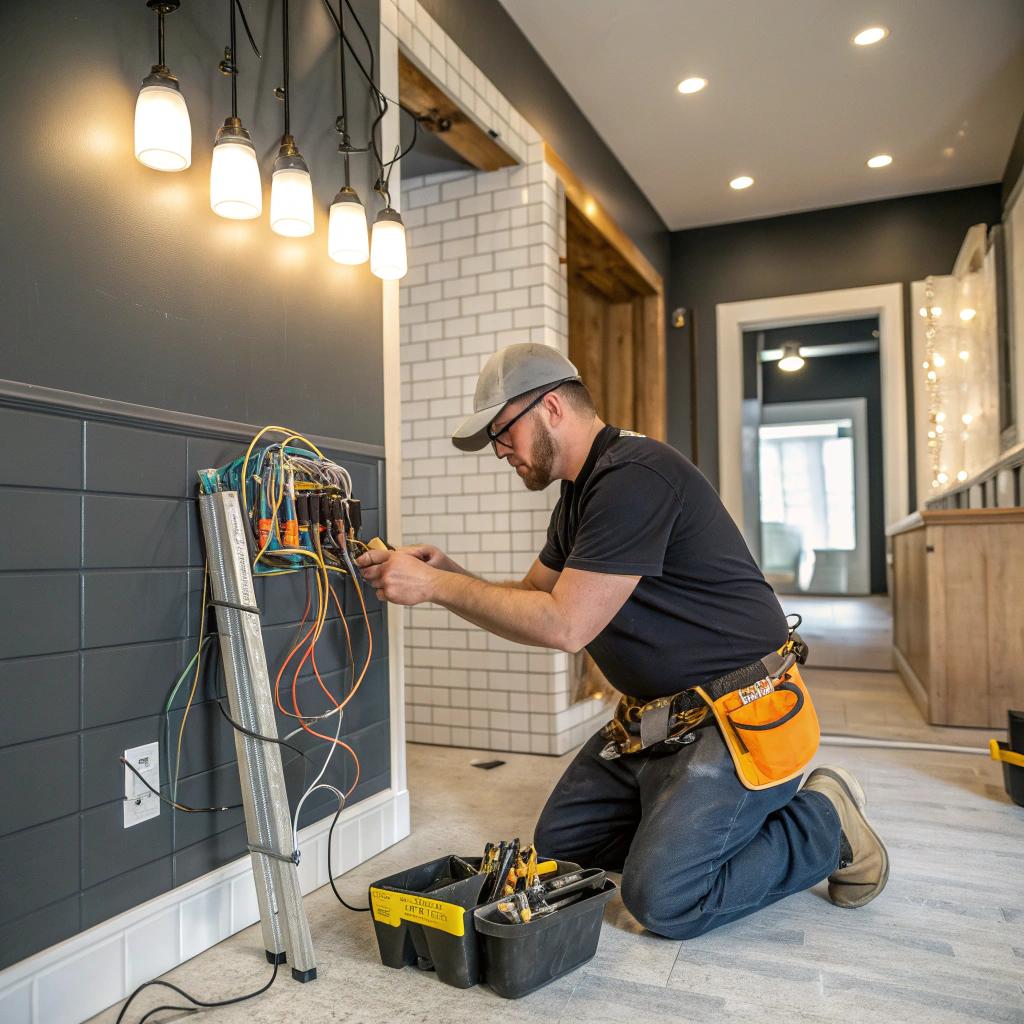
So, you are trying to find the best electrician in Indianapolis for your remodel. You do that by checking licensing, remodel experience, past projects, and how well they coordinate with other trades like flooring and carpentry.
Most remodel problems with electrical work do not come from the code book. They come from poor planning, rushed work behind walls, miscommunication with other contractors, and shortcuts that never show up until you move back in. If you pick the right electrician early, your remodel goes smoother, your flooring installer is happier, and you avoid tearing up brand new finishes because someone forgot a circuit or misread the layout.
Here are a few things you need to know right away:
- Licensing and insurance are non‑negotiable.
- Remodel experience matters more than new construction experience.
- Good electricians plan around flooring, cabinets, and layout, not just wires.
- Clear bids and written scopes prevent surprise costs later.
- Communication and cleanliness matter almost as much as skill.
If you already know you want to talk to a pro, you can start by checking an established electrician in Indianapolis and then compare from there. But if you want to understand the process, and not just hire the first name you see, keep reading. It will save you time and probably some money too.
Why remodel electricians are different from new build electricians
A lot of people assume that “an electrician is an electrician.” On paper that sounds fair. In real remodels, it is not.
Working in an older home during a remodel is a different job than wiring a brand new shell.
What remodel work actually looks like
Remodel electrical work usually involves:
- Opening walls and ceilings that might hide old or unsafe wiring
- Matching new circuits with an old panel that may already be crowded
- Routing wires without damaging new flooring, cabinets, or trim
- Solving unexpected problems, like ungrounded outlets or aluminum wiring
- Coordinating around other trades and existing finishes
New construction is more straightforward. You have open studs, open ceilings, and no one cares if there is sawdust everywhere.
In an active home remodel, you cannot behave like that. Or you can, but your life will be stressful.
For remodels, you want an electrician who is patient, flexible, and used to working inside finished spaces, not just empty frames.
If an electrician mostly talks about large new builds, apartments, or commercial projects, they might be talented but still not the right fit for a kitchen or basement remodel in a 1970s house on the north side.
How electrical work affects your renovation and flooring plans
Since this article is for people thinking about flooring and renovation, it helps to look at how electrical and flooring connect. They affect each other more than people expect.
Electrical first, flooring later (usually)
If you put new hardwood or luxury vinyl plank down before rough electrical is done, you raise the risk of:
- Damage from ladders, dropped tools, or cut wire pieces
- Needing to cut small sections of flooring to reach a chase or wall cavity
- Dust and debris getting in joints and transitions
Most of the time, the sequence should be:
- Demolition
- Rough electrical and plumbing
- Insulation and drywall
- Prime/paint walls
- Flooring installation
- Electrical trim (devices, fixtures, covers)
Is this sequence always perfect? No. Real life is messy. You might have a room where flooring goes in early because of delivery timing. Just try to keep the dusty, noisy, wire‑pulling part of electrical finished before flooring happens.
Ask your electrician to walk the house with you and your flooring installer, even for 15 minutes, so everyone agrees on the order of work and protection of surfaces.
That one short meeting can prevent arguments later about who scratched what.
Height, layout, and how flooring changes everything
New flooring can change the finished floor height by half an inch or more. That sounds small, but it affects:
- Outlet height relative to baseboards
- Clearance for floor plug covers in living rooms
- Stair lighting placement
- Cabinet toe‑kick lighting
If you plan to add a floor outlet in a living room, your electrician needs to know:
- The exact flooring type
- Subfloor thickness
- Whether there is an underlayment
Otherwise, you might end up with a floor box that sits proud of the floor or sinks below it, which both look bad and create tripping or water issues.
This is why you really want your electrician to care about the rest of your design. If they never ask about flooring, cabinets, or furniture layout, that is a small red flag.
What to look for in an Indianapolis remodel electrician
Now to the practical part. When you are talking to electricians in Indianapolis, what should you actually ask and check?
Here are the main areas to focus on:
- Licensing and insurance
- Remodel experience and portfolio
- References, reviews, and reputation
- Estimating style and clarity
- Communication habits
- Cleanliness and respect for your home
Let us go through each one in more detail.
Licensing and insurance basics
It is not picky to ask an electrician about licensing. It is just normal. If it feels awkward, you can blame “my insurance” or “my spouse” if you want. But still ask.
You want:
- A valid Indiana electrical license, individual or company
- General liability insurance
- Workers comp if they have employees
Do not just accept “yeah, we are licensed and insured” without anything to back it up. Ask for:
- License number
- Insurance certificate (a PDF is fine)
If an electrician hesitates or gets annoyed, that tells you something. Most pros are used to that question.
Experience with remodels in older homes
Try asking questions like:
- “How much of your work is remodels compared to new construction?”
- “Have you worked on homes built around the same year as mine?”
- “What are the most common surprises you run into in remodels in Indianapolis?”
You will learn a lot from their answers. If they say things like:
- “Knob and tube wiring in Meridian‑Kessler homes”
- “Panels that are full with no room for new circuits”
- “No grounding in older outlets”
That is a good sign. They know the local housing stock.
Look for someone who can describe real projects in neighborhoods like yours, not just generic stories that could be from any city.
Questions to ask about your specific remodel
When you talk to an electrician, do not just ask “how much to rewire this kitchen?” Go a bit deeper. Here are some questions that tend to reveal how they think:
- “How would you split up the circuits in this kitchen?”
- “Where would you put outlets so the counters stay usable?”
- “Is my current panel enough for this remodel, or do you see issues?”
- “How do you protect new floors or finishes while working?”
- “What are the likely ‘unknowns’ on a job like this?”
You do not need to know all the right answers yourself. You are just listening for:
- Clear explanations in normal language
- Honesty about what they will not know until walls are open
- Willingness to talk about options, not just one way
How much does a remodel electrician cost in Indianapolis?
Prices change, but we can look at rough ranges that you might see around the city. Do not treat these as quotes. They are more like a starting point so you are not shocked when bids come in.
| Type of remodel work | Typical range in Indianapolis | What affects the price most |
|---|---|---|
| Simple kitchen update (new outlets, some lighting) | $1,200 – $3,000 | Number of circuits, type of lighting, panel capacity |
| Full kitchen remodel (appliances, circuits, lighting plan) | $3,000 – $8,000+ | Age of home, panel upgrades, undercabinet and accent lighting |
| Bathroom remodel | $800 – $2,500 | Heated floors, fans, GFCI protection, access to walls |
| Basement finish or remodel | $3,000 – $10,000+ | Size, number of rooms, home theater or office circuits |
| Panel upgrade or replacement | $1,800 – $4,500 | Amperage, condition of existing service, grounding needs |
You might notice that the ranges are pretty wide. That is normal. Conditions behind your walls matter more than the square footage on paper.
Fixed price vs hourly for remodels
Many electricians in Indianapolis will price remodels in one of these ways:
- Fixed price with clear scope: Good for well‑defined projects like “full kitchen remodel with these fixtures and this layout.”
- Time and materials (hourly): Common for troubleshooting or “open wall, see what is there” work.
- Hybrid: Base scope is fixed, but any hidden problems or extras are hourly.
Ask directly:
- “Is this a fixed price or an estimate?”
- “What would count as an extra, and how would you price that?”
- “If you run into an unexpected problem, will you stop and talk to me before going ahead?”
If you are doing new flooring, it also makes sense to ask:
- “What happens if you do need to cut into areas where the flooring will go?”
- “Can we schedule the messy work before the flooring crew arrives?”
Red flags when choosing an Indianapolis electrician
Not all red flags are dramatic. Some are small signs that tell you how the project might go.
Common warning signs
- They cannot or will not provide a license number.
- They give a quote after a 2‑minute walk‑through with no notes.
- They push you to skip permits to “save time and money.”
- They dismiss your questions or make you feel silly for asking.
- Their online reviews mention poor communication or no‑shows.
None of this proves they are bad at their craft, but it affects your remodel. You want someone who respects the fact that you are living there, or at least paying a lot of money to improve the space.
Talking about permits and inspections
In many remodels, permits are not optional. Some small jobs might not need one, but panel changes, major kitchen rewires, and new circuits usually do.
Ask:
- “Will this job need a permit?”
- “Do you handle the permit and inspection process, or do I?”
If someone says “no need for permits, inspectors just slow things down,” that is a problem. Inspectors exist to catch mistakes that can lead to fire or shock, especially in older homes with hidden issues.
It might feel like a delay, but in a big remodel, inspection time is still small compared to the full schedule.
Coordinating your electrician with your flooring installer
This is where a lot of real‑world friction shows up. Not because people are bad at their jobs, but because their schedules and priorities are different.
Simple ways to avoid problems
You do not need a project management background. Just a bit of clarity.
Try to:
- Share your flooring schedule with your electrician as soon as you know it.
- Ask your electrician which tasks must be done before flooring.
- Protect the floors with something better than old cardboard if electrical work continues.
Many pros like Ram Board or similar floor protection. It is not perfect, but it is better than plastic that shifts or tape that damages finishes.
Think of your schedule as “rough work first, pretty finishes last.” If anything breaks that rule, slow down and ask why.
Common conflict points between electrical and flooring
You might run into tension around:
- Floor outlets in living rooms or offices
- Heated floor systems that tie into electrical circuits
- Doorway clearances where wires or thresholds meet
- Lighting controls for stair treads or step lights
For floor outlets, have your electrician and flooring installer agree on:
- Exact location measured from walls
- Type of box and cover (rated for your use)
- Timing of when the box gets set relative to the flooring install
For heated floors in bathrooms, coordination is even more important. The electrician needs to:
- Power the heating mat or cable on an appropriate circuit
- Install a thermostat at a comfortable height
- Test the system before tile or flooring goes down and again after
Planning your electrical layout for a remodel
Good electricians will help with layout, but you should still think through how you will use each room. That way, you can ask for what you actually need, not just the code minimum.
Kitchen remodel ideas to discuss
Think about:
- Countertop appliances and where they will live
- Under‑cabinet lighting for work surfaces
- Island outlets and possible seating areas
- Pendant lights vs recessed lights
- Walkway and toe‑kick lighting
Ask your electrician:
- “Can we walk around and mark where you think outlets and switches should go?”
- “Where would you put dimmers, and where should switches be simple on/off?”
Sometimes you will disagree with them. That is fine. The back and forth usually leads to a better layout.
Living room and bedroom remodel ideas
Here you might care more about comfort and flexibility.
Consider:
- TV wall outlet height so cords do not show
- Switched outlets vs ceiling lights
- Reading light placement near seating and beds
- Floor outlets for lamps in the middle of rooms
Electrical changes and flooring meet strongly in living rooms. Once the new floor is down, you will not want to cut into it. So think ahead about where you expect furniture to go.
You probably will move furniture over the years, that is true. Still, plan for how you live now, not some ideal version that might never happen.
Basement and home office remodel ideas
Basements and offices often need:
- Extra outlets for computers and equipment
- Stronger lighting to avoid dark corners
- Dedicated circuits for treadmills or home gyms
- Low‑voltage wiring for internet and media
Ask your electrician how they like to separate circuits:
- “Would you put the office on its own circuit?”
- “If I add a server, extra monitors, or more gear later, is there room for that?”
Sometimes people underbuild in basements because they do not live there yet. Then once it is finished and nice, they start using it more than the main level and wish they had planned for more circuits.
How to compare quotes from Indianapolis electricians fairly
You do not want to pick based only on price. At the same time, you probably have a budget. Comparing quotes can feel confusing, but you can make it simpler.
Create a simple scope sheet
Before you ask for quotes, write down a short, consistent description of the work. Something like:
- “Full kitchen remodel: new circuits for appliances, GFCI outlets along counters, under‑cabinet lights, new recessed lights, pendant over island, switch layout as marked, connect to existing 200A panel.”
- “Bathroom remodel: dedicated circuit for heated floor, GFCI protection at vanity, exhaust fan with timer, one vanity light, one shower light.”
Send this same description to each electrician. That way, you are not comparing three totally different scopes.
Then, when quotes come in, look for:
- Clear breakdown of labor and materials or at least line items for key parts
- Notes on what is included and what is excluded
- Warranty terms on workmanship and materials
Questions to ask after you get quotes
If one quote is far lower than the others, ask:
- “Can you walk me through what this includes, just to be sure I understand?”
- “Are permits included in this price?”
- “What kind of fixtures or materials are you planning to use at this price point?”
If one is higher but feels more detailed, you can say:
- “I like how clear your scope is. I have other quotes that are lower, but not as detailed. Is there anything they might be leaving out that you see often?”
You are not trying to play people against each other. You are just trying to compare apples to apples, as close as you can.
How to work with your electrician during the remodel
Once you pick an electrician, your job as the homeowner is not over. You still have a role.
Set communication expectations early
Ask:
- “What is the best way to reach you during the project?”
- “How often will you update me on progress or changes?”
- “Who should I talk to on site if you are not here?”
Some electricians are great in person but slow by text. Others are the opposite. Learn their style and adjust a little, but do not be afraid to ask for clear updates.
Marking and labeling on site
A simple trick that helps a lot:
- Use blue painter’s tape on walls to mark where you want outlets, switches, and fixtures.
- Write short notes like “3‑gang dimmers” or “sconce center here.”
Walk the space with your electrician and confirm these marks before they start cutting and drilling. This lowers the chance of “I thought you meant over here” problems.
If something feels off during a walk‑through, say it then. Moving a box before wiring is easy. Moving it after drywall and paint is not.
Living in the house during electrical work
If you are staying in the home during the remodel, ask your electrician:
- “Which areas will be without power, and for how long?”
- “Can you keep at least one outlet live in this room while you work?”
- “When will the noisiest and dustiest parts of the work happen?”
You might not get everything you want, but a small plan helps your daily life. For example, making sure the fridge circuit stays live, or that you have one working bathroom outlet at all times if possible.
Should you ever DIY electrical work during a remodel?
This is where opinions differ a bit. Some homeowners like to help, to save money or feel more involved. From a practical standpoint, there are a few lines that usually make sense.
Tasks homeowners sometimes handle
Some people:
- Remove old cover plates and label existing circuits
- Help with demolition that does not touch wires
- Patch small drywall areas after boxes are set
Those are mostly safe if you are careful and know where live power is present.
What tends to cause problems is when a homeowner:
- Runs their own cable incorrectly before inspection
- Installs boxes at the wrong depth or spacing
- Makes connections that are not up to code
Then the electrician has to fix or redo that work, and you pay twice.
If you want to help, talk openly with your electrician:
- “Is there anything I can do that will not slow you down or cause issues later?”
Some will gladly say “yes, remove these old fixtures” or “help label the panel.” Others might prefer to control everything. That is their choice, and you can decide if that fits what you want.
Common questions about hiring an electrician for remodels in Indianapolis
Q: How early should I bring an electrician into my remodel plans?
A: As soon as you have a rough layout in mind. Do not wait until walls are framed and floors are scheduled. If you talk to an electrician early, they can spot conflicts with the panel, layout, or budget before they turn into real headaches.
Q: Is it okay to pick the cheapest electrician?
A: Sometimes the cheapest one is fine. Sometimes they are cheap because they missed something or cut corners on planning, materials, or support. Price is one factor, but you also want clear communication, a solid track record, and a scope that actually covers what you need.
Q: Do I really need more circuits for a remodel?
A: Many older Indianapolis homes were not built for modern loads. A remodel is often the right time to add dedicated circuits for kitchens, baths, HVAC, or offices. Otherwise, you might end up with tripping breakers and limited options later. Still, you do not need to overbuild everything. Talk it through with your electrician and ask why they recommend each new circuit.
Q: How do I protect my new flooring from electrical work?
A: Schedule heavy, dusty work before flooring installation when you can. When that is not possible, use proper floor protection, set rules about ladders and tool storage, and ask your electrician how they normally handle finished spaces. A good one will have a routine for that.
Q: What if an electrician finds old, unsafe wiring during the remodel?
A: That is actually a good thing, even if it feels scary in the moment. Better to find it while walls are open than after the remodel is done. Ask for clear pictures, a written explanation, and options to fix it now versus later. Some extra cost may be unavoidable, but you can at least understand where your money is going and how it affects safety.
If you walk through your house today, what is the one room where better electrical planning would make your daily life easier?