
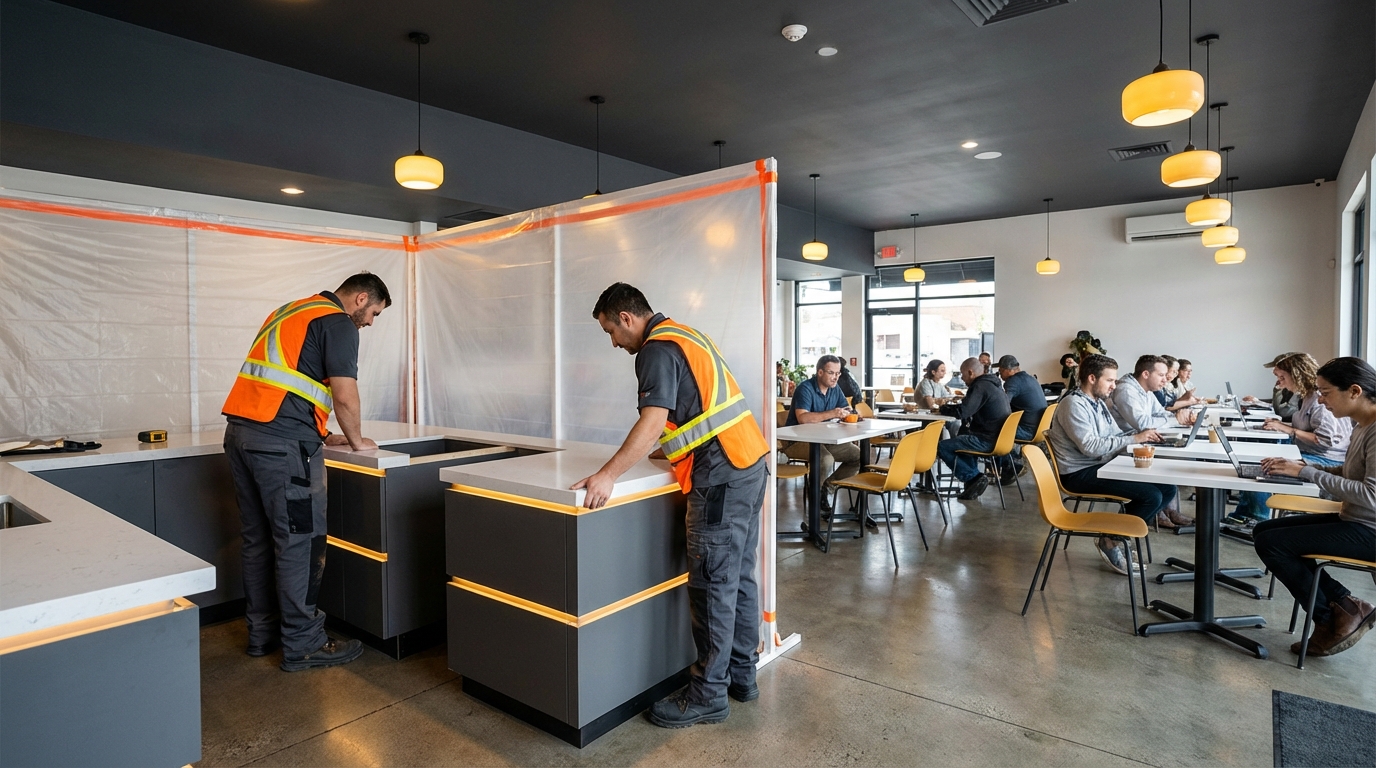
So, you are trying to figure out how to renovate with rapid installation options without closing your business and losing revenue. The short answer is: you can, but you need phased work, fast-install products, and tight scheduling around your trading hours.
You are not alone in this. Many retailers, clinics, restaurants, gyms, even small offices, need to modernize their spaces to keep up with customer expectations and safety standards. But shutting doors for even a few days can hit cash flow hard. The good news is, modern building systems and planning methods now let you do serious upgrades in evenings, overnight, or in short bursts, while you stay open.
Here are the main things that matter before we go deeper:
- Plan the work in phases tied to your opening hours and peak periods.
- Choose materials and systems that install fast, dry, and clean (click flooring, modular walls, plug-and-play tech).
- Use off-site prefabrication to shift work away from your premises.
- Protect customers and staff from dust, noise, and access issues with simple barriers and clear routing.
- Coordinate tightly with your contractors and vendors; schedule like a project, not a loose idea.
- Communicate with customers so any disruption feels managed, not chaotic.
Renovation without closing is less about magic products and more about smart sequencing, fast-install systems, and strict time control.
Why “rapid installation” matters for active businesses
So you want to renovate fast because closing for weeks or months is not an option. The pressure is real. Lost days are lost sales, but there is more to it:
- Revenue impact: A restaurant that does 2,000 dollars a day cannot casually lose 20,000 on a 10-day closure.
- Customer habits: People change habits fast. If they go somewhere else for two weeks, some do not come back.
- Staff stability: A long shutdown causes staff to look for other work.
- Cash flow: You still pay rent, utilities, and probably some payroll while closed.
Rapid installation is not just about speed for the sake of it. It is about shrinking the “non-earning” window.
Think of renovation time as downtime in a production line. Every hour the “line” is off, you lose capacity.
The good news: building products today are much more friendly to this reality than they were 15 or even 10 years ago.
Common business types and what “rapid” can look like
Different types of businesses have different constraints. It helps to see what rapid installation looks like in real cases.
Retail stores
Retail usually has:
- Peak traffic on weekends and some evenings.
- Predictable quiet windows early morning or late night.
- High sensitivity to dust, mess, and blocked aisles.
Rapid options for retail often include:
- Click-together flooring systems you can install in a few hours per zone.
- Modular shelving and gondolas you can pre-assemble off-site.
- Track lighting and electrified shelving that connects quickly.
A common pattern: close two hours early three nights per week for a month, and rework parts of the space zone by zone while staying open for all standard trading times.
Restaurants and cafes
Restaurants are more complex because of food safety, smells, and kitchen utilities.
Key constraints:
- You cannot have dust and open food in the same area.
- Cooking lines are hard to move and often the “heart” of revenue.
- Evening service can be a big share of daily turnover.
Rapid options:
- Pre-built bar counters or service stations that drop in and connect to existing plumbing and power.
- Prefinished wall panels that go over old tile with minimal demolition.
- Quick-connect kitchen equipment (plug-in refrigeration, induction units) instead of hardwired everywhere.
You see a lot of restaurants doing “midnight to 7 a.m.” shifts for heavy work, coupled with one or two single-day closures for the most disruptive pieces like deep kitchen work or major floor replacements.
Clinics, salons, and wellness spaces
Here, privacy and calm matter, and noise is an issue.
These spaces often use:
- Demountable partition systems that create or re-shape rooms in a few hours.
- Acoustic ceiling tiles that drop into grids, so lighting and HVAC changes are faster.
- Pre-plumbed treatment pods where supply and waste lines are bundled in one chase.
You can rotate rooms: renovate one cluster of rooms while using others, then swap. This keeps services running while the space changes step by step.
Core strategies to renovate without closing
Let us break the problem into the key levers you can control.
1. Phased construction planning
Phase-based planning is the backbone of staying open. Instead of “renovate everything in four weeks,” you look at the space as zones, and time as blocks.
You want to answer:
- Which parts of the space can be out of service at any given moment without killing daily revenue?
- What work can only happen when nobody is in the building?
- Which trades can overlap and which cannot for safety or space reasons?
One simple way is to map your space into a grid.
| Zone | Use | Daily revenue impact if closed | Renovation window |
|---|---|---|---|
| A | Main entrance & checkout | High | Overnight only |
| B | Secondary seating or waiting area | Medium | Off-peak hours, partial closure |
| C | Back-of-house storage | Low | Daytime possible |
| D | Restrooms | Compliance risk if all closed | One at a time only |
This simple view helps you decide where to start and where you must never shut everything at once.
Your goal is never “finish the project fastest,” it is “finish the project while protecting daily income and customer experience.”
2. Material and system choices that speed installation
If you pick the wrong materials, you box yourself into slow, messy work that forces closure. Rapid installation begins at the product selection stage.
Here are categories that usually help.
Fast flooring systems
Flooring is a big source of downtime because of curing time and smell.
Better picks for open-business work:
- Click LVT / SPC plank or tile: Installs over existing floors with minimal adhesives, easy to cut, little dust.
- Loose-lay vinyl tiles: Use perimeter adhesive only; fast removal and change.
- Carpet tiles: You can swap small sections overnight, glue is often low-odor and fast to set.
Slower or harder options when you need to stay open:
- Traditional ceramic tile with mortar and grout.
- Site-finished hardwood that needs sanding and multiple coats.
- Old-style solvent-based adhesives that smell strong and take long to cure.
If you must use tile or concrete, plan those areas for big overnight pushes or rare single-day closure events.
Modular walls and partitions
Permanent drywall with full framing, taping, sanding, and painting is slow and very dusty.
Rapid options:
- Demountable glass or panel walls that attach to floor and ceiling tracks with clips.
- Factory-finished metal or composite panels for back-of-house, kitchens, or clean rooms.
- Folding or operable walls for flexible meeting or dining spaces.
These systems:
- Arrive prefinished, so no on-site sanding and minimal painting.
- Can be reconfigured later, so you protect future flexibility.
Prefabricated counters, pods, and fixtures
This is where off-site work really shines.
Instead of building counters, reception desks, or treatment pods on site, you:
- Measure and design them precisely.
- Have them built and finished in a shop or factory.
- Bring them in for installation over a day or a single night.
Common examples:
- Reception desks with integrated wiring and data trunking ready to plug into floor boxes.
- Pre-plumbed restroom pods with toilets, sinks, and walls as one unit.
- Clinic exam pods with chase walls that hold all medical gases and power.
Prefab typically costs more per unit than site-built, but when you count the saved downtime, it often pays back.
Plug-and-play electrical and tech
If your tech needs a data rack, open walls, and heavy cabling, your down-time risk goes up.
Faster tech options:
- Power poles or floor boxes for islands and counters instead of complicated trenching.
- Modular wiring harnesses where outlets and fixtures connect with quick connectors.
- PoE (Power over Ethernet) lighting and devices that reduce the number of high-voltage runs.
- Wireless POS and mobile devices that can move around as you shift zones for construction.
The goal is to let electricians do rough-in during off hours and finish with minimal wall opening during working hours.
3. Off-site prefabrication and staging
Off-site work is your secret ally. Every hour your contractor spends building somewhere else is an hour your business can keep trading.
There are three levels of this:
- Component prefabrication: Cabinets, millwork, custom metalwork, doors and frames.
- Module prefabrication: Bathroom pods, kiosks, service counters, display islands.
- System prefabrication: Pre-assembled mechanical or electrical racks that mount as a unit.
You can also pre-stage and label parts so that on-site work feels more like assembly than construction.
Every screw that is driven off-site is one less minute your staff steps around ladders and cords.
Practical tip: ask contractors during bidding how much work they can shift off-site. Make it a selection factor, not an afterthought.
4. Scheduling around trading hours
This is where planning meets reality.
You have four main time blocks:
- Peak hours: Highest customer traffic. Avoid noisy or visible work.
- Shoulder hours: A bit quieter. Light tasks and discreet work can happen.
- Closed overnight window: Best time for loud, dusty work.
- Rare full-closure days: For major tasks you cannot safely do while open.
A typical pattern could look like this:
| Time | Renovation activity |
|---|---|
| 6 a.m. – 9 a.m. | Clean-up from night work, safety checks, subtle tasks like painting trim. |
| 9 a.m. – 5 p.m. | Business open. Only low-impact work in back-of-house or closed zones. |
| 5 p.m. – 8 p.m. | Depending on your pattern, minor works in non-critical customer areas. |
| 8 p.m. – 2 a.m. | Main construction push (flooring, walls, heavy electrical), business closed. |
You do not need 24-hour crews, but night work is very common in retail and food. Labor may cost more per hour at night, but the ability to stay open during the day often outweighs that.
5. Dust, safety, and noise control while trading
Customers are usually forgiving if they see progress and feel safe. They are not forgiving if they walk through dust, noise, and hazards.
There are some simple controls:
- Temporary partitions: Plastic walls with zippers, freestanding partitions, or framed plastic sheeting.
- Negative air machines: Pull dust out of work zones and exhaust it outside.
- Floor protection: Ram board, sticky mats, and edge guards to protect paths that stay open.
- Noise scheduling: Time the loudest tasks for periods with the fewest customers.
Think of it as creating “mini construction sites” inside your space that are physically separated from the customer route.
Regulators also care. If you are dealing with food or healthcare, you need to review:
- Local health codes about construction near food prep or treatment areas.
- Fire codes for blocked exits and temporary barriers.
- Occupational safety rules for staff who share space with construction.
A short code review meeting with your contractor and landlord before starting can avoid an ugly surprise halfway through.
6. Communication: turning disruption into a positive
You can flip the story. Renovation, handled well, can make customers feel like your business is investing in them.
Good communication practices:
- Tell customers what you are doing: Signage like “We are upgrading your experience. Work happens evenings so you can keep visiting.”
- Publish altered hours: On Google Business Profile, your website, and your door.
- Explain minor inconveniences: Short lines about why a restroom or section is temporarily closed.
- Give a small perk: Discount days or a simple thank-you treatment for regulars during the messiest periods.
For staff, daily or weekly briefings help:
- Where construction will be each day.
- What routes customers should follow.
- What questions to expect and how to answer them.
People forgive dust when they know what is going on and when it will end. They do not forgive feeling ignored or surprised.
Concrete “rapid installation” tactics by area
Let us get more detailed with specific zones inside a business.
Entrance and checkout or reception
This is your highest impact area. Closing it even for a few hours during business time can hurt.
Tactics:
- Temporary routing: Create a temporary side entrance or alternate checkout lane for one or two days.
- Drop-in counters: Pre-built counters that are swapped overnight, with wiring ready to plug into floor boxes.
- Floor transitions: Do entrance flooring on a separate night from inside flooring to keep at least part of the entry usable.
If you have to do heavy structural work near your entrance, plan that as your rare full-closure day and announce it early.
Sales floor or seating area
Open areas offer more flexibility.
Rapid strategies:
- Work in strips or pods: Take down shelves or tables in one strip, renovate that, move to the next strip later.
- Floating display units: Use movable gondolas instead of fixed shelving so you can roll and shift them while you work.
- Ceiling grids: If you have a suspended ceiling, you can change lighting or run cable from above with tiles moved temporarily and replaced quickly.
A real example: a 10,000-square-foot store replaced lighting while open by using mobile lifts at night, doing one aisle at a time, and cordoning off only that aisle for a few hours. No full closure needed.
Back-of-house areas
Storage rooms, offices, prep areas cause less customer disruption, so you can push more work into daytime.
Tactics:
- Reorganize inventory ahead of time so storage areas can be emptied in rotation.
- Use temporary storage like short-term containers or nearby vacant units.
- Set up temporary office space with laptops and mobile devices in another room or off-site.
Back-of-house is also a good candidate for more invasive works like plumbing re-routes or structural modifications, because you can block those areas while trading continues elsewhere.
Restrooms
Restrooms are sensitive because codes usually require them to be available.
Rapid options:
- Renovate one at a time: Keep at least one restroom open at all times.
- Portable restrooms: For outdoor-access businesses, bring in high-quality portable units during short closure of internal restrooms.
- Prefab pods: For full rebuilds, gut and install pods quickly instead of long on-site tile work.
For finishes, wall panels that go over existing tile reduce demolition time and dust, and can go up fast in a couple of evenings.
Kitchen and food prep areas
This is often the hardest part to renovate without losing trading time.
Most kitchens that renovate while active follow a pattern:
- Menu simplification for a period so fewer appliances are needed at once.
- Temporary cooking lines using mobile induction units or grills connected to existing utilities.
- Install-new-then-switch: Build a new line parallel to the old, then switch over in one night and remove the old.
Materials that help:
- Stainless steel wall panels that clip onto rails instead of full tile.
- Pre-located floor drains aligned with a modular equipment plan.
You might still plan one or two full closure days for deep hood work or major exhaust upgrades, but you can often cut this from weeks to days by pairing off-site prep with tight installation.
Choosing vendors and contractors for rapid work
Not every contractor likes to work around an open business. Some prefer “empty box” jobs. You want to work with teams used to night work and tight windows.
Questions to ask:
- “How many projects have you done where the client stayed open during construction?”
- “What is your process for dust, safety, and noise control in active spaces?”
- “Can you show a sample phased schedule from a past live-site job?”
- “What elements can your team prefabricate or pre-assemble off-site?”
You should also clarify:
- Working hours allowed by your lease and local rules.
- Security procedures for night work (keys, alarms, access control).
- Where materials and waste will be stored so they do not block customers.
Some owners try to save money by hiring the cheapest bidder who has never done live-site work. That often leads to:
- Mess during trading hours.
- Unplanned closures when things overrun.
- Conflicts with staff.
Paying a bit more for a team that can actually pull off rapid, phased work can protect far more revenue over the project.
Balancing cost, speed, and disruption
With rapid installation and live-site renovation, you are always balancing three things:
| Factor | What happens if you push it | Impact |
|---|---|---|
| Speed | More night shifts, bigger crews, more prefab. | Higher construction cost, lower revenue loss. |
| Cost | Fewer workers, less prefab, more manual site work. | Lower direct cost, higher risk of disruption and overrun. |
| Disruption | Stricter rules on noise/dust hours, more phases. | Longer project duration, smoother daily operations. |
You need to decide which of these you care about more. Many businesses pick this rule:
Protect daily revenue and customer experience first, even if project cost is a bit higher, because cash flow pays the bills.
To make that practical:
- Estimate the revenue you would lose for each day of full closure.
- Compare that to the extra cost for night shifts or prefabrication.
- Decide on a safe number of full closure days (if any) that your cash flow can handle.
This gives you a target: for example, “We can afford maximum three full closure days; everything else must happen around trading.”
Technology choices that support rapid renovation
Since your niche is technology, it is worth touching on tech decisions that make future upgrades faster too.
Wireless and modular systems
If your infrastructure is flexible, you can renovate with less downtime later.
Some ideas:
- Wireless POS so checkout can move around as needed.
- IoT sensors for temperature, occupancy, and lighting that only need power, not heavy data cabling.
- Cloud-based systems that do not rely on a fixed server room in the middle of your planned renovation zone.
These choices reduce the amount of “hard” wiring that locks your layout in place.
Ceiling-mounted and track systems
Tracks are your friend. Think of everything that can hang on tracks instead of being fully fixed:
- Lighting tracks for flexible spotlight placement.
- Ceiling-mounted power and data raceways over workstations.
- Display tracks on walls instead of fixed brackets.
With track-based systems, reconfiguration during a mini-renovation involves moving fixtures, not tearing out walls.
Standardization now for speed later
Standardizing parts and modules speeds up any future rapid changes.
Examples:
- All tables share the same base footprint, so you can replace tops in batches.
- All back-of-house shelves use the same hardware, so adding one more row is quick.
- Lighting types are limited to a small set, so replacements are easy to stock and swap.
It sounds small, but it adds up over years of updates.
Simple step-by-step roadmap to renovate without closing
To pull everything together into something you can act on, here is a straightforward sequence.
Step 1: Map your current business pattern
- Gather at least 2 to 4 weeks of sales and footfall data.
- Mark clear peak times, quiet times, and closed periods.
- List your zones (entrance, main area, restrooms, kitchen, storage, offices).
Step 2: Decide your “no-go” rules
- How many full closure days are acceptable?
- Which areas must always stay open during trading hours (for example, at least one restroom, one entrance)?
- Any times where no noise or mess can occur (for example during lunch, during clinics)?
Write these down. They are constraints for your contractor.
Step 3: Prioritize areas by business impact
- Rank each zone by its impact on revenue and customer perception.
- Target high-visibility areas for early phases if you want customers to see progress fast, or late phases if you need more planning time.
Step 4: Select rapid-friendly materials and systems
- Work with your designer or contractor to pick floor, walls, fixtures, and tech that install fast.
- Favor prefinished products, modular systems, and off-site prefabrication where possible.
- Review curing time, odor, and mess for each product; if it interferes with trading, reconsider it.
Step 5: Build a phased schedule tied to your hours
- Break the project into clear phases aligned with zones.
- Assign each phase a mix of overnight work and daytime low-impact tasks.
- Insert buffer days between phases for catch-up and problem solving.
If you are working with a contractor, ask for a visual schedule or Gantt chart, not just a list of tasks.
Step 6: Plan communication and customer routing
- Draft customer messages for signage, email, and social channels.
- Draw simple route maps showing temporary paths, entrances, or blocked zones.
- Train staff on explanations and basic safety guidance.
Step 7: Test a small “trial” phase
- Start with a smaller, lower-risk area.
- Watch how the schedule performs against reality; adjust work windows and crew size.
- Collect staff feedback on disruption levels and fix issues before larger phases.
This trial run helps you see what “rapid” really looks like in your specific context.
Step 8: Tighten, do not loosen, the rules as you go
Projects under time pressure tend to expand tasks into trading hours. Resist that.
- Reinforce your no-go rules weekly with the contractor.
- Lock in night or off-hour blocks in advance so crews can plan manpower.
- Track incidents (dust in open areas, blocked exits) and respond fast.
This keeps the renovation from slowly taking over your daily operations.
One thing you can do this week
Pick one high-impact area in your space, even something small like your checkout, host stand, or a waiting corner, and ask this question:
“If we had to replace or upgrade this area in a single night, what would need to change in the way it is built or wired?”
Walk through the answer with your designer or contractor: can counters be modular, can wiring come through floor boxes, can finishes be prebuilt? That one small exercise will start to shape your entire renovation around rapid installation thinking.