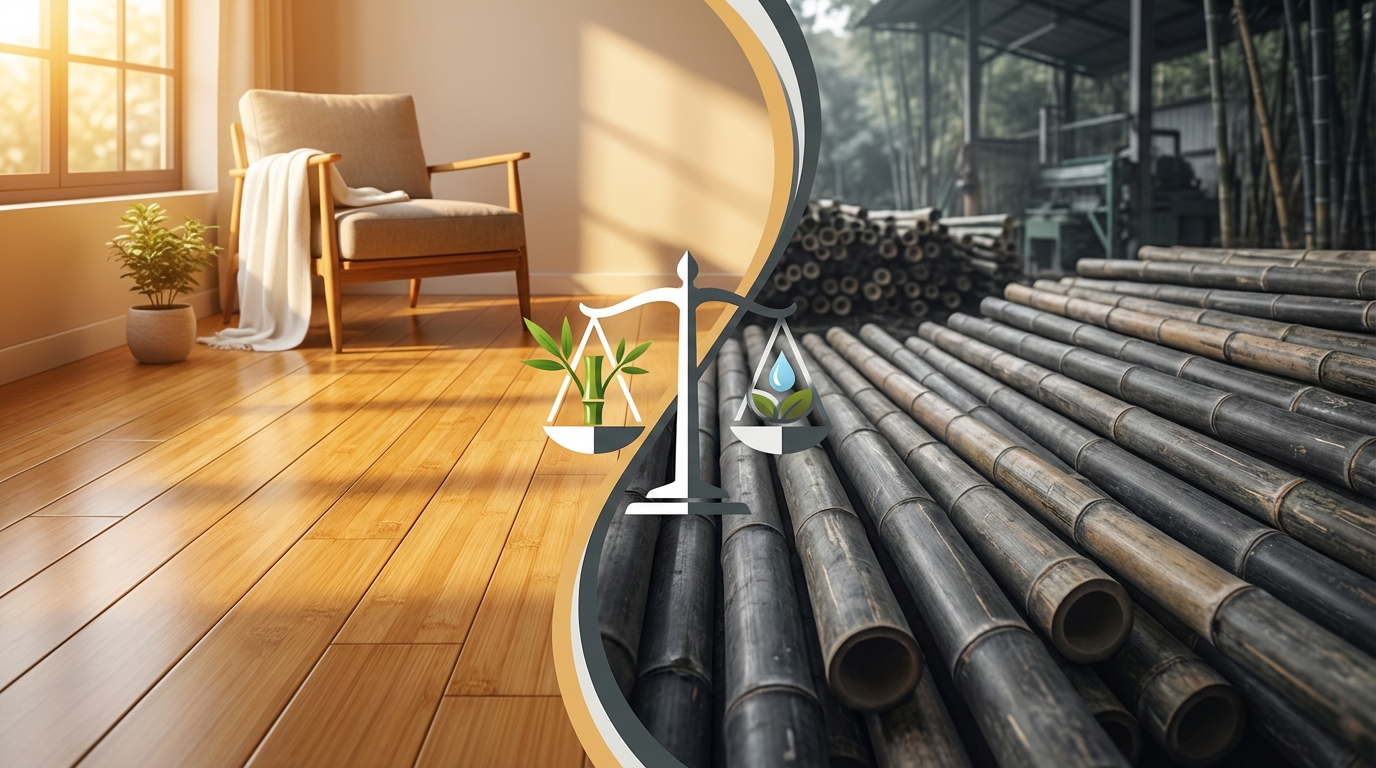
So, you are trying to figure out the real pros, cons, and environmental truth about bamboo flooring. The short answer is: bamboo flooring can be a strong, good-looking, lower-impact option than many hardwoods, but its real environmental benefit depends on how it is grown, processed, shipped, and installed.
Bamboo grows fast, uses fewer resources than many hardwoods, and can last a long time in your home. At the same time, some bamboo flooring uses heavy glue, travels across half the planet, and may not be as green as the marketing on the box suggests. You have to filter through the claims and look at the full life cycle.
Things you need to know:
- Not all bamboo flooring is the same; quality and impact vary a lot by brand and product type.
- Bamboo can be harder than oak, but some versions dent and scratch more easily.
- Environmental benefit hinges on farming practices, adhesives, certifications, and transport distance.
- Installation method affects repair, lifespan, and indoor air quality.
- Price is closer to mid-range hardwood and luxury vinyl, not the cheapest option.
- Bamboo handles humidity better than some hardwoods but still needs moisture control.
- You need to look for third-party certifications instead of marketing buzzwords.
What bamboo flooring actually is
So, what are you really buying when you pick bamboo flooring?
You are not getting a “bamboo tree.” Bamboo is a grass. Most flooring comes from a species called Moso bamboo grown in China and some other parts of Asia.
The process looks like this:
- Farmers cut mature bamboo culms (the tall, hollow stalks) at about 4 to 6 years old.
- The stalks are sliced into strips or shredded into fibers.
- The material is boiled or steamed to remove sugars and pests.
- The strips or fibers are dried and then glued together under pressure.
- Blocks are milled into planks, sanded, finished, and sometimes pre-stained.
So bamboo flooring is engineered by default. You are walking on material that is:
- Part natural fibers
- Part adhesives and finish
That mix is where both the strength and the environmental questions show up.
Bamboo flooring is not just “sliced bamboo.” It is a man-made product built from bamboo fibers plus adhesives and finish.
Types of bamboo flooring (and why they matter)
If you only remember one technical section from this article, make it this one. The type of bamboo flooring you pick changes:
- How hard it is
- How it looks
- How green it really is
Horizontal bamboo
Horizontal bamboo uses wider strips laid flat, side by side. You can clearly see the “nodes” or knuckles from the bamboo stalk.
- Look: Most “bamboo-looking” floors you see on Pinterest are horizontal planks.
- Feel: Moderate hardness, closer to a mid-range hardwood.
- Stability: Reasonable, but can move with humidity swings.
Vertical bamboo
Vertical bamboo uses narrow strips turned on their edge and pressed together.
- Look: More uniform, with fine lines; fewer visible nodes.
- Feel: Slightly harder than many horizontal products.
- Stability: Often a bit more stable than horizontal because of the grain orientation.
Strand woven bamboo
This is where bamboo starts to compete with very hard hardwoods.
The fibers are shredded, mixed with resin, and pressed under high pressure into a block. That block is milled into planks.
- Look: Can mimic hardwood, with varied grain and fewer obvious “bamboo” details.
- Feel: Often much harder than oak on the Janka hardness scale.
- Stability: Good dimensional stability, but quality varies by brand.
This type uses more adhesive than strip-based bamboo, so you trade extra hardness for more resin and usually higher glue content.
Strand woven bamboo is strong partly because of the glue. The engineering is the feature, not a side note.
Solid vs engineered bamboo
You will also see “solid” and “engineered” bamboo.
- Solid bamboo: The plank is bamboo through the full thickness (usually horizontal, vertical, or strand woven).
- Engineered bamboo: A bamboo wear layer on top of a plywood or HDF core.
Engineered versions can be more stable over concrete or radiant heat because the core controls movement. Solid versions often allow more sanding and refinishing.
The real pros of bamboo flooring
Lets go through the upsides without sugarcoating.
1. Fast growth and renewability
This is the headline you see everywhere: bamboo grows fast.
- Mature harvest age: About 4 to 6 years for Moso bamboo.
- Common hardwoods: Often 40 to 60 years to reach full maturity.
The root system stays in the ground and sends up new shoots, so the same clump can be harvested again and again.
From a raw material perspective, this gives bamboo a strong starting point:
- Less time on the land per harvest cycle
- More carbon pulled down into biomass per year
Compared to cutting down a 50-year-old tree, cutting a 5-year-old bamboo stalk from a living clump is a different story at the farm level.
The catch is that this does not automatically make the final product low impact. You still have:
- Processing energy
- Adhesives
- Coatings
- Shipping
But from a material sourcing view, bamboo is strong.
2. Material strength and hardness
When people say “bamboo is harder than oak,” they are usually talking about strand woven bamboo.
On the Janka scale (a standard hardness test):
| Material | Approx. Janka hardness (lbf) |
|---|---|
| Red oak | ~1290 |
| Maple (hard) | ~1450 |
| Horizontal/vertical bamboo | ~1200 to 1400 (varies) |
| Strand woven bamboo | ~2500 to 3500 (varies by brand) |
What this means for you:
- Strand woven bamboo can handle pets and kids better than many hardwoods.
- It still scratches; no flooring is scratch proof, but dents are often fewer.
- Cheaper bamboo that claims high hardness might not match real test data.
3. Dimensional stability
Bamboo is hygroscopic, like wood. It absorbs and releases moisture.
Good-quality bamboo, especially strand woven and engineered, often shows:
- Less expansion and contraction than some solid hardwoods
- Better performance over concrete with the right underlayment
You still need:
- Acclimation before install
- Expansion gaps at walls
- Controlled indoor humidity
So bamboo helps with stability, but it is not magic.
4. Design flexibility
Bamboo has grown beyond the “light yellow striped” look.
Modern products include:
- Natural (pale) and carbonized (darker, heated) tones
- Stained colors that mimic oak, walnut, or gray tones
- Wide planks and various textures (wire-brushed, hand-scraped)
You can go full “this looks like bamboo” or pick a product that passes for hardwood at first glance.
The design question is not “Do you like the bamboo look?” anymore. It is “Do you like this specific plank in this specific room lighting?”
5. Mid-range cost
Bamboo flooring usually sits between low-end laminate and premium hardwood.
Very rough ranges (per square foot, material only, not installed):
| Flooring type | Low range | Common range | High range |
|---|---|---|---|
| Basic laminate | $1 | $1.50 to $3 | $4+ |
| Luxury vinyl plank | $2 | $2.50 to $5 | $6+ |
| Bamboo (horizontal/vertical) | $2 | $3 to $5 | $6+ |
| Bamboo (strand woven) | $3 | $4 to $7 | $8+ |
| Solid hardwood | $3 | $4 to $8 | $10+ |
You still have:
- Underlayment
- Adhesives or fasteners
- Labor
So total project cost depends more on installation and prep than on the bamboo itself.
The downsides of bamboo flooring
Now lets talk about the parts marketers leave out of the brochure.
1. Adhesives and emissions
Because bamboo flooring is manufactured, not just milled, it relies on adhesive.
Older or cheaper products may contain more formaldehyde-based resins. That matters for:
- Indoor air quality (off-gassing)
- Worker exposure at the factory
You want to look for:
- Low VOC finishes
- Adhesive standards such as CARB Phase 2, TSCA Title VI, or equivalent
- Certifications like FloorScore or Greenguard Gold for indoor air quality
Bamboo that grew cleanly can still carry a higher footprint if it is soaked in high-emission glue and finish.
If a product does not publish its emission standards, treat the green claims with caution.
2. Environmental trade-offs and transport
There is a gap between the plant in the field and the plank in your hallway.
Key factors:
- Transport distance: Most bamboo flooring comes from Asia and ships across oceans.
- Processing energy: Drying, boiling, pressing, milling, finishing all take energy.
- Forest conversion risk: If native forests are cleared for bamboo, that is a large climate and biodiversity cost.
The environmental picture depends on comparisons:
- Bamboo shipped long distance vs locally sourced hardwood.
- Bamboo vs luxury vinyl plank made from petrochemicals.
- Bamboo vs laminate with shorter lifespan.
In many studies, well-managed bamboo still comes out ahead of vinyl or tile on carbon footprint, but it may not always beat certified local hardwood for every scenario.
This is why certifications and supply chain transparency matter.
3. Quality variation
The bamboo flooring market is wide. You can find products that last 20 years and others that fail in 3.
Risks with poor-quality bamboo:
- Soft or uneven boards that dent easily
- Color fading or uneven staining
- Warping or cupping in modest humidity swings
- Click systems that separate or squeak
Often, the problem is not “bamboo” but:
- Poor drying process
- Low-grade core or adhesive
- Rushed manufacturing
You can reduce risk by:
- Checking real-world reviews older than 2 years
- Sticking to known manufacturers with clear warranty terms
- Buying through channels that handle claims seriously
4. Moisture and water resistance limits
Bamboo can handle humidity swings better than some hardwoods, but it is not a waterproof floor.
Scenarios that are risky:
- Standing water from leaks or spills left for hours
- Bathrooms with daily shower steam and no exhaust fan
- Basements with high vapor emission through concrete
Result can include:
- Swelling
- Cupping
- Mold growth under or around boards
If you need real water resistance, luxury vinyl or ceramic tile typically perform better than bamboo.
5. Refinishing and repair limits
Not all bamboo flooring can be refinished the same way.
Horizontal and vertical solid bamboo may have:
- A wear layer thick enough for 1 or 2 sand-and-refinish cycles
- Less tolerance for aggressive sanding compared to thick solid hardwood
Strand woven bamboo is tricky:
- The fibers and resins can gum up sandpaper fast.
- You usually need an experienced pro with the right approach.
Engineered bamboo varies by product:
- Thin wear layer: Almost no sanding possible, only screen-and-recoat.
- Thicker wear layer: Maybe 1 light sanding, but you must check specs.
If you want a floor that can be refinished multiple times across 50 years, classic 3/4 inch solid hardwood still wins.
The environmental truth: where bamboo shines and where it falls short
Let us pull it together and really look at the environmental story, stage by stage.
Stage 1: Growing and harvesting
Upside:
- Bamboo stores carbon quickly.
- The same clump can be harvested repeatedly without replanting.
- Root systems help reduce soil erosion.
Risks:
- Conversion of natural forest to bamboo groves.
- High fertilizer or pesticide use in poorly managed sites.
What to look for:
- Certification such as FSC (Forest Stewardship Council) for bamboo products.
- Statements about no conversion from native forest, backed by third-party checks if possible.
A fast-growing plant is good. A fast-growing plant that replaces a diverse native forest is not.
Stage 2: Processing and manufacturing
Impact areas:
- Energy for drying, boiling, pressing
- Type and amount of adhesive
- Type of finish (UV-cured, water-based, solvent-based)
Questions you want answered:
- Are adhesives compliant with strict emission standards?
- Is the finish low VOC and certified?
- Does the manufacturer publish life-cycle or environmental data?
Some manufacturers invest in:
- Cleaner resins (lower formaldehyde)
- Better waste capture and energy recovery
Others chase the lowest possible cost. You can usually tell by how transparent they are.
Stage 3: Transport and logistics
Bamboo flooring usually travels:
- From farms to local factories
- From factories to ports
- Across oceans on ships
- From ports to distributors and retailers
Cargo shipping is fairly carbon efficient per ton-mile, but distance adds up.
Compared to:
- Local hardwood: Less shipping, but slower growth.
- Imported hardwood: Similar shipping impact, slower renewability.
- Vinyl or laminate: Often also imported, but made from fossil fuel feedstocks.
So transport is a factor, but not the whole story.
Stage 4: Use phase (how long it stays on your floor)
From an environmental view, lifespan is almost as key as raw materials.
If you put bamboo down once and keep it for 25 years, that is better than:
- A cheaper floor that fails in 7 years and heads to landfill
Durability, repairability, and style longevity matter.
To push the lifespan longer:
- Pick strand woven or high-quality engineered bamboo in high-traffic areas.
- Protect from deep scratches with felt pads and doormats.
- Follow humidity guidelines to avoid structural damage.
Stage 5: End of life
End-of-life pathways for bamboo flooring:
- Landfill
- Incineration with energy recovery
- Small-scale reuse (offcuts, DIY projects)
Because bamboo flooring contains adhesives and finishes, it is hard to recycle at industrial scale as a pure material.
Compared to:
- Vinyl: Usually landfilled; contains chlorine and plasticizers.
- Solid hardwood: Sometimes reused or chipped for other uses.
So bamboo is not perfect here, but it is not alone. Many flooring materials face similar end-of-life problems.
How bamboo compares to other common flooring options
Let us put bamboo in context.
| Feature | Bamboo | Hardwood | Luxury vinyl | Laminate |
|---|---|---|---|---|
| Material base | Rapidly grown grass + resin | Slow-growing trees | Petrochemical plastic + fillers | Wood fiber core + printed layer |
| Renewability | High at farm level | Lower (long rotation) | Low (fossil feedstock) | Medium (wood fiber, but highly processed) |
| Durability | Good; very good for strand woven | Good to excellent | Good surface wear, can gouge | Good surface wear, poor to repair |
| Water tolerance | Moderate; not waterproof | Poor to moderate | Often very good surface water resistance | Poor; swells with water |
| Indoor air quality | Good if low VOC; varies | Good if finished right | Varies; some off-gassing issues | Varies; adhesives and resins |
| Refinishing | Limited; better for solid types | Usually multiple times | No | No (only replacement) |
| Cost range | Mid-range | Mid to high | Low to mid | Low to mid |
The environmental truth sits in the middle:
- Bamboo often beats vinyl and laminate on raw material renewability and climate impact.
- Bamboo may or may not beat well-managed local hardwood, depending on farming, processing, and transport.
What to look for when buying bamboo flooring
If you have read this far, you care about both performance and the planet. Here is how to shop smarter.
1. Certifications that actually mean something
Look for:
- FSC for responsible bamboo sourcing where offered.
- FloorScore or Greenguard Gold for indoor air quality.
- CARB Phase 2 and TSCA Title VI compliance for formaldehyde emissions.
Avoid relying only on soft claims like:
- “Eco-friendly”
- “Green material”
- “Sustainable choice”
If the brand does not show clear labels or documents, the marketing copy is not enough.
2. Real specifications, not just marketing lines
Product data sheets should list:
- Janka hardness rating (ballpark)
- Plank thickness and wear layer thickness
- Recommended installation methods (nail, glue, floating)
- Indoor humidity and temperature guidelines
If all you see is pretty lifestyle photos and buzzwords, be careful.
3. Warranty details
Read beyond “25-year warranty.”
Key parts:
- Is it for finish only, or structure, or both?
- What conditions void the warranty (humidity, cleaning products, pets)?
- Is the warranty pro-rated?
A long but narrow warranty that covers almost nothing is more marketing than protection.
4. Brand track record
Check for:
- Reviews that mention performance after several years.
- Contractors or installers who have worked with the product before.
- Any recall or complaint history in forums or consumer sites.
A brand that has sold the same bamboo line for years with stable reviews is often safer than a new, bargain product with no history.
Installation choices that affect environment and performance
How you install bamboo can change both how it feels and how green it is.
Nail or staple down
Used mostly for:
- Solid bamboo planks over plywood or OSB subfloors
Pros:
- No adhesive spread across the floor (less chemical exposure).
- Traditionally strong connection to subfloor.
Cons:
- Not suitable over concrete without extra layers.
- More subfloor prep and skill needed.
Glue down
Common for:
- Concrete slabs
- Some engineered bamboo products
Pros:
- Solid feel underfoot, less hollow sound.
- Good for below-grade and multi-family noise reduction with the right adhesive.
Cons:
- Adhesive adds VOCs unless you choose a low-VOC product.
- Removal later is harder and more wasteful.
If you go this route, invest in low-VOC, moisture-control adhesive from a trusted brand and follow the spread rate carefully.
Floating installation
Planks click together and rest on underlayment without fasteners to the subfloor.
Pros:
- Fast install
- Easier removal or replacement
- Good option for apartments or DIY
Cons:
- Can feel more hollow or noisy without the right underlayment.
- Less forgiving if the subfloor is not flat.
From a green angle, a floating floor with low-VOC underlayment and prefinished bamboo can be a cleaner choice than troweled-on glue across the room.
Real-world scenarios: when bamboo makes sense and when it might not
Sometimes it helps to think through your exact use case.
Scenario 1: You want a lower-impact alternative to vinyl plank
You care about:
- Reducing plastic in your home
- Still getting decent water resistance
- Managing cost
Bamboo can be a good move if:
- You stick to dry or moderate-moisture areas (living room, bedroom, office).
- You choose certified low-VOC bamboo with a floating install.
You would still want something else like tile or vinyl in heavy splash zones such as full bathrooms.
Scenario 2: You are comparing bamboo to local hardwood
You care about:
- Climate impact
- Supporting local forests and jobs
- Long-term lifespan
In some regions, an FSC-certified local hardwood floor, finished with low-VOC products, can be as strong or stronger from an environmental view than imported bamboo.
In others, local hardwood is scarce or expensive, and bamboo fills a gap.
This is one place where a life-cycle study or at least some local expert input can help move from guesswork to grounded choice.
Scenario 3: You need very tough flooring for pets and kids
You care about:
- Scratch and dent resistance
- Easy cleaning
- Keeping it looking good for more than a few years
High-quality strand woven bamboo is a strong contender here. You trade a bit of environmental purity (more resin) for real-world longevity.
If your dog is large and active, you will still see surface scratches in almost any material, but deeper dents are often less frequent with strand woven products.
Simple maintenance that makes bamboo greener over time
The longer your bamboo floor lasts, the better its footprint looks spread across the years.
Here is a condensed care list that matters more than any leaflet:
- Keep indoor humidity roughly between 35 percent and 55 percent where possible.
- Use doormats at exterior doors to keep grit off the surface.
- Put felt pads on furniture, and replace them when they wear down.
- Clean with a damp, not wet, mop and a cleaner approved by the flooring maker.
- Wipe spills quickly; do not let water sit.
- Consider area rugs in heavy-traffic zones.
Protection habits are as much a part of sustainable flooring as the product label you read at the store.
A practical tip you can act on today: before you buy, contact at least two bamboo flooring manufacturers and ask them for their product emission data sheet or indoor air quality certification for the exact line you are looking at. The clarity and speed of their answer will tell you more about their environmental seriousness than any glossy marketing phrase.