
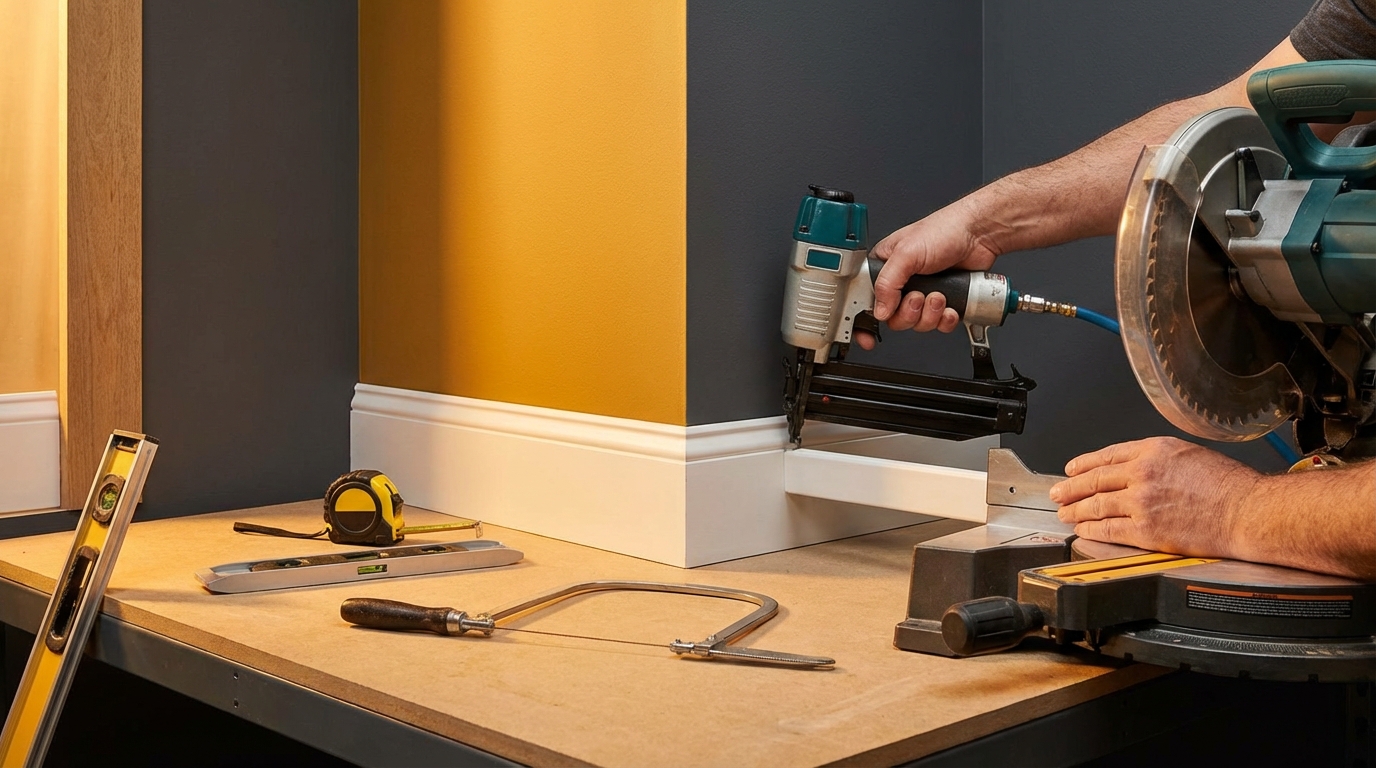
So, you want to know how to install baseboards like a pro. You install baseboards like a pro by planning your layout, using the right tools, cutting accurate miters and copes, fastening into studs, and finishing seams and nail holes cleanly with caulk and paint.
Most people think baseboards are just trim at the bottom of the wall. They are, but they also expose every mistake. Gaps, bad cuts, sloppy caulk lines, they all show. The good news is that if you slow down a bit, think through the order of steps, and use a few simple tricks, your work can look like someone who does it every day.
Here are some key points before we go deeper.
- Plan the order of walls and joints before you cut anything.
- Measure carefully and mark pieces directly from the wall, not only from a tape.
- Learn two skills: miter cuts and coping inside corners.
- Glue and nail into studs for a tight, long lasting install.
- Use caulk and wood filler to hide gaps and nail holes.
- Keep the floor reference consistent with spacers or shims.
- Pre-paint or prime when possible to save time later.
> If you treat baseboards like a finish product and not an afterthought, your room looks more expensive right away.
> Most “pro” results come from avoiding common mistakes, not from fancy tools.
> The wall is never as straight as you think, so plan for that.
> Taking 10 extra minutes on layout can save an hour of fixing gaps later.
Why baseboard installation feels harder than it looks
If you watch a short clip online, baseboards seem simple. Measure, cut, nail, done. Then you try it in your own room and find out walls are out of square, floors wave up and down, and corners do not meet cleanly.
This happens because:
- Very few houses have walls that are truly 90 degrees.
- Floors are often not level, especially near doors or corners.
- Baseboard profiles (shapes) make cuts less obvious if you plan them well, and more obvious if you do not.
- Materials behave differently (MDF vs wood vs PVC), so gaps show in different ways.
You do not need a full woodshop to get pro level results. You need a clear process. Think of it like writing code or setting up a server. There is an order that reduces errors. If you follow that order, the job feels easier and the results look sharper.
Tools and materials you need for pro looking baseboards
Core tools
You can install baseboards with hand tools, but power tools save time and give you more consistent results.
| Tool | Why you need it | Pro tip |
|---|---|---|
| Miter saw (chop saw) | For precise straight, miter, and bevel cuts | Use a 10 or 12 inch saw if you have tall baseboards |
| Brad or finish nailer | For fastening baseboards quickly and cleanly | 16 gauge for strength, 18 gauge for smaller holes |
| Air compressor or battery nailer | To power the nail gun | Battery nailers are easier for small projects |
| Caulk gun | To apply caulk along the top and in gaps | Use a dripless gun for smoother control |
| Tape measure | To measure wall lengths | Use a 25 foot tape for most rooms |
| Combination square & pencil | To mark straight, repeatable lines | Always mark “face up” side for consistency |
| Coping saw or jigsaw | To cope inside corners so they fit tight | Use a fine tooth blade to reduce chipping |
| Stud finder | To locate studs for strong fastening | Mark with light pencil lines above base height |
Materials
Your material choice affects how you cut, nail, and finish.
| Material | Pros | Cons | Good use cases |
|---|---|---|---|
| MDF (medium density fiberboard) | Stable, smooth, cheaper, paints well | Does not like moisture, can swell | Living rooms, bedrooms, dry areas |
| Finger jointed pine | Stronger than MDF, paint grade, repairable | Finger joints sometimes show through paint | Most interiors where you plan to paint |
| Solid wood (oak, maple, etc.) | Stainable, strong, classic look | More expensive, can move with humidity | High end rooms, stain grade trim |
| PVC or polystyrene | Moisture resistant, good for bathrooms | Can dent, can be flexible, not always sharp profiles | Bathrooms, basements, near water |
You also need:
- Construction adhesive (for extra holding power).
- Caulk (paintable latex or acrylic latex with silicone).
- Wood filler or spackle for nail holes.
- Sandpaper (120 to 220 grit) or sanding sponge.
- Primer and paint, or stain and clear coat, depending on your finish.
> If you are on the fence, MDF or finger jointed pine is usually the easiest path for painted baseboards.
Step 1: Plan your layout and cut order
Before cutting anything, walk the room and make a rough plan.
Decide your start wall and direction
You want to work in a way that makes your joints less visible. Often that means:
- Start on the most visible wall and work toward less visible areas.
- Place scarf joints (where two pieces meet on a long wall) away from direct view when you walk into the room.
- Plan for inside corners to be coped, not just mitered, especially if walls are not square.
For each wall, think:
- Do I have inside corners at both ends?
- Is there a door casing that breaks the run?
- Is this wall long enough that I need two pieces spliced together?
Mark stud locations and floor issues
Use a stud finder to locate studs and lightly mark vertical lines above the planned baseboard height. That gives you targets when you nail.
Look for:
- Gaps between the floor and drywall that are large.
- Areas where the floor is higher or lower (you can see it by holding a piece of baseboard against the wall).
- Any bump in the wall that pushes the board out.
If the floor has a big wave, note that spot. You will handle it later with shims or by slightly trimming the back of the baseboard.
> Ten minutes of planning and marking often saves more time than any fancy gadget.
Step 2: Pre-finish your baseboards when you can
Painting or staining baseboards before installing them makes the job cleaner.
Prime and first coat
Here is the usual sequence:
- Lay the boards flat on sawhorses or a clean surface.
- Lightly sand them with 180 to 220 grit to remove factory sheen.
- Wipe dust off with a clean cloth.
- Apply primer suited to your material (shellac or oil based for some woods, latex for MDF, etc.).
- After drying, sand lightly again to knock down raised fibers.
- Apply the first coat of paint or clear finish.
You do not need to get the final perfect finish now. Think of it as 80 percent done. After installation, you fill holes, caulk, and add the final coat.
If you are staining, pre-stain conditioner can help on blotchy woods like pine. That gives more even color.
> Pre-painting is like pre-processing data. You get a cleaner final result and fewer headaches late in the process.
Step 3: Learn the two core joints: miters and copes
You will face two main joint types:
- Outside corners: where the baseboard wraps around a corner that sticks out.
- Inside corners: where two walls meet in a recess.
Miter joints for outside corners
A miter joint is where each piece is cut at an angle so they meet cleanly at the corner.
Standard outside corner steps:
- Set the miter saw to 45 degrees.
- Measure from the last corner to the outside of the new corner.
- Transfer that measurement to your baseboard, marking the top edge.
- Cut the first piece with the miter opening toward the waste side.
- For the second piece, mirror the angle so they form a 90 degree corner together.
Reality check: not every corner is 90 degrees. If you test fit and see a gap at the front or back, the angle might be 88 or 92 degrees. Many compound miter saws have a tiny adjustment, or you can shift from 45 degrees slightly (for example to 44 or 46) and test again.
Coped joints for inside corners
A coped joint solves a common problem: walls that are not perfectly square. Instead of two 45 degree miters that rarely line up perfectly, you run one piece straight into the corner and cut the other to match its profile.
Steps to cope:
- Cut the first piece with a simple 90 degree cut and nail it tight into the inside corner.
- For the second piece, cut a 45 degree miter that exposes the profile of the baseboard.
- Use a coping saw or jigsaw to cut along the profile edge where the face meets the mitered surface.
- Angle your saw slightly to undercut the backside. That helps the visible edge tuck in tight.
- Test fit the coped piece against the first piece. Adjust with a file or sandpaper if needed.
This sounds harder than it is. After a couple of corners, you start to get a feel for it, and the corners look much tighter than regular inside miters.
> A good cope hides wall problems and makes you look more skilled than you might feel.
Step 4: Measure and mark like a pro
Cutting long pieces wrong is frustrating. A few simple habits reduce mistakes.
Always measure twice, cut once (for real)
When measuring:
- Hook the tape firmly into the previous corner or finished trim.
- Read the measurement carefully and say it out loud once.
- Write it down on a scrap or directly on the wall.
- Repeat the measurement and check what you wrote.
When you transfer measurements to the baseboard:
- Place the baseboard with the “face” up or toward you in a consistent way.
- Mark the length at the top edge, since that is the visible reference.
- Write a note near the mark like “inside corner, coped” or “outside miter right” to avoid confusion.
Use story sticks for repeating measurements
A story stick is just a scrap piece of trim or wood where you transfer key distances directly, instead of re-measuring every time. For example:
- Distance between the wall and the edge of a door casing.
- Distance between two inside corners on opposite walls in a repeated layout (like a hallway).
This is similar to using templates in tech projects. Reduce repeat manual entry to avoid errors.
Step 5: Cut and dry fit before you nail
Never trust the cut until you see it against the wall.
Use the right side on the saw
Common mistake: cutting with the board facing the wrong direction on the saw.
Guidelines:
- Keep the bottom of the baseboard against the fence or table in a consistent way.
- Decide: face toward you or away from you, then stick with that pattern.
- Mark the waste side of each cut with an “X” so you do not cut the wrong side.
Dry fit everything you can
Before you nail:
- Place the piece against the wall.
- Check the corners where it meets other pieces.
- Check if the top edge sits close to the wall without big gaps.
- Look at how it meets door casings and other trim.
If a corner is slightly open, ask:
- Can I adjust the angle by 1 degree and cut again?
- Can I sand or file a tiny amount off the back of the joint?
- Is the wall bowing in or out at that spot?
> Professionals do not magically get perfect cuts every time. They test, tweak, and sneak up on a tight fit.
Step 6: Attach baseboards securely
Once you are happy with the fit, it is time to attach.
Use both nails and adhesive when needed
If the wall is solid and you can hit studs at regular intervals, nails alone might be fine. Many pros still add a light bead of construction adhesive on the back of the baseboard for longer runs.
Process:
- Run a thin bead of adhesive on the back, a couple of inches from the top and bottom edges.
- Press the board into place and push it firmly against the wall and floor.
- Nail into studs where you marked them, usually every 16 inches horizontally.
- Add a few nails between studs if the baseboard flexes, but aim for solid backing.
For most baseboards:
- Use 16 gauge nails that are 2 to 2.5 inches long for strength.
- Angle nails slightly downward to pull the baseboard toward the wall.
- Keep nails about 1 inch up from the bottom and 1 inch down from the top profile edge.
Dealing with out of level floors
Sometimes the floor dips away from the wall, leaving a gap under the baseboard. You have three main fixes:
- Shim behind: Use thin shims behind the baseboard to keep the top tight and let the bottom follow the floor.
- Scribe and cut: Scribe the bottom of the baseboard to match the floor, then trim with a jigsaw or sander.
- Caulk small gaps: For small gaps, caulk can hide the space, especially if the floor finish is close in color.
For large gaps (over 1/4 inch), scribing or shimming looks better in the long term.
Step 7: Joints that disappear
Clean joints are what make your work look pro.
Scarf joints on long walls
If a wall is longer than your baseboard pieces, you need to connect two or more pieces along that run. Instead of a simple butt joint, use a scarf joint.
Steps:
- Set your saw to a 45 degree miter.
- Cut the end of the first piece at 45 degrees.
- Cut the end of the second piece at 45 degrees in the opposite direction so they overlap.
- Apply a bit of wood glue on the faces of the joint.
- Press them together on the wall and nail near the joint on both boards to hold it tight.
Angle the joint so that the overlap points away from the primary view when entering the room. That hides the shadow line more.
Inside corners with cope + miter hybrid
For tricky inside corners where the wall leans, you can combine a small miter with a cope. That gives the profile a place to land and helps hide slight gaps. This is more advanced, but it is a technique many trim carpenters use in older homes.
> Any place where two boards meet is where eyes go first. Spending a few extra minutes there gives the impression of higher skill across the whole room.
Step 8: Caulk, fill, and sand
Raw installed baseboard often looks rough. Nail holes, tiny gaps, and small chips show up. This is where the finish work matters.
Fill nail holes and minor defects
Use wood filler, spackle, or painter’s putty.
- Press the filler into each nail hole with a putty knife or your finger.
- Overfill slightly so you can sand flush.
- Let it dry fully based on product instructions.
- Sand flush with 180 to 220 grit paper until smooth.
For stain grade work, use a color matched wood filler and test on a scrap piece before filling all holes.
Caulk gaps along the top and corners
Use paintable caulk only. Do not use pure silicone for areas that will be painted.
Steps:
- Cut the caulk tube tip at a small angle, making a small opening.
- Run a steady bead along the top of the baseboard where it meets the wall.
- Run caulk in inside corners where tiny gaps remain.
- Use a damp finger or a caulk tool to smooth the bead, wiping excess onto a rag.
- Keep the bead small; you want just enough to fill the gap, not coat the whole surface.
If you see large gaps at the top, revisit the install. Large caulk lines look sloppy and can crack.
> Caulk is for hairline gaps, not for fixing large errors. If you are using a lot of it, something else is off.
Step 9: Final paint or finish
Once filler and caulk are dry, you can apply the final coat.
Mask and protect your work area
To keep lines clean:
- Use painter’s tape along the floor if you are worried about drips.
- If the walls are already painted, run tape just above the caulk line.
- Press tape edges down firmly for sharper lines.
Choose the right paint and sheen
For most baseboards:
- Use a trim paint or enamel for better durability.
- Sheen: semi gloss or satin is common, since it is easier to wipe.
- Match the color with other trim in the room for a consistent look.
Apply:
- One light coat if you pre-painted well and coverage is good.
- Two thin coats if coverage is uneven or you made many repairs.
If you are staining:
- Apply stain evenly and wipe off excess to avoid blotches.
- Add at least two clear coats (polyurethane or similar) with light sanding between coats.
Step 10: Common mistakes and how to avoid them
You will make mistakes. Everyone does. The key is to avoid the common ones that stand out the most.
Rushing measurements
Mistake: Measuring once, cutting, and finding the board is 1/4 inch short.
Fix:
- Always measure twice and mark carefully.
- When in doubt, cut slightly long and trim down.
Skipping coping on inside corners
Mistake: Using simple inside miters everywhere; gaps appear as walls move slightly over time.
Fix:
- Learn basic coping. Practice on scrap until it feels normal.
- Use miters only on inside corners that you know are square and stable.
Overfilling or under-sanding nail holes
Mistake: Big bumps where nail holes were, visible through paint.
Fix:
- Use a small amount of filler and a flat putty knife.
- Sand lightly with fine grit until the area feels flush to the touch.
Heavy caulk lines
Mistake: Thick beads of caulk that smear onto the wall and baseboard.
Fix:
- Cut a small opening in the caulk tube.
- Apply controlled beads, then smooth gently with a damp finger.
Inconsistent reveal around door casings
Mistake: Baseboard does not align nicely with door trim, leaving steps or odd gaps.
Fix:
- Check the relationship between baseboard height and door casing bottom before installing.
- Use returns (small pieces cut at 45 and back to 90) at casing ends where needed.
> If you see a detail that bothers you right away, fix it now. It will annoy you more later.
Pro level details that lift the whole room
Once you have the basics down, a few small upgrades can make your work look cleaner.
Use returns at exposed ends
Instead of leaving a baseboard cut square where it ends (for example at the side of a staircase or open doorway), add a “return” piece:
- Cut the main baseboard end at a 45 degree miter.
- Cut a tiny scrap piece with the opposite 45, then cut its back to leave a very small triangle of profile.
- Glue that tiny piece onto the end of the baseboard, closing off the profile.
This small step makes exposed ends look finished and prevents the profile from chipping.
Consistent reveals at doors and trims
Aim for consistency:
- The top of the baseboard lines up the same way around every door.
- Any small “step” between baseboard and door casing is the same everywhere.
You can test this visually by standing in the hallway and looking at all doors at once. Differences jump out. Adjust with thin shims or slight trimming if needed.
Use back bevels on outside corners
If outside corners tend to open up:
- Add a slight back bevel when you cut the miter so the back edges do not touch first.
- You want the visible front edges to meet, even if the back has a small gap.
That makes the corner line crisp and easier to caulk if needed.
Choosing between MDF, wood, and PVC: which is best for you
To pull this together, here is a quick comparison focused on real use.
| Feature | MDF | Wood (pine / hardwood) | PVC |
|---|---|---|---|
| Cost | Lower to medium | Medium to high | Medium |
| Paint finish | Very smooth | Good, may show grain | Smooth, sometimes softer detail |
| Stainable | No | Yes | Rarely |
| Moisture resistance | Poor | Medium | High |
| Durability vs dents | Medium | Medium to high (hardwood) | Medium, can dent |
| Ease of cutting | Very easy | Easy to medium | Easy, may melt with high speed |
If you want a painted look in a dry room, MDF or finger jointed pine gives you a balance of cost and quality. For bathrooms, PVC keeps water from ruining all your work.
Safety basics you should not skip
Installing baseboards is not high risk, but you still work with sharp blades and power tools.
Key habits:
- Wear safety glasses when cutting or nailing.
- Hearing protection when using saws for extended periods.
- Keep hands a safe distance from the miter saw blade; use clamps or hold-downs when cuts are short.
- Unplug or lock the saw off when changing blades or making adjustments.
- Use a mask when sanding filler or MDF, since the dust is fine.
This is one of those areas where a bit of caution pays off for years.
Simple project plan for your first room
To make all this feel more concrete, here is a sample plan you can follow in a weekend.
Day 1: Prep and pre-finish
- Measure your room and buy 10 to 15 percent extra baseboard length.
- Mark studs and check walls and floors for problem spots.
- Set up cutting and painting area.
- Lightly sand, prime, and apply first coat of paint to all baseboards.
Day 2: Cut, install, and finish
- Start with the longest wall, plan scarf joints if needed.
- Cut and dry fit each piece, coping inside corners.
- Glue and nail boards in place, working around the room.
- Fill nail holes, caulk gaps, and let everything dry.
- Apply final coat of paint on installed baseboards.
You might stretch this across more days if the room is large or your schedule is tight, but the sequence stays similar.
> Treat your first room like a training ground. By the second one, your speed and accuracy jump noticeably.
One last practical tip: keep a small box or bucket where you toss all your tiny offcuts, test pieces, and layout scraps. Those little pieces are perfect for practicing copes, testing paint, and shimming weird spots before you commit to cutting your full length boards.