So, you want to understand cork flooring, why it is soft, warm, and sustainable, and whether it is a good fit for your home.
Cork flooring is a resilient, quiet, and eco-friendly surface made from the bark of cork oak trees, and it works well in many rooms if you accept a few tradeoffs around dents, moisture, and sunlight.
Cork sits in a strange spot. It feels different from tile, vinyl, and hardwood. It is warmer than laminate, quieter than most engineered wood, and greener than a lot of synthetic products. At the same time, it is not perfect. It needs the right subfloor, good sealing, and some realistic expectations from you.
Things you need to know:
- Cork flooring comes from cork oak tree bark, harvested without cutting the tree down.
- It feels soft underfoot and stays warmer than tile and many laminates.
- It is great for sound reduction in apartments, condos, and upstairs rooms.
- It is renewable and often made with recycled cork from bottle stoppers.
- It can dent, fade in strong sunlight, and swell if exposed to standing water.
- You need the right type (glue-down vs click-lock) for your room and subfloor.
- Regular sealing and simple cleaning extend its life.
- Cost sits around mid-range: usually more than basic laminate, less than high-end hardwood.
> Cork is one of the few flooring materials where the tree survives the harvest and keeps absorbing CO₂ for decades.
> You do not walk on the tree itself, you walk on its outer layer, renewed again and again.
> In many homes, the real benefit is not the “green story” but the way cork feels under your feet after a long day.
What cork flooring actually is and how it is made
So, what are you really walking on when you walk on cork flooring?
Most cork flooring you see in stores comes in one of two structures:
- Glue-down solid cork tiles or planks
- Floating click-lock cork planks with a layered structure
Let us break this down.
The cork oak tree and bark harvesting
Cork flooring starts with the cork oak tree (Quercus suber), common in Portugal, Spain, and parts of the Mediterranean.
Here is the key part: the bark is harvested by hand every 9 to 12 years without cutting the tree down.
- The first harvest happens when the tree is around 25 years old.
- After that, bark can be taken roughly every decade.
- A tree can live 150 to 200 years and go through many harvest cycles.
The bark regenerates. The tree keeps capturing carbon, and cork forests support biodiversity. That is one of the main reasons cork flooring is marketed as sustainable.
From bottle stoppers to flooring
The top-grade bark usually becomes wine stoppers. The leftovers become raw material for flooring, insulation, and other products.
For flooring:
- Scrap cork is ground into granules.
- Those granules are mixed with resins or binders.
- The mixture is compressed under heat and pressure into blocks or sheets.
- Blocks are sliced into tiles or used as a core or veneer layer.
Two main product constructions appear on shelves:
| Type | Structure | Typical Use |
|---|---|---|
| Glue-down cork tiles | Solid cork, same material through the thickness | Dry rooms, design patterns, radiant heat, full-surface adhesion |
| Click-lock cork planks | Cork top layer on a core (HDF or cork) with a cork underlayment | Floating floors, DIY installs, condos, sound control |
> When you see a “cork plank” at a big-box store, you are often looking at a sandwich: wear layer on top, core in the center, acoustic cork layer below.
Why cork feels soft and warm underfoot
The comfort factor is what pulls many people toward cork.
The science in simple terms
Cork is filled with sealed, air-filled cells. Think of it like a tiny honeycomb structure. That structure gives cork three noticeable traits:
- Resilience: It compresses under weight and springs back.
- Thermal insulation: It slows heat transfer, so your feet do not feel cold.
- Acoustic dampening: It absorbs sound instead of reflecting it.
In practice:
- Standing on cork feels softer than standing on tile or stone.
- It is kinder to knees and lower back if you stand a lot while cooking or working.
- The floor does not feel icy first thing in the morning.
Comfort vs other floors
Here is a quick comparison so you can place cork in context.
| Floor type | Softness / Cushion | Warmth underfoot | Noise level |
|---|---|---|---|
| Tile / Stone | Very hard | Cold unless heated | Loud, echo |
| Solid hardwood | Hard with minor give | Moderate | Can be noisy |
| Laminate | Hard, slightly hollow | Moderate to cool | Clicky when walking |
| Vinyl / LVP | Moderate cushion (varies) | Moderate warmth | Quieter than laminate |
| Cork | Soft, resilient feel | Warm to the touch | Quiet, absorbs sound |
For many people who work from home and stand at a desk, or for parents with kids playing on the floor, this comfort difference matters more than they expect.
> You only notice floor comfort after living with it. A 5-minute showroom walk is not the same as 2 hours cooking on tile or 3 hours working at a standing desk.
How sustainable cork flooring really is
The marketing around cork is strong. You should look past the taglines and focus on clear points.
Renewable and tree-friendly harvesting
A few practical facts:
- The tree is not cut down for flooring.
- Bark grows back over about 9 to 12 years.
- Each tree can be harvested many times during its life.
Studies from Portuguese forestry agencies show that cork oak forests store significant carbon:
- A mature cork oak forest can capture several tons of CO₂ per hectare per year.
- Because the tree is not felled, that capture continues across its full life span.
Use of byproducts and recycled content
Many flooring products use what is left from stopper production. That means:
- Less waste from the stopper industry.
- More of the harvested bark ends up in long-lived products.
Labeling varies, but some cork floors list recycled content percentages. If sustainability is a priority for you, it is worth checking product specs instead of just trusting front-of-box claims.
Finishes, adhesives, and air quality
Sustainability is not just about the raw material. You also care about:
- Volatile organic compounds (VOCs) from finishes and adhesives.
- Binder resins inside the cork composite.
Look for:
- Low-VOC or zero-VOC water-based finishes.
- Products with third-party emissions certifications, like GREENGUARD Gold or similar regional standards.
- Click-lock products if you want to avoid full-spread adhesives on the subfloor.
> A cork tile with low-VOC glue and water-based finish can help you avoid strong indoor chemical smells that linger after installation.
Where cork flooring works best
You probably have some rooms in mind. Cork does better in some parts of the house than others.
Great use cases
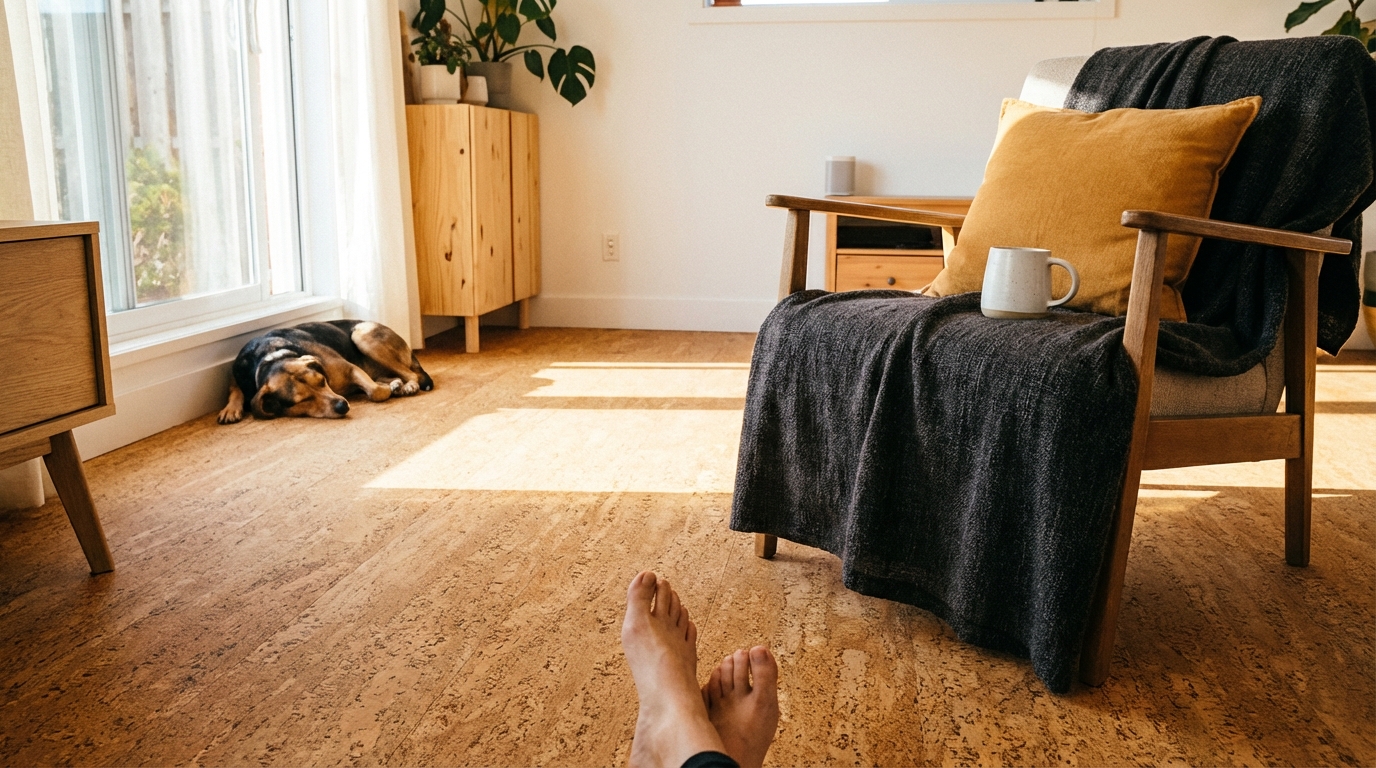
- Living rooms and family rooms: Quiet, comfortable, friendly for kids or pets that like to nap on the floor.
- Home offices: Good for standing desks, reduces echo on calls.
- Bedrooms: Warm under bare feet, soft when you get out of bed.
- Hallways and entry zones without heavy moisture: Absorbs sound, reduces footstep noise.
- Condos and apartments: Strong sound dampening helps with neighbor relations and noise complaints.
Rooms where you need caution
- Kitchens: Many people use cork here with success, but you must accept possible dents, scratches, and some maintenance. Rugs near sinks and dishwashers help.
- Bathrooms: Splashing and high humidity make this tricky. A well-sealed glue-down system with careful detailing can work, but risk is higher.
- Basements: Moisture from concrete, small leaks, or seasonal humidity swings can cause trouble. Floating cork with a strong vapor barrier can be acceptable in drier basements, but you need a moisture test first.
> Cork flooring does not like standing water. Think drips and splashes that get wiped up, not frequent puddles or leaks.
Key pros of cork flooring
Let us list the upsides clearly so you can weigh them against the downsides.
- Comfort: Soft, resilient surface that is easier on joints than tile or hardwood.
- Warmth: Better thermal comfort, especially in cooler climates or over unheated slabs.
- Sound control: Good impact noise reduction, useful in multi-story homes and apartments.
- Sustainability story: Renewable bark harvest, often with recycled content.
- Slip resistance: Natural texture that feels more secure than very smooth tile or polished stone.
- Design variety: Patterns that look natural, and some products that mimic wood planks or other surfaces.
- Repairability: Many unfinished or site-finished cork floors can be sanded and refinished once or twice, depending on thickness.
> The best benefit is usually the one you feel, not the one you read on the label. For cork, that is the comfort and noise reduction in daily use.
Key cons and limitations of cork flooring
You want the full picture. Cork has real tradeoffs.
- Denting and compression: Heavy furniture with small legs can leave marks.
- Scratches: Pet claws, dragged chairs, and grit can scratch the finish.
- UV fading: Strong direct sunlight can lighten or yellow cork over time.
- Moisture sensitivity: Floods, leaks, and long-term high humidity can cause swelling or damage.
- Limited sanding for some products: Thin veneer cork on floating floors cannot be sanded much, if at all.
- Style preference: Not everyone likes the visual texture of natural cork.
Here is a more direct comparison with some common options:
| Factor | Cork | Laminate | Luxury vinyl | Hardwood |
|---|---|---|---|---|
| Dent resistance | Moderate | Good | Good | Varies by species, moderate |
| Scratch resistance | Moderate | Good (surface layer) | Good | Moderate |
| Water resistance | Limited | Limited | High (for most products) | Low |
| Refinishing | Possible for solid cork | No | No | Yes, multiple times for solid |
| Comfort | High | Medium | Medium | Medium |
| Sustainability | Strong | Mixed | Mixed | Depends on sourcing |
Types of cork flooring: glue-down vs floating
Choosing the right construction can matter more than the brand label.
Glue-down cork tiles
Glue-down cork is often a thicker, more “true” cork floor, made from solid cork tiles or planks that you glue directly to the subfloor.
Pros:
- Good stability when properly glued and rolled.
- Often thicker cork layer, with a consistent material top to bottom.
- Works well with radiant floor heating when installed correctly.
- Better resistance to surface water if fully glued and well finished.
Cons:
- Installation is more complex and slower.
- Requires a very smooth, clean, stable subfloor.
- Removal later is more work.
Floating click-lock cork planks
These planks connect to each other instead of the subfloor. Often, they look like laminate or hardwood planks, but with cork layers.
Typical structure:
- Wear layer: Cork veneer or protective coating.
- Core: High-density fiberboard (HDF) or engineered cork core.
- Bottom: Cork underlayment layer for sound and comfort.
Pros:
- Faster, more DIY-friendly installation.
- Good over many existing floors, with the right underlayment.
- Easy to replace individual boards if damaged, as long as you can reach them from an edge.
Cons:
- More sensitive to moisture reaching the core.
- Can feel slightly more hollow than fully glued floors.
- Thin cork wear layers cannot be sanded significantly.
> If you want a long-term floor you can refinish, focus on thicker glue-down cork. If you want something installable in a weekend, floating click-lock usually wins.
Installation basics you should understand
You might not do the install yourself, but you should still know what matters. That is how you avoid problems later.
Subfloor preparation
Cork, especially glue-down, mirrors the quality of what is under it.
Key points:
- Subfloor must be clean, flat, dry, and structurally sound.
- High spots should be sanded down; low spots filled with patching compound.
- Moisture tests are needed on concrete slabs.
Typical flatness requirement is around 3/16 inch over 10 feet or similar, but always check the manufacturer instructions.
Acclimation
Cork expands and contracts with humidity. Most manufacturers ask you to:
- Bring the flooring into the space for 48 to 72 hours.
- Keep temperature and humidity within a target range before, during, and after install.
Skipping this step can cause gaps or buckling later.
Adhesive and finish
For glue-down cork:
- Use the adhesive recommended by the flooring brand.
- Spread evenly, respect open times, and roll the floor to remove air pockets.
- Many installers apply additional coats of finish after tiles go down, sealing seams.
For floating cork:
- Underlayment may be built in or separate, depending on the product.
- Click joints need to be clean and fully engaged to avoid gaps.
- Some products come prefinished and do not need extra coats right away.
> One of the biggest failure points with cork is moisture coming from below. A proper vapor barrier under a floating floor over concrete is not optional.
How cork flooring performs in kitchens and baths
You probably wonder: can I actually put cork in my kitchen?
Cork in kitchens
There are thousands of real-world installs where cork works in kitchens. People love standing on it for long cooking sessions.
Things that help:
- Use high-quality finish with multiple coats.
- Add mats near the sink, dishwasher, and fridge with ice/water dispensers.
- Wipe spills quickly instead of letting water sit.
- Use felt pads under chairs and stools to prevent wear patterns.
Risks:
- Dropped knives, heavy pans, or sharp objects can dent or chip the surface.
- Slow leaks from dishwashers or fridges can damage it if not caught early.
Cork in bathrooms
Bathrooms are more challenging.
If you want cork here:
- Prefer glue-down solid cork over floating planks.
- Use a moisture-resistant adhesive, approved by the manufacturer.
- Apply multiple layers of a water-resistant finish, covering all seams.
- Seal edges near tubs, showers, and toilets carefully.
- Use bath mats and good ventilation.
Even with all that, you accept higher risk than tile. So it is more for half baths or low-use baths, not a kids bath with daily splashing.
> A practical rule: if you often see puddles on your current bathroom floor, cork is not a good match.
Maintenance: cleaning, protection, and refinishing
Cork is not hard to maintain, but you do have to maintain it.
Daily and weekly care
Routine tasks:
- Sweep or vacuum regularly with a soft brush head.
- Clean spills right away with a soft cloth.
- Mop with a damp (not wet) mop, using a cleaner approved for cork or hardwood.
Avoid:
- Steam mops, which push moisture and heat into seams.
- Harsh cleaners with ammonia or abrasives.
- Saturated mops that leave standing water.
Protection strategies
You can extend the life of cork flooring with small changes:
- Use felt pads or glides under chairs, tables, and sofas.
- Add walk-off mats at entry doors to catch grit.
- Keep pet nails trimmed.
- Lift heavy furniture rather than dragging it.
- Use blinds or curtains to limit direct sun exposure in bright rooms.
Refinishing and repairs
Your options depend on product type.
For thick glue-down cork:
- Surface scratches can often be buffed and touched up with finish.
- Heavier wear can be addressed by light sanding and applying fresh finish.
For thin veneer floating floors:
- Spot repairs often mean plank replacement.
- Some surface-level scuffs can be hidden with repair kits or colored fillers.
> Before buying, ask the retailer directly: “Can this floor be sanded, and if so, how many times?” and get the answer in writing if you can.
Cost: where cork fits in your budget
You want to know whether cork fits the budget, not just the marketing story.
Material cost range
Prices vary by brand and thickness, but a rough guide:
- Entry-level floating cork: around 3 to 4 USD per square foot.
- Mid-range better-quality cork: around 4 to 6 USD per square foot.
- High-end designer or thicker tiles: can reach 7 to 10 USD per square foot or more.
Compare that to:
- Basic laminate: often 1.5 to 3 USD per square foot.
- Typical LVP: 2 to 5 USD per square foot.
- Solid hardwood (common species): often 4 to 8 USD per square foot.
Installed cost
If you hire a professional, labor and materials together might land in a range like:
- Floating cork: around 6 to 12 USD per square foot installed, depending on region and prep.
- Glue-down cork with finish: often 8 to 15 USD per square foot installed.
Subfloor repair, removal of old flooring, moisture barriers, and extra finishing coats can push costs up.
> Cork usually lands in the “comfortable middle”: not the cheapest thing in the store, not the most expensive, with comfort benefits that justify the gap for many homeowners.
Tech side note: cork and radiant floor heating
If you have or plan to add radiant heating, cork can work quite well, but with a bit of planning.
Compatibility factors
Cork is an insulator. That sounds like a conflict with radiant heating, but in practice:
- Heat still passes through; it just does so more gradually.
- Cork helps even out temperature swings, so you feel a steady warmth.
What you need to check:
- Manufacturer guidelines about maximum floor surface temperature.
- Type of radiant system: hydronic (water-based) or electric.
- Thickness of cork and any other layers (underlayment, adhesives, etc.).
Most products ask you to:
- Turn the radiant system on before install to dry the slab, then off during install.
- Bring heat back up slowly after install to avoid stressing the floor.
How to decide if cork is right for you
At this point, you know cork has real strengths and real limits. So how do you decide?
Ask yourself a few practical questions:
- Do you care more about comfort and warmth than maximum surface hardness?
- Are you willing to do light maintenance and protect the floor with pads, rugs, and routine care?
- Is your home prone to leaks, flooding, or very high humidity in the target room?
- Does the visual look of cork appeal to you, or are you trying to mimic stone or hardwood exactly?
- Do you live above other units where sound reduction matters?
- Is lower environmental impact a major factor in your material choices?
If comfort, sound, and sustainability sit near the top of your list, and you have a relatively dry, stable environment, cork often fits very well.
> Many people who choose cork are repeat buyers. They install it once in an office or bedroom, get used to the feel, and then add it to other rooms later.
Common myths and misunderstandings about cork flooring
A few myths float around that are worth clearing up quickly.
“Cork is too soft; every step leaves a mark”
Reality: Cork compresses under weight and then recovers. Heavy point loads, like a piano on tiny metal casters, can leave permanent dents, but regular walking does not crush it flat. Use wider furniture glides, and you reduce permanent compression.
“Cork is only for eco homes or niche projects”
Reality: Cork has been used in homes, libraries, and commercial spaces for decades. It is not niche at this point. It is less common than vinyl or tile simply because fewer stores push it heavily, not because it cannot handle daily life.
“Cork flooring stains very easily”
Reality: Unfinished cork would stain fast, but modern cork floors almost always have factory or site-applied finishes. If you seal it well and clean spills, staining is manageable, on par with many hardwoods.
“Cork is going out of style”
Style is subjective. What actually matters is whether you like the look and whether it fits your home. Manufacturers now offer cork patterns that look more muted and understated than older “speckled” designs, so you have more choice than before.
Practical tip to move forward
Before you commit to cork flooring across a whole level of your home, buy a small box or a few sample tiles, install them in one room or even on a large test board, live with them for a few weeks, and track how they feel underfoot, how they look in your real lighting, and how they handle your daily cleaning routine.