
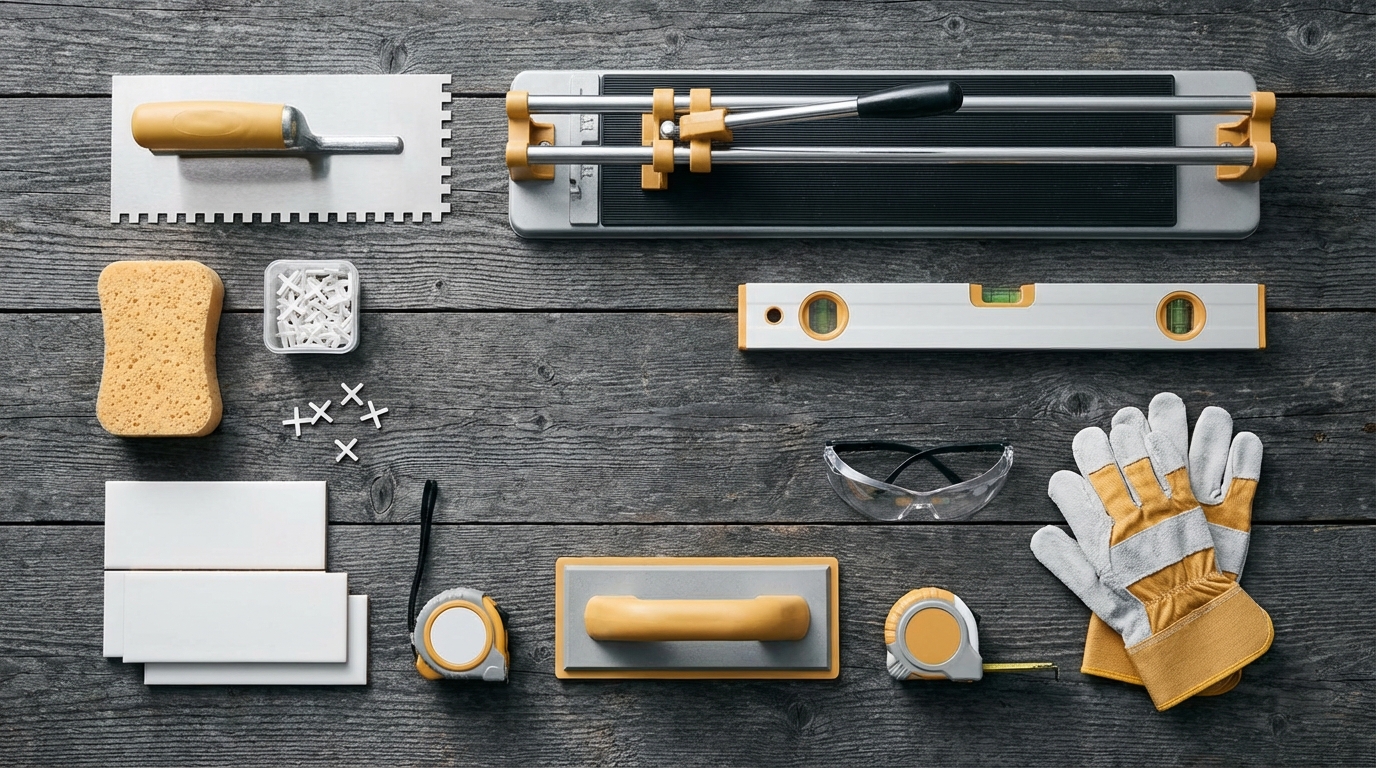
So, you are trying to figure out the essential tool kit for laying tile and you want to know what you actually need, not a giant list from a hardware catalog.
You need a focused kit that covers measuring, cutting, spreading adhesive, spacing, leveling, and cleanup, with a few tools that make the work faster and the finish cleaner.
Most DIY tile jobs go wrong not because of the tile or the adhesive, but because of gaps in the tool kit. You miss a simple tool like a margin trowel or a good leveling system, and suddenly you have lippage, crooked grout lines, or tiles that sound hollow. So the goal here is not to buy the most expensive tools, but to get the right mix that keeps your layout straight, your cuts clean, and your surface flat.
Things you need to know:
- You can tile well with a relatively small set of tools, if each one is chosen with a clear job in mind.
- Your measuring and layout tools decide how good the finished job looks before you even spread adhesive.
- The right trowel size and notch pattern matter more than brand names.
- A decent tile cutter or saw saves a lot of tile, time, and frustration.
- Grout and cleanup tools are what make the final surface look professional.
- Buy the best safety gear you can tolerate wearing. You will need it over many hours.
> Most of the “pro look” in a tile job comes from a tape measure, a level, a pencil, and patience, not fancy gadgets.
> A cheap tile job with great prep looks better than an expensive tile job with poor prep.
> Before you buy tools, decide what tile you are laying and where. Wall vs floor, big vs small, ceramic vs porcelain changes your list.
Why your tile tool kit matters more than the tile itself
When a tile job looks bad, people usually blame the tile. The color feels off, or the pattern looks wrong, or the grout lines feel weird. But if you look closer, what you actually see is poor layout, uneven joints, tiles not flat to each other, or chipped edges from bad cuts.
All of that is a tool and process problem, not a tile problem.
Here is how this usually plays out in real life:
- The layout line drifts because there is no laser or reference line.
- The tiles sit at slightly different heights because there is no leveling system or the substrate is not checked properly.
- Adhesive is spread with the wrong notch trowel, so coverage is poor and tiles later crack or sound hollow.
- Grout joints are inconsistent because spacers are mixed or not used at all.
- Edges chip during cutting because the blade is dull or the cutter is wrong for the tile material.
You can avoid most of these headaches with a focused toolkit and a clear workflow, even if it is your first time tiling.
Core categories of tools for laying tile
Think of your tile tool kit in six simple groups:
- Measuring and layout tools
- Surface prep tools
- Adhesive and mortar tools
- Cutting tools
- Grout and finishing tools
- Safety and cleanup tools
You do not need every fancy version in each group. You just need at least one tool that does each job properly.
Measuring and layout tools
Your layout tools decide how easy or painful the rest of the project feels. If you skip this part or wing it, everything fights you later.
1. Tape measure (good, readable, and locking)
You need a 16 or 25 foot tape measure with clear markings and a lock that works. That is it.
You will use it to:
- Measure room size and calculate tile quantities.
- Plan tile layout and centering.
- Mark cuts on tiles and around obstacles.
For example, if you are tiling a 10 x 12 foot floor with 12 x 24 inch tiles, you will measure both directions, check where full tiles will fall, and avoid leaving a thin 1 inch sliver of tile near a wall or doorway. That planning starts with a simple tape measure.
2. Carpenter’s pencil and fine-tip marker
You want two marking tools:
- A carpenter’s pencil for marking floors, walls, and backer board.
- A fine-tip permanent marker for marking tiles where pencil is hard to see.
A small detail: keep your pencil sharp. A blunt pencil gives you a wide line, which creates guesswork on cuts.
3. Chalk line or laser line
This is where your layout stops guessing and becomes repeatable.
You have two main options:
| Tool | Pros | Cons |
|---|---|---|
| Chalk line | Low cost, no batteries, simple to use | Lines can smudge, harder to use on vertical walls |
| Cross-line laser | Fast, visible on walls and floors, very accurate | Higher cost, needs batteries, fragile if dropped |
If you plan to tile more than once, a basic cross-line laser is worth it. You can line up your first course of tile dead straight and keep referencing that line for the rest of the job.
4. Spirit level or straightedge
You will need at least a 4 foot spirit level. Longer is better for floors.
You use it to:
- Check if floors or walls are flat before tiling.
- Spot high or low spots that need leveling compound.
- Confirm tiles are aligned and not dipping or rising.
A long metal straightedge (like a 6 or 8 foot aluminum level or screed) is helpful on floors where tile size is large, such as 12 x 24 or 24 x 24 inch tiles. It helps you catch subtle waves that your eye cannot see yet but will notice when light rakes across the finished floor.
5. Square (speed square or framing square)
Tile loves straight, square lines. Out-of-square rooms are common, but you still need reference points.
A speed square helps:
- Check corners for square.
- Lay out 45 degree cuts.
- Mark right angles on tiles quickly.
> If you skip checking for square at the start, you might spend hours cutting tiny slivers at one side of the room later.
Surface prep tools
Tile needs a solid, flat, clean surface. Adhesive is not glue that fixes structural problems. You need prep tools to get the base right.
6. Margin trowel
This small, rectangular, pointed trowel is one of the most underrated tile tools. You use it to:
- Mix small batches of thinset or mortar.
- Scrape out buckets.
- Apply mortar to the back of tiles for back-buttering.
- Clean up excess adhesive near edges.
Many people try to do all this with a notched trowel. That leads to a mess. A margin trowel gives you control.
7. Mixing bucket (and a couple of spares)
You need at least one sturdy 5 gallon bucket for mixing mortar or thinset, plus one or two more for clean water and grout mixing.
Key points:
- Use clean buckets. Old dried mortar fragments ruin new batches.
- Do not mix more than you can spread within the pot life in the instructions.
8. Drill with mixing paddle
Hand-mixing mortar for a floor or wall job is not realistic. You want a corded drill or a strong cordless drill with a mixing paddle attachment.
Look for:
- Variable speed, so you do not whip air into the mix.
- A paddle made for mortar, not paint. The shape is different.
> Consistent mortar mix is one of those boring details that keeps tiles from popping loose later.
9. Floor scraper and/or putty knife
For surface prep you will need:
- A long-handled floor scraper for removing old adhesive, paint, or debris from floors.
- A stiff putty knife for smaller areas or walls.
Tile adheres best to clean, sound surfaces. Old adhesive ridges, paint flakes, or dust act like a release layer.
10. Straightedge or screed for checking flatness
You already saw this as part of layout, but for prep it matters again. Use a long straightedge to:
- Find dips that need floor leveler.
- Spot humps that might need grinding.
Large format tile (any side 15 inches or more) is very sensitive to small waves. Most tile makers recommend no more than 1/8 inch variation in 10 feet for those sizes.
Adhesive and mortar tools
These tools handle spreading thinset or adhesive and setting the tile accurately.
11. Notched trowels (different sizes)
This is one of the most critical choices you make. Different tiles need different notch sizes.
Common types:
| Notch type | Size (example) | Typical use |
|---|---|---|
| Square notch | 1/4″ x 1/4″ | Small wall tile, some floor tile up to about 8″ |
| Square notch | 1/4″ x 3/8″ | Standard floor tile, 12″ or so |
| Square notch | 1/2″ x 1/2″ | Larger format tile, uneven backs, or floors needing more build |
| V-notch | 1/4″ V | Smaller wall tile, mosaics |
Tile manufacturers usually give a minimum coverage rate in their documentation. Many call for at least 80 percent coverage indoors on walls, and 95 percent in wet areas or on floors. Your notch size and trowel technique control that.
A practical tip: comb all your notches in one direction, not swirled. Then press and slide the tile slightly across the ridges. That collapses them and improves coverage.
12. Rubber mallet and beating block
To bed tiles into the thinset without cracking them, you will want:
- A white or non-marking rubber mallet.
- A beating block (a flat block of wood or plastic, longer than a tile).
You gently tap the beating block over tiles to level them with each other. This is very helpful with larger tiles, where hand pressure alone sometimes leaves voids.
13. Tile spacers
These small pieces of plastic control joint width and keep lines straight. They come in many sizes:
- 1/16 inch: tight joints, often with rectified tiles.
- 1/8 inch: common for floors and many walls.
- 3/16 inch or 1/4 inch: more forgiving, often on rustic or uneven tile.
For floors, you can use “T” or cross-shaped spacers. For walls, wedge spacers are very handy to adjust for slight size variation or wall movement.
Do not leave cheap hollow spacers buried in grout joints where they might show or make weak spots. Pull them as you go if the design calls for it.
14. Tile leveling system (clips and wedges or caps)
For many floor jobs, especially with longer tiles like 12 x 24, a leveling system is worth every dollar.
These systems use:
- Plastic clips that go under the tile edges.
- Wedges or threaded caps that pull neighboring tiles into the same plane.
They do not fix a badly uneven floor, but they help keep small differences under control and reduce lippage.
> Lippage is when one tile edge sits higher than the next. In strong side light, even a tiny ridge is very obvious.
Cutting tools
This is where many DIY tilers get stuck. Wrong cutter, wrong blade, and you burn through tiles. The right cutters make this part almost boring, which is what you want.
15. Manual tile cutter
A manual snap cutter is fast for straight cuts in ceramic or some porcelain.
Look for:
- A rigid base and rails that do not flex.
- A good scoring wheel made for ceramic or porcelain (depending on your tile).
- A length capacity longer than your largest tile.
You place the tile, score once with firm, steady pressure, then snap. Do not go back and forth with the scoring wheel; one pass is enough.
For tough porcelain, many pros still prefer a wet saw, but a quality snap cutter can handle many jobs.
16. Wet tile saw
If your tile is:
- Porcelain with a hard body.
- Natural stone like marble or granite.
- Large format that needs precise cuts.
- Part of a complex layout with notches and L-cuts.
then a wet saw with a diamond blade is your main cutter.
Key features:
- Adjustable fence for repeatable cuts.
- Sliding tray or rail for stable movement.
- Water reservoir and pump that actually keep the blade wet.
Use a blade rated for your tile material. A dull or wrong blade chips edges and slows your work.
17. Angle grinder with diamond blade
For irregular cuts around pipes, toilet bases, curved corners, or notches that a snap cutter cannot handle, a small angle grinder is very useful.
You want:
- A 4.5 inch grinder with a continuous rim diamond blade for tile.
- Eye and ear protection every time you use it.
You can dry-cut outside or in a ventilated area. It creates dust, so use a mask and avoid cutting inside finished rooms when you can.
18. Tile nippers
Tile nippers are simple but helpful tools for small adjustments:
- Nip off tiny edges that are slightly too large.
- Shape tile arcs around pipes or curves.
They work best on ceramic and some porcelain. Thick or very hard tiles are harder to nibble without breaking.
19. Hole saws for tile
To run pipes, shower valves, or plumbing through a tiled surface, you will often need round holes. Diamond hole saws made for tile give clean circles.
A common workflow:
- Mark the center of the hole on the tile.
- Use a guide or start at a slight angle to avoid wandering.
- Drill with steady, moderate pressure and some water for cooling.
Grout and finishing tools
This is where the look of the installation really comes together. Even with perfect tile work, poor grouting can ruin the impression.
20. Rubber grout float
A grout float is how you pack grout into joints.
Look for:
- A dense rubber base that is not too soft.
- A handle that feels good in your hand; you will hold it for a while.
To use it, you spread grout at a 45 degree angle across joints, pressing firmly to pack gaps and then skimming off excess.
21. Sponges and clean water buckets
You will need at least two large, dense sponges and two buckets:
- One bucket for initial cleanup water.
- One bucket with cleaner water for final wipes.
Wipe grout haze in a controlled way:
- Do not flood the joints with water; that weakens grout.
- Rinse sponges often and wring them well.
- Wipe diagonally across joints to avoid pulling grout out.
> Many grout problems come from using too much water during cleanup, not from the grout itself.
22. Caulking gun and caulk for movement joints
Where tile meets another material or in corners, you usually want flexible caulk, not grout. These are movement joints.
You need:
- A caulking gun that feeds smoothly.
- Color-matched silicone or acrylic caulk made for tile areas.
Run a trim bead, then tool it with a wet finger or a profiling tool.
23. Grout sealer (and small brush or applicator)
Some grout needs sealing after curing, especially many cement-based grouts. Check the manufacturer’s guidance.
You can use:
- A small foam brush.
- A squeeze bottle with a small wheel or tip for joints.
Seal only when grout is clean and fully dry, and avoid flooding the tile surface unless the product is rated for that.
Safety and comfort tools
These often get ignored in tile videos, but you will feel every mistake with your body by day two.
24. Knee pads or kneeling pad
Tiling a floor without knee protection is a fast route to pain.
You can choose:
- Strap-on knee pads (gel or foam).
- A thick kneeling pad you shift along the floor.
Comfort affects focus. When your knees are screaming, you rush decisions and make layout errors.
25. Eye, ear, and breathing protection
Basic kit:
- Safety glasses for cutting tile and mixing powders.
- Ear protection for saws and grinders.
- Dust mask or respirator for cutting and mixing.
Cement powders and silica dust are not friendly to lungs. Wet cutting and a mask reduce exposure.
26. Gloves
Thinset and grout are alkaline and can irritate skin. You want:
- Nitrile or latex-coated gloves for mixing and grouting.
- Work gloves for carrying boxes of tile and backer board.
27. Shop vacuum or broom and dustpan
Clean work areas help you see layout lines, remove debris under tile, and keep dust down. A small shop vac speeds this up, but even a good broom and dustpan help a lot.
Extra helpers that make tile work smoother
These are not always listed in “must have” checklists, but they often save time and mistakes.
28. Tile suction cups
For large or heavy tiles, suction cups:
- Give you a better grip.
- Help you place tiles carefully into tight spots.
You can even use double suction handles to lift big format pieces for adjustment.
29. Layout battens and temporary ledgers
On walls, gravity fights you. A straight board screwed to the wall (a ledger) holds the first row of tiles level while adhesive cures.
You can also use:
- Drywall screws and straight 1×2 or 1×3 boards.
- Mark layout lines directly on the board to help alignment.
After the field tiles above are set, you remove the ledger and fill in the bottom row against the floor or tub rim.
30. Small pry bar or flat bar
Useful to:
- Lift baseboards before or after tiling.
- Pull spacers or clips.
- Adjust thresholds.
31. Utility knife
You will use a sharp utility knife constantly:
- Open bags and boxes.
- Cut backer board mesh tape.
- Trim underlayment or membranes.
Keep spare blades handy. A dull blade causes slips.
Matching your tool kit to your tile project type
You do not need the exact same kit for a small backsplash as you do for a full bathroom floor and shower. Let us match tools to common projects.
Small kitchen backsplash
For a simple backsplash with ceramic subway tile, your kit can be lighter:
- Measuring: tape, pencil, small level, maybe a simple laser.
- Prep: margin trowel, bucket, putty knife.
- Adhesive: smaller notched trowel (like 1/4″ V or 1/4″ square), spacers.
- Cutting: good score-and-snap cutter, small wet saw for outlet openings, tile nippers.
- Grout: rubber float, sponges, caulk gun for corners, sealer if needed.
- Safety: glasses, mask, light knee pad or cushion for working near countertops.
You probably do not need a tile leveling system for standard small wall tiles if your wall is flat and tile sizes are consistent.
Bathroom floor with 12 x 24 porcelain
Here your needs grow a bit:
- Measuring: tape, long level, chalk or laser line, square.
- Prep: margin trowel, mixing drill, buckets, floor scraper, straightedge for flatness.
- Adhesive: 1/2″ square notch trowel (or as tile maker advises), spacers, leveling system.
- Cutting: wet saw with a porcelain-rated blade, angle grinder, hole saws for toilet flange and pipes.
- Grout: float, sponges, caulk for perimeter and fixtures.
- Safety: knee pads, eye/ear protection, dust mask.
For this kind of job, skipping the leveling system often leads to lippage that will bother you every time light hits the floor.
Full shower with wall tile and shower floor mosaic
For a full shower:
- Measuring/layout: tape, laser, levels, square, detailed layout marks on walls.
- Prep: proper backer board or waterproof system (and its tools), margin trowel, mixing drill, buckets, utility knife, mesh tape.
- Adhesive: a couple of trowel sizes (one for wall field tile, one smaller for mosaic floor), spacers, wedges, maybe a leveling system for large wall tiles.
- Cutting: wet saw, angle grinder, hole saws for valves and shower head arms, nippers for mosaic tweaks.
- Grout: float suited for narrow joints, sponges, caulk gun for corners and changes of plane.
- Safety: mask and gloves for long sessions, knee pads for working at low heights on shower floors.
> Showers add water exposure and gravity to the mix, so surface prep and layout tools matter even more.
Picking quality without overspending
Tile tools come at many price points. You do not need the most expensive version of everything, but you also do not want the absolute weakest tools on key items.
Here is one way to rank where to spend more:
| Tool category | Spend level | Reason |
|---|---|---|
| Wet saw & blade | Medium to high | Clean cuts, fewer ruined tiles, less chipping |
| Notched trowels & margin trowel | Medium | Comfortable handle, consistent notches, long life |
| Tile leveling system | Medium | Strong clips/wedges avoid snapping or slipping |
| Safety gear | Medium | Comfortable gear is gear you will actually wear |
| Buckets, sponges, spacers | Low | Cheaper options usually work fine |
| Manual tile cutter | Medium | Stiff rails and good wheel matter, but mid-range works |
You can also rent high-price tools like a wet saw for a weekend instead of buying. That often gives you a better tool than what you would have bought cheap.
Common mistakes linked to missing tools
Let us connect specific problems to tools so this becomes very practical.
- Problem: Tiles not flat to each other on a floor.
Often missing: Straightedge for checking floor, leveling system, beating block. - Problem: Hollow-sounding tiles when tapped.
Often missing: Correct notch trowel size, margin trowel for back-buttering, mixing drill for proper mortar consistency. - Problem: Crooked grout lines.
Often missing: Laser or chalk line, good spacers, time spent checking square with a level and square. - Problem: Chipped tile edges.
Often missing: Quality wet saw blade, stable cutting setup, angle grinder practice on scrap pieces. - Problem: Grout color blotchy or weak.
Often missing: Multiple clean sponges, separate rinse buckets, measuring cup for water, patience during cleanup.
> When you see a pattern of problems on a job, you can usually trace it back to one or two tools that were never on site.
Simple workflow using this tool kit
Here is a practical sequence that brings everything together:
Step 1: Assess and prep the surface
- Use your tape and level to measure and check flatness.
- Mark high and low areas with pencil.
- Scrape loose material with floor scraper and putty knife.
- Vacuum or sweep dust.
If you need leveling compound or patches, follow those system instructions with your mixing tools and straightedge.
Step 2: Plan layout
- Measure room and tile to figure out joint layout.
- Use a chalk line or laser to mark main reference lines.
- Dry lay a row of tiles with spacers to see cuts at edges.
- Adjust to avoid tiny sliver cuts where possible.
This is where tech helps: you can use an app or simple spreadsheet to test layouts faster rather than re-measuring many times.
Step 3: Mix adhesive
- Use bucket, water, and mortar mix in the ratio on the bag.
- Mix with drill and paddle until lump-free.
- Let it slake if required, then remix.
Do not add extra water later to “retemper” beyond what the product allows. That weakens it.
Step 4: Spread and set tile
- Use your notched trowel to spread adhesive in small, workable sections.
- Comb notches in one direction.
- Back-butter tiles with your margin trowel when recommended.
- Set tiles along your layout lines, using spacers and leveling clips.
- Use a beating block and mallet to tap tiles into plane.
Keep wiping off excess thinset from tile surfaces and joints as you go with a damp sponge or cloth.
Step 5: Cut tiles as needed
- Measure and mark cuts clearly with pencil or marker.
- Use the manual cutter for straight cuts where it works.
- Use the wet saw or grinder for notches, L-cuts, or tough materials.
- Check each cut against its spot before spreading adhesive.
Practice on scrap tile first to get a feel for the cutter pressure and speed.
Step 6: Grout and seal
- After adhesive cures, mix grout in your bucket with the drill paddle.
- Apply with a grout float at a 45 degree angle to joints.
- Wait a short time, then start wiping with sponges and clean water.
- After full cure, apply grout sealer if the product calls for it.
Finish with caulk in movement joints, corners, and changes of material.
Quick reference: compact tile tool kit list
Here is a tight checklist you can keep on your phone before a store run:
- Tape measure, carpenter’s pencil, marker
- Chalk line or cross-line laser
- 4 ft level, optional longer straightedge
- Speed square or framing square
- Margin trowel
- Mixing drill and mortar paddle
- At least 2 buckets (5 gallon)
- Floor scraper, putty knife
- Notched trowels (sizes matched to your tile)
- Rubber mallet and beating block
- Tile spacers and possibly a leveling system
- Manual tile cutter
- Wet saw with tile-appropriate blade (or rental)
- Angle grinder with diamond blade
- Tile nippers
- Diamond hole saws if pipes or fixtures are present
- Rubber grout float
- Large sponges and clean water buckets
- Caulking gun and tile-rated caulk
- Grout sealer and small applicator
- Knee pads or kneeling pad
- Safety glasses, dust mask, ear protection, gloves
- Shop vac or broom and dustpan
- Utility knife, small pry bar, optional suction cups
If you want one practical tip to anchor all of this: lay out your tools in the order you will use them before you start, just like a workflow line. You will spot what is missing before the thinset is mixed and the clock is ticking.