
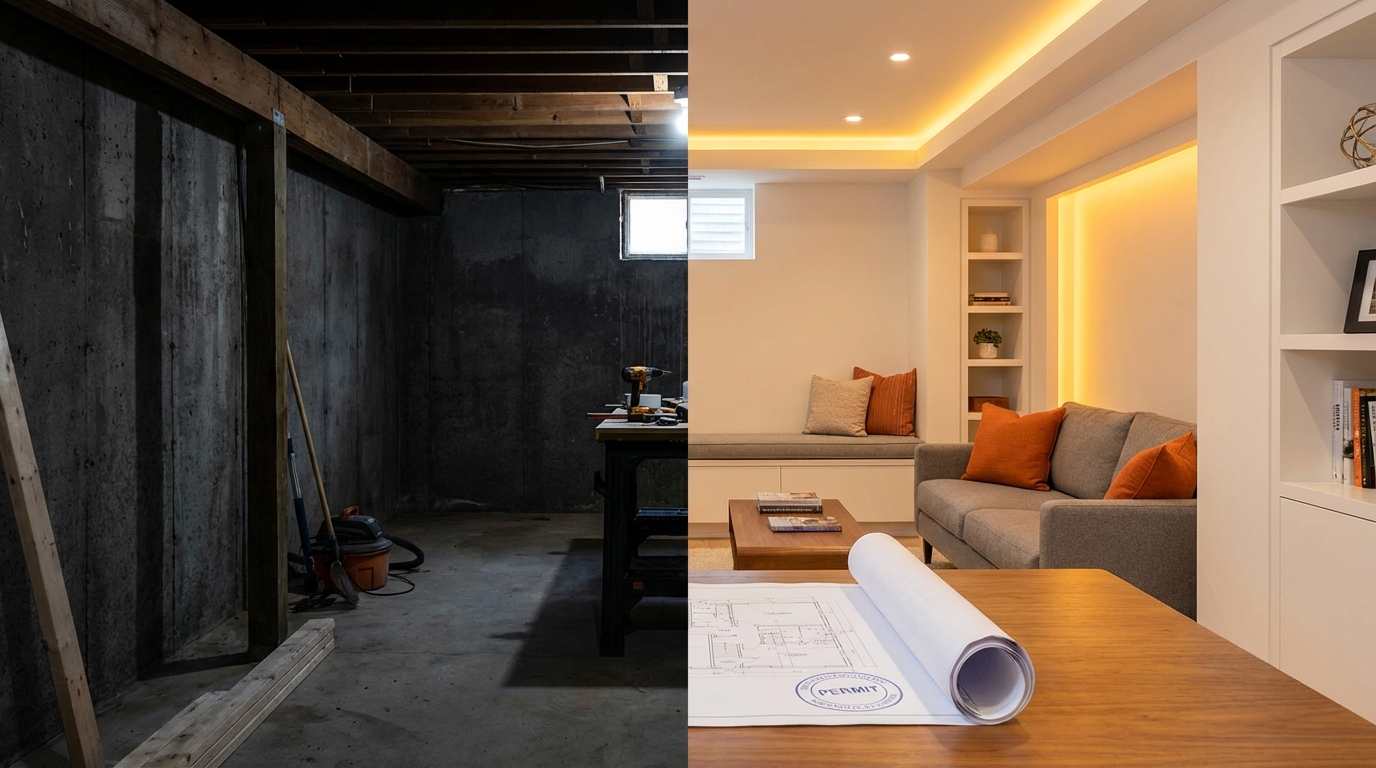
So, you are trying to figure out how to make your basement renovation “count” as legal square footage. The direct answer is: your basement only counts as legal square footage if it meets your local building code for a “habitable” space and passes inspection, which usually means proper ceiling height, egress, ventilation, moisture control, electrical, and permits.
Most homeowners do not lose value because of the finishes in their basement. They lose value because the space looks great on Instagram but fails basic code. Appraisers then treat it as bonus space, not real living area. If you want banks, buyers, and inspectors to treat your basement like any other floor in your home, you have to plan it from day one as code-compliant space, not just a “nice finished basement.”
Things you need to know:
- Legal square footage is a code and appraisal issue, not just “did I finish the room.”
- You almost always need permits for a real basement renovation.
- Ceiling height, egress, and moisture control are the three biggest make-or-break items.
- Bedrooms in basements have stricter rules than rec rooms.
- DIY work that skips inspections can hurt resale and insurance claims.
- Local rules vary, so you need to check with your city or county before you start.
What “legal square footage” actually means for a basement
Let us clear up the big misunderstanding right away.
When you talk to a real estate agent, an appraiser, and a building inspector, each one might use different terms:
- “Finished basement” (real estate listing)
- “Gross living area” (appraiser)
- “Habitable space” (building code)
You care about all three, but if you want your basement to add real value, the building code and the appraiser’s definition matter most.
Most building codes use ideas like:
- Is it heated by a permanent system?
- Does it have proper ceiling height?
- Does it have egress (a safe way out in a fire)?
- Is it dry, insulated, and safe to live in for long periods?
If the basement fails on those, real estate agents may still brag about it, but appraisers often keep that space out of the main “living area” number.
> A finished but non‑code basement is like a fancy car without a title: it looks nice, but it does not fully count.
Above grade vs below grade: why that phrase keeps coming up
Appraisers and lenders often split space into two buckets:
- Above grade: Everything above ground level. This is the gold standard.
- Below grade: Basements and partially below-grade spaces.
Many lenders and appraisers do not include below-grade space in “gross living area,” even if it is gorgeous and fully legal. They list it as finished basement area instead.
This does not mean you should give up. A legal, finished basement can still raise your home’s value and appeal a lot. It can:
- Attract more buyers because the house “lives” larger.
- Support a higher price than homes without finished basements.
- Help with rental income if local rules allow secondary suites.
But you need realistic expectations: your basement might not count the same way as your main floor square footage in every appraisal, yet code compliance still pays off.
Core code requirements that make a basement “habitable”
Let us walk through the core pieces that usually decide if your basement can legally be called habitable space.
I am generalizing from common U.S. and Canadian building codes (IRC/IBC style). You always need to confirm details with your local building department, because numbers can differ.
1. Minimum ceiling height
Most residential codes require something like:
- Minimum 7 feet clear ceiling height for habitable spaces.
- Some areas allow 6 feet 8 inches in basements or under beams/ducts for small portions.
Low ceilings are one of the toughest issues in older houses.
Many basements are stuck at 6’4″ to 6’8″. Without structural work, you cannot legally claim those as full living space in many regions.
Common options if your ceiling is too low:
- Dig down (basement lowering). Expensive. Involves excavation, new footings, and serious engineering.
- Rework ducts and pipes to tuck them between joists or reroute.
- Use dropped beam designs in limited areas and keep most of the room at full height.
If you have low ceilings, talk to an engineer or architect early. Do not just drywall everything and hope nobody notices.
2. Egress and exits (how you get out in a fire)
Building codes focus heavily on safe escape routes.
Most places require:
- At least one standard exit path to the main level or exterior.
- Egress windows or exterior doors in any basement bedroom.
Typical code requirements for egress windows (check local rules):
- Minimum net clear opening of around 5.7 square feet.
- Minimum opening height and width (often around 24″ x 20″).
- Maximum sill height from the floor (often 44″).
- If the window opens into a well, the well must be large enough for a person to climb out and must have a ladder if deep.
If you are planning:
- A basement bedroom
- A rental suite
- Any space where someone might sleep
you almost always need at least one proper egress window or door in that area.
If you cannot get out of the room fast without using the main stairs, inspectors will not call it a legal bedroom.
This affects square footage value too, because legal bedrooms push prices higher.
3. Moisture control and water management
A dry basement is not just about comfort. It is about safety and durability.
To count as habitable space, the basement usually must have:
- No active water intrusion or chronic dampness.
- Proper foundation drainage (sump, weeping tile, drain tile, or similar).
- Vapor barriers and insulation installed to code.
If you frame walls against damp concrete without:
- Exterior waterproofing, or
- Interior drainage, or
- A vapor barrier and proper insulation
you risk mold, which can fail inspections and scare buyers.
Common moisture control steps:
- Fix exterior grading so water flows away from the house.
- Add or repair gutters and downspouts with extensions.
- Seal cracks in the foundation.
- Install or repair interior drains and sump pumps if needed.
Never start framing or drywall until you have lived through a few heavy rains and are confident the space stays dry.
4. Heating, cooling, and ventilation
To count as habitable, your basement usually needs:
- A permanent heat source, not just portable space heaters.
- Proper supply and return air if tied into central HVAC, or a separate system.
- Mechanical ventilation in bathrooms and laundry rooms.
If you are adding bedrooms or a suite, pay attention to:
- Fresh air requirements for occupants.
- Separate temperature control if local rules expect that.
In many jurisdictions, a “finished” space with no permanent heat is still not legal living space.
5. Electrical and lighting safety
This is where permits matter a lot.
A legal basement renovation usually needs:
- New circuits sized correctly.
- GFCI and AFCI protection where required.
- Recessed lights or fixtures rated for insulated ceilings.
- Proper spacing and height for receptacles.
Many inspectors look for:
- Smoke alarms in and near bedrooms, hard-wired with battery backup.
- Carbon monoxide alarms near sleeping areas.
If your electrical work is not inspected, insurers may push back on fire claims, and buyers may negotiate hard or walk away.
The most common “red flag” in basement renovations is unpermitted electrical work hidden behind nice drywall.
6. Insulation and energy performance
Energy codes have tightened over the years.
Typical expectations:
- Insulated exterior walls to a required R‑value (varies by climate zone).
- Insulated slab edges or floors in colder regions.
- Sealed penetrations to limit air leakage.
If your insulation does not meet local code, you may fail inspection, and the basement may feel uncomfortable, which hurts its perceived value.
Permits: the boring step that actually protects your value
You cannot talk about “legal square footage” without talking about permits.
Why permits matter for basement renovations
Permits are not just paperwork. They do three key things:
- They tell the city: “This space is now intended as habitable.”
- They trigger inspections that check structure, fire safety, electrical, and plumbing.
- They create an official record that helps with resale, refinancing, and insurance.
Without permits:
- Appraisers might treat your basement as “finished storage” instead of habitable space.
- Buyers can ask for a discount or demand retroactive permits and corrections.
- The city can issue fines or force you to remove work if someone reports it.
If you want your basement counted like a real floor of the house, the path almost always goes through the permit office.
Typical permits needed
You often need separate permits for:
- Building / structural (framing, egress windows, new openings).
- Electrical.
- Plumbing (bathrooms, laundry, wet bars).
- Mechanical / HVAC (furnace, ducts, venting, gas lines).
Some cities bundle them. Others require separate applications, sometimes with stamped plans.
How permit status affects appraisal and listing
From an appraiser’s perspective, a finished basement that:
- Has permits and passed inspections
- Meets egress and height rules
is a safer and easier space to count and compare with other properties.
An unpermitted basement creates uncertainty. Appraisers might:
- Discount the value they assign to the basement.
- Rate the home as riskier for lenders.
Real estate agents also must be careful. Many will disclose:
- “Basement finished without permits.”
which can slow down offers or increase negotiations.
Legal bedrooms vs “bonus rooms” in basements
Buyers often get excited by “4 bedrooms” vs “3 bedrooms.” So the legal status of basement bedrooms is critical.
Requirements for a legal basement bedroom
Common conditions:
- Egress: A window or exterior door that meets escape size and height rules.
- Ceiling height: Meets the basement standard for habitable space.
- Heating: Permanent heat source.
- Electrical: Proper outlets and lighting.
- Closet: In some markets, a closet is expected, though this varies.
If the room fails on egress or height, code officials and appraisers will not treat it as a legal bedroom.
Instead, they might call it:
- “Den”
- “Office”
- “Bonus room”
That can cut into how much value that room adds.
Sample comparison of legal vs non‑legal basement bedrooms
| Feature | Legal Basement Bedroom | Non‑Legal Basement Room |
|---|---|---|
| Egress window or door | Yes, meets size and height rules | Small window or no window |
| Ceiling height | Meets code (often 7′) | Too low in most of the room |
| Permits | Permitted and inspected | No record or failed inspection |
| How it is marketed | “4th bedroom” | “Den / office / bonus room” |
| Impact on value | Higher usable bedroom count | Less impact than a true bedroom |
Basement suites, rentals, and secondary units
If your goal is not just more space but also rental income, there are more layers to think about.
When a basement can be a second unit
Many cities allow:
- Legal basement apartments
- Accessory dwelling units (ADUs)
- Secondary suites
To be legal, these often require:
- Separate entrance.
- Independent or code‑compliant shared HVAC.
- Fire separation between units.
- Smoke and CO detectors interconnected between units.
- Parking requirements in some areas.
Building a suite without approvals can cause serious issues:
- Fines from the city.
- Forced removal of kitchens or baths.
- Insurance denial if there is a fire involving tenants.
So if rental income is your goal, make “legal suite” your target from day one, not something you tack on later.
Common basement renovation mistakes that hurt legal status
You are trying to add legal square footage, not just decorate. These are the mistakes that quietly ruin that goal.
1. Finishing before fixing water problems
People see concrete, some musty smells, and think: “We can fix that with paint and drywall.”
What happens:
- They box in wet walls.
- Mold develops behind drywall.
- Inspections fail or buyers detect moisture.
Always solve water first, then finish.
2. Ignoring egress until late in the project
You frame bedrooms, install drywall, then find out:
- The window is too small.
- The well is too shallow or narrow.
Cutting a new, larger window in a finished wall is costlier and riskier. Plan egress at the design stage.
3. Dropping the ceiling too low
People love recessed lights and hide every pipe inside a drop ceiling. This often:
- Eats up 4 to 6 inches of height.
- Drops ceiling below the minimum in parts of the room.
Better approach:
- Run services between joists where possible.
- Create localized soffits for ducts instead of dropping the whole ceiling.
- Use low‑profile lights rated for direct contact with insulation.
4. DIY electrical and plumbing without permits
You might save some upfront money, but:
- Insurance risk goes up.
- Inspectors can force rework if found later.
- Buyers’ inspectors often flag “unprofessional workmanship.”
You can still DIY framing, insulation, and finishes and hire licensed pros for technical trades.
5. Treating bedrooms as an afterthought
If you think you might want:
- One or two bedrooms
- A home office that could be marketed as a bedroom later
plan them now with:
- Egress windows.
- Closets and proper layout.
- Wiring and ventilation.
Changing from “rec room” to “bedroom” late often triggers more code requirements and cost.
How to plan a basement renovation that adds legal square footage
Let us walk through a practical approach step by step.
Step 1: Clarify your goals for the space
Ask yourself:
- Do you want extra family space only?
- Do you want legal bedrooms?
- Do you want a rental unit?
- Are you planning to sell in the next 3 to 7 years?
Your goals change the code path:
- Rental suite usually needs the most work and approvals.
- Family rec room is simpler.
Write this down. It helps when you speak with the building department or a designer.
Step 2: Gather local rules and constraints
Before designing anything:
- Visit your city or county building department website.
- Search: “basement finishing requirements” or “secondary suite requirements.”
- Look for any handouts or checklists.
If the website is unclear, call or visit in person. Bring:
- Your address.
- Basic sketch of your basement (even rough).
Ask direct questions like:
- “What is the minimum ceiling height for habitable basement rooms in my area?”
- “What is required for a legal bedroom in the basement?”
- “Are basement suites allowed at my address, and what permits are needed?”
City staff answer these questions every day. Short, specific questions get the best guidance.
Step 3: Assess your current basement conditions
You want a clear picture of what you are starting with.
Check:
- Ceiling height: Measure in multiple spots, including under ducts and beams.
- Moisture: Look for stains, efflorescence (white powder), musty smell.
- Structure: Bowed walls, cracks, prior repairs.
- Mechanical layout: Locations of furnace, water heater, main drain stack.
- Windows: Size, sill height, possible locations for new egress.
If you see serious signs of water or structural issues, bring in a specialist before planning finishes.
Step 4: Sketch a code-aware layout
At this stage, do not worry about fancy design. Focus on:
- Where stairs enter the basement.
- Best zone for bedrooms (near windows that can be egress).
- Bathroom location near existing plumbing stacks if possible.
- Separation of noisy mechanical areas from sleeping or living areas.
Overlay code ideas:
- Keep habitable spaces within the parts of the basement with enough ceiling height.
- Reserve lower-height areas for storage or mechanical rooms.
- Plan egress windows early in the design, not as an add‑on.
Step 5: Decide what to DIY and what to hire out
You can often handle:
- Framing walls and bulkheads.
- Insulation and vapor barriers, guided by code.
- Drywall, painting, and trim.
- Flooring installation (if you pick basement‑friendly floors).
For legal status and safety, it is wise to hire licensed pros for:
- Electrical rough‑in and panel work.
- Plumbing for bathrooms and laundry.
- HVAC modifications or gas lines.
- Structurally significant changes (e.g., cutting new windows, removing walls).
You can still manage the project yourself as a general contractor, but let pros handle the code‑critical trades.
Step 6: Apply for permits with clear plans
When you apply for permits, you will likely need:
- Floor plan with room labels.
- Locations of doors, windows, and egress windows.
- Plumbing locations and fixtures.
- Electrical layout in some jurisdictions.
If you are adding a suite, you may also need:
- Fire separation details.
- Soundproofing approach.
- Separate metering plans in some places.
This is where a designer, architect, or design‑build contractor can earn their fee by handling code and submission details.
Step 7: Sequence the work to pass inspections smoothly
Most projects follow a basic sequence:
- Waterproofing and structural fixes.
- Framing and rough egress work (e.g., cutting windows).
- Rough plumbing, electrical, and mechanical.
- Insulation and vapor barriers.
- Inspections at rough‑in and insulation stages.
- Drywall, ceilings, and finishes.
- Final inspections.
Missing an inspection or covering work too early can lead to delays and, in worst cases, ripping out finished walls.
Basement‑safe materials that help protect your investment
To keep that new legal space dry, comfortable, and looking good long term, material choices matter.
Flooring choices
Better options:
- Luxury vinyl plank (LVP) or tile rated for below‑grade.
- Tile with proper underlayment.
- Engineered wood approved for basements over a proper subfloor.
Risky options:
- Solid hardwood nailed directly over slab.
- Cheap laminate with weak moisture resistance.
- Thick carpet padding over a damp slab.
Whatever you choose, test for moisture in the slab first.
Wall assemblies
Safer assembly for many basements:
- Moisture control at the exterior (drainage, waterproofing) where possible.
- Rigid foam or mineral wool insulation that tolerates occasional moisture.
- Treated bottom plates in contact with concrete.
Avoid trapping moisture:
- Do not put fiberglass batts directly against damp concrete without a plan for drying.
How much value can a legal basement add?
I will not throw out a random percentage, because it jumps around by location, market, and quality.
What we see across markets:
- Finished, legal basement space rarely adds dollar‑for‑dollar like main‑floor additions, but it is often far cheaper to build.
- Homes with legal, finished basements sell faster and get stronger offers than similar homes with dark, unfinished basements.
- Legal bedrooms and baths in basements give more listing flexibility and attract larger households.
Think of it like this:
- You are lowering the “cost per usable square foot” of your home, which is attractive to buyers.
If you are considering rental, you can also model:
- Construction cost vs expected monthly rent.
- Time to recover the investment.
Again, a legal suite with permits tends to command higher and more stable rent than an off‑the‑books setup.
Technology tools that make planning and compliance easier
This is where you can bring a bit of tech into a very physical project.
Digital design and layout tools
You can use:
- Home design apps (like SketchUp, RoomSketcher, or similar) to mock up your basement layout.
- Laser measures to create accurate dimensions quickly.
These help you:
- Check furniture fit before building walls.
- Plan egress window locations.
- Share clear drawings with your contractor and inspector.
Moisture and air quality tech
To monitor conditions before and after the renovation:
- Use inexpensive humidity sensors to track moisture levels over weeks.
- Set up leak detectors near sumps and water heaters.
- Consider smart dehumidifiers that turn on automatically based on humidity.
This is not just gadget love. Stable humidity and quick detection of leaks protect that legal space and your investment.
Project management and documentation
Keep a digital record:
- Photos of walls and ceilings before insulation and drywall (showing wiring, plumbing, framing).
- Copies of permits and inspection approvals.
- Receipts and manuals for equipment (pumps, HVAC, etc.).
Use cloud storage or a simple project app to organize all this. When you sell, this packet reassures buyers and appraisers that the basement is properly done.
Red flags that suggest your current finished basement is not legal
If the previous owner “already finished” the basement, you need to check what you are dealing with.
Signs that you might not have legal habitable space:
- No record of permits at your city office.
- Bedrooms with tiny windows or no windows.
- Visible electrical junction boxes buried behind panels or ceilings.
- Ceiling below 6’8″ in most of the area.
- Visible mold, chronic dampness, or musty smell.
- No smoke or CO detectors near sleeping areas.
If you see these, consider bringing in:
- A home inspector.
- An electrician.
- A contractor who knows local code.
They can help you figure out what it would take to bring the space up to legal standards. Sometimes it is not as bad as it looks. Other times, part of the basement might need to be stripped and redone.
When it is not worth forcing a basement into “legal square footage”
There are situations where chasing full legal status and appraiser recognition is not the smartest move.
Examples:
- Your ceiling height is far below code and lowering the floor is cost‑prohibitive.
- Your area has strict rules that would require extreme work for a suite.
- You plan to move soon and the market does not strongly reward finished basements.
In those cases, you might:
- Focus on a cleaner, brighter storage and hobby area.
- Invest in dehumidification, lighting, and organization.
- Be honest in listings about the basement being non‑conforming but usable as bonus space.
Legal status is a tool, not a religion. If the cost is wildly out of line with what your market will pay, you adjust your approach.
Practical tip: how to talk to your building department so you get better answers
When you call or visit your city office, go in with a specific, short script. For example:
“I live at [address]. I want to finish my basement and add one legal bedroom and a bathroom. What are your minimum requirements for ceiling height, egress windows, and permits, and do you have any handouts for basement finishing?”
Write down:
- The name of the person you spoke with.
- The date.
- Key points they shared.
Then, before you buy materials or sign a contract, adjust your design so it matches what they told you. This one step, done early, is often the difference between a basement that truly adds legal square footage and one that just looks finished on the surface.