
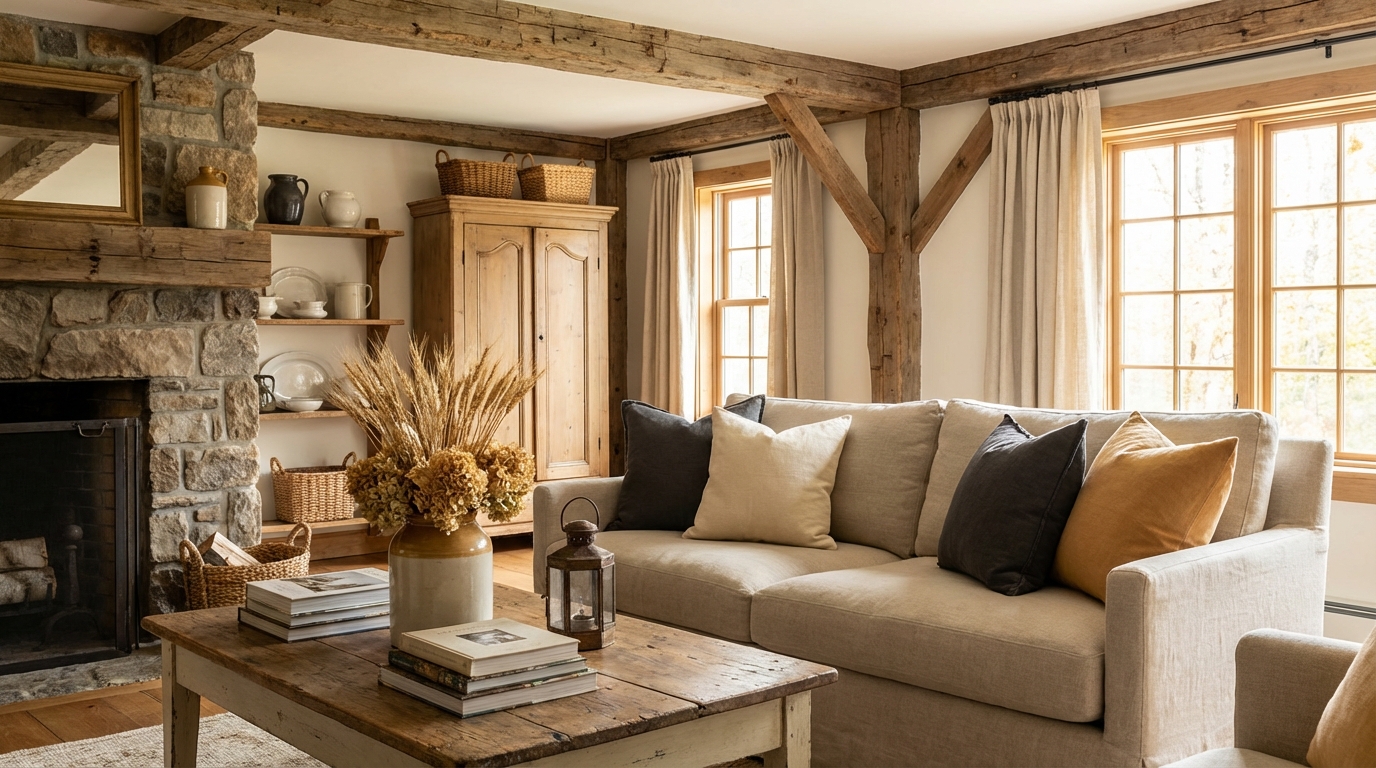
So, you want to know how to achieve the farmhouse look and still keep that rustic charm without your home feeling like a theme park. The short answer is: focus on warm neutrals, natural materials, lived-in textures, simple lines, and a handful of thoughtful details that feel honest and practical, not staged.
You are not trying to rebuild an old barn in your living room. You are trying to create a calm, warm, slightly worn-in space that feels like it has a story. That means choosing finishes, furniture, and decor that look like they could age well, that are practical, and that do not scream “trend” at first glance. Think more “comfortable country house” and less “photo set.”
Things you need to know:
- Start with a neutral base: warm whites, soft grays, and beige with depth.
- Use real-feeling materials: wood, metal, stone, cotton, linen, wool.
- Mix new and old: one weathered piece can shift an entire room.
- Keep lines simple and functional, not overly ornate.
- Layer texture to avoid a flat, sterile look.
- Limit decor and use pieces that have a job or a clear purpose.
- Repeat a few key finishes and colors through the whole home.
- Do not chase every farmhouse trend; pick what fits your life.
What “Farmhouse Look” Really Means (Without the Buzzwords)
So, you want that farmhouse style, but what does that actually mean in practice?
At its core, farmhouse style is about:
- Comfort over perfection.
- Function first, looks second (but still strong on looks).
- Natural, honest materials that age well.
- A sense that things have been used and loved, not just staged yesterday.
You might see a lot of photos with shiplap, giant “Gather” signs, and distressed everything. You do not need all of that. In fact, if you add every farm-style trend you see on social feeds, your home will feel dated faster.
Think of farmhouse as a set of guiding ideas, not a checklist:
- Would this piece have made sense in a practical country home?
- Does it feel comfortable to live with, not just look at?
- Can it handle wear without looking ruined?
If the answer is mostly “yes”, you are close.
Farmhouse style works best when it feels like it could have evolved over time, not like it was delivered in one truckload last weekend.
Start With the Base: Color, Floors, and Walls
Choosing the Right Color Palette
So, you want to nail the farmhouse color palette. Start simple.
Your base: warm neutrals.
- Whites with cream or beige, not icy blue.
- Soft, warm grays that do not feel cold.
- Greige (a mix of gray and beige) for flexible walls.
The goal is to create a calm backdrop that lets wood, metal, and texture take the lead.
Good wall color families:
- Warm white (think soft vanilla or natural cotton).
- Light greige (sits nicely with wood floors).
- Soft taupe (nice for bedrooms and living rooms).
Accent colors that fit farmhouse:
- Muted sage green.
- Dusty blues.
- Charcoal, used lightly.
- Warm terracotta in small doses, like a vase or cushion.
You do not need every color. Pick 2 to 3 neutrals and 1 to 2 accent colors and repeat them across rooms.
If you can take a photo of your room, turn the saturation way down, and it still looks calm and balanced, you are on the right track with your color choices.
Floors: The Foundation of Rustic Charm
Flooring does more for the farmhouse look than people think.
Here are strong options:
- Wood floors: wide planks, visible grain, warm or medium tones.
- Luxury vinyl plank (LVP): if you have kids or pets, this can mimic wood while handling spills.
- Tile in stone tones: for kitchens, entries, or baths.
Try to avoid:
- Very shiny, orange-toned floors.
- Super dark floors that show every speck of dust.
- Cool gray floors with a fake look.
If you cannot change your floors, rely on rugs:
- Natural fiber rugs: jute, sisal, seagrass for texture.
- Flatweave or low-pile rugs: feel simple and easy to maintain.
- Distressed pattern rugs: hint of vintage without feeling too busy.
Walls: Shiplap, Paneling, and Paint
So, do you need shiplap to get farmhouse style? No.
You have three main paths:
- Plain painted walls: clean, flexible, and timeless.
- Accent paneling: board and batten or simple vertical planks on one wall.
- Full shiplap: works best in smaller areas like entryways or a single accent wall.
If you like shiplap, keep it simple:
- Run it horizontally in most rooms.
- Use a soft white or light neutral, not bright stark white.
- Avoid overdoing it in every room. One or two key spaces is enough.
Think of wall treatments as seasoning. A little bit brings out character. Cover everything, and it overwhelms the room.
Furniture: Where Rustic Meets Practical
Farmhouse Furniture Basics
So, you are trying to pick furniture that feels farmhouse but not fake. The key is simple shapes, comfortable proportions, and honest materials.
You want pieces that look like you can actually sit, eat, and work on them without babying them.
Core farmhouse furniture traits:
- Clean lines with small details like simple turned legs or cross-backs.
- Sturdy look: not fragile or razor-thin legs everywhere.
- Natural wood or painted finishes in soft tones.
Living Room Pieces
Focus on:
- Sofa: neutral fabric, soft but not saggy cushions.
- Chairs: maybe one in a subtle pattern like a stripe or check.
- Coffee table: wood or wood + metal base.
- Side tables: simple shapes, maybe repurposed from an old stool or crate.
Fabric choices that work well:
- Cotton or linen blends.
- Performance fabric in a natural texture if you have kids or pets.
- Slipcovers for an easy relaxed look.
Try to avoid:
- Overly shiny leather.
- Ultra modern shapes that feel like a tech showroom.
- Very bold patterns on your biggest pieces.
Dining Room and Kitchen Furniture
In a farmhouse-style space, the dining table is often the star.
Traits of a strong farmhouse table:
- Wood top with visible grain.
- Chunkier legs, but not cartoon-thick.
- Comfortable size that fits your daily life, not just holidays.
Seating options:
- Simple wood chairs, maybe mix in a bench on one side.
- Woven seats or cross-back chairs for character.
- End chairs that are slightly different for a collected feel.
Kitchen furniture ideas:
- Wood or metal stools at an island.
- Open shelving with real daily-use items, not just decor.
- A freestanding hutch or sideboard instead of more built-ins.
If a piece of furniture looks like it could move with you from home to home and still make sense, it usually works well in farmhouse style.
Bedroom Furniture
For bedrooms, keep it quiet and soft but still grounded.
Good fits:
- Upholstered headboard in linen or cotton.
- Wood headboard with a simple, slightly vintage profile.
- Nightstands that look like small tables or old cabinets.
- Dresser with cup pulls or simple knobs.
Mixing painted and wood pieces is helpful. For example:
- Wood bed + painted nightstands, or
- Painted bed + wood dresser.
Materials and Finishes: What Makes It Feel Rustic
Wood: Your Main Character
So, you want rustic charm. Wood carries a lot of that.
Look for:
- Visible grain.
- Knots and minor markings.
- Matte or low-sheen finishes.
Types of wood tones that fit well:
| Wood Tone | Where It Works | Notes |
|---|---|---|
| Light oak | Floors, dining tables, open shelves | Gives an airy, modern farmhouse feel |
| Medium brown | Coffee tables, beams, cabinets | Feels warm and grounded |
| Weathered grey-brown | Accent pieces, benches | Adds age without feeling too dark |
| Dark walnut | Smaller pieces, picture frames | Use sparingly, pairs with light walls |
Try not to mix five different wood tones in one room. Two to three that repeat is easier on the eyes.
Metals: The Supporting Cast
Metals help balance the softness of fabric and wood.
Strong farmhouse metal finishes:
- Black iron or matte black.
- Brushed nickel or pewter.
- Oil-rubbed bronze.
- Soft, brushed brass in small doses.
Use metals on:
- Light fixtures.
- Cabinet hardware.
- Table legs.
- Picture frames.
- Candle holders and small decor.
If all your metals match perfectly, the room can feel flat. If they clash wildly, it feels chaotic. Aim for 2 main metal finishes repeated across the space.
Textiles: Where the Cozy Lives
Textiles carry a lot of the “farmhouse feel.”
Think:
- Cotton, linen, canvas, and wool.
- Simple stripes, checks, or small-scale patterns.
- Chunky knits for throws.
Good places to add textural textiles:
- Pillows on the sofa and bed.
- Throws on chairs or baskets.
- Rugs in living areas and entries.
- Curtains in light, airy fabrics.
Avoid loading the room with ten different prints. One print + one stripe + solids gives enough interest without noise.
Stone, Tile, and Other Surfaces
In kitchens and baths, your surfaces matter.
Countertops that fit farmhouse style:
- Butcher block (real or high-quality lookalike).
- Quartz that mimics marble, but easier to care for.
- Honest marble if you can handle patina and small stains.
Backsplash ideas:
- Classic white subway tile with light grout.
- Simple square tiles in a soft neutral.
- Textured tile that looks handmade.
Floor tile in baths or mudrooms:
- Hex tile in a mid-size, not tiny.
- Patterned cement-look tile in muted tones.
- Stone-look tile that does not feel too glossy.
Lighting: Warmth, Not Harsh Spotlight
Layer Your Lighting
So, you want your farmhouse space to feel warm, not flat and clinical. Lighting does that.
You need three levels:
- Overhead lighting: chandeliers, flush mounts, pendants.
- Task lighting: table lamps, floor lamps, under-cabinet lights.
- Accent lighting: wall sconces, small lamps, candles.
Aim for bulbs in the warm white range (usually around 2700K to 3000K). Very cool white can make rustic materials feel fake.
Fixture Styles That Fit Farmhouse Look
Look for fixtures with:
- Simple shapes like domes, lanterns, and clean-lined chandeliers.
- Metal finishes like black, bronze, or brushed nickel.
- Clear or seeded glass shades.
Some ideas:
- Black lantern-style pendant lights over a kitchen island.
- Iron chandelier in the dining room with candle-style bulbs.
- Adjustable metal sconces by the bed or in a reading corner.
Think of lighting like jewelry: it finishes the outfit, but it should not fight with everything else in the room.
Decor and Styling: Farmhouse Without Going Overboard
Wall Art and Signs
So, do you need word signs everywhere to get farmhouse style? No.
You can include one simple sign if it feels right, but use restraint.
Better options:
- Framed black-and-white photos of your family or meaningful places.
- Botanical prints or line drawings.
- Vintage-style landscape art with muted tones.
If you like a quote sign:
- Pick one that truly means something to you.
- Keep the font simple, not overly curly.
- Avoid having a different word sign in every room.
Shelves, Surfaces, and Tabletop Decor
For open shelves and coffee tables:
- Mix practical items with a few decorative ones.
- Use baskets for hidden storage.
- Repeat materials: wood, metal, ceramic, glass.
Good decor items for farmhouse style:
- Ceramic pitchers or jugs.
- Stacked books with worn covers.
- Simple vases with greenery or branches.
- Wooden bowls or cutting boards.
- Metal trays to group smaller items.
Try a simple formula for a coffee table:
- One stack of books.
- One tray with a candle and small vase.
- One natural object like a bowl or small plant.
Textiles and Soft Decor
The fastest way to shift a room toward farmhouse style is through soft items.
For your living room:
- Swap busy, shiny pillows for linen or cotton covers.
- Add a throw with a knit or woven texture.
- Ground the space with a neutral rug that has some pattern or texture.
For your bedroom:
- Layer white or off-white bedding with a quilt or coverlet.
- Use 2 to 4 pillows in covers that mix solid and subtle pattern.
- Bring in a textured throw at the foot of the bed.
Bringing in Vintage Without Making It Cluttered
How Much Vintage Is Enough?
So, you want rustic charm but not clutter. Vintage pieces help, but they need space to breathe.
Think in terms of “anchors” and “accents”:
- Anchor pieces: one large vintage piece like a hutch, table, or chest.
- Accent pieces: small items like an old clock, framed print, or pottery.
Suggested limits per room:
- 1 to 2 vintage anchor pieces.
- 3 to 5 small vintage accents.
Where to Use Vintage Pieces
Good spots for vintage:
- Entry: a vintage bench or console table.
- Living room: old trunk as a coffee table.
- Dining room: vintage sideboard for storage.
- Kitchen: old bread boards or crocks holding utensils.
- Bedroom: antique nightstand or chest at the foot of the bed.
If every surface is covered in vintage finds, you do not see any one of them clearly. Give your favorite pieces room and they feel more special.
Kitchen: The Heart of the Farmhouse Look
Cabinets and Hardware
So, you want a farmhouse kitchen without a gut renovation. There are levels to this.
If you can update cabinets:
- Paint them in white, cream, or soft greige.
- Change hardware to black, bronze, or brushed nickel.
- Add glass fronts on a few upper cabinets for display.
If you cannot change cabinets:
- Update hardware only for a fast shift.
- Use runners and rugs in natural tones.
- Style counters with wooden boards and simple jars.
Counter Styling Without Visual Noise
Keep only what you use daily on your counters.
Practical, good-looking counter items:
- Wood cutting boards leaned against the backsplash.
- Ceramic jar for utensils.
- Simple fruit bowl.
- Small lamp for warm light.
Try to group items:
- Use a tray to hold oil, salt, and pepper.
- Keep coffee gear in one zone.
Living Room: Rustic, But Still Modern Enough
Layout and Flow
So, you want it cozy but not cramped. Focus on:
- Seating gathered around a focal point (fireplace, TV, or large window).
- Clear walkways 3 feet wide if possible.
- Coffee table about 18 inches from the sofa.
Farmhouse living room ingredients:
- Neutral sofa.
- Pair of chairs or one chair + bench.
- Wood coffee table.
- Rug large enough so front legs of seating sit on it.
- Simple media console or cabinet for storage.
Styling the Fireplace (If You Have One)
Mantel decor often gets busy fast. Try this approach:
- One large piece in the center: mirror, art, or family photo.
- One or two pairs of items: candle holders, small vases.
- One natural element: greenery, small plant, or branches.
For the hearth:
- Basket with throws.
- Neat stack of wood (even if just for looks).
- Lantern or metal bucket.
Bedroom: Calm, Soft, and Simple
Bedding Layers
So, you want a farmhouse bedroom that feels restful.
Start with:
- Simple white or off-white sheets.
- Neutral duvet or quilt.
- Second layer like a folded throw or extra quilt at the end of the bed.
Pillow setup that works:
- 2 standard sleeping pillows.
- 2 shams matching the quilt or duvet.
- 1 or 2 smaller accent pillows with texture (knit, stripe, or linen).
Bedroom Decor Restraint
Keep decor low-key:
- One piece of art or mirror over the bed.
- Small lamp on each nightstand.
- No more than a few items on each surface.
Farmhouse-friendly bedroom decor:
- Woven baskets for extra blankets.
- Vintage-style alarm clock.
- Ceramic vase with a branch or small floral stem.
Small Spaces: Entry, Bathroom, and Hallways
Entryway
So, you want people to feel that rustic charm right when they walk in.
Key pieces:
- Bench or small chair for sitting.
- Hooks or pegs for coats and bags.
- Basket or tray for shoes or smaller items.
Decor:
- Mirror to reflect light.
- Rug in a flatweave pattern.
- Small piece of art or greenery.
Bathroom
Bathrooms often get ignored in style plans.
Simple farmhouse steps:
- Swap hardware to black or brushed metal.
- Change light fixture to a simple sconce or bar.
- Add wood or woven elements like a stool or basket.
- Use white or striped towels.
Counter styling:
- Soap dispenser and toothbrush cup that match.
- Small plant or simple vase.
- One tray with daily items, nothing more.
Mixing Farmhouse with Other Styles
Modern Farmhouse
So, you like clean lines but still want rustic charm.
To blend modern and farmhouse:
- Use more black and white for contrast.
- Choose simple hardware and fixtures with straight lines.
- Keep decor minimal, but add one or two rustic wood pieces.
- Mix in some smooth surfaces like plain cabinetry and flat-front doors.
Traditional Farmhouse
If you lean traditional:
- Add more curves in furniture: rolled arms, arched headboards.
- Use classic patterns like ticking stripes and checks.
- Bring in more vintage-style art and mirrors.
Industrial Farmhouse
For a bit more edge:
- Add metal pipes or brackets on shelves.
- Use metal stools and metal light fixtures.
- Balance it with warm wood so it does not feel cold.
Common Mistakes When Trying to Get the Farmhouse Look
Overdoing the Distress
So, you are tempted to sand and paint every piece until it looks decades old. Easy trap.
Too much chippy paint can make a room feel costume-like.
Better approach:
- Have 1 to 2 distressed pieces per room.
- Keep other furniture in smoother finishes.
- Use age as an accent, not the entire story.
Too Many Signs and Words
If every wall talks to you, your brain never rests.
Limit:
- 1 word sign per major area, at most.
- More art and photos, fewer slogans.
Cluttered Surfaces
Farmhouse does not mean every surface filled with decor.
Simple rule:
- Leave some empty space on each table or shelf.
- Let your strongest pieces stand out.
Ignoring Function for the Look
If you cannot reach what you need because decor blocks it, the style fails.
Ask:
- Can I clean this surface easily?
- Can kids or guests move through this space without stress?
- Does this decor piece earn its spot?
A Quick Room-by-Room Farmhouse Checklist
Living Room
- Neutral sofa with textured pillows.
- Wood coffee table or trunk.
- Large rug that anchors the seating area.
- Layered lighting: overhead + lamps.
- One vintage or rustic anchor piece.
- Greenery in at least one corner.
Kitchen
- Simple hardware in black or brushed metal.
- Wood boards and ceramic jars on counters.
- Neutral or lightly patterned rug or runner.
- Open shelf or glass-front area styled with daily dishes.
- Warm lighting, not stark blue-white.
Bedroom
- Soft, neutral bedding with one extra layer.
- Lamps on both sides of the bed.
- Simple art above the headboard.
- Woven basket or trunk for storage.
- Few, well-chosen decor pieces, not many.
Bathroom
- Matching, simple towels.
- One small plant or greenery stem.
- Tray or basket for daily items.
- Updated hardware and light fixture if budget allows.
You do not need to change everything at once. One room, one project, or even one corner at a time still moves you closer to the look you want.
A Practical Tip to Start Today
Pick one room, walk through it with a laundry basket, and remove every decorative item that is either broken, has no meaning, or feels out of place. Put the basket in another room. Live with the cleared space for three days before you add anything back. When you do, add back only the pieces that fit your farmhouse goal: simple, useful, and warm.