
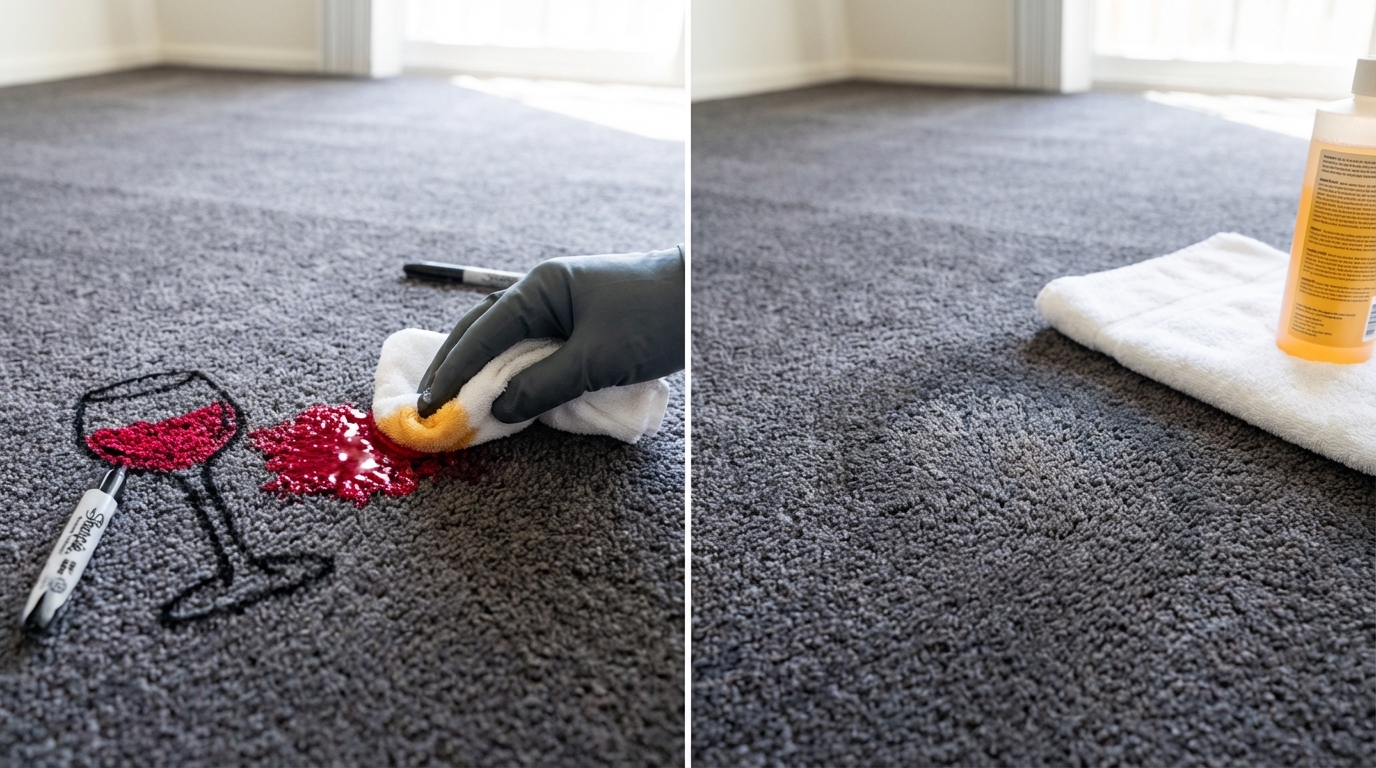
So, you are trying to remove Sharpie or wine from your carpet and you are worried it is ruined.
You actually can fix most Sharpie and wine stains with the right products, some patience, and the right order of steps.
The short version: act fast, blot (never scrub), test cleaners on a hidden spot, then work from the outside of the stain toward the center with the right solution for the type of stain.
Here is the thing: carpets are like landing pages. One careless move and they look bad for a long time. Sharpie and red wine both feel permanent. One is pigment and solvent. The other is tannins and dye. But they respond to different chemistry. When you use the wrong cleaner or scrub too hard, you push the stain deeper, just like sending bad traffic to a good page. The key is method, not magic. I will walk you through step by step, with options depending on what you have at home.
- Act quickly: fresh stains are much easier to remove than dry ones.
- Always blot, never rub or scrub hard.
- Test every cleaner on a hidden area first.
- Use different methods for Sharpie vs wine. They are not the same kind of stain.
- Work from the outside of the stain toward the center.
- Use white cloths or paper towels so you can see progress.
- Do not mix chemicals (like bleach and ammonia or different strong cleaners).
- Let the carpet dry fully before judging the result.
- If the stain is old, expect to repeat steps more than once.
- Know when to stop and call a pro so you do not damage the carpet backing.
“Most ‘permanent’ stains on carpet are more about panic reactions than the original spill.”
Understanding the enemy: why Sharpie and wine are so stubborn
Before you start pouring things on your floor, it helps to know what you are dealing with.
What is in a Sharpie stain?
Permanent markers like Sharpie generally use:
- Pigments and dyes: tiny color particles that want to stay put.
- Solvents (like alcohol): help the pigment soak into surfaces.
- Resins: help the color bond and resist water.
That mix makes them resistant to plain water and common mild cleaners. Water by itself does not break the bond, so you need solvents, surfactants, and sometimes a bit of oxygen power.
Sharpie on carpet is harder if:
- The carpet fiber is porous (like some natural fibers).
- The stain is old and has been walked on.
- You already tried random cleaners and rubbed hard.
What is in a red wine stain?
Red wine is different:
- Tannins: plant compounds that cling to fibers.
- Anthocyanin dyes: the red-purple pigment that stains.
- Acids and sugars: can attract dirt later if not cleaned well.
Water alone can spread the stain. Heat can set it. That is why hot water or steam, right away, is risky.
“The stain you see today is only half the story. The bigger problem is the residue that will attract more dirt tomorrow.”
First steps: what to do in the first 2 minutes
Whether it is Sharpie or wine, you always start with the same baseline steps.
Step 1: Pause and do not rub
Your instinct is to grab a sponge and start scrubbing. That is how many stains turn from a small dot into a big ring.
Instead:
- Stop and breathe for five seconds.
- Take a photo if you want a “before” picture or need to show a pro later.
Step 2: Blot up what you can
Use white paper towels or a clean white cotton cloth.
- Press down gently on the stain.
- Lift straight up, do not scrub back and forth.
- Rotate to a clean part of the cloth each time.
For wine, you are removing liquid.
For fresh Sharpie, you might not get much out, but you still want to remove any wet ink sitting on the surface.
Step 3: Test your cleaner on a hidden spot
Before you touch the main stain, you test.
Pick an unseen area of carpet, like behind a couch or inside a closet, and:
- Apply a tiny bit of your chosen cleaner.
- Blot with a cloth.
- Let it dry for 5 to 10 minutes.
You are watching for:
- Color fading or bleeding.
- Texture change (stiffness, roughness).
If the carpet looks fine, you can move on.
Tools and cleaners you can use
Here is a simple table of what tends to work on each stain type. This is not about fancy brands. It is about what is already in your house or easy to buy.
| Cleaner / Tool | Good for Sharpie? | Good for Wine? | Notes |
|---|---|---|---|
| Rubbing alcohol (isopropyl 70%) | Yes, often very helpful | Sometimes as a follow-up | Dissolves many inks, do not pour, dab only |
| Non-acetone nail polish remover | Sometimes (test carefully) | Rarely needed | Can damage some carpet fibers or backing |
| Hairspray (alcohol-based) | Sometimes (older trick) | Not ideal | Can leave sticky residue, check label for alcohol |
| Dish soap + cool water | Good as a gentle follow-up | Good first step for wine | Use a small amount of soap |
| White vinegar + water | Minor help | Helpful for wine tannins | Use diluted, equal parts or weaker |
| Baking soda | Absorbent, not a primary cleaner | Good for soaking up remaining wine | Vacuum after dry |
| Hydrogen peroxide (3%) | Sometimes, last resort | Often helpful on light carpets | Can bleach dark fibers, always test first |
| Oxygen-based stain remover (like Oxi-type) | Moderate, test first | Strong choice for wine | Follow package directions closely |
| Commercial carpet stain remover (for ink or wine) | Often effective | Often effective | Pick a product meant for your stain type |
| Cold water | Limited benefit | Helpful immediately for wine | Never use hot water at first on wine |
“Think of each cleaner like a campaign: targeted, measured, tested on a small audience before a full roll-out.”
How to remove Sharpie from carpet: step-by-step
Here is a structured way to approach Sharpie. You start mild and progress only if needed.
Step 1: Blot and prep
- Blot any fresh ink gently with a dry white cloth.
- Do not add water yet. Plain water can sometimes spread ink.
If the ink is already dry, skip straight to the next step.
Step 2: Use rubbing alcohol (main method)
Rubbing alcohol is often the most practical starting point.
- Take a small bowl and pour in a small amount of 70% isopropyl alcohol.
- Dip a cotton ball, cotton swab, or the corner of a white cloth into the alcohol.
- Blot the Sharpie stain gently, starting from the outside edge and moving inward.
Tips:
- Do not pour alcohol straight on the carpet. That can push the ink down into the backing.
- Rotate to clean parts of the cloth as the ink transfers.
- Use light pressure. You are trying to lift, not grind.
You should start to see ink transfer onto the cloth. That is your feedback loop.
If you see no movement after a couple of minutes, switch tactics.
Step 3: Add a mild dish soap solution
Once you have lifted a good chunk of the ink with alcohol, you might have a faint stain left along with alcohol residue.
Mix:
- 1 cup of cool water
- 2 to 3 drops of clear dish soap
Process:
- Dab this solution onto the area with a new cloth.
- Blot, do not scrub.
- Follow with a cloth dampened with plain water to rinse out soap.
Why this matters: alcohol breaks down ink; soap helps remove the loosened particles and any oily residue.
Step 4: Try non-acetone nail polish remover (backup method)
If alcohol alone is not working well and your carpet passed the spot test, you can try non-acetone nail polish remover.
- Use a tiny amount on a cotton swab or cotton ball.
- Blot at the stain edge, again from outside toward the center.
- Work slowly. Watch the fibers for any change.
Right after:
- Blot with a damp cloth (plain water) to remove residue.
- Follow with the mild dish soap solution if needed.
I would not use acetone-based remover on carpet. It is harsher and more likely to damage backing or padding.
Step 5: Hairspray method (if that is all you have)
If you do not have alcohol or nail polish remover but you do have hairspray, check the label. You want one that lists alcohol high in the ingredients.
Process:
- Spray a small amount on a cloth, not straight on the carpet.
- Blot the stain gently.
- As ink transfers, switch to a cleaner section of the cloth.
Then:
- Rinse by blotting with a damp cloth, because hairspray can leave a sticky layer.
- If the area feels tacky, repeat the rinse with the mild dish soap solution and then plain water.
“Hairspray works mostly because of its alcohol content. The rest of the formula often creates another mini problem you then have to clean up.”
Step 6: Last resort oxygen or peroxide on light carpet
If you still see a shadow of Sharpie and you have light-colored carpet, consider:
- 3% hydrogen peroxide, or
- a diluted oxygen stain remover
Always test on a hidden spot first. Peroxide can lighten color.
For peroxide:
- Apply a small amount with a cotton swab to the stain.
- Let sit for 5 to 10 minutes.
- Blot with a dry cloth.
- Rinse by blotting with a damp cloth.
For oxygen-based cleaner:
- Follow the instructions on the package.
- Usually you will mix with water, apply, let sit a few minutes, then blot and rinse.
Do not use chlorine bleach on carpet. It rarely ends well.
How to remove red wine from carpet: step-by-step
Wine stains respond better to a slightly different playbook. Here you want to dilute, lift, then treat the tannins.
Step 1: Blot up as much wine as possible
Right away:
- Use thick white paper towels or a folded white cloth.
- Press down to soak up wine.
- Switch to fresh towels as they fill with wine.
Avoid:
- Scrubbing or twisting motions.
- Standing and grinding your heel into the stain.
You want the carpet to go from wet to just damp.
Step 2: Add a bit of cool water
Once you have lifted most of the liquid:
- Pour a small splash of cool water on the stain. Do not flood it.
- Blot again with fresh towels to lift more pigment.
Think of this like a rinse and repeat cycle. You are diluting then extracting.
Step 3: Dish soap and vinegar solution
Here is a simple DIY that works for many red wine stains.
Mix:
- 1 cup of warm (not hot) water
- 1 teaspoon of clear dish soap
- 1 teaspoon of white vinegar
Process:
- Dab the solution onto the stain with a white cloth or sponge.
- Press gently, do not scrub.
- Let it sit for about 5 minutes.
- Blot with a dry cloth to lift the liquid.
Repeat until you see the color fading significantly.
Then:
- Rinse by blotting with plain water.
- Blot dry as much as you can.
Why this works: the dish soap helps break surface tension and lift pigment, the mild acid in vinegar helps deal with tannins.
Step 4: Baking soda paste for deeper pulling
For a stain that still has color:
- Mix 3 parts baking soda to 1 part water to form a paste.
- Apply a thin layer over the damp stained area.
- Let it dry fully. This can take several hours.
Once dry:
- Vacuum the dried baking soda thoroughly.
Baking soda does not “erase” wine by itself. It acts more like an absorbent layer that helps lift remaining pigment and any lingering odor.
Step 5: Oxygen-based cleaner for tough red wine stains
If you still see a stain after the dish soap and baking soda steps, an oxygen-based cleaner can help quite a bit.
General process (always follow your product label):
- Mix the powder with warm water if required.
- Apply to the stained area. Do not oversoak.
- Let sit for the time the product suggests, usually 5 to 30 minutes.
- Blot with a clean cloth.
- Rinse by blotting with a damp cloth and then blot dry.
Many commercial “red wine removers” use some version of this approach plus surfactants.
“For fresh red wine on carpet, an oxygen-based product tested in a corner is often the closest thing to a ‘cheat code’ you will find.”
Step 6: Hydrogen peroxide for light carpets
Hydrogen peroxide comes into play again for light carpets that still show wine shadows.
- Test on a hidden area first.
- If safe, apply a small amount of 3% peroxide to the stained area.
- Let it sit for 5 to 10 minutes.
- Blot with a dry cloth.
- Rinse with a damp cloth and blot dry.
If the stain lightens but does not vanish, you can repeat the process after the area dries.
I would not use peroxide on dark or richly dyed carpets unless the test spot looks perfect after drying.
What if the stain is old and already dry?
Old stains take more patience. That is normal. You are dealing with pigment or tannins that have had time to bond deeper.
Old Sharpie stain strategy
For an older Sharpie stain:
- Start with rubbing alcohol again, but allow it a bit more contact time.
- Apply alcohol by dabbing, then let it sit for 5 minutes.
- Blot gently to lift dissolved ink.
You might need several cycles of:
- Alcohol application
- Wait a few minutes
- Blot
Then move to:
- Mild dish soap solution
- Careful dabs of non-acetone remover if the test area went well
- Very cautious use of peroxide on light carpet
Give the carpet time to dry fully between some of these cycles. Wet fibers can hide what the stain will look like when dry.
Old wine stain strategy
A dried wine stain might not even look red anymore. It can be brownish or gray.
Approach:
- Lightly dampen the stain with cool water. You are rehydrating the residue.
- Apply the dish soap and vinegar solution.
- Let it sit 10 to 15 minutes.
- Blot and repeat.
Then:
- Use an oxygen-based cleaner according to its directions.
- Consider peroxide on light carpets if there is still discoloration.
Old stains are where many people give up too early. Think in terms of several short sessions instead of one marathon.
What not to do: mistakes that make stains worse
Sometimes the biggest gains come from what you avoid.
Common mistakes with Sharpie
- Scrubbing with force: pushes ink deeper into the pile and backing.
- Pouring cleaners directly on the stain: spreads the ink horizontally and vertically.
- Using random strong solvents like acetone or paint thinner without testing: can damage backing, glue, or padding.
- Mixing cleaning chemicals: never mix chlorine bleach with ammonia or acidic products. This can create dangerous fumes.
Common mistakes with wine
- Using hot water right away: can set the pigment in some fibers.
- Dumping salt and rubbing it in: salt can scratch fibers and does not always help more than simple blotting.
- Using colored cloths or sponges: the dye can transfer and add another stain to your problem.
- Letting soap residue stay in the carpet: soapy areas attract dirt and can look dirty again fast.
“Most damage in DIY cleaning comes from panic and overconfidence together. Slow and gentle usually wins.”
Special cases: different carpet types
Your carpet material affects how aggressive you can be.
Synthetic carpets (nylon, polyester, olefin)
Most modern residential carpets are synthetic.
They generally:
- Tolerate rubbing alcohol well if used gently.
- Handle dish soap and vinegar solutions without much trouble.
- Respond well to oxygen-based cleaners.
Still test first, especially with peroxide.
Wool carpet
Wool is more sensitive.
Guidelines:
- Avoid strong alkaline cleaners (some powders or heavy-duty products).
- Use mild dish soap and cool water as your first line of attack.
- Use vinegar in low concentrations.
- Be very careful with peroxide, and only after a good test.
In many wool cases with large stains, a professional cleaner is a safer route if the carpet has significant value.
Patterned or richly colored carpet
With deep colors or complex patterns:
- Be cautious with any bleaching agent, even mild ones like peroxide.
- Test longer. Let your test area dry fully before deciding it is safe.
- Focus more on lifting than lightening. Even partial stain removal may be less visible within a busy pattern.
When to bring in professional help
Some jobs are not worth the risk of DIY because of the carpet value, the stain age, or the size of the damaged area.
Consider calling a professional cleaner when:
- The carpet is wool, silk, or another natural fiber with high cost.
- The stain covers a large area (like a whole glass of wine on a broad section).
- You tried home methods and the stain is still very visible.
- The backing feels very wet and you worry about mold or odor.
Professional cleaners have:
- Specialized spot treatments for ink and dye.
- Equipment that extracts moisture more thoroughly than home vacuums.
- Experience with fiber types and dye behavior.
If you plan to sell or rent a property, a professional fix can pay for itself quickly by avoiding a carpet replacement.
Prevent future Sharpie and wine disasters
You can reduce the odds of a major stain with a few small habits.
Sharpie control habits
- Keep permanent markers in one defined area, not scattered around the house.
- Use them at tables, desks, or counters, not on soft furniture.
- For kids, use washable markers in common areas and keep Sharpies out of reach.
- Have a “marker mat” or cheap placemat where drawing happens.
Wine spill reduction habits
- Serve red wine in areas with fewer carpeted surfaces when you can.
- Use coasters and small trays on soft ottomans or low tables.
- Keep a basic spill kit handy: paper towels, dish soap, white vinegar, baking soda.
- Talk through a simple “spill playbook” with family members or roommates so no one grabs the nearest random cleaner and scrubs.
Tech angle: using your phone and simple tracking
Since your niche is technology, let me add a small system you can use.
Document stains with your phone
Instead of guessing what worked, use your camera and notes.
- Take a photo of the stain right after it happens.
- Record what you used to treat it in a notes app: product, time, number of cycles.
- Take a “after” photo once the area is dry.
Over time, you build a personal reference library. When the next spill happens, you are not starting from zero.
Use reminders for drying and repeat treatments
If you:
- Apply a cleaner that needs 10 or 20 minutes dwell time, set a timer on your phone.
- Plan a second round after the carpet dries, schedule a reminder for a few hours later.
This keeps you from letting a half-treated stain sit for days because you got busy.
Track which products work best in your home
Not every carpet, water source, and product combo behaves the same.
Keep a tiny cleaning log in your notes app:
- Room and spot (for example: “living room front corner”)
- Stain type (Sharpie, wine, coffee, etc.)
- Products and order used
- Result: 1 to 5 rating next day
This is the same mindset you bring to A/B testing. Over a year, you figure out which two or three products do almost all the work for your specific home.
Simple “recipes” you can save
It helps to have a few ready-made mixes in your head. You can save them to a note or print them and keep them in a kitchen drawer.
Recipe 1: Basic ink remover sequence
- Blot dry.
- Dab 70% rubbing alcohol from outside in.
- Blot until transfer slows.
- Apply mild dish soap + cool water mix.
- Blot, then rinse with damp cloth.
- Let dry and reassess.
Recipe 2: Basic wine remover sequence
- Blot as much wine as possible with white towels.
- Pour a small amount of cool water, then blot again.
- Apply dish soap + white vinegar + warm water mix.
- Let sit 5 minutes, then blot.
- Use baking soda paste on damp area, let dry, and vacuum.
Recipe 3: Light carpet “stain shadow” reducer
For that faint leftover mark:
- Test 3% peroxide in a hidden spot.
- If safe, dab onto stain.
- Wait 5 to 10 minutes.
- Blot dry.
- Rinse by blotting with damp cloth.
- Let dry fully before judging.
Drying and finishing touches
Once you have done your cleaning cycles, do not forget the drying process.
Drying without damaging the carpet
- Blot up as much moisture as you can with dry towels.
- Place a fan to blow across the damp area, not straight down.
- If safe with your carpet type, open windows for air flow.
You do not want moisture stuck deep in the padding. That can create odor or even mold in long, neglected cases.
Groom the fibers
Sometimes the cleaned spot looks off not because of color but because the carpet pile is crushed or out of direction.
After the area is mostly dry:
- Gently brush the fibers with your hand or a soft brush to match the surrounding nap direction.
- Vacuum the area once fully dry.
That small step helps the spot blend back in visually.
“A clean stain that still looks wrong is often about texture and pile direction, not remaining pigment.”
Here is one practical tip you can set up today:
Put together a small “spill response box” and keep it somewhere central. Stock it with white cloths or old white T-shirts, a small bottle of rubbing alcohol, a mild clear dish soap, a small container of baking soda, and a printed card with your Sharpie and wine recipes. The next time a marker or glass of wine hits your carpet, you will not waste time hunting for supplies or guessing your first move.