
So, you want to understand the carbon footprint of quarrying natural stone and whether this material is actually as “green” as people claim.
Short answer: quarrying natural stone does produce CO2, mainly from fuel, blasting, transport, and processing, but over a building’s full life, stone often has a lower carbon footprint than many common building materials like concrete, brick, and some metals, if it is sourced and used wisely.
The context here is simple: a lot of marketing calls natural stone a sustainable material because it is durable and does not need high-temperature manufacturing. That part is true. At the same time, quarries use diesel, explosives, and heavy processing machinery. The real question is not “stone: good or bad” but where it comes from, how it is quarried, how far it travels, and how long it lasts in your project.
Things you need to know:
- Most of the carbon from stone comes from fuel use, not from the stone itself.
- Energy for cutting, finishing, and transport can double or triple the footprint of raw quarry blocks.
- Local stone with simple finishes often beats imported, highly polished stone on carbon.
- Natural stone needs very little replacement, so lifetime emissions per year of use are usually low.
- Choosing the right thickness, finish, and source can cut emissions without changing material.
- Third-party data (EPDs, LCA reports) helps separate marketing stories from real numbers.
- Waste management, water use, and land restoration at quarries matter beyond CO2.
Why natural stone has a carbon footprint at all
Natural stone feels low-tech. It comes from the ground, gets cut into slabs or blocks, and you use it. No huge chemical plant. No 1,400 °C kiln.
So where does the carbon come from?
There are four main buckets:
- Extraction (drilling, blasting, cutting at the quarry)
- On-site handling (moving, trimming, shaping)
- Processing (sawing, polishing, resin treatment, edge finishing)
- Transport (quarry to factory, factory to site, sometimes global shipping)
The stone itself does not release CO2 just because it is dug up. There is no calcination step like in cement, where limestone chemically releases CO2. With stone, the emissions are mostly from fuel and electricity.
A simplified way to think of it:
> Stone’s carbon footprint is borrowed from the machines that touch it, not from the chemistry of the stone.
Breaking down emissions across the stone life cycle
1. Quarry extraction
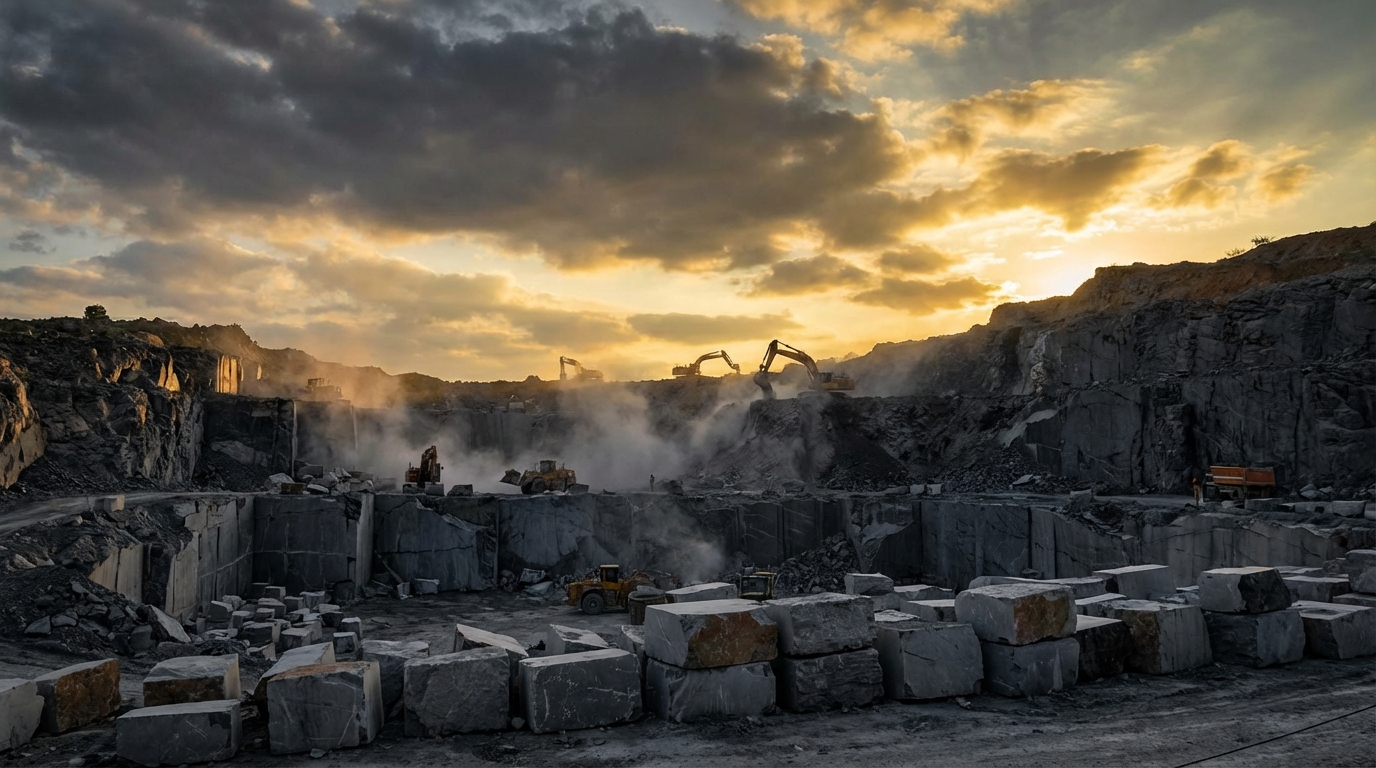
This is where the story starts: open-pit quarries or underground stone mines.
Typical steps:
- Clearing and preparing the site
- Drilling holes for blasting or wire saws
- Using explosives or chainsaws / wire saws to detach blocks
- Lifting blocks with loaders, excavators, or cranes
- Moving blocks to storage or processing areas
Main CO2 sources:
- Diesel in excavators, loaders, haul trucks
- Electricity for drilling rigs, compressors, wire saws, pumps
- Explosives manufacturing and use (smaller share, but non-zero)
To make this more concrete, let us look at rough numbers from industry studies and some EPDs for granite, limestone, and marble:
| Stage | Typical range of CO2e | Per unit | Comments |
|---|---|---|---|
| Quarry extraction | 5 – 30 kg CO2e | per ton of rough block | Depends on quarry layout, methods, and fuel type |
| Primary cutting (block sawing) | 10 – 40 kg CO2e | per ton of slab | Electricity mix has a large effect |
| Secondary processing | 5 – 50 kg CO2e | per ton of finished stone | More polishing and resin adds more energy |
| Transport (local, 100 km) | 5 – 15 kg CO2e | per ton | Truck size, load factor, and road conditions matter |
| Transport (international shipping) | 30 – 150+ kg CO2e | per ton | Ocean freight low per km, but distance is huge |
These are broad ranges, but they show one thing very clearly:
> The distance your stone travels can rival or exceed all quarry and processing emissions.
So when you see a nice marble that flew across an ocean, remember that the CO2 story is often in those kilometers, not only in the quarry.
2. Processing and finishing
Processing converts rough stone blocks into products people want:
- Slabs for countertops
- Tiles for floors and walls
- Cladding panels
- Setts, curbs, and pavers
Common processes:
- Block sawing (gang saws, block cutters)
- Tile cutting and trimming
- Polishing or honing
- Brushing, flaming, sandblasting, bush hammering
- Resin filling or reinforcement
- Edge cutting and profiling
Most modern stone processing uses electric motors and pumps. So the carbon intensity of your electricity matters a lot.
If your factory uses renewable-heavy electricity, a polished slab can have a reasonably low footprint. If it is running on coal-rich power, the same product will have much higher emissions.
One rule of thumb from several European EPDs:
- For many stones, 40 to 70 percent of the “cradle to gate” emissions come from processing and finishing.
So you are not just choosing a color or texture. Finish is a carbon decision too.
Here is a simple comparison per square meter of 3 cm thick stone, based on multiple EPDs (values approximate, to give scale):
| Finish | CO2e range (kg/m²) | Why it differs |
|---|---|---|
| Sawn, unpolished | 20 – 35 | Less polishing, fewer passes, simpler handling |
| Honed | 25 – 40 | More grinding and slurry treatment |
| Polished | 30 – 55 | Multiple polishing steps, more energy and consumables |
| Textured (flamed, bush hammered) | 35 – 65 | Thermal or mechanical treatment plus more passes |
It is not that polished or textured stone is bad. For high-traffic public spaces, those finishes are part of safety and performance. Just know that every extra treatment step usually adds more energy and more CO2.
3. Transport and logistics
If there is one part of the stone story that people underestimate, it is distance.
Transport emissions come from:
- Quarry to processing plant
- Processing plant to port
- Ocean freight
- Port to distributor
- Distributor to construction site
Typical emission factors:
- Heavy truck: roughly 60 – 120 g CO2e per ton-kilometer
- Container ship: roughly 5 – 15 g CO2e per ton-kilometer
A simple example:
- Locally quarried stone, 80 km from quarry to site, all by truck.
If we take 80 g CO2e per ton-km as a ballpark:
80 km x 80 g = 6,400 g = 6.4 kg CO2e per ton.
Now compare that to an imported stone:
- Truck 100 km to port
- Ship 6,000 km
- Truck 200 km to the project
Truck share:
300 km x 80 g = 24,000 g = 24 kg CO2e per ton.
Ship share:
6,000 km x 10 g = 60,000 g = 60 kg CO2e per ton.
Total around 84 kg CO2e per ton of stone, just for transport.
> So the imported stone can have transport emissions roughly 10 times higher than a nearby source, before you even talk about quarry practice.
This is why many low-carbon building guidelines push for local or regional stone, where possible.
4. Installation, use, and end of life
Installation itself usually has smaller emissions compared with production:
- Site cutting using electric saws
- Mortars and adhesives
- Mechanical fixings
- Scaffolding, lifting gear
Where CO2 can creep in:
- High-cement adhesives or thick mortar beds
- Resin-heavy systems for fixing stone panels
- Over-design: using very thick stone where a thinner panel with mechanical fixing would be safe
In use, natural stone is stable. It does not need frequent repainting. It can last several decades or more with modest maintenance.
If you split emissions by years of service life, stone usually performs well. Many cradle-to-grave LCAs for walls or floors show that replacement cycles drive long-term carbon more than the original material, if that first choice fails early.
At end of life:
- Stone can often be reused as stone (salvaged blocks, pavers, cladding)
- Alternatively, broken stone can be crushed for aggregate
- Landfilling is possible but wasteful, and adds transport again
> The more you can design stone for deconstruction and reuse, the less its lifetime carbon per m²-year.
Comparing stone with other building materials
To see where stone sits on the carbon scale, let us line it up next to other options. Values are approximate and can vary by region, product, and supplier, but they give a sense of the ranges.
Embodied carbon per unit mass
| Material | Approx. CO2e per kg | Notes |
|---|---|---|
| Natural stone (unprocessed block) | 0.01 – 0.04 | Quarry stage only |
| Finished stone (slabs/tiles) | 0.05 – 0.20 | Includes quarry + processing, excludes long-distance shipping |
| Ready-mix concrete | 0.10 – 0.25 | Depends strongly on cement content and mix design |
| Clay brick | 0.20 – 0.40 | High-temperature firing drives emissions |
| Aluminum | 7 – 15 | Very high; smelting is energy heavy |
| Steel (structural) | 1.5 – 2.5 | Varies with share of recycled content and energy source |
You can see that per kilogram, stone is on the lower side. But you do not build a wall by kilograms. You build it by area and function.
Embodied carbon per m² for cladding or flooring
Here is a very rough comparison per m² of external surface, from a mix of LCAs and EPD summaries.
| Assembly | Approx. CO2e per m² (cradle to gate) | Comments |
|---|---|---|
| 3 cm stone cladding (local, simple finish) | 40 – 80 kg | Low transport, moderate processing |
| 3 cm stone cladding (imported, polished) | 80 – 160+ kg | More finishing + long-distance transport |
| Clay brick veneer wall | 70 – 150 kg | Energy use in firing |
| Aluminum composite panel cladding | 120 – 250+ kg | High-carbon metal core and coatings |
| Glass curtain wall | 120 – 300+ kg | Glass and aluminum both carry high embodied carbon |
So natural stone is not always the lowest-carbon option, but it often beats high-processed, high-temperature products, especially when you minimize distance and finishing.
> The carbon story of stone is not “this material is always low” but “this material has a low baseline, which can go high or stay low depending on your choices.”
Factors that shape the carbon footprint of a quarry
Not all quarries operate in the same way. There is a big spread in energy intensity and environmental practice.
1. Equipment and fuel
Key levers:
- Using modern, fuel-efficient excavators and loaders
- Switching from diesel generators to grid electricity where the grid is cleaner
- Investing in electric or hybrid quarry vehicles
- Good maintenance to avoid fuel waste
Some quarry groups are starting to pilot electric haul trucks and loaders, especially where there is a short haul distance and good charging infrastructure.
A quarry that runs its saws on hydropower-fed electricity and uses efficient loaders has a very different footprint than one running older gear on dirty fuel.
2. Quarry design and extraction method
Planning the quarry well can cut emissions per ton:
- Shorter haul distances between face and processing
- Optimal bench heights to reduce overburden removal
- Wire saws and chainsaws that reduce waste and rework
- Careful blasting that minimizes overbreak and need for extra shaping
Waste plays a role here. The more of each block that becomes saleable stone, the lower the emissions per m² of product.
> High yield in quarrying is a quiet but powerful carbon lever.
3. Energy source for processing
If you are comparing two quarries with similar stone and similar methods, the carbon intensity of electricity is often the big difference.
- Regions with hydro, nuclear, or high renewable penetration give stone factories a head start.
- Regions with heavy coal use produce more CO2 per kWh of stone processing.
Some producers now install on-site solar to power their plants or at least part of the load. Others sign green power contracts.
From your point of view, the practical step is to ask for EPDs or third-party LCAs. These often list energy mixes and give a more transparent view.
4. Water, slurry, and waste management
While this is more about ecology than CO2, it still matters because:
- Pumping, treating, and recycling water uses energy.
- Moving and managing waste stone uses fuel.
- Bad waste practice can lead to regulatory pressure and forced changes.
Many modern plants now use closed-loop water systems where they:
- Collect slurry (stone dust + water)
- Separate solids with filter presses
- Recover water for reuse in saws and polishing lines
Good systems reduce both water use and energy, while turning sludge into saleable or at least usable material (e.g., fillers for other industries, aggregate).
Natural stone vs “engineered stone” and other alternatives
You often see natural stone compared with:
- Engineered quartz (agglomerated stone)
- Solid surface materials
- Ceramic or porcelain tiles
Natural stone vs engineered quartz
Engineered quartz includes:
- Crushed quartz or stone aggregate
- Resin binders (often polymer-based)
- Pigments and additives
Manufacturing involves mixing, vibro-compaction, curing, and often more intense polishing. The resin comes from petrochemicals, which adds to embodied carbon and can raise questions about indoor air quality if not well managed.
According to multiple EPDs:
- Engineered quartz often has higher embodied carbon per m² than natural stone of similar thickness, due to resin and more processing.
But it can offer tight tolerances and consistent appearance, which is why it is common in kitchens and bathrooms.
Natural stone vs porcelain tiles
Porcelain tiles rely on:
- Clay and mineral mixes
- High-temperature firing (often above 1,200 °C)
That firing stage is energy intensive and often gas-fired or coal-fired, which drives up CO2 per m².
On the plus side, porcelain tiles can be very thin with high strength. Thin profile can partly offset the energy of firing.
When you look at embodied carbon data:
- Natural stone with moderate finishing often compares well with porcelain, especially if it is local.
- Porcelain starts to look better when you use ultra-thin large-format tiles, which cover a lot of area with little mass.
Again, the point is not that one material wins in every case. Thickness, distance, and finishing change the equation.
> If your target is low-carbon design, treat natural stone as one option in a comparative toolbox, not as a fixed winner.
How to evaluate the carbon footprint of specific stone products
When you choose stone for a project, you do not buy “stone in general.” You buy a specific quarry, thickness, finish, and layout.
Here is a basic process you can follow.
1. Ask suppliers for EPDs or LCA summaries
Look for:
- Product-specific EPDs for the exact stone and thickness
- Cradle-to-gate data (A1-A3) that covers quarrying and processing
- Information on energy sources and transport assumptions
If the supplier only has generic category data, that is still better than nothing, but less precise.
2. Pay attention to system boundaries
Some EPDs stop at the factory gate. Others include transport to site or installation.
To compare options fairly, line up the same boundary:
- Compare A1-A3 to A1-A3, not A1-A3 to A1-A4 or A5.
If you do not do this, it is easy to misread a low number that simply cuts off more of the life cycle.
3. Ask about distance and transport mode
For each candidate stone:
- Where is the quarry and where is it processed?
- How far is your project from the processing facility?
- Is the stone shipped by truck, rail, or ship?
Simple rule:
> Stone that crosses a continent and an ocean before reaching your site carries a very different carbon story than stone from a nearby region.
You do not have to restrict yourself to 50 km radius, but moving from imported exotic stone to regional stone can reduce CO2 drastically.
4. Compare finishes for the same stone
If you like a stone, check if there is a lower-energy finish that still meets your design needs:
- Sawn or honed instead of high-gloss polished
- Less aggressive texturing
- Standard thickness instead of overly thick sections
Sometimes a small shift in finish can cut several kg CO2e per m².
5. Look at lifetime, not just the upfront number
If a floor tile lasts twice as long as an alternative, the annualized CO2 can be lower even if the upfront value is higher.
For example:
- Stone floor: 60 kg CO2e per m², service life 50 years.
- Alternative floor: 35 kg CO2e per m², service life 15 years.
Approximate per-year emissions:
- Stone: 1.2 kg CO2e per m² per year.
- Alternative: 2.3 kg CO2e per m² per year (with two replacements over 45 years and associated removal emissions).
Durability changes the story quite a bit.
Practical ways to lower the carbon footprint when you choose stone
You cannot control what happens at every quarry. You can only steer your own project. So let us focus on moves that are in your hands.
1. Choose regional stone when performance allows
If you can meet performance needs with stone that comes from your country or region, you:
- Cut transport emissions
- Support suppliers who may be more accessible for audits and site visits
- Reduce risk tied to supply chain disruptions
This does not mean you can never pick imported stone. It means you ask: “Is there a similar local stone that works here with lower carbon?”
> Many historic buildings in cities used stone from nearby quarries for a reason. That same mindset tends to be low-carbon today.
2. Match stone type to the job
Using an over-strong stone where it is not needed can raise embodied carbon with no extra benefit.
Examples:
- Use softer limestones or sandstones for interior walls where compressive strength is not critical.
- Reserve high-strength granites or basalts for heavy traffic paving or structural elements.
The more you align performance with need, the less you over-build, the lower the carbon per function.
3. Right-size thickness and substructure
Thinner stone with good fixing can lower emissions without lowering safety.
Some paths:
- Consider 20 mm or 25 mm panels instead of 30 mm, where structurally acceptable.
- Explore composite panels where a thin stone veneer is bonded to a backing (check fire and durability requirements).
- Use modern anchoring systems that support thinner panels without oversized support structures.
Just check local codes and engineering guidance. You do not want to save a bit of CO2 and create a safety issue.
4. Prefer simpler finishes where you can
Ask the design question: “What is the least processed finish that still looks and performs well here?”
Possible changes:
- Use honed instead of fully polished in areas where glare is a problem anyway.
- Use sawn finish for rustic outdoor paving instead of deep texturing.
- Limit special textures to feature areas instead of the whole facade.
A subtle texture shift can quietly cut energy demand in processing.
5. Plan for long life and possible reuse
If you treat stone as a permanent part of the building, you are already thinking in the right direction.
Some design moves:
- Use mechanical fixings that allow removal without breaking the stone.
- Avoid adhesives that make slabs impossible to separate from substrates.
- Pick module sizes that are easy to salvage and reuse in future projects.
> Think of stone as an asset you are borrowing for a few decades, not as a one-off covering.
6. Ask about quarry and factory practices
When you engage with suppliers, a few questions go a long way:
- What share of your electricity is renewable?
- Do you have an energy management plan or targets to reduce fuel and power use?
- How do you manage water and slurry?
- Do you publish EPDs or have third-party verified data?
Even if this is a smaller project, those questions signal demand for lower-carbon products. Over time, suppliers respond where there is steady demand.
7. Combine stone with lower-carbon systems around it
Do not look at stone in isolation.
Look at:
- What mortar or adhesive are we using? Can we pick a lower-clinker cement or alternative binder?
- What structure is behind the stone? Can we reduce steel where it is not needed?
- Are we over-supporting the stone with heavy subframes when we could design a lighter, well-engineered system?
Sometimes the substructure or adhesive has more CO2 per m² than the stone itself.
Common myths about natural stone and carbon
Let us clear a few recurring claims.
“Natural stone has zero embodied carbon because it is natural”
No. Quarrying, cutting, and transport all emit CO2. The stone itself does not, but the machines do.
What is true is that stone does not need a high-temperature kiln or chemical process that releases CO2 from the stone, like cement does.
“Imported stone is always worse than local stone”
Often, but not always.
Cases where imported can be competitive:
- Local stone uses very old, inefficient equipment with dirty power.
- Imported stone comes from a highly efficient plant powered by renewables, shipped by sea only, and the local transport leg is short.
This is rare, but the real message is: check data, not just location.
> Distance is a strong signal. It is not the whole story.
“Polished is just a surface thing, it does not affect carbon much”
Polishing and texturing add real energy use. On a single countertop, that may feel small. On thousands of square meters, it builds up.
It is worth asking if the finish is needed for function, or if it is just a habit.
“Stone is always better than concrete”
Not always.
If you use very thick structural stone where a slender concrete design would work, your mass and transport emissions can rise.
On the other hand, for non-structural walls or cladding, stone often compares well with concrete-based options, especially when sourced locally.
Again, context and design matter.
What technology is changing in quarrying and processing
From a technology perspective, the stone sector is not static. Several trends affect carbon footprints.
1. Automation and digital quarry models
More quarries now use:
- 3D scanning and digital terrain models for planning
- GPS-based fleet management to cut idle time and wasted trips
- Predictive maintenance to keep machines running at higher efficiency
Over time, this reduces fuel use per ton and also minimises unnecessary movement and rework.
2. Electric and hybrid machinery
We are starting to see:
- Electric wire saws powered by clean grids
- Hybrid or electric loaders for short-distance hauling
- Charging infrastructure installed next to crushing and cutting plants
As grid electricity gets cleaner, this shift can dramatically cut CO2 without changing the stone itself.
3. Better waste upcycling
Processing plants used to throw away a lot of off-cuts and sludge. Now, more are:
- Crushing off-cuts into aggregate
- Using fines in cement or ceramics production
- Supplying fillers for paints, plastics, or fertilizers, depending on stone type
> When stone waste becomes a feedstock for other products, the effective carbon per unit of useful output goes down.
4. Data transparency and digital product passports
Expect more stone products to come with:
- QR codes linking to EPDs and quarry info
- Digital passports that track source, energy use, and possible reuse data
For you, that means less guessing and more measurable comparison.
Key questions to ask before you specify natural stone
To wrap all this into something you can actually use in a design or procurement process, here is a checklist.
- What is the exact stone (type, quarry, country, thickness, finish)?
- Do you have an EPD or LCA for this specific product?
- What is the cradle-to-gate CO2e per m² for this thickness and finish?
- How far is this stone travelling, and by which modes?
- Can we get a similar look or performance from a closer quarry?
- Is there a simpler finish that still meets our needs?
- Can we reduce thickness safely with good fixings?
- How long will this assembly likely last before replacement?
- Can it be removed and reused at end of life?
You do not need perfect data for every single point. But each question pushes the conversation from “beautiful stone” to “beautiful stone with a known, managed carbon profile.”
> If a supplier can answer these clearly, that is already a sign they have thought about both performance and impact.
A practical tip you can apply on your next project: take one stone item you often specify, get its EPD, then model the same detail with a local stone, a thinner panel, and a simpler finish. Compare the kg CO2e per m². That one exercise will tell you more about the real carbon footprint of natural stone quarrying than a dozen generic brochures.