
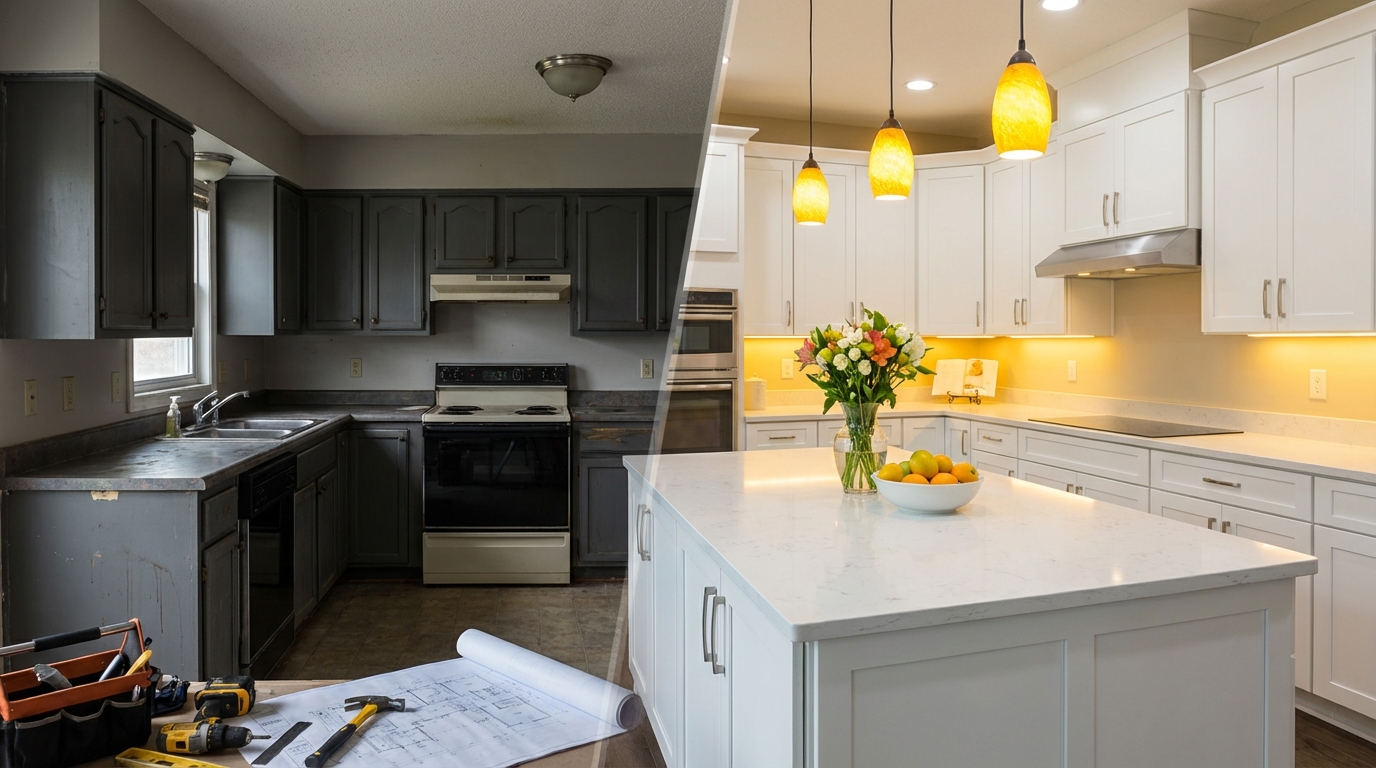
So, you are trying to figure out which kitchen remodels give you the highest return on investment. The projects that usually deliver the best ROI are midrange kitchen remodels that improve layout, cabinets, appliances, and lighting without going ultra luxury or changing the whole structure.
A midrange kitchen remodel often recoups around 60% to 80% of its cost at resale, while very high-end, fully custom kitchens can give you a much lower payback. Buyers love a fresh, functional kitchen, but they do not pay dollar-for-dollar for every upgrade. They pay for how the kitchen feels, looks, and works. That is the key.
Things like cabinet refacing, new counters, better lighting, and updated appliances usually move the needle the most. Full structural changes or luxury brands often look great in photos, but they do not always come back in resale value.
Here are the core points you need to know before you start:
- Best ROI usually comes from midrange remodels, not luxury overhauls.
- Buyers notice cabinets, counters, layout, light, and appliances first.
- Minor kitchen remodels often save money and deliver a higher percentage return.
- Trendy finishes age fast; timeless design holds value better.
- Smart tech in the kitchen helps if it makes daily tasks simpler, not more complex.
- Overbuilding for your neighborhood usually kills ROI.
- Good planning and sequencing saves money on change orders and delays.
- You remodel for both: your daily life now and a future buyer later.
Why kitchen remodels are ROI magnets
Buyers walk into a home, and the kitchen sets the tone. If the kitchen feels cramped, dark, or dated, they start mentally discounting the house right away.
Real estate data across multiple reports often shows:
- A midrange minor kitchen remodel recoups roughly 70% to 80% of its cost on resale in many markets.
- A major midrange kitchen remodel usually lands lower, around 55% to 70%.
- Upscale, luxury kitchens often recoup far less, sometimes under 50%.
Numbers shift by city, but the pattern holds. Modest, well-planned upgrades usually beat total tear-down luxury projects in terms of percentage of cost recovered.
> When your goal is ROI, you do not remodel to impress your Instagram followers. You remodel to impress the buyer who writes the check.
Minor vs major kitchen remodels: which wins on ROI?
Let us define what we are talking about, because contractors and homeowners often use the same words to mean different things.
What is a minor kitchen remodel?
A “minor” kitchen remodel keeps the basic layout and structure. The walls and plumbing stay where they are. You give the space a strong cosmetic upgrade and swap out several key items.
Typical minor remodel tasks:
- Paint or reface cabinets instead of replacing them.
- Replace counters with new materials (quartz, quality laminate, sometimes butcher block).
- Update sink and faucet.
- Swap older appliances for modern, energy-efficient models.
- Improve lighting (recessed lights, under-cabinet lighting, better pendants).
- Refresh backsplash, add new cabinet hardware.
- New flooring if the current floor is damaged or very dated.
From an ROI view, this kind of project usually shines because:
- You fix what buyers care about visually.
- You do not spend on moving walls or re-routing plumbing.
- You often can keep electrical work modest.
> A minor remodel often lets you say “new kitchen” in your listing without the “new mortgage” price tag for the project.
What is a major kitchen remodel?
A “major” remodel goes deeper:
- Removing or moving walls.
- Relocating plumbing lines or gas lines.
- Full cabinet replacement with custom or semi-custom boxes.
- High-end appliances, built-in panels, or pro-style ranges.
- New windows, moving doors, or adding skylights.
- Changing ceiling height or adding structural beams.
This type of project can make a cramped 80s kitchen feel like a different house. It can also get expensive very quickly.
ROI comparison: minor vs major
Here is a simple way to compare them. These numbers are rough and vary by city, but they help frame the conversation.
| Remodel Type | Typical Cost Range | Typical Resale Value Added | Estimated ROI % |
|---|---|---|---|
| Minor kitchen remodel (midrange) | $15,000 – $35,000 | $10,000 – $25,000 | 70% – 80% |
| Major kitchen remodel (midrange) | $40,000 – $80,000 | $25,000 – $50,000 | 55% – 70% |
| Major kitchen remodel (upscale) | $80,000 – $180,000+ | $40,000 – $90,000 | 40% – 55% |
Notice something: the more you spend, the more you often lose as a percentage. Not always, but often.
If you care about ROI, then your goal is not “perfect kitchen at any cost”. It is “biggest perceived upgrade for each dollar spent”.
The parts of a kitchen remodel with the highest ROI
Let us break the kitchen into its main parts and look at which ones usually pull the most weight for resale.
1. Cabinets: refacing, painting, and selective replacement
Cabinets take up most of the visual space in a kitchen. People remember them. That means they carry a lot of influence over perceived value.
You have three main paths:
- Repaint existing cabinets.
- Reface cabinet doors and drawer fronts.
- Replace cabinets completely.
Repainting cabinets
Repainting is usually the lowest cost move with a very strong return.
- Cost: often $2,000 – $6,000 depending on kitchen size and labor rates.
- Colors that help resale: white, off-white, soft gray, light greige.
- What buyers see: “Fresh, bright, clean, move-in ready.”
> An average buyer is far more likely to be turned off by orange oak than by a mid-priced quartz brand they have never heard of.
If the cabinet boxes are solid and the layout is decent, painting often beats ripping everything out.
Refacing cabinets
Cabinet refacing keeps the boxes but replaces doors and drawers with new styles and veneers.
- Cost: usually $8,000 – $20,000 depending on kitchen size and finish quality.
- Best for: solid boxes, dated doors, but decent layout.
- Benefit: looks like “new cabinets” to most buyers, at a lower cost than full replacement.
If your kitchen layout works but the doors scream “1995”, refacing often hits a great ROI sweet spot.
Full replacement
Full replacement makes sense when:
- Layout is bad and needs reconfiguration.
- Boxes are damaged, low quality, or falling apart.
- The home price supports a higher-end kitchen.
For ROI, you want to be careful with how high you go:
- Stock or semi-custom cabinets often give a better return than full custom in starter or midrange homes.
- Premium storage features (pull-out trash, full extension drawers, lazy Susans) often pay off more than rare wood species or exotic finishes.
2. Countertops: where looks meet budget
Counters are the second big visual surface. People lean on them, set things on them, and judge the kitchen quality in a second.
Common options:
- Laminate
- Butcher block
- Quartz
- Granite
- Solid surface (like Corian)
From an ROI angle:
- In entry-level homes, high-quality laminate or affordable quartz often hits the sweet spot.
- In midrange homes, quartz usually wins because buyers like the clean look and low maintenance.
- In higher-end homes, buyers often expect stone or quartz. Cheap laminate there can hurt value.
> A well-chosen mid-priced quartz can do more for resale than a rare stone that scares buyers with maintenance.
Watch out for very bold patterns or colors. They tend to age more quickly and can narrow your buyer pool.
3. Appliances: new, reliable, and consistent
Buyers love seeing a full set of newer appliances. It signals less near-term spending, and it lifts the whole space.
For ROI:
- Matching suite helps: same brand and finish across fridge, range, dishwasher, and microwave.
- Stainless or black stainless still draws buyer interest in many markets.
- Energy-efficient ratings can be a selling feature for some buyers, especially where utilities are high.
You do not need pro-grade appliances in most homes. Expensive professional ranges and built-in fridges rarely return their full cost unless the home itself is already in a very high price tier.
A rule of thumb:
- Spend enough that appliances feel current and reliable.
- Avoid spending so much that replacement cost later scares buyers.
4. Layout and flow: when does it pay to move walls?
Layout can make or break a kitchen. An awkward triangle between sink, stove, and fridge, or a narrow galley that feels cramped, can hurt resale.
But moving walls, plumbing, and electrical is expensive.
So the question is: when does layout work pay off?
It often pays when:
- You remove a wall between kitchen and dining or family room and create an open, social area that buyers in your area expect.
- You fix major traffic problems, like a fridge that blocks access when open.
- You add an island that increases storage, counter space, and informal seating.
> A small, smart change in layout often adds more value than a giant, fancy fridge ever will.
You want to compare:
- The cost of moving or removing a wall.
- The value gain of turning a closed, awkward kitchen into something that looks like the rest of the homes buyers are seeing in your price range.
In some starter homes, keeping the layout and improving surfaces is enough. In higher-priced neighborhoods, a closed-in kitchen might feel out of step with what buyers are used to, which can drag down value.
5. Lighting: the silent ROI booster
Lighting often sits low on the priority list, yet it influences how every surface looks, how big the room feels, and how functional the work zones are.
Types of lighting you want to think about:
- General lighting: recessed lights or a central fixture.
- Task lighting: under-cabinet lights for counters, lights over the sink and stove.
- Accent lighting: pendants over islands or breakfast bars.
Well-planned lighting can:
- Make modest counters look more expensive.
- Make smaller spaces feel larger and more inviting.
- Show off backsplash texture or cabinet details.
From an ROI view, lighting upgrades:
- Usually cost less than big structural work.
- Raise perceived quality of the whole room.
It is easy to overlook, but it is one of the highest-impact, lower-cost changes you can make.
6. Backsplash and finishes: small details, big perception
Backsplash tile, cabinet hardware, faucets, and small details often create the “finished” look.
For ROI, you want:
- Neutral tile patterns that will not look dated quickly.
- Simple hardware that feels solid in hand.
- Faucets with a pull-down sprayer, recognized brand, and a clean profile.
> Think of the backsplash and hardware as the shoes and belt of your kitchen. They either pull the whole outfit together or make it feel off.
Avoid heavy trends that might fade within a few years. You want a design that still feels current to a buyer 5 to 10 years from now.
What about smart kitchen tech and gadgets?
You are reading a technology-focused blog, so let us talk about the tech angle. Smart kitchens sound cool. But how do they perform on ROI?
Common tech features in kitchens:
- Smart refrigerators with screens and internal cameras.
- Wi-Fi enabled ranges and ovens.
- Smart dishwashers and microwaves.
- Smart faucets (motion or voice control).
- Smart lighting and switches.
From a resale view:
- Smart lighting and smart switches usually carry the best balance of cost, function, and value.
- App-connected ranges and ovens can appeal to tech-savvy buyers, especially if they are from well-known brands.
- Very complex or niche gadgets can make some buyers worry about maintenance or confusing interfaces.
A few rules if you want tech without killing ROI:
- Choose tech from brands with strong support and regular software updates.
- Prioritize tech that still works normally without the app (for example, physical knobs and buttons alongside smart features).
- Avoid overcomplicating basic tasks like turning on the lights or using the oven.
> Tech should make cooking easier, not turn making toast into a software project.
If budget is tight, start with:
- Smart dimmer switches or smart bulbs.
- Under-cabinet LED strips with smart control.
- A smart speaker for timers, recipes, and voice control of lights.
These are low-cost, high-perceived-value additions that do not lock anyone into a strange ecosystem.
How much should you spend on a kitchen remodel for good ROI?
This is the tricky part. Spend too little and the kitchen still feels tired. Spend too much and you start losing money on resale.
A common guideline many real estate pros use:
- Total kitchen remodel budget usually stays within 5% to 15% of your home’s current value.
Example:
- Home value: $400,000
- Kitchen budget range for good ROI: roughly $20,000 – $60,000, depending on scope.
Within that range:
- At the lower end, you are in minor remodel territory: paint, counters, appliances, lighting, some flooring.
- In the middle, you can upgrade cabinets, improve layout slightly, and go for solid surfaces.
- At the higher end, you might be tackling more structural work or more premium materials, which start to lower ROI percentage.
This still is a range, not a rule. The target should match:
- The ceiling home price in your neighborhood.
- How long you plan to stay.
- How far behind your current kitchen is compared to nearby listings.
Common mistakes that destroy kitchen ROI
Let us go through some of the classic traps people fall into.
1. Overbuilding for the neighborhood
If every home near you sells for $350,000 with simple but clean kitchens, putting a $150,000 chef’s kitchen in your house will almost never fully come back in price.
Buyers compare your home against others nearby:
- If your price is far higher purely because of the kitchen, many will not pay that premium.
- You are better off aiming for “one of the nicer kitchens in the area” instead of “restaurant-level buildout” in a starter-home neighborhood.
2. Underbuilding compared with the home itself
The opposite issue also hurts. If you have a high-end home in a price tier where buyers expect a certain level of finish, a very basic or dated kitchen can drag down the entire value.
So you want balance:
- Kitchen level should match the rest of the house.
- Both should match what buyers in your area expect in that price tier.
3. Over-personalizing design
You might love bright red cabinets and patterned cement tile. That is fine if you plan to stay long-term.
But for ROI:
- Very bold design choices usually shrink your buyer pool.
- Neutral, timeless design choices let more buyers imagine themselves in the space.
> You are not designing your dream café in Paris. You are designing a room that helps your home sell faster and for more money.
If you want to express your taste, do it through items that are easy to swap out later: bar stools, rugs, art, and small fixtures.
4. Ignoring function for aesthetics
Beautiful photos sell online. But if buyers show up and realize there is nowhere to prepare food or store pantry items, they will notice.
Function basics you should protect:
- Enough counter space near the stove and sink.
- Clear traffic paths through the kitchen.
- Good triangle between fridge, sink, and stove.
- Storage for pots, pans, spices, and pantry food.
An island that looks amazing but blocks the fridge door from opening fully will hurt more than help.
5. Skimping on skilled trades
DIY can save money, but certain work should be done by licensed pros, especially:
- Electrical
- Plumbing
- Gas lines
- Structural changes
Poor installation leads to:
- Inspection issues
- Safety problems
- Visible flaws that hurt perceived value
Buyers might accept modest finishes if the work looks solid. They rarely forgive visible shortcuts.
ROI example scenarios
Let us walk through a few simple examples to see how choices change return, even with similar budgets.
Scenario 1: 1970s starter home, tight budget
- Home value: $280,000
- Current kitchen: dark cabinets, old laminate counters, basic appliances, worn vinyl floor.
- Budget: $20,000
High ROI plan:
- Paint cabinets white or soft gray.
- New mid-priced quartz counters.
- New stainless appliance suite (standard sizes).
- New LVP (luxury vinyl plank) floor.
- Tile backsplash in a neutral subway pattern.
- Under-cabinet lights and a few recessed lights.
- New cabinet hardware and faucet.
No major wall moves, no luxury brands. Likely result: significant bump in buyer appeal and strong ROI.
Scenario 2: Midrange suburban home, outdated layout
- Home value: $500,000
- Current kitchen: small, closed off, 90s style, low storage.
- Budget: $60,000
High ROI plan:
- Remove half wall to open kitchen to family room.
- Semi-custom cabinets with added storage (pantry pull-outs, deeper drawers).
- Quartz counters and large island with seating.
- Mid to upper-midrange appliances (no full pro line).
- Layered lighting: recessed, pendants, under-cabinet.
- Neutral backsplash, durable flooring.
Here, layout change likely pays off because buyers in this price range expect some kind of open kitchen.
Scenario 3: High-end neighborhood, decade-old builder kitchen
- Home value: $1,000,000
- Current kitchen: basic builder cabinets, granite, standard appliances, but good layout.
- Budget: $90,000
Better ROI approach:
- Upgrade cabinets to higher-grade, but not extreme custom.
- Replace granite with refined quartz or natural stone that fits the home’s style.
- Upgrade appliances to respected premium brands, but avoid the very top tier.
- Improve lighting scheme.
- Refresh backsplash and hardware.
Here, full ultra luxury might feel natural, but the last 20% of spend often does not come back in price.
How long you plan to stay affects ROI decisions
Your time horizon matters as much as your budget.
If you plan to sell in 1 to 3 years
Think of the remodel like this:
- You are preparing a product for market.
- Focus on broad appeal and obvious flaws.
- Skip very personal choices or rare finishes.
High priority projects:
- Fix anything that feels old, worn, or broken.
- Update surfaces and lighting.
- Improve layout only if it is a real problem compared with nearby homes.
If you plan to stay 5 to 10+ years
Your kitchen will serve you for a long time before you sell. That shifts the math:
- You can accept lower ROI percentage if the daily value to your family is high.
- You can justify higher-quality cabinets or better hardware that will last longer.
- You can take a few more style risks, because you will enjoy them for years.
It becomes a mix of financial return and life quality. You still want to avoid decisions that will obviously hurt resale, but you can tilt more toward what you like.
How to plan your kitchen remodel for strong ROI
Planning can prevent a remodel from turning into an open-ended cost sink.
1. Start with research in your local market
Look at:
- Recent sales in your neighborhood with new or updated kitchens.
- Listing photos to see what level of finish buyers are responding to.
- Price differences between homes with old kitchens and those with new ones.
That gives you a real benchmark, not just national averages.
2. Rank your kitchen problems
Make a simple list:
- Functional issues (no counter space, bad layout, broken drawers).
- Visual issues (dated colors, old counters, worn flooring).
- Missing features (no dishwasher, too little storage, poor lighting).
Address the functional issues first, then visual, then extras. A beautiful kitchen that still lacks storage will feel off.
3. Set a clear budget and include a buffer
Remodels rarely run below budget. Hidden issues appear: old wiring, plumbing surprises, subfloor problems.
A simple plan:
- Set your target budget.
- Allocate 10% to 20% of that as a contingency.
So if your budget is $40,000, hold back $4,000 to $8,000 for surprises. That way, you do not have to cut crucial elements later because of something hidden behind a wall.
4. Get at least two or three bids with matching scopes
When you ask contractors for bids:
- Provide the same scope to each: same materials level, same layout plan.
- Ask for labor and materials to be clear, so you can compare.
> The cheapest bid is not always the lowest cost. It can hide change orders and shortcuts that cost you more later.
Check:
- Reviews and references.
- Photos of previous kitchens in your price tier.
- Licenses and insurance.
5. Decide what you can phase
If budget is tight, some items can wait:
- Backsplash
- Hardware upgrades
- Smart lighting extras
- Decor elements
What you should not phase, if possible:
- Cabinet layout
- Electrical rough-in
- Plumbing rough-in
- Flooring under cabinets
Those structural items are painful and costly to redo later.
Technology tools that help you protect ROI
Since you care about technology, here are some practical tools you can use during planning and execution.
1. 3D kitchen design software
Many cabinet companies and home improvement stores now offer 3D design services, either online or in-store.
Benefits:
- Test different layouts and cabinet configurations before spending money.
- See how islands affect traffic flow.
- Check how tall cabinets, open shelves, or different appliances will look.
There are also independent design apps that let you create floor plans and render simple 3D views without hiring a designer.
2. Project management and budgeting apps
Keeping track of costs and decisions is half the battle:
- Use a spreadsheet or budgeting app to track quotes, deposits, and final costs.
- Store receipts, finish details, paint colors, and warranty info in a shared folder.
- Create a simple task list with timelines so you can see dependencies.
This reduces “scope creep”, where small add-ons quietly push the budget higher.
3. Smart energy monitoring
After the remodel, smart plugs and energy monitoring systems can track how new appliances perform.
For some buyers, being able to show lower energy bills compared with older appliances adds another layer of value.
Where to save and where to spend for the highest ROI
Finally, let us talk about which line items often give you leverage and which ones you can downgrade without hurting ROI too much.
Spend more on
- Cabinet structure and hardware (hinges, drawer slides).
- Countertop material and professional installation.
- Lighting plan and fixture placement.
- Quality labor for tile, electrical, and plumbing.
These affect daily function, durability, and first impressions. Poor quality in these areas shows quickly.
Spend less on
- Faucets that are all brand prestige and little extra function.
- Very high-end appliance models unless your home value demands them.
- Exotic cabinet finishes that are hard to touch up or replace.
- Very complex custom storage that most buyers will not fully use.
You are looking for that sweet spot where the kitchen feels more expensive than it actually cost.
> Someone walking through your home should think, “This kitchen feels great.” They do not need to know the exact brand of your hinges.
A practical tip to end on: before you sign any contract, go tour three or four open houses in your area that recently remodeled their kitchens. Take notes on what you like, what feels cheap, and how those homes are priced. Then build your kitchen plan around beating those examples, not beating the photos you saw on luxury design sites.