
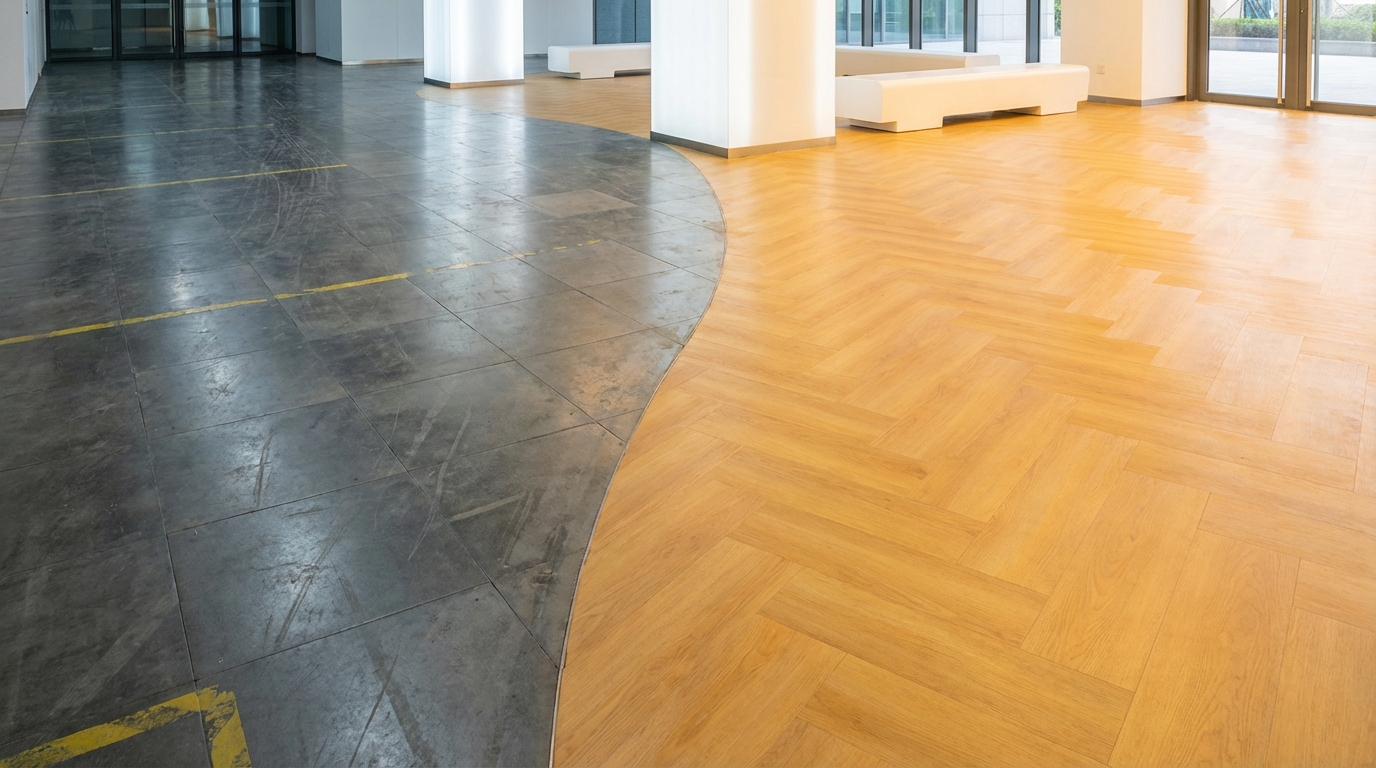
So, you are trying to figure out the real lifespan of commercial flooring and when you should replace it, without wasting money or wrecking your space with constant work.
You should replace commercial flooring when safety, appearance, or maintenance costs start to outweigh the value of keeping it, which for most materials lands somewhere between 7 and 25 years, depending on traffic, care, and type of floor.
Most people focus on “how many years does this floor last” and miss the bigger picture. The question is less about a fixed number and more about visible wear, risk, and cost. A floor can still be glued to the slab and not technically “failed,” yet still be hurting your brand, eating your maintenance budget, or creating hazards. That is the real replacement point.
Things you need to know:
- Lifespan ranges: carpet tile (7-12 years), sheet vinyl/LVT (10-20 years), rubber (15-30 years), ceramic/porcelain (20+ years), hardwood (15-30+ years with refinishing), polished concrete (20+ years with maintenance).
- Visible wear, not the calendar, drives smart replacement timing.
- Trip hazards and slip hazards matter more than small stains or color fading.
- Your cleaning methods can either double or cut the lifespan in half.
- High-traffic areas reach end of life much faster than back-of-house or offices.
- Sometimes replacing only critical zones beats a full-floor overhaul.
- You should track maintenance and failures so you see trends, not just “gut feel.”
Why “lifespan of commercial flooring” is not a single number
If you talk to three vendors about lifespan, you will get three different answers.
One will say “10 years.” Another will say “20 years with proper care.” The manufacturer sheet might say “warranty 15 years.” All three can be technically true and still not help you decide when to replace.
There are really three “lifespans” of commercial flooring:
- Functional lifespan
How long the floor performs without cracks, tears, trip hazards, or moisture issues. - Aesthetic lifespan
How long it still looks good enough for your brand, users, or clients. - Financial lifespan
How long the cost of keeping it (cleaning, repair, lost image) is lower than the cost of replacement.
You hit replacement time when any one of those three breaks down badly, not just when the warranty ends.
> The calendar is a weak guide for flooring. Your traffic and cleaning choices matter far more than the year count.
Let me break down lifespan by material, then the warning signs, then some numbers so you can plan.
Average lifespan by commercial flooring type
Quick comparison table
| Flooring Type | Typical Lifespan (Commercial) | Best Use Areas | Main Failure Modes |
|---|---|---|---|
| Broadloom Carpet | 5-8 years | Offices, hotel rooms | Matting, stains, seam failure |
| Carpet Tile | 7-12 years | Offices, call centers, education | Flattening, staining in traffic lanes |
| LVT (Luxury Vinyl Tile/Plank) | 10-20 years | Retail, offices, healthcare waiting, corridors | Scratching, wear layer loss, edge gaps |
| Sheet Vinyl | 10-20 years | Healthcare, labs, kitchens, wet areas | Cuts, weld failures, discoloration |
| Rubber Flooring | 15-30 years | Gyms, transit stations, schools | Color fading, surface wear, curling edges |
| Ceramic/Porcelain Tile | 20+ years | Restrooms, lobbies, outdoors (porcelain) | Cracked tiles, loose tiles, grout failure |
| Hardwood (Engineered/Solid) | 15-30+ years | Office lobbies, hospitality, restaurants | Surface wear, dents, finish loss, cupping |
| Polished Concrete | 20+ years | Warehouses, retail, showrooms | Surface wear, staining, cracking |
These are not promises. They are rough ranges from actual commercial use, not a lab test. Heavy point loads, heavy carts, rolling medical equipment, pallet jacks, or sand and grit at entrances can cut these numbers.
> A busy hospital corridor can burn through flooring in 7 years that would last 18 years in a quiet office.
Now let us walk through each major type, with real triggers for replacement.
Carpet in commercial spaces: when to replace
Broadloom vs carpet tile
Broadloom carpet is rolled carpet glued or stretched wall to wall. Carpet tile is modular squares or planks.
Carpet tile generally lasts longer in commercial environments because you can swap individual tiles in traffic lanes or stain-prone areas. Broadloom often forces larger replacement zones when one area fails.
Typical lifespan ranges
- Broadloom carpet: 5-8 years in high-use spaces, sometimes 10+ in low-traffic executive or conference areas.
- Carpet tile: 7-12 years, with partial replacement of worn tiles starting as early as year 3-5 in very busy paths.
Key signs your commercial carpet is at end of life
Here is what matters more than the age on paper:
- Matting and crushing
Fibers in main walk paths stay flat even after cleaning. You see “lanes” from doors to desks or from elevators to reception. - Permanent staining
Large stains that do not come up with standard methods. Coffee, red drinks, oils, inks. When you start to rearrange furniture just to hide spots, you are near replacement. - Seam failure or fraying edges
Edges curl, break down, or pull away from transitions. This is more than cosmetic. It is a trip hazard. - Odor you cannot clear
Persistent smell from spills, pet visits, mold, or repeated moisture. If deep cleaning stops working, backing may be contaminated. - Cushion failure
Floor feels “hard” or uneven underfoot. Pad or backing is breaking down.
> If you are scheduling carpet cleanings more often and still not happy with the look, that carpet is costing you more than you think.
When replacement beats cleaning
There is a tipping point where your annual cleaning and spot repair cost starts to approach 20-30 percent of the cost of a new floor, and complaints still keep coming in. That is a red flag.
For example:
- Office floor area: 10,000 sq ft
- Professional cleaning twice a year: 10,000 × $0.20 × 2 = $4,000/year
- Extra spot clean visits: $1,000/year
- Total: about $5,000/year
- New carpet tile installed: 10,000 × $5.00 (material + install) = $50,000 (rough ballpark)
If you are in year 9, with constant complaints, dirty traffic lanes that do not clean out, and a few ripples that risk trips, you are better off calling it and planning a phased replacement than living with it.
Luxury vinyl tile (LVT) and sheet vinyl
Vinyl is popular for a reason. It is durable, looks good, and is easier to clean than carpet.
Typical lifespan ranges
- LVT
Average 10-20 years depending on wear layer thickness, traffic, and cleaning. - Sheet vinyl
Average 10-20 years, often at the higher end in healthcare or labs with strict maintenance programs.
Wear layer thickness and type matter a lot. A 20 mil wear layer in a busy supermarket entrance will show wear faster than a 28 or 30 mil product in a small lobby.
Signs your vinyl floor is due for replacement
- Wear through of the pattern
In walk-off areas, you may literally see the design layer thin out or fade. Once the pattern starts to lose clarity, you are at or near replacement time. - Deep scratching and gouges
Light scratching can often be managed with scrubbing and finishing schedules. Deep gouges that collect dirt or create cleaning problems are a different story. - Edge gaps or plank movement
LVT planks may start to gap at ends or sides from subfloor movement, poor acclimation, or wrong adhesives. If you see more and more repairs, the system might be failing. - Surface dulling that does not respond to maintenance
If you strip, scrub, or follow recommended process and the floor still looks flat and tired, the wear layer might be gone. - Moisture problems
Bubbles, blisters, or discoloration from below suggest moisture under the floor. Fixing the source can be costly. Sometimes full replacement with moisture control is the only rational move.
> A vinyl floor can still be bonded to the slab and technically “fine,” yet cost you every day because it looks tired in a high-visibility space.
When vinyl is still serviceable vs when it is hurting your brand
Think about entrances and main corridors. These are your “first impression” zones.
If:
- Visitors notice edges lifting.
- Carts thump over bubbles or ridges.
- Staff complain about mopping “never getting it clean.”
You probably passed the financial lifespan, even if the product could physically last 5 more years in a warehouse.
In back-of-house or storage, you can nickel and dime repairs longer. In public-facing space, visual quality and safety matter more.
Rubber flooring in commercial buildings
Rubber floors show up in gyms, schools, transit areas, and some healthcare or lab zones.
Typical lifespan ranges
- Rolled or tile rubber flooring: 15-30 years in most commercial environments, with heavy athletic use closer to the lower end.
Signs your rubber floor needs replacement
- Surface wear and texture loss
Raised patterns, nubs, or textures flatten over time, which can impact slip resistance. - Color fading and chalking
UV exposure near windows or doorways can fade pigmented rubber. This is often cosmetic but can telegraph age strongly. - Edge curling or shrinkage
Tiles pulling back at edges or seams opening up. Dirt collects in gaps and cleaning becomes harder. - Permanent indentation
If point loads or heavy equipment leave deep impressions that do not recover, this might create uneven surfaces or cleaning traps.
For a gym, safety and performance are key. If the rubber under weight areas has compressed and lost resilience, it stops doing its job.
> In high-abuse spaces, rubber is often replaced not because it is “broken,” but because its safety and support qualities fade over time.
Ceramic and porcelain tile
Tile is known for long life. There are public buildings with original tile floors that have been down for over 50 years. In commercial spaces, the weak links are often grout and installation, not the tile itself.
Typical lifespan
- Ceramic tile: 20+ years when installed on a sound substrate with correct mortar.
- Porcelain tile: 20+ years, often longer. Very dense and resistant to moisture.
Signs your tiled floor needs partial or full replacement
- Cracked tiles across traffic paths
A few isolated cracks are repairable. A pattern of cracks often points to movement in the substrate or structural issues. - Loose or “hollow” sounding tiles
Tap tiles with a hard object. Hollow sound suggests loss of bond. These may eventually crack or pop. - Heavily stained or eroded grout
Grout can be cleaned or replaced, but if staining is deep and widespread, or grout is eroding, areas might need more than just regrout, especially in wet locations. - Slip-risk surfaces
Old gloss-finish ceramic in restrooms or commercial kitchens can be risky. If slip incidents rise, replacement with higher slip resistance tile or a different surface is a safety move, not an aesthetic one.
> With tile, you often replace only sections or overlay with newer systems, as full demo is disruptive and loud.
For lobbies, architects often choose to keep the tile and refresh the grout and cleaning regimen rather than tear everything out. For restrooms, tile might be replaced earlier due to sanitary concerns or design changes.
Hardwood and engineered wood
Wood in commercial spaces lives a tougher life than in homes. High heels, rolling loads, weather at entrances, and cleaning chemicals all add up.
Typical lifespan
- Engineered wood: 15-25 years, with 1-3 sand and refinish cycles depending on veneer thickness.
- Solid hardwood: 20-30+ years if thick enough to refinish several times and if moisture is managed.
Key signals that it might be time to refinish or replace
- Deep wear into the wood
Finish worn through to bare wood in traffic lanes. Minor wear can be handled with screen and coat. Deep cuts across the grain may require sanding. - Cupping or crowning
Boards become concave or convex from moisture imbalance. If severe or widespread, you might need replacement rather than simple refinishing. - Board movement and gaps
Seasonal gapping is normal. Wide permanent gaps that collect debris or cause unevenness suggest problems in installation or environment.
At some point, you sand down to fasteners or lose too much thickness to refinish again safely. That is the end of that floor’s life.
> With wood, each full sanding burns future lifespan. Plan refinish cycles carefully and only when needed.
Polished concrete floors
Many commercial and industrial spaces now expose and polish the slab instead of covering it.
Typical lifespan
- Polished concrete: 20+ years, often much longer, with regular maintenance (dust mopping, auto-scrubbing, periodic re-polish).
When do you “replace” concrete floors?
You rarely rip out concrete. You either:
- Re-polish and densify the surface.
- Overlay with resin, LVT, carpet, or tile.
You are “due for something” when:
- The surface has worn to a rough, porous state and cleaning is tough.
- Stains and etching from chemicals are deep and wide.
- Cracking spreads and cannot be controlled with joint repairs.
So replacement here usually means adding a new floor over the concrete rather than replacing the slab.
Traffic levels and zones: the real lifespan drivers
The same product installed in two different zones in your building can have very different lives.
Think about three types of zones:
- Primary traffic: entrances, main corridors, elevators, reception.
- Secondary traffic: side corridors, open office areas, waiting areas.
- Low traffic: private offices, file rooms, storage.
As a rough guide:
| Zone Type | Wear Rate vs Spec Sheet | Practical Effect |
|---|---|---|
| Primary traffic | 2x to 4x faster | A 20-year product might feel “done” in 7-10 years. |
| Secondary traffic | Close to spec sheet | Product lifespan often matches marketing claims. |
| Low traffic | Slower than spec sheet | Same floor can look fine much longer than stated life. |
> If you plan flooring by average age across the whole building, you will over-replace some zones and under-protect others.
This is why a phased replacement plan is smarter: hit primary zones early, then tie secondary zones into larger projects, and leave low-traffic to last.
Maintenance: the factor that can double or halve lifespan
Maintenance does not just keep floors clean. It changes how long they last.
Common maintenance mistakes that kill flooring early
- Wrong cleaners
High-pH strippers or harsh chemicals on LVT, rubber, or wood can damage wear layers or finishes. - Too much water
Wet mopping wood, certain laminates, or carpet can cause swelling, mold, and breakdown of adhesives. - No walk-off mats
Without entrance mats, grit and moisture reach your floor. Grit is like sandpaper on vinyl and wood finishes. - Under-cleaning high traffic
If you clean a busy hospital corridor with the same schedule as a small office, soils stay on the floor, scratch surfaces, and dull finishes.
On the flip side, good maintenance:
- Removes grit before it grinds the wear layer.
- Keeps finishes refreshed.
- Prevents staining from bonding permanently.
> A vinyl floor with consistent, correct maintenance can outlast a “tougher” product that is neglected or mis-cleaned.
If you want longer lifespan, the cheapest thing you can do is improve entrance matting and cleaning routines.
Safety triggers: when flooring becomes a liability
The most critical reason to replace flooring is safety, not looks.
Trip hazards
Common causes:
- Loose tiles or planks.
- Carpet ripples or buckles.
- Raised edges at transitions.
- Cracked tiles and broken corners.
These are not just maintenance items. They are liability risks. If staff or visitors fall, you will not be glad you “got one more year” out of that old floor.
Slip hazards
You might need replacement or surface modification when:
- The floor has been polished or finished to a high gloss that is slippery when wet.
- Old finishes create uneven traction across a walkway.
- Restroom or kitchen floors fail slip-resistance tests or see increased incident reports.
> Once you have documented slip or trip incidents tied to a floor, your decision shifts from “nice to replace” to “need to mitigate.”
If budget is tight, you can look at targeted replacement in incident zones first.
Aesthetic triggers: when floors hurt your brand
Your floor is one of the largest surfaces in your space. If it looks tired, everything else feels tired.
This matters more for:
- Retail and hospitality.
- Client-facing offices.
- Healthcare waiting areas.
Less so for:
- Back-of-house storage.
- Mechanical rooms.
- Closed file rooms.
Watch for:
- Visible soil lanes employees mention regularly.
- Clients apologizing for the look of spaces to their guests.
- Branding changes where old colors/patterns clash with your updated identity.
> If your staff start saying things like “ignore the carpet, it is on the list,” you are already paying a brand cost.
Sometimes you can postpone full replacement by:
- Repainting walls and adding better lighting.
- Doing targeted replacement at entrances and reception first.
- Swapping only the worst carpet tiles in focus areas.
But these are short-term moves. At some point, your visuals will push you to schedule full work.
Financial triggers: when replacement saves money
Flooring is not just a cost; it is an asset that depreciates. The trick is to know when ongoing cleaning, repair, and soft costs cross a line.
Basic way to think about cost over life
Here is a simple model:
- Take installed cost per square foot.
- Divide by expected life in years.
- Add annual cleaning cost per square foot.
Example with carpet tile:
- Installed cost: $5.00/sq ft.
- Expected life: 10 years.
- Annualized capex: $0.50/sq ft/year.
- Cleaning: $0.40/sq ft/year.
- Total “normal” annual cost: $0.90/sq ft/year.
In years 1-6, you may stay close to that.
By year 7-8, you may see:
- Extra spot cleaning: +$0.10/sq ft/year.
- Repairs, patches: +$0.05/sq ft/year.
You are now at $1.05/sq ft/year, with worse appearance.
At some point, adding another year on a decaying floor costs more than starting a new cycle of a better one.
> If your maintenance intensity and costs are climbing, you have probably passed the sweet spot and are throwing good money after bad flooring.
This is where planned replacement wins over breakdown replacement.
How to know “when” for your building: practical signals
You do not need a complex model. Start with a few simple checks.
1. Age vs condition matrix
Create a basic table for each area and floor type:
| Area | Floor Type | Installed Year | Current Age | Condition (1-5) | Safety Issues? | Brand Impact (1-5) |
|---|---|---|---|---|---|---|
| Lobby | LVT | 2014 | 11 years | 2 (Worn) | Yes, edges lifting | 5 (High) |
| Open Office | Carpet Tile | 2018 | 7 years | 3 (Fair) | No | 3 (Medium) |
Anything with:
- Condition 1-2 and safety issues: high priority.
- Condition 2-3 and high brand impact: next priority.
2. Maintenance log review
Ask your cleaning and maintenance teams:
- Which areas require the most “extra” work?
- Where do they revisit the same stains or repairs?
- Where do they get complaints from staff or guests?
Those spots are your early warning.
3. Incident review
Check incident and risk reports for:
- Trips and falls linked to flooring.
- Slip events in wet zones.
- Work orders for emergency patching or tape-down fixes.
More than one or two incidents per year in the same area is a strong signal.
Phased replacement strategy so you are not tearing everything up at once
Flooring replacement scares people because of disruption. You have noise, dust, downtime, and scheduling headaches.
A phased approach helps:
- Phase 1: Life-safety and high-risk issues
Fix areas with trip hazards, moisture failures, or major defects first. Might be limited corridors, ramps, stairs, or entrances. - Phase 2: Brand-critical zones
Reception, lobbies, conference centers, showrooms, retail floors. - Phase 3: Operational zones
Open offices, classrooms, back-of-house corridors. - Phase 4: Low-visibility or storage
Only as needed or when projects in those zones happen anyway.
> Instead of waiting for the perfect budget cycle to “do it all,” chip away at the worst floors in logical phases.
If you combine flooring work with other projects, you can often reduce labor and downtime. For instance, when painting and lighting work is scheduled, that might be the right time to also tackle floors in that zone.
How long should you plan for each type going forward?
If you are budgeting, you need some planning numbers, not precise predictions.
Here is a planning guide:
| Floor Type | Low Traffic Planning Life | Medium Traffic Planning Life | High Traffic Planning Life |
|---|---|---|---|
| Carpet Tile | 12 years | 9-10 years | 7-8 years |
| Broadloom Carpet | 8-9 years | 6-7 years | 4-6 years |
| LVT | 18-20 years | 13-15 years | 10-12 years |
| Sheet Vinyl | 18-20 years | 13-15 years | 10-12 years |
| Rubber | 25-30 years | 18-20 years | 15-18 years |
| Ceramic/Porcelain | 25+ years | 20+ years | 20+ years (with repair budget) |
| Hardwood | 25+ years | 20 years | 15-18 years |
| Polished Concrete | 25+ years | 20+ years | 20+ years (with more frequent re-polish) |
These planning lives are not ceilings. Some floors will outlast them. Think of them as points where you will probably need at least partial replacement or major refurbishment.
> If you plug these lives into your capital plan and tie them to install dates, you will never be “surprised” by a large flooring bill again.
What about “stretching” flooring life: when is it smart, when is it risky?
Everyone wants to “get a couple more years” out of flooring.
Sometimes that is practical. Sometimes it is false savings.
Stretching life makes sense when:
- Floor is structurally sound, with no trip or slip issues.
- Aesthetic issues are minor and mostly visible to staff, not clients.
- You expect a major remodel in a few years and do not want to replace twice.
Stretching life does not make sense when:
- You have recurring safety incidents tied to the floor.
- Maintenance work orders are spiking.
- Customers or higher-level managers comment on the look regularly.
A useful trick: get an outside pair of eyes.
Walk the space with:
- Your facility team.
- Your housekeeping / janitorial lead.
- Someone from outside the building who has not “gone blind” to the flaws.
> People who see the same floor every day develop “floor blindness” and stop noticing how bad it looks.
You will get a much clearer sense of whether you are actually stretching life or just living with something that drags on your image and risk.
One practical tip you can act on this week
Walk your building and tag three zones:
- One area where flooring is a clear safety risk.
- One area where flooring clearly hurts your image.
- One area that still looks fine but is getting close in age for its type.
For each, write down:
- Age of the floor.
- Floor type.
- What it would roughly cost per square foot to replace (get one quick supplier quote).
- Recent maintenance issues or complaints.
Then schedule replacement of just the safety zone as a near-term project, and build a simple 3-year plan for the other two. That small step turns “we should probably replace the floors someday” into a real, manageable plan.